Freight Fuel Surcharge Disputes: Catch Overcharges Before You Pay
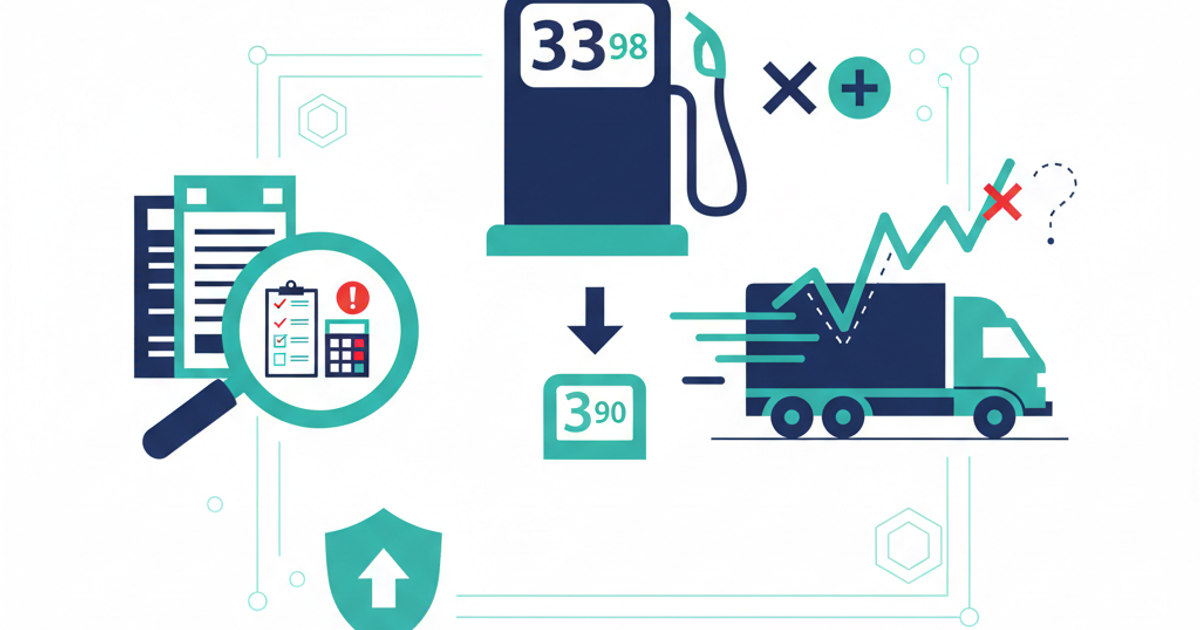
A $0.05 per mile fuel surcharge error doesn't sound like much until you multiply it across 300 loads a month on 800-mile lanes. That's $12,000 a year walking out the door because nobody checked the math. Freight fuel surcharge disputes are one of the most overlooked sources of margin loss for small and mid-size brokerages, and they're hiding in plain sight on carrier invoices. The problem isn't that brokers don't care about surcharges. It's that the formulas are just opaque enough to discourage manual checking, and most TMS platforms don't flag the discrepancy automatically. This guide gives you the exact formulas carriers use, the three most common calculation errors, and a repeatable audit process that takes less than five minutes per invoice. Real numbers, real examples, no theory.
How Fuel Surcharges Actually Get Calculated (And Where Carriers Get It Wrong)
Before you can catch an error, you need to understand how fuel surcharges are supposed to work. There's no single industry standard. Carriers use one of three general methods, and each one creates different opportunities for miscalculation.
The Three Common Fuel Surcharge Methods
The first method is a flat per-mile surcharge tied to the Department of Energy (DOE) national diesel average. A typical formula works like this: the rate con specifies a base fuel price (say $2.50 per gallon) and a surcharge rate (say $0.01 per mile for every $0.05 the DOE average exceeds the base). If the DOE national average is $3.82 per gallon, you subtract the base ($3.82 minus $2.50 equals $1.32), divide by the increment ($1.32 divided by $0.05 equals 26.4 increments, rounded down to 26), and multiply by the per-mile rate ($0.01 times 26 equals $0.26 per mile). On an 800-mile load, the correct surcharge is $208.
The second method is a percentage of linehaul. The rate con states a base fuel price and a percentage that applies to the linehaul rate once the DOE average exceeds the base. For example, a rate con might specify a 6% fuel surcharge on a $3,900 linehaul, making the surcharge $234.
The third method is a sliding scale schedule published by the carrier, where specific DOE price ranges correspond to fixed surcharge rates. These schedules can have dozens of rows, and the surcharge changes every time the DOE average crosses a threshold.
Each of these methods depends on three inputs: the correct DOE index date, the correct base fuel price from the rate con, and the correct surcharge rate or formula. Get any one of those wrong, and the invoice is off. The problem is that most carriers calculate surcharges in their own billing systems, and brokers have no visibility into which inputs were used.
The 3 Most Common Fuel Surcharge Errors Showing Up on Carrier Invoices
After reviewing thousands of carrier invoices, three fuel surcharge calculation errors come up again and again. They're not fraud (usually). They're system misconfigurations, stale data, or manual entry mistakes. But they cost you real money.
Error 1: Wrong DOE Index Date
This is the most frequent offender. Rate cons typically specify which DOE weekly diesel average to use (often the Monday report closest to the pickup date). But carrier billing systems sometimes pull a DOE average from a different week, sometimes two weeks older, sometimes two weeks newer. If diesel prices are trending upward, an older index date can actually work in your favor. But if prices spiked and the carrier grabs a later week, you're overpaying. Here's a real example: a rate con specifies the DOE average for the week of pickup. Pickup is March 4. The correct DOE average is $3.78/gallon. But the carrier's system pulls March 18, when the average was $3.94/gallon. On a per-mile surcharge formula with a $0.01/$0.05 increment, that's roughly $0.04 per mile more than it should be. On an 800-mile lane, that's $32 per load. Run 30 loads a month on that lane, and you're overpaying $960 per month, or $11,520 per year, on one lane.
Error 2: Wrong Surcharge Percentage or Rate Applied
The rate con says the fuel surcharge is 6% of linehaul. The carrier invoices at 8%. It happens more than you'd expect, especially with carriers who run multiple surcharge schedules for different customers and accidentally apply the wrong one. On a $3,900 linehaul, 6% is $234 and 8% is $312. That's a $78 overcharge on a single load. If this carrier handles 10 loads a month for you, that's $780 per month, or $9,360 per year, from a single misapplied percentage.
Error 3: Rounding and Increment Miscalculations
Sliding-scale and per-mile increment formulas require rounding decisions. Does the carrier round up or down at partial increments? The rate con should specify, but many don't. And carrier billing systems sometimes round up by default. Going back to our earlier example: $1.32 divided by $0.05 equals 26.4 increments. Rounded down, that's 26 increments at $0.01/mile, or $0.26/mile. Rounded up, it's 27 increments, or $0.27/mile. On an 800-mile load, that's an $8 difference. Small per load, but across hundreds of loads per month it adds up. One carrier invoicing $0.31/mile instead of $0.26/mile is a $40 overcharge on a single 800-mile load, which suggests either a rounding error compounded with a wrong DOE date.
Rate Con Says One Thing, Invoice Says Another: How to Spot the Mismatch
The rate con is your contract. The invoice should match it. When they don't, you have a fuel surcharge rate con mismatch, and you need to catch it before you approve payment.
What to Compare, Line by Line
Pull the rate con and the carrier invoice side by side. Check these five items: (1) the fuel surcharge method stated on the rate con (flat per-mile, percentage, or sliding scale), (2) the base fuel price on the rate con, (3) the DOE index date specified on the rate con versus the date the carrier actually used, (4) the surcharge rate or percentage on the rate con versus what appears on the invoice, and (5) the total surcharge dollar amount on the invoice versus your own calculation using the correct inputs. If the rate con doesn't specify a DOE index date, that's a problem for your next rate confirmation template, not an excuse for the carrier to pick whichever date gives them the highest surcharge.
Most fuel surcharge rate con mismatches fall into a gray area where the rate con language is ambiguous. Phrases like "fuel surcharge per current DOE" leave room for interpretation. The fix is to tighten your rate con language going forward: specify the exact DOE report (EIA Weekly Retail Gasoline and Diesel Prices, U.S. National Average), the exact week (the Monday report published on or before the pickup date), and the exact formula with rounding rules. This alone eliminates a large percentage of future disputes before they start.
Step-by-Step: Auditing a Fuel Surcharge in Under 5 Minutes
You don't need a forensic accountant to catch these errors. Here's a five-minute audit process you can train any billing coordinator or ops manager to follow.
The Five-Minute Fuel Surcharge Audit
Step one: open the rate con and identify the fuel surcharge method, base price, surcharge rate, and DOE index date. Write these four values down (or pull them into a spreadsheet). Step two: go to the EIA website (eia.gov) and pull the DOE weekly diesel average for the date specified on the rate con. Screenshot this page. You'll need it if you file a dispute. Step three: calculate the correct surcharge using the rate con formula and the DOE average you just pulled. For a per-mile increment formula, subtract the base from the DOE average, divide by the increment, round down (unless the rate con says otherwise), and multiply by the per-mile rate. Then multiply by total miles. Step four: compare your calculated surcharge to the surcharge on the carrier invoice. If the numbers match within a dollar or two (due to minor mileage differences), approve the invoice. If they don't match, flag it. Step five: for any flagged invoice, document the discrepancy. Record the carrier name, load number, rate con surcharge terms, your calculated correct amount, the invoiced amount, the dollar difference, and attach the DOE screenshot and rate con.
That's it. Five steps, five minutes. The hardest part is pulling the DOE data, and that's just a bookmark and a screenshot. If you want to cut that time further, tools that extract rate con data and match it against invoice line items can automate steps one through four. Laneproof's document extraction tool at /tools/document-extract pulls surcharge terms directly from uploaded rate cons and flags mismatches automatically.
How to File the Dispute So Carriers Actually Respond
Finding the error is half the battle. Getting the carrier to correct it is the other half. Most fuel surcharge disputes die in email threads because the broker sends a vague complaint and the carrier ignores it. Here's how to file a dispute that gets resolved.
What to Include in Every Dispute
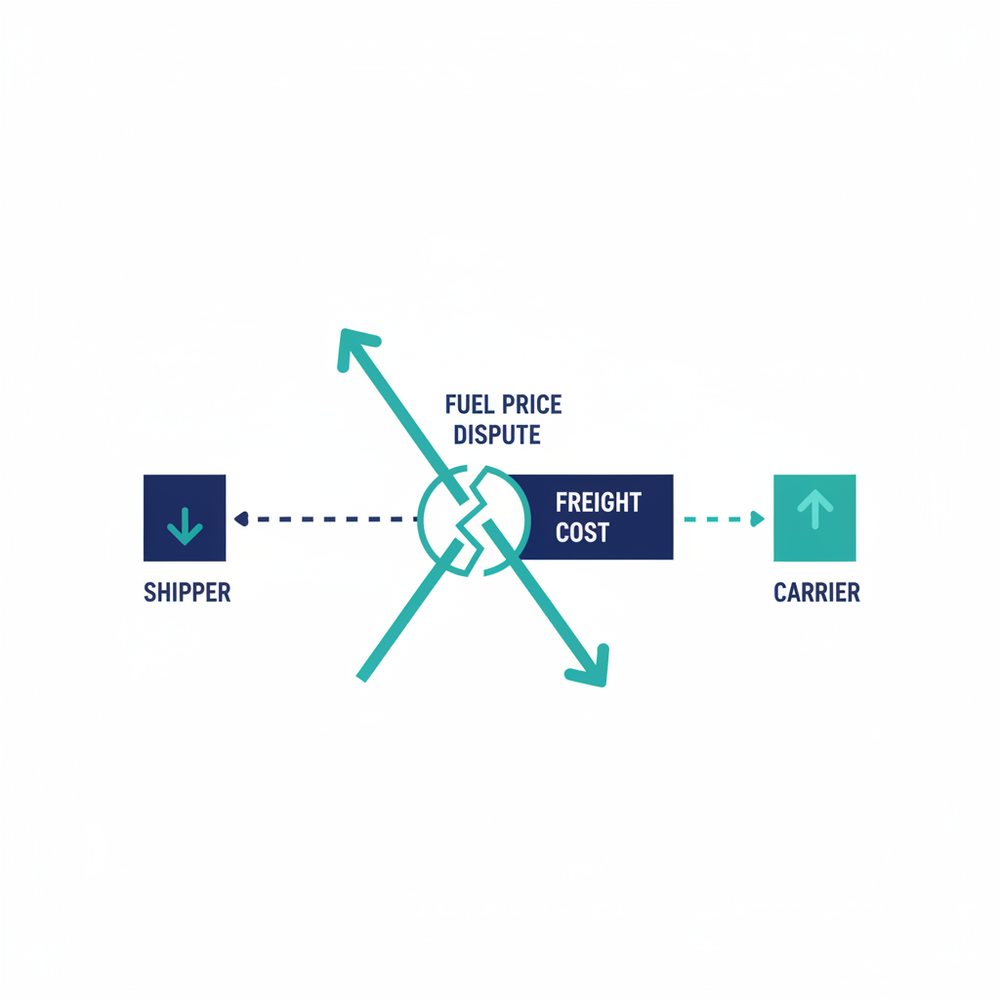
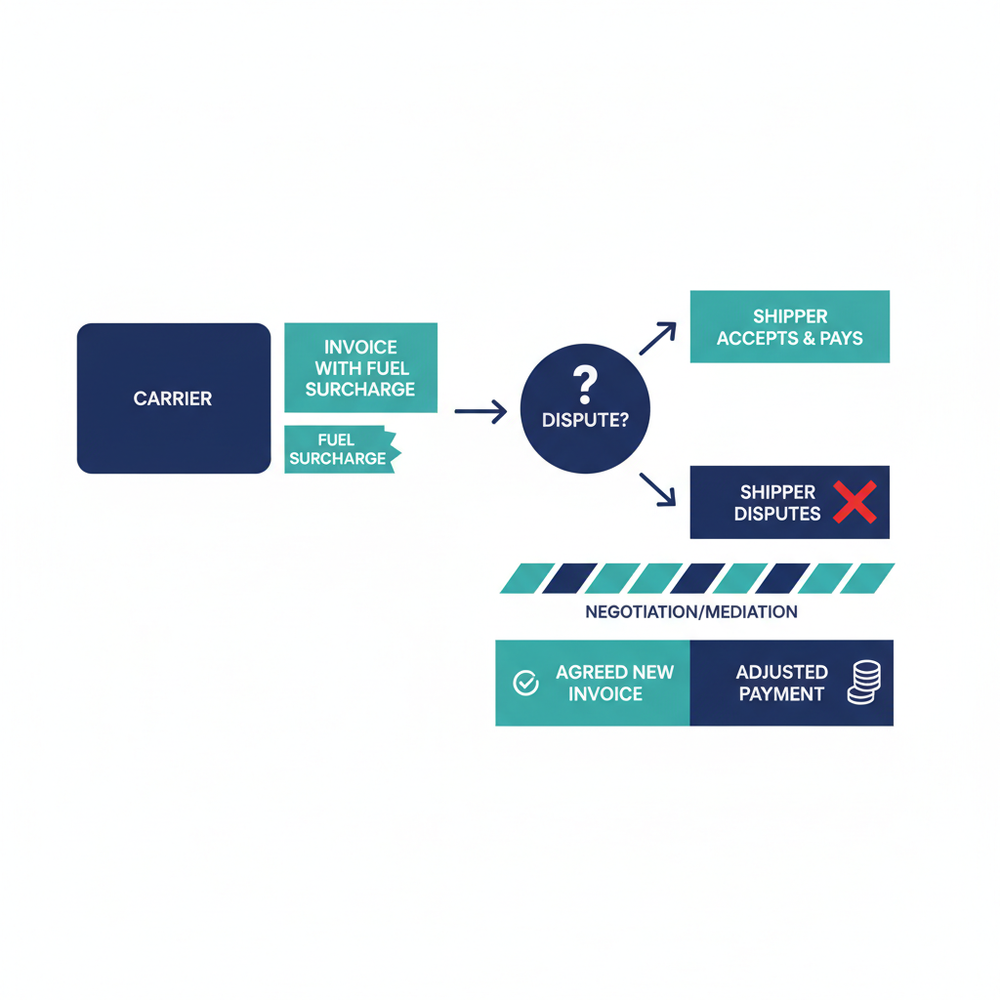
Your dispute email needs five attachments: (1) the signed rate con highlighting the fuel surcharge terms, (2) the carrier invoice highlighting the surcharge line item, (3) a screenshot of the DOE weekly diesel average for the correct date, (4) your surcharge calculation showing the correct amount step by step, and (5) a summary line stating the exact dollar difference you're disputing. Here's a template you can adapt: Subject: Fuel Surcharge Dispute, Load #[LOAD NUMBER], [CARRIER NAME] Hi [carrier contact name], We've identified a fuel surcharge discrepancy on Load #[number], picked up [date]. Per the signed rate con (attached), the fuel surcharge is calculated as [method] using the DOE national diesel average for [specified date]. The DOE average for that date was $[X.XX]/gallon (screenshot attached). Using the rate con formula, the correct fuel surcharge is $[amount]. Your invoice shows $[amount], a difference of $[amount]. Please issue a corrected invoice reflecting the rate con terms, or let us know if you believe there's an error in our calculation. Attached: rate con, invoice, DOE screenshot, surcharge calculation. Thanks, [Your name]
Send this to the carrier's billing department, not just your daily contact at the carrier. CC your ops manager. Set a 48-hour follow-up reminder. If you don't hear back in 48 hours, forward the same email with a note that you'll be deducting the disputed amount from the next payment unless they respond with documentation supporting their calculation. Most carriers will correct the invoice within a week. They know the math doesn't lie.
What a $4,200/Month Fuel Surcharge Problem Looks Like on 300 Loads
Let's put this in perspective for a brokerage running 300 loads per month. After implementing a weekly fuel surcharge audit, one broker discovered that 4.7% of invoices (about 14 loads per month) carried fuel surcharge errors. The average overcharge was $14 per load. That's $196 per month, or $2,352 per year. Not dramatic on its own.
But that was the average. The distribution was skewed. Most errors were small ($5 to $10), but a handful were large ($40 to $78 per load). Those outliers pushed the total monthly overpayment to $351 per month during some months. Over a full year, total recovered overpayments hit $4,218. And that was just fuel surcharges. When the same broker started auditing detention and accessorial charges using the same method, total billing error recovery exceeded $14,000 annually.
4.7% of invoices carried fuel surcharge errors averaging $14 per load. On 300 monthly loads, that's $4,218 in annual overpayment recovered after implementing a weekly audit.
The math is simple. If you're running 300 loads a month and you're not auditing fuel surcharges, you're almost certainly leaving $3,000 to $5,000 a year on the table from fuel surcharges alone. That's money that goes straight to your bottom line once you start catching it. No new customers needed, no rate renegotiations, just checking the math on invoices you're already paying.
Stop Paying Wrong Surcharges: Build a Weekly Audit Habit That Sticks
Catching fuel surcharge errors once is useful. Catching them every week is where the real money is. Here's how to build a weekly audit habit that doesn't collapse after two weeks.
Make It a Process, Not a Project
The brokers who sustain their audit habit treat it like accounts receivable, not a special initiative. It happens on the same day every week, takes the same amount of time, and produces a simple report that tracks dollars flagged and dollars recovered. Pick a day (Friday afternoons work well because invoice batches from the week are complete). Block 30 to 60 minutes depending on your load volume. Pull all carrier invoices approved that week. Run each one through the five-minute audit or batch them through a reconciliation tool. Flag discrepancies, file disputes same day, and log everything in a tracking spreadsheet or your TMS.
Your Weekly Fuel Surcharge Audit Checklist
Use this checklist every week: - Pull all carrier invoices approved or pending approval for the week - For each invoice, locate the fuel surcharge line item - Pull the corresponding rate con and identify surcharge terms (method, base price, DOE date, rate) - Confirm the DOE weekly diesel average for the specified date on eia.gov - Calculate the correct surcharge using the rate con formula - Compare your calculation to the invoiced surcharge amount - Flag any invoice where the difference exceeds $2 - Document each flagged invoice: load number, carrier, correct amount, invoiced amount, difference - Send dispute emails for all flagged invoices using the template above - Log all disputes in your tracking spreadsheet with date sent and resolution status - Follow up on any open disputes older than 48 hours - At month end, total up dollars disputed and dollars recovered - Review your top 10 carriers by dispute frequency to identify repeat offenders
That last item matters more than it looks. If one carrier keeps showing up with surcharge errors, it's not bad luck. It's a billing system issue on their end. Have a direct conversation with their billing team and request they fix the root cause. If they don't, factor that into your carrier selection decisions.
For brokerages handling 100 or more loads per month, doing this manually for every invoice isn't realistic long-term. That's where batch reconciliation tools earn their keep. Laneproof's invoice reconciliation tool at /tools/reconcile lets you upload carrier invoices in bulk, automatically matches surcharge line items against rate con terms, and flags discrepancies so you can focus your time on disputes instead of data entry. It won't catch every edge case (nothing will), but it turns a 60-minute weekly task into a 15-minute review of pre-flagged exceptions.
Fuel surcharge disputes aren't glamorous work. Nobody builds a brokerage brand around catching $14 billing errors. But those errors compound across loads, lanes, and months into real money. The brokers who build a consistent audit process recover thousands per year, strengthen their carrier relationships by holding everyone to the same standard, and protect margins that are already thin enough. Start with one week of invoices. Run the five-minute audit on each one. See what you find. The numbers will make the case for you.