Freight Fraud Is Costing You More Than You Think: A Broker's Checklist
Researched and written with AI assistance. Reviewed by the Laneproof team.
Picture this: a shipper calls Monday morning about a $42,000 load of electronics that never delivered. You paid the carrier Friday. The carrier on your rate con says they never touched the load. Now you have a claim, a payment you can't pull back, and a file full of emails that may or may not prove anything. That's what freight fraud looks like from a broker's desk, and it isn't rare. According to the Transportation Intermediaries Association, fraud in the supply chain is costing the freight industry over a billion dollars a year.
You've read the fraud-types listicles. This isn't one. You'll get the actual line items that make up a fraud loss, a carrier vetting checklist you can run in under 10 minutes, and a 24-hour response plan for when a load goes bad anyway.
Why Freight Fraud Is So Hard to Prove When It Hits You
Brokers are the main target. A fraud survey covered by Land Line found that broker scams accounted for 43% of reported fraud cases, followed by email spoofing at 17% and identity theft at 11%. Look at what those three categories have in common: each one works by making fake paperwork look real. A fake carrier packet. A spoofed email from a dispatcher you've worked with for two years. A real MC number attached to someone who isn't that carrier.
The fraud itself is only half the problem. The other half is proving what happened, fast. When a load goes missing or an invoice looks wrong, the question on your desk is simple: can you show the shipper, the insurer, and the carrier's factoring company exactly what was agreed, who hauled it, and when, by end of day?
For most small brokerages, the honest answer is no. The rate con lives in one inbox. The carrier packet sits in a shared drive. The BOL was scanned sideways by the shipper, and the POD is a photo on a driver's phone. Matching all of it takes hours, and by the time you've pieced together the story, the money has moved. If your team is still keying documents by hand, the guide on why retyping BOLs costs you money explains where those hours go.
Fraud thrives in that gap between what the paperwork says and what you can verify quickly. Close the gap and most schemes stop working.
What Freight Fraud Actually Costs You (Not Just 'Billions a Year')
The big numbers are real. The National Insurance Crime Bureau cites estimates that cargo theft costs $15 billion to $35 billion a year, and per NICB data, cargo theft losses rose 27% in 2024 with another 22% increase projected for 2025. The U.S. Department of Transportation treats cargo theft as a multimodal freight problem that touches trucking, rail, and ports.
Those figures are also useless when you're deciding whether 10 extra minutes of vetting per load is worth it. You don't run a national economy. You run a brokerage with a P&L. What matters is cost per incident, in your own numbers.
The line items that actually hit your P&L
- The carrier payment you already sent. If you quick-paid, or a factoring company funded the invoice and you paid them, that money is usually gone.
- The shipper claim. Depending on your contract, you may owe the full cargo value or your contingent cargo deductible.
- The second payment. In double brokering, the carrier who actually hauled the freight often comes after you for the linehaul they never received.
- Recovery freight. Re-covering a load or a replacement shipment on short notice usually means paying above your normal rate.
- Staff hours. Pulling email threads, calling police, filing claims, and answering the shipper eats days of ops and billing time.
- The lane. One bad load can cost you a shipper relationship worth far more than the claim.
Run your own number before the next incident
Here's a simple formula you can drop into a spreadsheet: cost per incident = carrier payment lost + claim exposure (full value or deductible) + second carrier payment + recovery premium + (staff hours × loaded hourly rate).
Plug in your typical linehaul, your contingent cargo deductible, and what an hour of your ops team actually costs. Most brokers who do this find the number is several times the linehaul on the load. That's the figure you should compare against the cost of vetting, and we walk through the math in the scenarios section below.
One more thing to check: your contingent cargo policy. Some policies attach conditions related to carrier selection and vetting. Read yours now, not after a claim is filed, and know what documentation your insurer expects to see.
Double Brokering: How It Works and What It Drains From Your Margin
You know the definition. Ryder's overview of double brokering and how to protect your freight covers the basics well. What most explainers skip is the money trail, which is what actually matters when you're trying to stop it.
How the re-brokered load actually moves
- A fraudster with active authority (real, purchased, or stolen) books your load at your posted rate. Say $2,800 linehaul.
- They repost the same load on a board at $2,100, often under a different name or MC.
- A legitimate carrier picks it up and hauls it. That carrier has never heard of you.
- The fraudster invoices you for $2,800, usually through a factoring company so the cash moves fast.
- They collect and disappear. The carrier who actually hauled never gets the $2,100 and starts calling the shipper, the receiver, or you.
Where it hits your margin
Using the hypothetical numbers above, if you sold that load to the shipper at $3,200, your expected margin was $400. Now the real carrier wants $2,100. Pay it and you're down $1,700 on a load that should have made you $400. Refuse and you risk a lien fight, a damaged shipper relationship, or a bond claim against you.
The bigger risk is cargo. If the freight goes missing while a carrier you never vetted is hauling it, the insurance of the carrier on your rate con may not respond, because that carrier never had the load. That's how a $2,800 linehaul turns into a five-figure claim.
Warning signs that a load is being re-brokered: the carrier won't give you a driver name or cell, declines your tracking app, sends truck and trailer numbers that change, or the shipper reports a different company name on the cab door at pickup. Ask your shippers to confirm the MC on the truck against your rate con before loading. It takes 30 seconds and catches a lot.
Fake Carrier Packets and Stolen MC Numbers: The Paper Trail That Lies
A carrier packet is supposed to be your proof. In fraud cases, it's often the weapon. Every document in it can be forged, and most brokers check for presence (is there a W-9, is there a COI) rather than accuracy.
What a fake carrier packet looks like
- A COI that came from the carrier instead of directly from the insurance agent.
- An email domain that doesn't match the one on the carrier's FMCSA registration, or a free webmail address for an established fleet.
- A phone number in the packet that differs from the one on file with FMCSA.
- A W-9 with a business name or EIN that doesn't line up with the registered legal name.
- A notice of assignment from a factoring company you've never seen this carrier use.
- Recent changes to the carrier's address, phone, or email on its registration.
Email spoofing makes this worse. With email spoofing showing up in 17% of reported cases in the Land Line fraud report, a message that looks like it came from a carrier you trust may not have. Look at the actual sending address, not the display name.
Identity theft trucking: when the MC is real but the carrier isn't
Identity theft accounted for 11% of cases in that same report. This is the hardest scheme to catch because the authority checks out. The MC is active, the safety record is clean, the insurance is real. The only thing fake is the person on the phone.
Here's how fast it can move. In a hypothetical but realistic case, a fraudster takes over a legitimate carrier's identity, changes the contact email and phone, and books 14 loads across multiple brokers in 48 hours. At $2,500 average linehaul, that's $35,000 in freight under their control before anyone flags the account. Every broker who booked one of those loads ran an authority check. It passed.
Regulators are responding. FMCSA requires brokers and carriers to register and maintain financial security before operating, and Fleet Owner's analysis explains how FMCSA's new rules focus on carrier identity verification and registration to cut down on fraud and double brokering. That helps, but it won't stop a call from someone impersonating a carrier you already work with. Your process has to do that.
Your Pre-Load Carrier Vetting Checklist (Run This Before Every Booking)
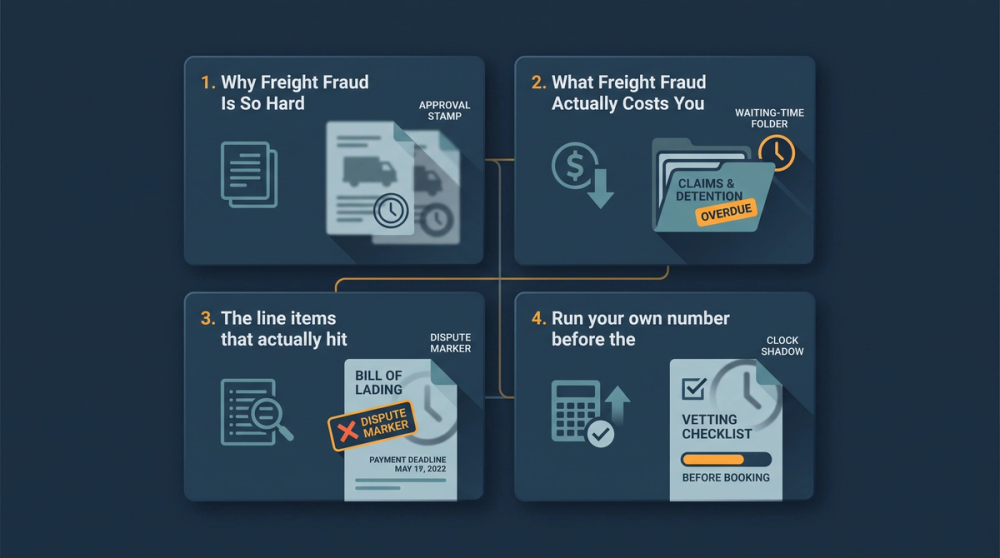
You're skeptical that vetting can be fast. Fair. Most vetting is slow because it's unstructured: someone opens six tabs and checks whatever they remember. The diagram above lays out a fixed order. Run the same steps every time and it takes under 10 minutes for a new carrier, and less for repeat carriers where you're only checking for changes.
The 10-minute check
- Minutes 0 to 2: Pull the FMCSA record. Confirm authority is active, the entity type matches (carrier, not broker-only), and note how long the authority has been active.
- Minutes 2 to 4: Match contact details. Compare the phone, email, and address in the carrier packet to the FMCSA registration. Call the number on file, not the one in the email signature, and confirm the person booking the load works there.
- Minutes 4 to 6: Verify insurance at the source. Call the agent listed on the COI using the agency's published number. Confirm auto liability and cargo coverage are active and that the policy covers the equipment you're booking.
- Minutes 6 to 7: Look for recent changes. A new email, phone, address, or officer in the last 90 days is your biggest identity theft signal. Ask about it directly.
- Minutes 7 to 8: Confirm remit-to and factoring. Compare any notice of assignment to prior payments for this carrier. TIA's guidance on protecting brokers against payment fraud is worth reading here, because changing payment details is one of the most common ways money gets redirected.
- Minutes 8 to 9: Run an identity or fraud check. Use your carrier monitoring or identity verification tool if you have one. Highway's quarterly Freight Fraud Index is a useful read for understanding which patterns are trending right now.
- Minutes 9 to 10: Document it. Save screenshots with timestamps to the load file. If something goes wrong, this record is what your insurer and attorney will ask for first.
Red flags that should end the booking
- The carrier won't take a call at the FMCSA phone number.
- Insurance can't be verified by the agent, or the agent has never heard of the carrier.
- Contact info changed within the last few weeks and nobody can explain why.
- They push for quick pay to a new factoring company or bank account on the first load.
- The rate they accept is well below market for a lane they claim to run often, or they accept instantly on a hard load nobody else wants.
After booking: pickup and in-transit checks
Vetting doesn't stop at the rate con. Get the driver's name and cell before dispatch. Require tracking. Ask the shipper to confirm the company name and MC on the truck at pickup, and to note truck and trailer numbers on the BOL. If any of those don't match your rate con, hold the load until you've talked to the carrier at their FMCSA number.
Ten minutes of carrier vetting costs a few dollars in staff time. One fraudulent load can cost thousands. The math isn't close.
You've Been Hit. Here's Your First 24 Hours
Even good vetting misses things. When it does, speed matters more than anything else. Money moves fast, freight moves faster, and evidence disappears when email accounts get deleted. Here's the order of operations.
Hours 0 to 4: stop the money and find the freight
- Put a hold on any unpaid invoice from the carrier. If a factoring company is involved, notify them in writing, by email and phone, that the invoice is disputed and under investigation.
- If you already paid, call your bank immediately and ask about a recall or fraud claim on the transfer.
- Call the carrier at the number on their FMCSA registration (not the number you've been using) to confirm whether they actually have the load.
- Notify the shipper and receiver. Give them the facts you have and ask them to report any contact from an unknown carrier.
- File a police report with the jurisdiction where the load was picked up. Get a report number, because your insurer will want it.
Hours 4 to 12: lock down the evidence
- Export full email threads with headers, not just screenshots. Headers show the real sending server.
- Save the rate con, carrier packet, BOL, any POD, tracking pings, call logs, text messages, and load board postings.
- Write a timeline: who booked it, when, what was confirmed, and when contact stopped.
- Screenshot the carrier's current FMCSA record before anything changes.
This is the same discipline that wins billing disputes. The guide on winning freight invoice disputes with the right docs covers how to organize a document trail so anyone can follow it in five minutes.
Hours 12 to 24: report and notify
- Notify your contingent cargo insurer and send the police report number and your timeline.
- File a complaint with FMCSA (covered in the next section).
- If email compromise was involved, file with the FBI's Internet Crime Complaint Center (IC3).
- Check the NMFTA's Freight Fraud Prevention Hub for current reporting resources and recent scheme alerts.
- Flag the carrier internally so nobody on your team books them again.
How to File a Complaint on a Freight Broker or Carrier
Filing a complaint won't put money back in your account by itself. It does create an official record, help regulators spot patterns, and support any bond claim or legal action you take later. Here are the channels that matter.
Filing with FMCSA
FMCSA's National Consumer Complaint Database accepts complaints about brokers and carriers, including fraud, identity theft, and non-payment. You can file online or call the FMCSA hotline at 1-888-DOT-SAFT (1-888-368-7238). Include the MC and DOT numbers, load details, dates, dollar amounts, and your police report number. Attach your timeline. A clean, specific complaint gets more attention than a vague one.
Claiming against a broker's $75,000 bond or trust
Per FMCSA's broker registration and financial security requirements, brokers must maintain $75,000 in financial security, either a surety bond (BMC-84) or a trust fund (BMC-85). If another broker double-brokered your load or failed to pay, look up their financial security provider on their FMCSA record and file a claim with that surety or trust company. File quickly. That $75,000 is shared among all claimants, and when a fraudulent broker has hit many companies at once, it can run out.
Other channels worth using
- TIA offers fraud reporting and resources for members, and its commentary on fraud costing the industry over a billion dollars shows the association is actively pushing for enforcement.
- Your state attorney general's consumer protection or fraud division.

- Civil action or small claims court for smaller amounts, especially when you can identify the party.
- Local and federal law enforcement, especially when cargo theft crosses state lines.
Run the Numbers: Three Fraud Scenarios With Real Math
The scenarios below are hypothetical, built with realistic rates so you can swap in your own figures. They show how fraud costs stack up and why proving a discrepancy quickly matters.
Scenario: The double-brokered electronics load
You book a load of electronics with Carrier A at $3,100 linehaul. Carrier A re-brokers it to Carrier B at $2,400. The load is stolen in transit. The shipper files a $42,000 claim.
- Step 1: Payment to Carrier A, already sent via quick pay: $3,100 lost.
- Step 2: Carrier B demands their unpaid linehaul: $2,400 exposure.
- Step 3: Carrier A's cargo insurance declines because Carrier A never hauled the load.
- Step 4 (best case): Your contingent cargo policy responds, and you pay a $10,000 deductible. Total: $3,100 + $2,400 + $10,000 = $15,500.
- Step 4 (worst case): Your policy doesn't respond and you owe the full claim. Total: $3,100 + $2,400 + $42,000 = $47,500.
Either way, the cost is many times the $3,100 linehaul, before you count staff time or the shipper you might lose.
Scenario: Ten minutes of vetting vs. one bad load
A brokerage running 300 loads a month weighs whether to add a 10-minute vetting step. Their loaded labor cost is $35 an hour.
- Step 1: Cost per vetting check: 10 minutes ÷ 60 × $35 = $5.83.
- Step 2: Monthly cost: 300 loads × $5.83 = $1,750.
- Step 3: Cost of one smaller fraud incident: $2,400 carrier payment lost + $5,000 contingent cargo deductible + 30 staff hours × $35 ($1,050) + $250 recovery premium = $8,700.
- Step 4: Break-even: $8,700 ÷ $1,750 = about 5 months of vetting covered by preventing a single incident.
Repeat carriers drop the time per check sharply, because you're only looking for changes. Your real monthly cost will likely be lower than $1,750.
Scenario: $450 in padded detention caught by a POD timestamp
Not all fraud involves a stolen load. Padded accessorials are the quiet version. A carrier invoice shows 8 hours at the receiver and bills detention for 6 hours after 2 free hours, at $75 an hour, for $450.
- Step 1: Pull the rate con. Terms: 2 hours free, $75 per hour after.
- Step 2: Pull the POD. The receiver's stamp shows in at 7:10 and out at 9:40, for 2.5 hours on site.
- Step 3: Compare. 2.5 hours minus 2 free hours leaves 0.5 hours. If your rate con bills in full-hour increments after free time expires, the carrier may be owed one hour ($75). If it rounds down or requires a full hour before billing, nothing is owed.
- Step 4: Dispute with the POD attached. Recovery: $375 to $450 on a single invoice.
The catch only happens if someone actually matches the POD to the invoice. The breakdown of what carriers pad most on invoices and the look at what freight audit roles actually catch both show how often these small charges slip through when nobody checks.
Frequently Asked Questions
What is a common challenge faced by freight brokers?
Fraud is one of the biggest. A survey reported by Land Line found broker scams made up 43% of reported fraud cases. Close behind are invoice disputes, padded accessorials, and slow document matching, which make it hard to prove what was agreed on a load when something goes wrong.
What is cargo fraud?
Cargo fraud is the use of deception to steal freight or the money paid to move it. Common forms include double brokering, fake carrier packets, stolen carrier identities, and spoofed emails that redirect payments. Unlike straight theft, cargo fraud usually starts with paperwork that looks legitimate, which is why verification matters more than documents alone.
What industries have the most fraud?
Fraud concentrates where goods are valuable, easy to resell, and pass through many hands. Freight fits that profile, which is why the NICB tracks cargo theft as a growing loss category, with losses up 27% in 2024. Within freight, brokers are a primary target because they sit between shippers and carriers.
How to file a complaint on a freight broker?
File through FMCSA's National Consumer Complaint Database online or by calling 1-888-368-7238. Include MC and DOT numbers, load details, and dollar amounts. If you're owed money, also file a claim against the broker's $75,000 surety bond or trust, which is listed on their FMCSA record. Report fraud to law enforcement too.
How long should carrier vetting take per load?
A structured check takes under 10 minutes for a new carrier: FMCSA record, contact match, insurance verified with the agent, recent changes, remit-to, and documentation. Repeat carriers take less time because you only check for changes since the last load. The key is running the same steps in the same order every time.
The Bottom Line on Freight Fraud
Freight fraud costs more than the stolen load. It's the payment you can't recover, the second carrier asking to be paid, the claim deductible, and the hours your team burns piecing together a paper trail. The fix isn't complicated: a 10-minute vetting routine before every booking, pickup checks that confirm who's actually hauling, and a 24-hour response plan your team can run without thinking.
Underneath all of it is one skill: matching documents fast. The same habit that catches a fake carrier packet catches a $450 detention charge that doesn't line up with the POD.
If your team handles more than 50 carrier invoices a week and matching rate cons, BOLs, and PODs is eating your afternoons, tools that automatically extract and cross-check freight documents can flag those mismatches for you. You can compare plans here when you're ready.
Sources
- Registration and Financial Security Requirements for Brokers: Federal Motor Carrier Safety Administration
- The Freight Broker's Secret Weapon Against Payment Fraud: Transportation Intermediaries Association
- How FMCSA's new rules are reshaping carrier trust amid increasing cargo fraud: FleetOwner
- Broker industry 'under siege' by fraud, new report reveals: Land Line
- Multimodal Freight: Cargo Theft: U.S. Department of Transportation
- Cargo Theft: National Insurance Crime Bureau
- Freight Brokers Still Challenged with Fraud in 2025: Food Logistics
- How to Avoid Fraud and Double Brokering: Ryder
- Q1 2025 Freight Fraud Index: Highway
- Freight Fraud Prevention Hub Blog: NMFTA Freight Fraud Prevention Hub