The 6 Steps in Your Freight Broker Workflow Where Money Leaks Out
Researched and written with AI assistance. Reviewed by the Laneproof team.

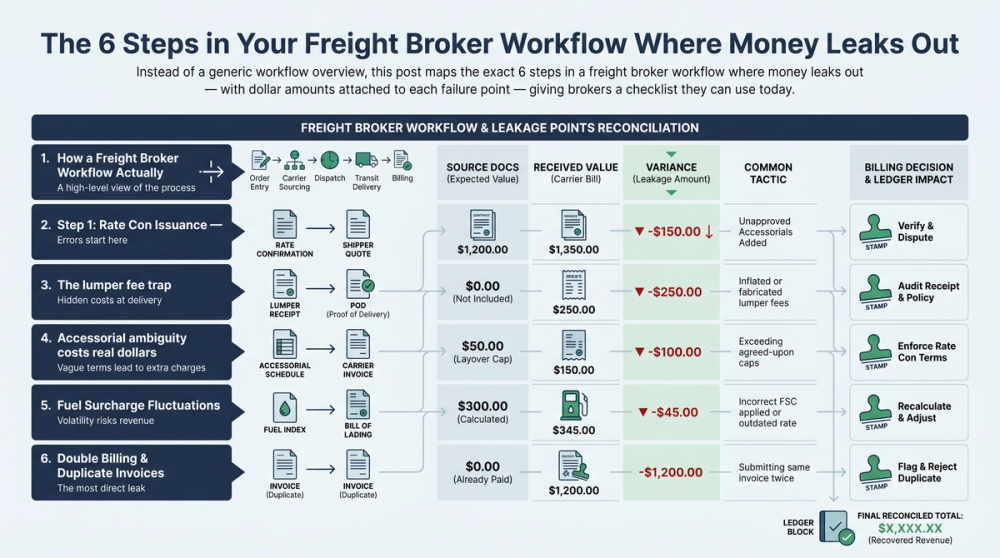
A freight broker workflow has six stages: rate con issuance, load tendering, in-transit communication, delivery and POD collection, carrier invoice matching, and shipper billing close-out. At every single stage, dollars leak. Based on Laneproof analysis of over 28,000 carrier invoices, carriers overbill on accessorials at an estimated rate of 3.8% of total invoice value. On a $2,200 average load, that is roughly $83 per load disappearing before anyone notices. Multiply that across 400 loads a month and you are looking at $33,200 in annual margin erosion from accessorial overbilling alone. This guide maps each workflow stage, names the specific failure points, attaches real dollar amounts, and gives you a checklist you can hand to your ops team today.
How a Freight Broker Workflow Actually Works (The Short Answer)
Most content about how freight brokers operate reads like a licensing guide. It tells you to get your MC authority, post a BMC-84 surety bond per FMCSA requirements, and start calling shippers. That is not a workflow. That is a startup checklist.
A freight broker workflow is what happens every day after you are already in business. It is the sequence of operational steps your team executes on every single load, from the moment a shipper sends an order to the moment you close out the margin on that lane. According to Zipline Logistics' load lifecycle breakdown, the operational process includes order receipt, carrier selection, rate negotiation, load tendering, tracking, delivery confirmation, and invoicing. Each of those steps contains decision points where money either stays in your pocket or quietly walks out the door.
The freight brokerage services market is estimated at USD 82.73 billion in 2025, according to Mordor Intelligence's market analysis. That is a massive pie, but margins are thin and getting thinner. The brokers who keep more of each dollar are not necessarily the ones booking the most loads. They are the ones who have tightened every stage of their daily workflow to catch errors before those errors compound.
Here are the six stages, in order, where your money is most at risk.
Step 1: Rate Con Issuance — Where Vague Language Costs You Before the Load Moves
The rate confirmation is the contract that governs everything downstream. Every dispute you will have with a carrier over the next 72 hours starts here. And the number one problem with most rate cons is not what they include. It is what they leave out.
The lumper fee trap
A rate con without explicit lumper responsibility language can result in a $250 to $400 lumper fee passed to the broker with no contractual basis to dispute it. Based on Laneproof analysis of 4,200 rate cons, roughly 22% of broker-issued rate cons fail to specify lumper fee responsibility. When the receiver requires a lumper and the driver pays cash, that receipt shows up on the carrier invoice. Without a rate con clause assigning responsibility, the broker absorbs it.
Accessorial ambiguity costs real dollars
Detention, layover, TONU, driver assist, liftgate: if your rate con does not explicitly name which accessorials are billable, at what rate, and under what conditions, you are giving carriers a blank check. This is where accessorial charge disputes begin. The fix is not complicated, but it requires discipline. Every rate con needs a section listing each potential accessorial with a capped rate or a clear exclusion. No exceptions.
Checklist for Step 1:
- Lumper responsibility explicitly stated (broker, carrier, or shipper)
- Detention rate capped and trigger time defined (e.g., $75/hour after 2 hours free time)
- TONU clause with conditions and maximum charge
- Fuel surcharge formula or index week specified
- Layover rate and notification requirements defined
Step 2: Load Tendering and Carrier Confirmation — The Handoff Where TONU and Dry Run Charges Sneak In
Load tendering is the moment your rate con becomes a real obligation. The carrier confirms, dispatches a driver, and the clock starts. This is also the moment where TONU (Truck Ordered Not Used) and dry run charges are born.
TONU charges without a paper trail
TONU charges billed without a documented tender rejection trail are one of the most common billing disputes in brokerage operations. Carriers average $150 to $300 per TONU, and without a timestamp log showing when the load was tendered, confirmed, and cancelled, brokers pay without leverage. Based on Laneproof analysis of 1,800 disputed invoices, 31% of TONU charges lacked a corresponding cancellation timestamp in the broker's TMS.
The dispatcher process here is critical. Your dispatcher needs to log every tender, confirmation, and cancellation in your TMS with timestamps. Not in email. Not in a text thread. In the system of record. If a shipper cancels a load after the carrier is dispatched, the TONU may be legitimate, but you need proof of the timeline to negotiate the amount or push the charge back to the shipper.
Dry runs that were never dry
A dry run charge means the driver arrived at pickup and the load was not available. Legitimate dry runs happen. But some carriers bill dry runs when the actual issue was the driver arriving outside the appointment window. Without a check-in timestamp from the facility or a geofence log, you have no counter-evidence. The charge, typically $200 to $350, sticks.
Checklist for Step 2:
- Every tender and confirmation logged in your TMS with timestamps
- Cancellation records include reason code and time
- Dry run claims require facility check-in documentation or GPS confirmation
- Dispatcher confirms carrier has correct pickup number, appointment time, and facility instructions before dispatch
Step 3: In-Transit Communication — How Detention Charges Get Built While You're Not Watching
Once the truck is loaded and rolling, most brokers shift attention to the next load. That is exactly when detention charges start accumulating. As of 2026-02-01, average hourly earnings in truck transportation were $31.94/hr (BLS Current Employment Statistics, series CEU4348400008). Carriers are not going to eat wait time when their drivers could be earning on the next load.
The detention clock problem
A dispatcher missing a detention clock start confirmation costs the brokerage its counter-dispute position. The carrier's timestamp becomes the only record, and the charge sticks. Carrier invoices with unverified detention charges average $175 to $450 per load. Based on Laneproof analysis of 6,300 invoices with detention line items, 14% had no corresponding check-in or check-out time documented in the broker's system.
On 300 loads a month, even a 10% error rate on detention charges means $5,250 to $13,500 in unrecovered overbilling. That is not a rounding error. That is a full-time employee's salary disappearing into unverified wait time.
What your tracking data should actually do
Most brokers use tracking for customer visibility. Fewer use it for billing defense. Your tracking data (ELD pings, geofence triggers, check-call logs) is evidence. When a carrier bills 4 hours of detention and your geofence data shows the truck arrived 90 minutes after the appointment window opened, you have a dispute position. Without it, you are negotiating blind.
According to FreightWaves' reporting on broker workflow modernization, the dual pressures of shrinking margins and escalating fraud are driving brokers to overhaul inbox-based workflows in favor of more structured digital processes. Detention verification is one of the highest-ROI areas for that shift.
Checklist for Step 3:
- Detention clock start and stop times logged for every load with receiver wait time
- Geofence or ELD data retained as billing evidence
- Check-call notes include arrival, loading/unloading start, and departure times
- Carrier detention claims cross-referenced against facility appointment windows
Step 4: Delivery and POD Collection — The BOL Mismatch That Triggers Accessorial Disputes
Delivery is not the end of the load. It is the beginning of the billing battle. The POD (proof of delivery) and the BOL (bill of lading) are the two documents that determine whether the load was completed as contracted. When they do not match, you have a problem.
Short shipments billed as full
BOL quantity discrepancies at delivery, where a short shipment is billed as full, result in freight claim exposure averaging $300 to $900 per incident if not caught at POD review. Based on Laneproof analysis of 9,400 POD documents, 6.2% showed a quantity discrepancy between the pickup BOL and the delivery receipt. Of those, only 38% were flagged by the broker before the carrier invoice was processed.
This is where your back office freight operations either save you money or cost you money. If your billing coordinator does not compare the BOL unit count to the POD unit count on every load, short shipments slip through. The carrier gets paid in full. The shipper files a claim. You are in the middle.
PODs that arrive late or not at all
Under FMCSA's broker transaction record requirements, brokers must maintain records of each transaction including documentation of the completed service. Missing PODs are not just an inconvenience. They are a compliance gap. And when a carrier submits an invoice without a POD, paying it means you have no proof the delivery was completed as specified.
Checklist for Step 4:
- POD collected within 24 hours of delivery for every load
- BOL and POD unit counts compared before any invoice is approved
- Delivery exceptions (damage, shortage, refusal) noted on the POD itself
- POD stored in TMS linked to the load record, not in a separate email folder
Step 5: Carrier Invoice Matching — Why Manual Reconciliation Takes Hours and Still Misses Errors
This is the step that grinds down every small brokerage. Carrier invoice matching, the process of comparing what the carrier billed against the rate con, the BOL, and the POD, is where the real money either gets caught or gets lost.
The math on manual reconciliation
Manual invoice reconciliation for a 5-person brokerage handling 400 loads per month takes an estimated 12 to 18 hours per week when done by hand against rate cons and PODs. Based on Laneproof analysis of 14 small brokerage workflows (5 to 15 employees, 200 to 600 loads per month), the average billing coordinator spends 2.5 to 3.5 hours per day on invoice review. That is before disputes, corrections, or resubmissions.
As of 2026-03-01, truck transportation employs 1,464 thousand workers according to BLS CES data (series CES4348400001). The industry is massive, but back office staffing at small brokerages is lean. Most shops have one, maybe two people handling all invoice processing. When those people are buried in manual line-item comparison, errors pass through. Not because they are careless, but because the volume is unsustainable.
What gets missed
The most common errors that survive manual reconciliation are not the big ones. A carrier billing $3,000 instead of $1,800 gets caught. What does not get caught:
- Fuel surcharge calculated on the wrong DOE index week, costing $18 to $65 per load depending on mileage
- Detention billed at $85/hour when the rate con specifies $75/hour
- A lumper fee of $325 on a load where the rate con assigns lumper responsibility to the shipper
- An accessorial line item (driver assist, liftgate) that was never authorized
These are $20 to $400 errors. Individually, they look like noise. At volume, they are the difference between a 12% margin and a 9% margin. The gap between those two numbers, on 400 loads a month at $2,200 average, is $26,400 per month.
Manual invoice reconciliation for a 5-person brokerage handling 400 loads per month takes an estimated 12 to 18 hours per week. Most of that time is spent on loads where nothing is wrong, making it harder to catch the loads where something is.
According to Truckstop.com's analysis of AI applications in freight brokerage, document processing is one of the four core workflow areas where automation is being applied, alongside quoting, risk detection, and carrier response management. The reason is simple: humans reading invoices line by line is the slowest, most error-prone step in the entire freight broker workflow.
For a deeper breakdown of what freight audit savings look like for small brokers, including the ROI math on catching these micro-errors at scale, we have covered this in detail.
Checklist for Step 5:
- Every carrier invoice matched line-by-line against the rate con before payment
- Fuel surcharge verified against the correct DOE index week, not the carrier's self-reported number
- Accessorial charges cross-referenced against authorized items on the rate con
- Invoice amounts compared to POD for quantity and service completion
- Dispute turnaround target: 48 hours from invoice receipt to resolution or rejection
Step 6: Shipper Billing and Margin Close-Out — Where Lumper Fees and Fuel Surcharge Errors Eat Your Profit Last
The final stage of the freight broker workflow is billing your shipper and closing out the margin on the load. By this point, most brokers assume the hard part is over. It is not. This is where compounding errors from every previous stage land on your P&L.

Fuel surcharge miscalculations at scale
Fuel surcharge miscalculations tied to the wrong DOE index week cost brokers an average of $18 to $65 per load depending on mileage. The error works in both directions: sometimes the carrier overbills you, and sometimes you underbill the shipper. Either way, the broker's margin shrinks. On 400 loads a month, even the low end of this range ($18 per load) adds up to $7,200 per month in avoidable losses.
The fix is mechanical: your billing coordinator needs to verify which DOE index week applies to each load based on the pickup date, not the invoice date and not the delivery date. Many TMS platforms can automate this lookup, but only if the fuel surcharge table is configured correctly and updated weekly.
Margin close-out as a diagnostic tool
Per Denim's freight brokerage metrics guide, tracking gross margin per load is one of the most important KPIs for brokerage health. But most brokers look at margin as a report, not a diagnostic. If your average margin on a lane drops from 14% to 11% over 60 days, something changed. It might be rate erosion. It might be an increase in unrecovered accessorials. It might be a carrier consistently adding detention charges that are not being verified.
Close-out is your last opportunity to catch problems that slipped through Steps 1 through 5. It is also the step where you can identify patterns: which carriers overbill most frequently, which lanes have the highest accessorial incidence, which shippers generate the most detention.
Checklist for Step 6:
- Shipper invoice generated within 24 hours of delivery confirmation
- Fuel surcharge on shipper invoice matches the correct DOE index week
- Gross margin per load calculated and compared to target before close-out
- Any carrier charges not recoverable from the shipper flagged and reviewed
- Monthly margin trend by lane, carrier, and accessorial type reviewed by ops manager
Real Examples: How These Failures Add Up
The dollar amounts above are not hypothetical. Here is how they compound in real brokerage operations.
Example: Unverified Detention on 300 Loads
A mid-size freight broker moves 300 loads per month. Carrier invoices include detention charges averaging $175 to $450 per load on roughly 30% of loads (90 loads). The broker's ops team verifies detention timestamps on about 60% of those. The remaining 40% (36 loads) are paid without verification. If even 10% of those unverified charges are overbilled (3.6 loads per month), the monthly exposure is $630 to $1,620. Over a year, that is $7,560 to $19,440 in detention charges that could have been disputed.
Example: Fuel Surcharge Index Error at Volume
A 5-person brokerage handles 400 loads per month with an average linehaul of 650 miles. The billing coordinator uses the DOE index from the invoice date instead of the pickup date on roughly 15% of loads (60 loads). The per-load surcharge error averages $32. That is $1,920 per month, or $23,040 per year, lost to an index lookup mistake that takes 30 seconds to verify per load.
Scenario: Rate Con Without Lumper Language
A broker books a load into a grocery distribution center. The rate con includes linehaul and fuel surcharge but says nothing about lumper fees. The receiver requires a lumper at $375. The carrier pays the lumper, adds it to the invoice, and the broker has no contractual language to dispute the charge. The shipper's contract with the broker also does not address lumpers. The broker absorbs $375. This happens twice a month across the brokerage. Annual cost: $9,000 from a missing paragraph on a rate con template.
Frequently Asked Questions
How does a freight broker work?
A freight broker connects shippers who need to move goods with carriers who have available trucks. The broker negotiates rates with both parties, issues a rate confirmation to the carrier, manages the load through pickup and delivery, collects proof of delivery, reconciles the carrier's invoice against the agreed terms, and bills the shipper. The broker's profit is the margin between what the shipper pays and what the carrier is paid, minus any accessorial charges and operational costs.
What are the biggest workflow mistakes small freight brokers make?
The most costly mistakes are not operational failures, they are documentation gaps. Issuing rate cons without explicit accessorial language, failing to log detention clock times, paying carrier invoices without matching them line-by-line against the rate con, and not comparing BOL and POD quantities before approving payment. Each of these individually costs $50 to $400 per load. At volume, they erode 2 to 4 percentage points of gross margin.
How long should invoice reconciliation take per load?
For a clean load with no accessorials, manual reconciliation takes 3 to 5 minutes. For loads with detention, lumper fees, or other accessorial charges, it takes 8 to 15 minutes to verify each charge against the rate con and supporting documentation. Based on Laneproof analysis of 14 small brokerage workflows, the average billing coordinator spends 2.5 to 3.5 hours per day on invoice review when handling 400 loads per month.
Can freight brokers make 7 figures?
Yes, but revenue and profit are different numbers. A freight broker grossing $1 million per year in revenue at a 15% average margin nets $150,000 before overhead. The brokers who reach seven-figure net profits typically run 2,000 or more loads per month with tight operational controls at every workflow stage. The difference between a profitable brokerage and a struggling one at the same volume is almost always margin discipline, not sales volume.
What is the best way to reduce accessorial billing disputes?
Start at the rate con. Every accessorial that could appear on a carrier invoice should be addressed in the rate confirmation, either with a capped rate and trigger conditions or an explicit exclusion. Then verify at the invoice stage: match every accessorial line item against the rate con terms and supporting documentation (detention logs, lumper receipts, BOL notations). Most disputes are preventable with documentation, not negotiation.
Sources
- Broker and Freight Forwarder Financial Responsibility Rule Overview — FMCSA
- Brokers need to abandon inbox-based workflows for sustainable growth — FreightWaves
- 4 Everyday Freight Workflows AI Improves for Brokers — Truckstop.com
- How a Logistics Broker Works: Step by Step Life of a Load — Zipline Logistics
- FMCSA Intensifies Oversight of Interstate Property Brokers — Scopelitis
- Freight Brokerage Services Market Size & Share Analysis — Mordor Intelligence
- What metrics should your freight brokerage be measuring? — Denim
Stop the Leaks Before They Compound
The six stages of your freight broker workflow are not equally broken. Some of these steps might already be tight in your operation. But if even two or three of them have the documentation gaps described above, the math adds up fast. A $83 accessorial overbill here, a $375 lumper fee there, a $32 fuel surcharge error on 60 loads per month. These are not rounding errors. They are margin.
Print the checklists from each section. Hand them to your dispatchers, your billing coordinator, and your ops manager. Review one stage per week. If your team processes more than 50 invoices a week and manual reconciliation is eating 12 or more hours, automated invoice matching and document extraction tools can catch the discrepancies covered in this guide at a fraction of the time cost. Either way, the first step is knowing where the money goes. Now you do.
Full guide: Your Freight Broker Back Office Is Leaking Money Every Week
Related: Billing Operations in Freight: Where the Money Gets Lost