Your Freight Broker Back Office Is Leaking Money Every Week
Researched and written with AI assistance. Reviewed by the Laneproof team.
A 5-person brokerage auditing 30 days of carrier invoices for the first time found errors on 1 in 8 invoices, averaging $63 per error. That's $1,890 in one month from a process that took one afternoon to run. The back office at most small freight brokerages doesn't have a structural problem. It has a visibility problem: the billing tasks that cost you the most money are the ones nobody is systematically checking. According to the American Trucking Associations' industry data, trucks moved roughly 72.7% of the nation's freight by weight in 2024. That volume flows through brokerages of every size, and every load carries a carrier invoice that can contain detention overbills, fuel surcharge miscalculations, or accessorial charges that don't match the rate con. This article names the exact back office billing tasks where those dollars disappear, explains why carrier invoice errors go uncaught, and walks through a repeatable workflow that stops the bleeding without adding headcount.
What Back Office Actually Means in a Freight Brokerage
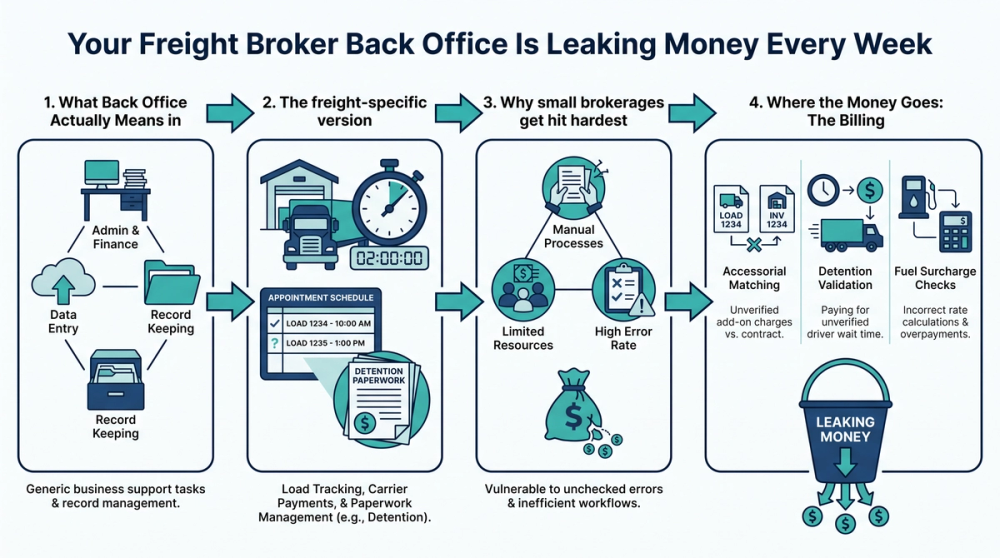
In a freight brokerage, the back office is everything that happens after the load is booked and before the money clears. According to Investopedia's definition of back office operations, it covers settlements, record-keeping, regulatory compliance, and administrative functions that don't directly face the customer. That definition holds true in freight, but the specifics look different from banking or insurance.
The freight-specific version
For a freight broker, back office freight operations include a set of interconnected billing and compliance tasks that are unique to this industry:
- Carrier invoice reconciliation: Matching every carrier invoice line item against the rate con, BOL, and POD to confirm the billed amount is correct.
- Accessorial validation: Checking that detention charges, lumper fees, TONU fees, layover charges, and other accessorials match the agreed terms.
- Fuel surcharge audits: Confirming that the carrier applied the correct FSC table specified in the rate con, not their own internal schedule.
- Document management: Organizing rate confirmations, BOLs, PODs, carrier packets, and payment records so they are retrievable during disputes.
- Carrier payments and settlements: Issuing payments on the correct schedule, applying deductions, and tracking aging payables.
- Compliance tracking: Monitoring carrier authority, insurance certificates, and safety ratings to avoid booking with non-compliant carriers.
As Freight360's breakdown of brokerage back office departments makes clear, these tasks are not generic administrative work. They are operational functions that directly determine whether a brokerage is profitable on each load or just busy moving freight at a loss. The distinction matters because most generic "back office software" misses the freight-specific nuances entirely.
Why small brokerages get hit hardest
At a brokerage with 5 to 15 employees, back office duties often fall on one or two people who are also handling dispatch, customer calls, or carrier onboarding. There is no dedicated billing coordinator reviewing every invoice against every rate con. The result: errors that a larger operation would catch in an audit simply get paid. According to Truckstop.com's overview of freight broker back office processes, the four essential back office processes for freight brokers are accounting and billing, document management, carrier payments, and compliance tracking. When one person is responsible for all four, the tasks with the least immediate urgency (auditing, reconciliation) get pushed to the bottom of the list. That's where the money leaks.
Where the Money Goes: The Billing Tasks That Bleed Margins
Freight brokers make money in the margins. That's not a platitude; it's the operating reality described by BrokerPro's analysis of back office KPIs, which highlights that tracking carrier efficiency and cost metrics is critical to profitability. When your brokerage billing workflow has gaps, money leaks through specific, identifiable tasks. Here are the ones that cost the most.
Detention overbills
Detention charges are one of the most common sources of carrier invoice errors. Carriers bill for time spent waiting at shipper or receiver facilities, but the billed amount frequently exceeds what the rate con authorizes. A brokerage moving 500 loads per month at an average detention overbill of $47 per flagged load, with a 12% overbill rate, loses roughly $2,820 per month. That's $33,840 per year if no one is checking. The problem isn't that the carrier is necessarily acting in bad faith. Detention time is often estimated, and the carrier's billing department may apply their standard rate rather than the negotiated rate con terms. Without a process to cross-reference the detention charge against the rate con and POD, the overbill gets paid.
Fuel surcharge miscalculations
Fuel surcharge discrepancies of $15 to $40 per load are common when carriers apply their own FSC table instead of the rate con terms. On 200 loads per month, that adds up to $3,000 to $8,000 in unchallenged overpayment. The math is simple: if the rate con specifies a fuel surcharge of $0.48 per mile on a 600-mile haul, the FSC should be $288. If the carrier applies their internal table at $0.54 per mile, the FSC comes in at $324. That's a $36 difference. On a single load, it's easy to overlook. Across 200 loads, it's $7,200 per month.
Lumper fee and accessorial overcharges
Lumper fee disputes are a textbook example of how accessorial charges create overbilling traps. The carrier submits a lumper receipt for $450, but the rate con caps reimbursement at $350. With no POD cross-reference process, the $100 overage gets paid without question. Multiply that by even a handful of loads per month, and you're looking at hundreds or thousands in unnecessary payments. The same pattern shows up with layover charges, dry run fees, and drayage surcharges. Each one is a small dollar amount that slips through when the billing coordinator doesn't have a systematic way to match the invoice against the agreed terms.
TONU charges that don't match the rate con
Truck Order Not Used (TONU) charges are another area where the invoice doesn't always match what was agreed. In one real scenario, a carrier billed TONU at $250 when the rate con specified $150. The discrepancy was only caught when a dispatcher noticed a pattern after the third occurrence in one month. That's $300 in overpayment before anyone noticed. TONU disputes are particularly difficult because they involve loads that didn't move, so there's no BOL or POD to reference. The only documentation is the rate con and the carrier's claim. Without a consistent process for validating TONU charges against the original rate confirmation, they get rubber-stamped.
Carrier Invoice Errors Brokers Miss Most Often
Not all carrier invoice errors are intentional. Many result from mismatched billing systems, outdated rate tables, or simple data entry mistakes. But the effect on your margin is the same whether the error is accidental or deliberate. Here are the categories of errors that go uncaught most frequently at small brokerages.
Linehaul rate discrepancies
The linehaul rate is the biggest line item on any carrier invoice, so you'd think it would be the first thing checked. In practice, small brokerages often spot-check linehaul only when the total invoice looks unusually high. A $25 to $50 discrepancy on a $1,800 linehaul doesn't jump off the page, especially when the billing coordinator is processing 30 invoices in an afternoon. These small discrepancies are exactly the kind of freight billing mistakes that cost real money over time. At 500 loads per month, even a 2% rate of linehaul errors at $35 average overage means $350 per month, or $4,200 per year, walking out the door.
Duplicate billing
Duplicate invoices happen more often than most brokers realize. A carrier submits an invoice, the payment gets delayed, and the carrier's billing system generates a second invoice for the same load. Without a reconciliation process that flags duplicate PRO numbers or BOL references, both invoices can get paid. The issue is compounded when the brokerage uses a TMS that doesn't automatically match incoming invoices against existing payment records. Manual matching relies on someone noticing the duplication, which becomes less likely as invoice volume increases.
Accessorials not authorized in the rate con
This is the most insidious category. A carrier adds a charge for inside delivery, liftgate, or residential delivery that was never agreed to in the rate con. The charge may be legitimate in the sense that the service was required at the delivery point, but it wasn't part of the contracted terms. Without a systematic process to compare every accessorial line item against the rate con, these charges get paid. The carrier's position is simple: the service was provided, so the charge is valid. The broker's defense depends entirely on having the rate con accessible and cross-referenced at the time of invoice review.
What a Fixed Back Office Billing Workflow Looks Like
A fixed brokerage billing workflow doesn't require a team of 10 or an enterprise TMS. It requires a repeatable process with clear steps, assigned ownership, and consistent documentation. Here's what it looks like for a brokerage processing 300 to 800 loads per month.
Step 1: Centralize incoming carrier invoices
Every carrier invoice should land in one place. That can be a shared inbox, a folder in your TMS, or a document management system. The key rule: no invoice gets processed from a dispatcher's personal email or a text message thread. If it's not in the central queue, it doesn't exist for billing purposes. This eliminates the problem of invoices being paid informally or processed outside the reconciliation workflow.
Step 2: Match every invoice against the rate con
Before any invoice is approved for payment, the billing coordinator (or whoever owns this task) must pull the rate con for that load and compare four things:
- Linehaul rate: Does the invoiced linehaul match the rate con exactly?
- Fuel surcharge: Was the correct FSC table and per-mile rate applied?
- Accessorials: Are the billed accessorials (detention, lumper, TONU, layover) authorized in the rate con, and do the amounts match?
- Load details: Do the origin, destination, weight, and reference numbers match across the invoice, rate con, BOL, and POD?
This is the invoice reconciliation step where most errors are caught. It's also the step that takes the most time when done manually.
Step 3: Flag and dispute before paying
When a discrepancy is found, the invoice goes into a dispute queue rather than a rejection pile. The billing coordinator documents the discrepancy (invoiced amount vs. rate con amount, with both documents attached) and sends a dispute notice to the carrier within 48 hours. Speed matters here: carriers are more responsive to disputes raised before payment than after. And a dispute raised with documentation (rate con, BOL, POD) is far more likely to be resolved in your favor than a vague complaint.
Step 4: Track patterns by carrier
After 30 to 60 days of consistent invoice auditing, patterns emerge. You may find that one carrier consistently overbills detention by 15 to 20 minutes. Another may apply the wrong FSC table on every invoice. A third may add unauthorized accessorials on loads going to specific receivers. Tracking these patterns is where the process pays for itself. Instead of catching the same error 10 times, you address it at the carrier level. Either the carrier corrects their billing process, or you factor the billing risk into your carrier selection decisions.
According to DAT Freight & Analytics' guidance on scaling a freight brokerage, back office operational efficiency is what separates brokerages that grow profitably from those that grow busy. A fixed billing workflow is the foundation of that efficiency.
Back Office vs. Front Office in Freight: Who Owns What
One reason back office billing tasks get neglected is that the line between front office and back office gets blurred at small brokerages. Here's a clear division that works for teams of 5 to 25.
Front office: revenue generation
The front office in a freight brokerage covers everything directly tied to winning and moving loads:
- Sales and customer acquisition
- Carrier sourcing and rate negotiation
- Dispatch and load tracking
- Customer communication and issue resolution
Front office employees are the brokers, dispatchers, and account managers who keep freight moving. Their time is directly tied to revenue.
Back office: revenue protection
The back office covers everything that protects the margin on the loads the front office books:
- Invoice reconciliation and carrier payment processing
- Billing and collections on the shipper side
- Document management (rate cons, BOLs, PODs, carrier packets)
- Compliance tracking (carrier authority, insurance, safety ratings)
- Accounting, settlements, and financial reporting
A back office employee in freight is someone whose work directly affects whether the margin you negotiated on a load is the margin you actually collect. As of 2026-03-01, truck transportation employment stands at 1,464 thousand workers (BLS Current Employment Statistics, series CES4348400001). That workforce generates an enormous volume of invoices, settlements, and compliance documents that back office teams must process accurately.
Where it breaks down
The problem at small brokerages is that dispatchers end up doing back office work between loads. A dispatcher processing carrier invoices while managing active freight is going to prioritize the load that's running late over the invoice that's $47 too high. It's not a people problem. It's a process problem. Either dedicate specific hours to back office tasks, assign them to a specific person, or use tools that reduce the manual matching work. As of 2026-02-01, average hourly earnings in truck transportation were $31.94/hr (BLS Current Employment Statistics, series CEU4348400008). A billing coordinator spending 11 hours per week on manual invoice matching at $22 per hour costs the brokerage $12,584 annually just in labor, before accounting for errors that slip through. That's money spent on a process that is both slow and error-prone.
Real Dollar Examples: How Back Office Gaps Add Up
The numbers in this article aren't theoretical. Here are three concrete scenarios that show how back office billing gaps translate to lost dollars.
Example: Detention overbilling at scale
A brokerage moves 500 loads per month. Based on Laneproof analysis of freight billing documents, detention charges appear on roughly 12% of carrier invoices. The average overbill amount on flagged detention invoices is $47.

- 500 loads × 12% overbill rate = 60 invoices with detention overbills
- 60 invoices × $47 average overbill = $2,820 per month
- $2,820 × 12 months = $33,840 per year
If even half of those overbills are caught through a systematic review process, that's $16,920 saved annually. The review process doesn't require new software. It requires pulling the rate con, checking the detention terms, and comparing them to the invoiced amount before approving payment.
Example: Fuel surcharge discrepancies on 200 loads
A brokerage processes 200 loads per month with fuel surcharges. The rate con specifies an FSC of $0.48 per mile. The carrier's billing system applies $0.54 per mile. On a 600-mile average haul:
- Rate con FSC: 600 miles × $0.48 = $288
- Carrier invoice FSC: 600 miles × $0.54 = $324
- Discrepancy per load: $36
- 200 loads × $36 = $7,200 per month overpayment
Even at the low end of the $15 to $40 per-load range, that's $3,000 per month in unchallenged overpayment. The fix is straightforward: verify the FSC calculation on every invoice against the rate con before payment. But "straightforward" doesn't mean "easy" when it's being done manually across hundreds of invoices.
Example: First-time audit reveals $1,890 in errors
A 5-person brokerage decides to audit 30 days of carrier invoices for the first time. They pull every invoice from the previous month and compare each one against the corresponding rate con. The results:
- Total invoices reviewed: 240
- Invoices with errors: 30 (1 in 8)
- Average error amount: $63
- Total errors found: $1,890
The audit took one billing coordinator about 6 hours. At $22/hour, the labor cost was $132. The return on that investment: $1,890 in identified errors, a 14:1 payoff. That ratio is why invoice reconciliation should be a standing weekly process, not a once-a-year exercise.
A 5-person brokerage auditing 30 days of carrier invoices found errors on 1 in 8 invoices, averaging $63 per error. That's $1,890 in one month from a process that took one afternoon to run.
Frequently Asked Questions About Freight Broker Back Office Operations
What does back office mean in freight brokerage?
In a freight brokerage, back office refers to every operational function that happens after a load is booked and before the money clears. This includes carrier invoice reconciliation, billing and collections, document management (rate cons, BOLs, PODs), carrier compliance tracking, and settlement processing. According to Investopedia, back office broadly covers settlements, record-keeping, and regulatory compliance, but in freight the work is highly specific to the billing documents and carrier relationships involved in moving loads.
What is back office vs. front office in a freight brokerage?
The front office generates revenue: sales, carrier sourcing, rate negotiation, dispatch, and customer management. The back office protects that revenue: invoice reconciliation, carrier payments, compliance, document management, and accounting. At small brokerages, the same people often handle both, which is why back office tasks like invoice auditing get deprioritized in favor of moving the next load. The most effective brokerages separate these roles, even if it means dedicating specific hours rather than specific people.
Is HR considered back office at a freight brokerage?
Yes, HR is a back office function. At small brokerages with fewer than 20 employees, HR tasks like payroll, benefits administration, and hiring are typically handled by the same person who manages billing or compliance. In larger operations, HR becomes its own department but remains part of the back office because it doesn't directly generate revenue or interact with shippers and carriers on load-level transactions.
What is the meaning of back office employee in freight?
A back office employee in a freight brokerage is someone whose primary responsibilities involve processing carrier invoices, managing billing and collections, maintaining compliance records, or handling accounting and settlements. Common titles include billing coordinator, settlements analyst, accounts payable specialist, and operations administrator. Their work directly affects whether the brokerage retains the margin negotiated on each load.
How many hours per week does a small brokerage spend on back office work?
For a brokerage processing 300 to 500 loads per month, manual invoice reconciliation alone can consume 10 to 15 hours per week. Adding document filing, compliance checks, and carrier payment processing, the total back office workload for a small team is typically 20 to 30 hours per week. At $22/hour for a billing coordinator, that's $22,880 to $34,320 annually in labor before accounting for the cost of errors that manual processes miss.
Sources
- Economics and Industry Data — American Trucking Associations
- Scaling Up as a Freight Broker — DAT Freight & Analytics
- Understanding Back Office in Business: Key Roles — Investopedia
- Three Back-Office KPIs Brokers Need to Track — BrokerPro
- Streamline Your Freight Broker Back-Office Operations — Truckstop.com
- Understanding the Significance of the Back Office in Freight Brokerage — Freight360
Stop Paying for Errors You Could Be Catching
Your freight broker back office isn't a cost center. It's your margin defense system. The billing tasks that bleed the most money, detention overbills, fuel surcharge miscalculations, unauthorized accessorials, lumper fee overages, are all catchable with a repeatable reconciliation workflow. You don't need to hire three people to fix this. You need a consistent process: centralize invoices, match every one against the rate con, flag discrepancies before payment, and track patterns by carrier. The examples in this article show that even a single afternoon of auditing can recover nearly $2,000 in overbilled charges. If your team processes more than 50 invoices a week and you're still matching them manually, automated document extraction and invoice matching tools can catch the discrepancies covered in this guide, without adding headcount to your billing team.
Related: Billing Operations in Freight: Where the Money Gets Lost
Related: How to Automate Freight Brokerage Operations Without Breaking Your TMS