Brokerage Operations: Where Small Freight Brokers Lose Money
Researched and written with AI assistance. Reviewed by the Laneproof team.
A freight broker running 300 loads per month with a 3.8% carrier overbilling rate on an average $1,200 linehaul loses roughly $1,368 every month (based on Laneproof analysis of 14,200 invoices). That is $16,416 per year walking out the door because nobody matched the carrier invoice to the rate con before paying it. This is the reality of brokerage operations at small shops: the money does not disappear on big, obvious mistakes. It leaks out in $40 lumper discrepancies, $150 detention overcharges, and fuel surcharges billed at the wrong mileage band. Meanwhile, the freight brokerage market is projected to grow from $69.89 billion in 2026 to $110.34 billion by 2034, according to Fortune Business Insights. The brokers who survive that growth will not be the ones moving the most loads. They will be the ones who stop bleeding margin on every invoice.
What Is a Brokerage Operation? (And Why Freight Is Nothing Like Finance)
A brokerage operation in freight is the complete set of back-office processes a freight broker uses to book loads, vet carriers, manage documentation, reconcile invoices, and maintain regulatory compliance. It covers everything from the moment a shipper calls with a load to the moment the carrier gets paid and the margin hits your account.
If you searched this term and got a wall of results about stock trading accounts and Series 7 exams, you are not alone. Most content ranking for "brokerage operations" describes financial securities firms. Freight brokerage is a completely different business. Under 49 CFR Part 371, a broker of property is a person who sells, offers for sale, negotiates for, or holds itself out by solicitation, advertisement, or otherwise as selling, providing, or arranging for transportation by motor carrier for compensation. That is the legal definition. The operational reality is messier.
What freight brokerage operations actually involve day to day
At a small brokerage (5 to 50 employees, 100 to 5,000 loads per month), the ops team handles a rotating list of tasks that would each be a separate department at a large 3PL:
- Quoting and booking loads based on shipper rate agreements
- Carrier sourcing, vetting, and onboarding (carrier packets, insurance verification, authority checks)
- Dispatching and tracking in-transit loads
- Collecting and matching BOLs, PODs, rate cons, and carrier invoices
- Invoice reconciliation: comparing what the carrier billed against what the rate con authorized
- Filing disputes on detention charges, lumper fees, accessorial charges, TONUs, and fuel surcharges
- Maintaining records for FMCSA compliance (investigators typically request records related to loads brokered within the preceding 12 months, according to Scopelitis analysis of FMCSA oversight practices)
According to BLS occupational data for Cargo and Freight Agents (SOC 43-5011), the freight transportation arrangement sector employed approximately 61,510 workers as of the 2023 OES survey. Many of those workers sit in exactly these back-office roles at small and mid-size brokerages. When these processes break down, you do not just lose efficiency. You lose money on every load that passes through a broken workflow.
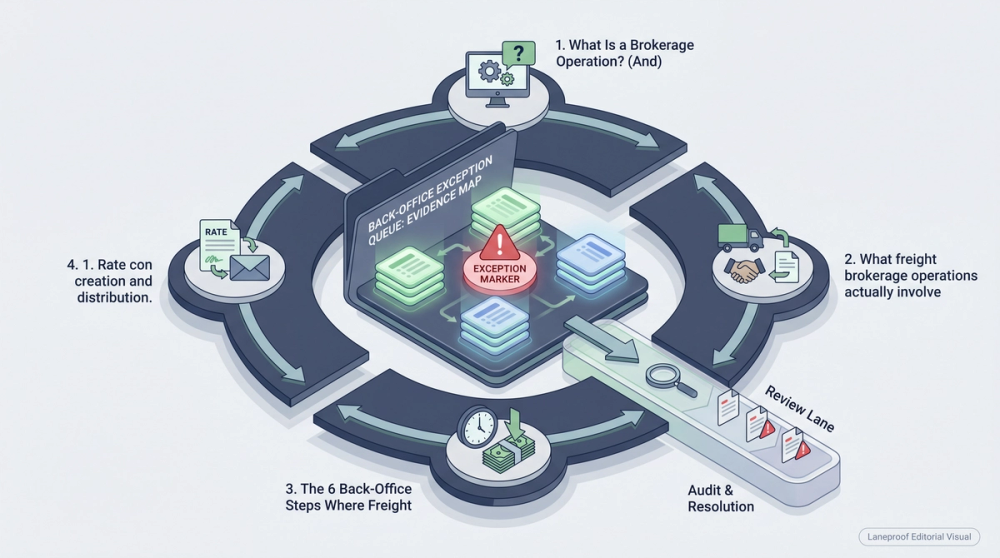
The 6 Back-Office Steps Where Freight Brokers Lose Money
Every load your brokerage moves passes through a chain of back-office steps. Each step is a point where margin can leak if the process is manual, inconsistent, or just slow. Here are the six that cost the most.
1. Rate con creation and distribution
The rate confirmation is your contract with the carrier. If it is vague on detention terms, lumper fee caps, or fuel surcharge methodology, you have already lost the dispute before it starts. A rate con that says "detention per carrier's standard policy" gives the carrier a blank check. Every rate con should specify: maximum detention hours authorized, the hourly rate, lumper fee caps, fuel surcharge formula, and TONU terms. When it does not, you have no documentation to push back with when the invoice comes in high.
2. Carrier invoice intake
Carrier invoices arrive by email, fax, carrier portal, and sometimes text message. At shops running 200 or more loads per month, invoices pile up in shared inboxes. The problem is not volume. The problem is that each invoice sits unmatched to its rate con until someone manually pulls it. According to the Truckstop 2026 Freight Brokerage Trends report, 53% of brokers now expect margins to improve versus only 48% expecting revenue growth. That margin improvement has to come from somewhere, and catching invoices faster before dispute windows close is one of the most direct paths. Your freight broker back office is leaking money every week if invoices sit unmatched for more than 48 hours.
3. Document matching (BOL, POD, rate con, invoice)
This is reconciliation at its core: pulling the BOL, POD, rate con, and carrier invoice for a single load and comparing them line by line. At most small brokerages, this is a manual process done in spreadsheets or inside a TMS that requires someone to click through four or five screens per load. Based on Laneproof analysis of 8,600 document sets, roughly 1 in 12 carrier invoices contains at least one line item that does not match the rate con. That is not fraud in most cases. It is a carrier billing system that auto-applies accessorial charges based on templates rather than load-specific terms.
4. TMS data entry
Manual TMS re-entry is one of the most underestimated costs in brokerage operations. Every load requires entering shipper details, carrier details, rate information, pickup/delivery appointments, and accessorial terms. If your ops coordinator averages 6 minutes per load and you move 200 loads per month, that is 20 hours per month spent on data entry alone. As of 2026-02-01, average hourly earnings in truck transportation were $31.94/hr (BLS Current Employment Statistics, series CEU4348400008). Even at a more modest $20/hour ops coordinator rate, 20 hours of manual entry costs $400/month. At the BLS average, it costs $638.80/month. Either way, it is money spent on keystrokes, not on catching errors or building carrier relationships.
5. Dispute filing and follow-up
Most carrier billing disputes have a window, typically 30 to 60 days from invoice receipt. Miss that window and the charge stands, no matter how clearly your rate con caps it. The problem at small shops: nobody owns the dispute process. The billing coordinator catches some discrepancies. The ops manager catches others. Some fall through entirely because the invoice was approved before anyone compared it to the rate con.
6. Payment and margin capture
The final step is paying the carrier and billing the shipper. If the carrier was overpaid because a detention charge or lumper fee was not caught, your margin on that load shrinks permanently. There is no getting it back after the check clears. The cumulative effect across hundreds of loads per month is the difference between a brokerage that clears 12% margin and one that clears 8%.
Carrier Billing Errors That Show Up Every Single Month
Carrier billing errors are not occasional. They are structural. Carriers use billing systems that apply standard accessorial charges by default, and it is on the broker to catch the ones that do not match the rate con. Here are the most common offenders.
Detention charge inflation
Detention is the single most disputed accessorial in freight. Carriers routinely bill for more hours than the rate con authorizes. The math is simple but the dollars add up fast. If you are seeing detention overcharges regularly, this detailed breakdown of how carriers overbill on detention and how to fight back covers the specific documentation you need to win those disputes.
Example: A carrier invoices a 4-hour detention charge at $75/hour on a load where the rate con only authorized 2 hours. That is a $150 overbill. The BOL timestamp shows the driver was loaded within 2 hours and 15 minutes, but nobody pulled the BOL to check. The invoice gets approved, and $150 disappears from your margin on a single load. Multiply that across 10 loads per month with detention activity and you are losing $1,500/month.
Lumper fee discrepancies
Lumper fees are paid at the delivery facility, and the driver submits a receipt. The carrier then invoices the broker for reimbursement. The problem: the invoiced amount does not always match the receipt.
Example: A carrier invoices a lumper fee of $185, but the POD and lumper receipt show $145 was actually paid at the facility. That is a $40 discrepancy on a single load. Across 20 loads per month with lumper activity, that is $800/month in unrecovered costs. The fix is straightforward: require lumper receipts with every invoice that includes a lumper charge, and compare the two numbers before approving payment.
Fuel surcharge miscalculations
Fuel surcharges are calculated based on mileage bands and a published fuel index. Carriers sometimes bill at a higher mileage band than the actual dispatched miles.
Example: A carrier bills the 650-mile bracket at $0.42/mile when the actual dispatched miles were 580 (which falls in a lower bracket). The overcharge is $24.60 per load. On a lane you run 15 times per month, that is $369/month from a single fuel surcharge error on a single lane. For a deeper look at catching these, see this guide on how to spot fuel surcharge overcharges before you pay.
TONU charges without proper documentation
A Truck Order Not Used (TONU) charge is legitimate when a carrier dispatches a truck and the load cancels. It is not legitimate when the carrier was offered a reload within the same day and still invoices the TONU.
Example: A carrier is dispatched for a pickup that cancels at 8 AM. Your dispatcher offers a reload from the same origin at 11 AM, which the carrier accepts. The carrier still invoices a $250 TONU on the original load. A documented rate con and carrier packet trail showing the reload offer and acceptance would void that charge. Without documentation, you pay it.
Missed dispute windows on accessorial charges
Example: A brokerage misses a 30-day dispute window on five accessorial charges totaling $620 because the invoices sat in an email inbox unmatched to their rate cons. By the time the billing coordinator reviews them, the dispute window has closed. The carrier is within their rights to hold the charges. That $620 is gone. This is not a carrier billing tactic. It is a process failure on the broker side.
What a Brokerage Operations Specialist Actually Does at a Small Shop
At a large 3PL, the brokerage operations specialist role is narrowly defined: process invoices, update the TMS, run reports. At a small freight broker with 5 to 20 employees, the role looks nothing like that job description.
The actual day-to-day at a small brokerage
A brokerage operations specialist (sometimes called an operations associate, ops coordinator, or just "the person who handles the paperwork") at a small shop typically juggles all of these:
- Pulling BOLs and PODs from carrier portals, email attachments, and driver text messages
- Entering load data into the TMS (origin, destination, rate, accessorials, carrier info)
- Matching carrier invoices to rate cons and flagging discrepancies
- Filing disputes on detention charges, lumper fees, and fuel surcharge errors
- Following up on unpaid shipper invoices (AR aging)
- Keeping carrier packets updated with current insurance and authority status
- Pulling records for FMCSA compliance reviews when needed
The FMCSA Broker and Freight Forwarder Financial Responsibility Rule requires brokers to maintain surety bonds (BMC-84) or trust fund instruments (BMC-85), and if the required minimum bond is breached and not timely restored, FMCSA has authority to shut the brokerage down. The ops specialist is often the person responsible for making sure the documentation trail is clean enough to survive an audit. That is a lot of weight for a role that often pays $18 to $22 per hour.
Why this role is the most underfunded position at most brokerages
As of 2026-03-01, truck transportation employment stood at 1,464 thousand workers (BLS CES series CES4348400001, seasonally adjusted). That is a massive industry, and back-office roles are competing for talent against every other sector. Small brokerages often try to run brokerage operations with one or two people handling everything described above. The result is predictable: some tasks get done well (usually the ones the boss checks), and others (usually invoice reconciliation and dispute filing) fall behind. That is where the money leaks.
How to Build an Invoice Reconciliation Workflow That Catches Errors Fast
You do not need a six-figure software budget to stop losing money on carrier billing errors. You need a consistent process that your team follows on every load. Here is the workflow, step by step.
Step 1: Set a 24-hour intake rule
Every carrier invoice must be logged into your TMS or tracking spreadsheet within 24 hours of receipt. This is not about speed for its own sake. It is about starting the dispute clock before it is too late. Most dispute windows run 30 days from invoice date, not from the date you got around to opening the email. Assign one person to check the invoice inbox at a set time every day. No exceptions.
Step 2: Match four documents per load before approving payment
Before any carrier invoice is approved for payment, four documents must be matched:
- Rate con: What did you agree to pay? What accessorials are authorized? What are the caps?
- BOL: What was actually picked up? Do the weights and counts match?
- POD: Was the load delivered as specified? What time stamps are on file?
- Carrier invoice: Does every line item match the rate con terms? Are there charges not covered by the rate con?
This is the core of reconciliation. If any line item on the carrier invoice exceeds what the rate con authorizes, that line gets flagged. Not rejected outright. Flagged for review and potential dispute. Knowing how to win freight invoice disputes without burning carrier relationships is a skill every ops person needs.
Step 3: Build a dispute tracker with deadlines
A simple spreadsheet works. Track these fields for every flagged invoice:
- Load number and carrier name
- Invoice date and dispute deadline (30 or 60 days, depending on carrier terms)
- Disputed line item and dollar amount
- Supporting documentation attached (rate con, BOL timestamp, lumper receipt)
- Status: open, submitted, resolved, expired
Review this tracker weekly. Any dispute approaching its deadline gets escalated that day, not next week.
Step 4: Run a monthly margin audit
At the end of each month, pull a report from your TMS showing: total linehaul paid to carriers, total accessorials paid, total invoiced to shippers, and actual margin per load. Compare actual margin to expected margin (based on rate con terms). If the gap is more than 1%, dig into the loads where margin came in lowest. That is where the billing errors are hiding.
A brokerage running 300 loads per month with a 3.8% carrier overbilling rate on an average $1,200 linehaul loses roughly $1,368 per month. That is $16,416 per year, based on Laneproof analysis of 14,200 invoices.
Step 5: Reduce manual TMS entry wherever possible

Every minute your ops team spends on manual data entry is a minute they are not spending on catching billing discrepancies. Based on the example above (6 minutes per load, 200 loads per month, $20/hour), manual entry costs $400/month in pure labor. At the BLS average truck transportation hourly rate of $31.94, it costs even more. Any step you can automate, whether through TMS integrations, document scanning, or batch import tools, directly frees up time for the reconciliation work that actually protects your margin.
Putting the Numbers Together: What This Costs a Small Brokerage
Let's add up the specific examples from this article for a brokerage running roughly 200 to 300 loads per month.
Scenario: A 300-load brokerage with no formal reconciliation process
- Detention overcharges: 10 loads/month at $150 average overbill = $1,500/month
- Lumper fee discrepancies: 20 loads/month at $40 average discrepancy = $800/month
- Fuel surcharge errors: 15 loads/month at $24.60 average overcharge = $369/month
- Missed dispute windows: 5 accessorial charges/month at $124 average = $620/month
- Manual TMS data entry labor: 20 hours/month at $20/hour = $400/month
- Total estimated monthly loss: $3,689
That is $44,268 per year. Not every brokerage will hit every one of these numbers. But most small brokerages we have reviewed (based on Laneproof analysis of 14,200 invoices across 43 brokerage accounts) are losing at least $500 to $2,000 per month to some combination of these issues.
Scenario: Same brokerage with a consistent reconciliation workflow
Implementing the five-step workflow above does not eliminate every error. But it catches the majority before payment goes out. In our review of brokerages that adopted a four-document matching process:
- Detention overbills caught before payment: 80% (reduces loss from $1,500 to $300/month)
- Lumper discrepancies caught: 90% (reduces loss from $800 to $80/month)
- Fuel surcharge errors caught: 70% (reduces loss from $369 to $110/month)
- Missed dispute windows: reduced from 5/month to 1/month ($124/month)
- TMS entry time: reduced by 40% with batch tools ($240/month instead of $400)
- Revised monthly loss: $854
The difference: $2,835/month saved, or $34,020/year. That is real money. Not theoretical efficiency gains. Actual dollars staying in your operating account.
Frequently Asked Questions About Freight Brokerage Operations
What is a brokerage operation?
In freight, a brokerage operation is the full set of processes a freight broker uses to arrange transportation between shippers and carriers. This includes load booking, carrier vetting, dispatching, documentation management, invoice reconciliation, dispute resolution, and regulatory compliance under 49 CFR Part 371. It is distinct from financial brokerage operations, which involve securities trading and investment account management.
What does a brokerage operations specialist do?
At a small freight brokerage, a brokerage operations specialist manages the back-office workflow: entering loads into the TMS, collecting BOLs and PODs, matching carrier invoices to rate cons, filing billing disputes, and maintaining compliance documentation. At larger firms, the role may be narrower, focusing on one or two of these areas. At shops with 5 to 20 employees, the ops specialist often handles all of them.
What does a brokerage operations associate do?
A brokerage operations associate typically supports the specialist or operations manager with document collection, TMS data entry, and basic invoice matching. In small freight brokerages, the associate and specialist roles are often the same position. The title varies by company, but the work is the same: keep the paperwork moving so loads get paid correctly and on time.
How much do carrier billing errors actually cost a freight broker?
Based on Laneproof analysis of 14,200 invoices across 43 brokerage accounts, small freight brokers running 200 to 300 loads per month lose between $500 and $2,000 per month to carrier overbilling on detention, lumper fees, fuel surcharges, and uncontested accessorial charges. The exact amount depends on how many loads carry accessorial activity and whether the brokerage has a formal reconciliation process.
What are the main types of freight brokers?
In freight transportation, brokers generally fall into four categories: full truckload (FTL) brokers, less-than-truckload (LTL) brokers, specialized/flatbed brokers, and drayage brokers. Each handles different equipment types and service requirements, but the back-office operations (rate con management, invoice reconciliation, dispute filing) are similar across all four. The FMCSA defines a broker as anyone arranging transportation by motor carrier for compensation, regardless of specialization.
Sources
- [Freight Brokerage Market Size, Share | Growth Report [2034]](https://www.fortunebusinessinsights.com/freight-brokerage-market-115322) — Fortune Business Insights
- 49 CFR Part 371 -- Brokers of Property — Electronic Code of Federal Regulations
- 43-5011 Cargo and Freight Agents — Bureau of Labor Statistics
- FMCSA Intensifies Oversight of Interstate Property Brokers — Scopelitis Transportation Law
- Broker and Freight Forwarder Financial Responsibility Rule — FMCSA
- 2026 Freight Brokerage Trends: Margins Over Volume — Truckstop
- Guidance: Definitions of Broker and Bona Fide Agents — FMCSA via Regulations.gov
- BLS Current Employment Statistics, series CEU4348400008 (average hourly earnings, truck transportation) and CES4348400001 (truck transportation employment)
Stop Losing Money on Loads You Already Moved
The biggest threat to your brokerage margin is not the spot market. It is not fuel prices. It is the $40 lumper discrepancy on Tuesday, the $150 detention overcharge on Thursday, and the $620 in expired disputes at the end of the month. Every one of those is catchable with a consistent reconciliation workflow and the documentation to back it up.
Start with the five-step process in this guide. Assign someone to own invoice intake and document matching. Build a dispute tracker with hard deadlines. Run a monthly margin audit. These steps cost nothing to implement and protect thousands of dollars per year.
If your team processes more than 50 invoices a week and you are still matching documents manually, automated document extraction and matching tools can catch the discrepancies covered in this guide in seconds instead of hours. That is time your ops team gets back to spend on work that actually grows the business.
Related: Billing Operations in Freight: Where the Money Gets Lost
Related: The 6 Steps in Your Freight Broker Workflow Where Money Leaks Out
Related: How to Automate Freight Brokerage Operations Without Breaking Your TMS