Freight Audit for SMB Brokers: What It Costs to Skip It
Researched and written with AI assistance. Reviewed by the Laneproof team.

A freight brokerage moving 500 loads per month at an average carrier invoice of $1,800 faces roughly $34,200 in potential overbilling exposure every month, just from accessorial charge errors alone. That's not a worst-case scenario. According to the American Journal of Transportation, cited by Pando.ai's industry analysis, approximately 25% of freight bills contain some form of error. If your team isn't running a consistent freight audit process, those errors aren't hypothetical. They're hitting your margin on loads you've already moved. Most guides on this topic are written for enterprise shippers spending six figures on third-party audit firms. This one is for brokers with 5 to 50 employees who need a practical, repeatable process they can start this week.
What Is a Freight Audit? (And Why the Textbook Definition Misses the Point)
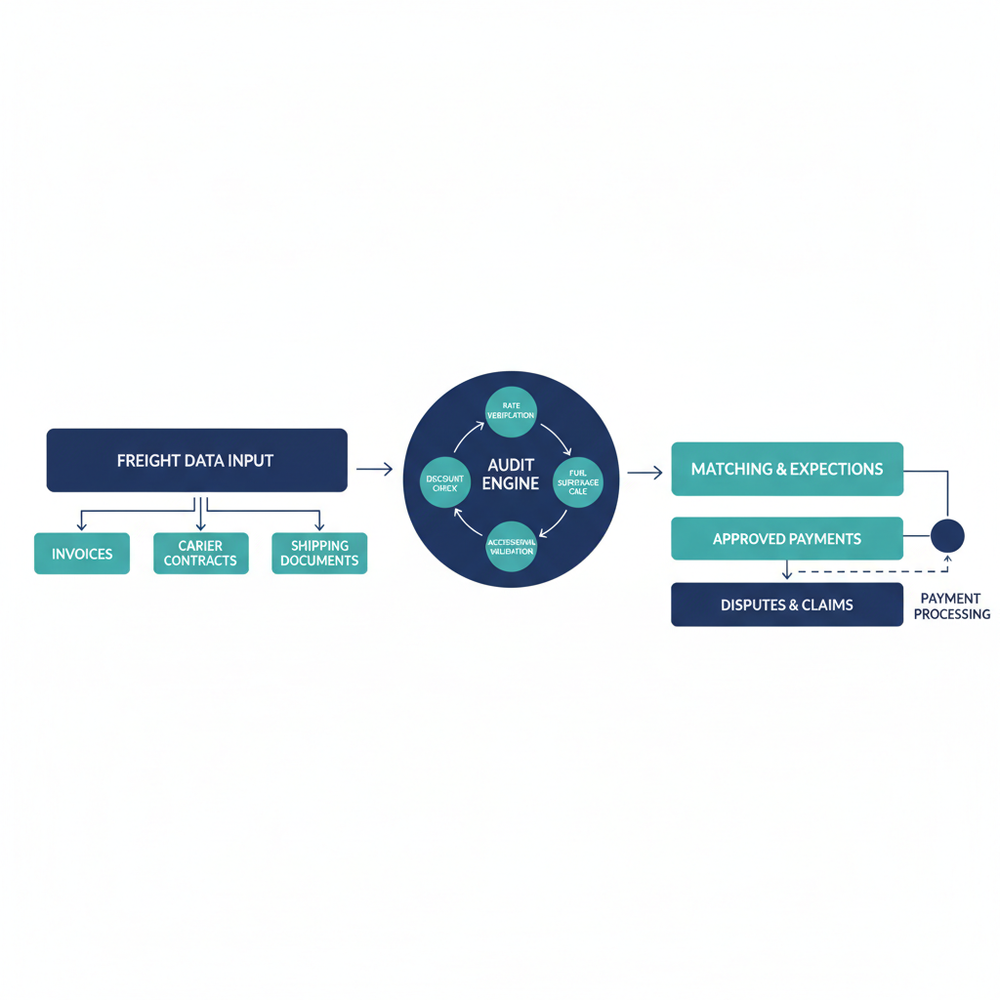
A freight audit is the process of reviewing, verifying, and correcting freight invoices to ensure you only pay accurate, contractually agreed-upon charges. It covers linehaul rates, accessorial charges, fuel surcharges, and any other line items a carrier bills against a load. The process typically includes:
- Collecting carrier invoices and matching them against rate confirmations
- Verifying accessorial charges (detention, lumper fees, TONU, layover) against signed documentation
- Checking fuel surcharge calculations against agreed FSC tables
- Flagging discrepancies before payment is released
- Documenting dispute outcomes for future carrier negotiations
That's the textbook version. According to Wikipedia's overview of freight audit, the practice is defined as examining, adjusting, and verifying freight bills for accuracy, serving as both a financial and operational checkpoint. Fair enough. But here's the problem: most definitions describe what happens at companies with dedicated audit departments, automated payment platforms, and thousands of invoices flowing through an ERP system every week.
If you're an SMB broker, your "audit process" might be an ops coordinator with two monitors open, toggling between a TMS, a carrier's emailed PDF invoice, and a rate con screenshot. The real question isn't what a freight audit is. It's whether the version you're running (or not running) is actually catching errors before you pay them.
Why the Standard Definition Doesn't Fit Small Brokerages
Enterprise freight audit guides assume you have a payment automation layer, a team of analysts, and clean data flowing from a well-integrated TMS. SMB brokerages rarely have any of those things. What you do have is a billing coordinator spending hours per week on manual reconciliation, a folder of rate cons that may or may not match the carrier's invoice, and a gut feeling that some charges don't look right. That gap between what you suspect and what you can prove is where margin disappears. The rest of this guide is built to close that gap, dollar by dollar.
Where the Money Actually Disappears: The Most Common Carrier Invoice Errors
Per Transportation Insight's analysis of freight billing, a typical freight bill audit finds that between 3% and 6% of invoices contain errors, with most errors stemming from accessorial charges. That range might sound small until you run the numbers on your own load volume. For a brokerage processing 500 loads per month, even a 3.8% error rate at an average invoice of $1,800 means roughly $34,200 in potential overbilling exposure every month. Here are the specific error types that account for the bulk of that number.
Detention Overcharges
Detention is one of the most frequently disputed accessorial charges, and for good reason. The error pattern looks like this: the rate con specifies a 2-hour free period and a $75/hour detention rate, capped at 2 billable hours. The carrier's invoice shows 4 hours of detention billed at $75/hour, totaling $300. The legitimate charge should be $150. Without checking the rate con cap, your team pays the full $300.
Example: A carrier bills $300 for 4 hours of detention at $75/hour. The rate con caps billable detention at 2 hours after a 2-hour free period. The correct charge is $150. That's a $150 overcharge on a single load. Across 20 loads per month with detention events, that adds up to $3,000 in potential overpayment per month if nobody checks.
Unauthorized Lumper Fees
Lumper fees are supposed to be pre-authorized. When a carrier bills a lumper fee that wasn't on the rate con and has no signed receipt attached to the POD, you have a clear basis for dispute.
Example: A carrier invoices a $185 lumper fee. The rate con makes no mention of lumper authorization, and the POD package has no signed lumper receipt. To dispute this: pull the rate con, confirm no lumper language exists, check the POD for any attached receipts, and respond to the carrier with a written dispute referencing the absence of both authorization and documentation. The documentation wins. If there's no signed receipt and no rate con authorization, you don't owe it.
TONU (Truck Ordered Not Used) Billing Errors
TONU charges are legitimate when a carrier dispatches to a pickup and the load cancels. They're not legitimate when the carrier agreement includes exceptions that apply, or when dispatch records show the load was actually covered.
Example: A carrier invoices a $250 TONU charge. Your dispatch records show the load was reassigned per a clause in the carrier agreement that covers reassignment within 4 hours of pickup. The $250 charge should be $0. To catch this during reconciliation, cross-reference the TONU invoice against your dispatch log and the specific carrier agreement language. If you don't have a consistent invoice matching process, these slip through every time.
Fuel Surcharge Miscalculations
Fuel surcharge (FSC) errors are harder to spot because they require checking a calculation, not just comparing two numbers. The most common mistake: the carrier calculates FSC on gross weight instead of billable weight.
Example: A load has a gross weight of 42,000 lbs but a billable weight of 36,000 lbs. The carrier calculates the fuel surcharge on 42,000 lbs. Depending on the FSC table and distance, that results in a $40 to $90 overcharge per load. On 200 loads per month where FSC applies, that's $8,000 to $18,000 per year in silent overpayment. To catch this, compare the weight on the BOL to the weight used in the carrier's FSC calculation. If they don't match, flag it.
LTL Freight Class Reclassification
For brokerages handling LTL, reclass errors are one of the most expensive per-shipment mistakes. A carrier upgrades the freight class (say, from class 70 to class 85) without documentation, and the rate jumps accordingly.
Example: A carrier reclassifies a shipment from class 70 to class 85, adding $60 to $200 per shipment depending on the weight break. To dispute it, pull the BOL and verify the NMFC code listed. If the NMFC code on the BOL supports class 70, the carrier needs to provide inspection documentation justifying the reclass. No documentation, no reclass.
How to Run a Freight Audit In-House: A Step-by-Step Workflow
You don't need a six-figure audit platform to start catching these errors. What you need is a repeatable process that your ops team can run consistently. According to NVision Global's freight audit checklist, the core steps of a freight audit include invoice collection, rate verification, accessorial validation, and exception handling. Here's how to adapt that into a practical workflow for a small brokerage.
Step 1: Collect and Centralize Every Carrier Invoice
Before you can audit anything, you need all carrier invoices in one place. If invoices arrive via email, carrier portal, and fax (yes, some carriers still fax), your first job is centralization. Create a single intake point. This could be a shared inbox, a folder in your TMS, or a document management tool. The point is: nothing gets paid until it's been through this intake.
Step 2: Match Each Invoice to the Rate Confirmation
Pull the rate con for every invoice. Compare the linehaul rate, any pre-authorized accessorials, and the agreed fuel surcharge terms. This is the most time-consuming step and the one where most errors get caught. Check for:
- Linehaul rate matches the rate con exactly
- Accessorial charges are listed on the rate con or have separate written authorization
- Fuel surcharge percentage or per-mile rate matches the agreed FSC table
- Weight and mileage figures match the BOL and trip data
If you want a deeper look at where invoice matching typically breaks down, the guide on where carrier bills go wrong during invoice matching covers the most common failure points.
Step 3: Validate Accessorial Charges Against Documentation
For every accessorial line item (detention, lumper, layover, TONU, dry run), ask two questions: Was this charge authorized on the rate con or via a separate written agreement? Is there supporting documentation (signed lumper receipt, facility check-in/check-out times, dispatch log entries)?
If the answer to either question is no, flag the charge for dispute. Don't pay it and sort it out later. Flag it before payment.
Step 4: Check Fuel Surcharge Math
Pull up the agreed FSC table. Verify the carrier used the correct DOE fuel index date, the correct weight (billable, not gross), and the correct mileage. Fuel surcharge errors are almost never intentional fraud. They're usually the result of outdated or incorrect inputs in the carrier's billing system. That doesn't mean you should pay them.
Step 5: Flag, Dispute, and Document Exceptions
Every discrepancy gets documented. Create a simple exception log (a spreadsheet works fine) that tracks: the load number, the invoice amount, the correct amount, the difference, the error type, and the dispute status. This log serves two purposes. First, it gives you the documentation you need to win disputes. Second, it reveals patterns. If a specific carrier overbills on detention consistently, that's a conversation you need to have before the next rate negotiation. For more on how to handle those conversations without damaging the relationship, see the guide on winning freight invoice disputes without burning carriers.
Step 6: Approve and Release Payment
Only after an invoice has passed through steps 1 through 5 does it get approved for payment. This sounds obvious. In practice, many small brokerages pay carrier invoices on receipt to maintain relationships, then try to recover overpayments after the fact. That approach costs more time and recovers less money than auditing before payment.
In-House vs. Outsourced Freight Audit: An Honest Comparison for Small Brokerages
According to Mordor Intelligence's market sizing report, the freight audit and payment market is estimated at $0.97 billion in 2025 and is expected to reach $1.89 billion by 2030, growing at a CAGR of 14.2%. That growth is driven largely by enterprise shippers outsourcing to third-party audit firms. But does outsourcing make sense for a brokerage running 100 to 5,000 loads per month? Not always.
When In-House Makes Sense
In-house freight auditing works best when:
- Your load volume is under 1,000 loads per month and one or two people can handle the review
- You need dispute resolution speed (third-party firms add processing time)
- Your margin per load is thin enough that even a 2% to 3% fee on recovered savings wipes out the benefit
- You want direct control over carrier relationships during the dispute process
The tradeoff is labor. A brokerage spending 11 hours per week on manual invoice reconciliation at an ops coordinator rate of $22/hour loses approximately $12,584 per year in labor cost alone, before accounting for the errors that still slip through undetected.
When Outsourcing Makes Sense
Outsourcing to a freight audit and payment provider becomes more practical when:
- Load volume exceeds 2,000 per month and your team can't keep up with the review volume
- You're dealing with multi-modal shipments (FTL, LTL, drayage, parcel) that each have different billing structures
- You need analytics and reporting that your TMS doesn't provide natively
- The cost of the audit service is clearly less than the cost of the errors it catches
Per Gartner's reviews of freight audit and payment providers, the market includes a range of solutions from full-service outsourced providers to technology platforms that automate specific audit steps. For most SMB brokers, the sweet spot is often somewhere in between: running the core audit in-house with tools that automate the most time-consuming steps like document extraction and rate con matching.
How to Calculate Whether Your Audit Process Is Worth the Time
Every hour your team spends on freight invoice review needs to earn more than it costs. Here's how to calculate whether your current process (or lack of one) makes financial sense.
The Labor Cost Calculation

Start with what the reconciliation process actually costs in labor:
- Hours per week spent on invoice reconciliation: estimate honestly (track it for two weeks if you haven't)
- Fully loaded hourly rate of the person doing the work (salary plus benefits, not just wage)
- Multiply hours times rate times 52 weeks
Scenario: Your ops coordinator spends 11 hours per week on manual freight invoice review. At a fully loaded rate of $22/hour, that's $242 per week, or $12,584 per year. That's the cost of your current process before you measure whether it's actually catching errors.
The Error Exposure Calculation
Now calculate what's at risk if you don't audit, or if your audit misses things:
- Monthly load volume times average carrier invoice amount equals total monthly carrier spend
- Total monthly carrier spend times estimated error rate (use 3% to 6% per Transportation Insight's data) equals monthly error exposure
- Monthly error exposure times 12 equals annual error exposure
Scenario: 500 loads per month at $1,800 average invoice equals $900,000 in monthly carrier spend. At a 3.8% error rate, that's $34,200 per month in potential overbilling, or $410,400 per year. Even if your manual audit process catches half of those errors, you're still losing over $200,000 annually. Compare that to the $12,584 labor cost. The audit pays for itself many times over, assuming it's catching a meaningful percentage of errors.
The Break-Even Question
The real question is: what percentage of errors does your current process need to catch to break even? If your annual labor cost for auditing is $12,584 and your annual error exposure is $410,400, your process only needs to catch about 3% of errors to pay for itself. That's an extremely low bar, which tells you something important: almost any audit process is better than no audit process. The question isn't whether to audit. It's how to make the process efficient enough that your team can sustain it without burning out. For a deeper look at what freight audit savings look like for small brokerages specifically, see the breakdown of real costs for small broker freight audits.
Approximately 25% of freight bills contain some form of error, resulting in businesses overpaying. The most common source: accessorial charges that don't match the rate con. (American Journal of Transportation, via Pando.ai)
Frequently Asked Questions About Freight Auditing
What is a freight audit?
A freight audit is the process of reviewing, verifying, and correcting carrier invoices to ensure you only pay charges that are accurate and contractually agreed upon. It covers linehaul rates, fuel surcharges, accessorial charges like detention and lumper fees, and any other billable line items. For SMB brokers, it's the primary defense against carrier overbilling that quietly erodes margin every month.
How often should a small brokerage audit freight invoices?
Every invoice, every time, before payment. Some brokerages batch their audits weekly, reviewing all invoices received that week before releasing payment. Others audit daily as invoices come in. The key is consistency. An audit process that only runs when someone has spare time will miss most errors. If your reconciliation process takes too long to run on every invoice, that's a signal to simplify the workflow or add automation, not to skip invoices.
What are the most common freight billing discrepancies?
The highest-dollar discrepancies for SMB brokers typically fall into five categories: detention charges billed beyond rate con caps, unauthorized lumper fees with no signed receipt, fuel surcharges calculated on incorrect weight, TONU charges that don't align with dispatch records or carrier agreement terms, and LTL freight class reclassifications without supporting inspection documentation. Accessorial charges are the most frequent source, per Transportation Insight's freight billing analysis.
How do I audit freight charges if I don't have an audit team?
You don't need a dedicated team. Most small brokerages assign the audit function to an ops coordinator or billing coordinator as part of their existing workflow. The process described in this guide (centralize invoices, match to rate cons, validate accessorials, check FSC math, flag exceptions, then approve payment) can be run by one person for brokerages under 500 loads per month. Above that volume, you'll likely need either a second person or tools that automate the document extraction and matching steps.
What's the difference between a pre-audit and a post-audit?
A pre-audit reviews carrier invoices before payment is released. A post-audit reviews invoices after payment to identify overpayments for recovery. Pre-audit is almost always more effective for SMB brokers because recovering money after payment requires more effort, more documentation, and more friction with carriers. According to FreightWaves' coverage of freight invoice audits, catching errors before payment significantly reduces the cost of dispute resolution and improves carrier relationships compared to clawing money back after the fact.
Sources
- The freight audit industry: Navigating complexity and key insights — Pando.ai (citing American Journal of Transportation)
- Freight Audit And Payment: Protecting Profit In Soft Rates — Transportation Insight
- Freight audit — Wikipedia
- Freight Audit And Payment Market Size & Growth to 2030 — Mordor Intelligence
- Best Freight Audit and Payment Providers Reviews 2026 — Gartner
- The Ultimate Freight Audit Checklist in 2025 — NVision Global
- Freight Invoice Audits and Why They Matter — FreightWaves
Start Catching the Errors You're Currently Paying For
The math on freight auditing is simple: almost any consistent process pays for itself, because the error rates in carrier invoicing are high enough that even a basic review catches real dollars. The harder part is building a process your team can actually sustain week after week without it becoming a bottleneck.
Start with the workflow in this guide. Centralize your invoices, match every one to a rate con, validate accessorials with documentation, and check your fuel surcharge math. Track your exceptions so you can see which carriers and which error types cost you the most. That pattern data is what turns a reactive audit into a proactive one.
If your team processes more than 50 invoices a week and the manual matching is eating hours you can't afford, tools that automatically extract and flag invoice discrepancies can take the most repetitive steps off your team's plate. But the process comes first. Get the workflow right, and the tools make it faster. Skip the workflow, and no tool will save you.
Related: Orca Freight Audit Reviewed: What SMB Brokers Actually Get
Related: Freight Audit Software: What It Must Catch to Be Worth Using