Freight Billing Dispute Letter Template (Copy, Fill In, Send)
Researched and written with AI assistance. Reviewed by the Laneproof team.
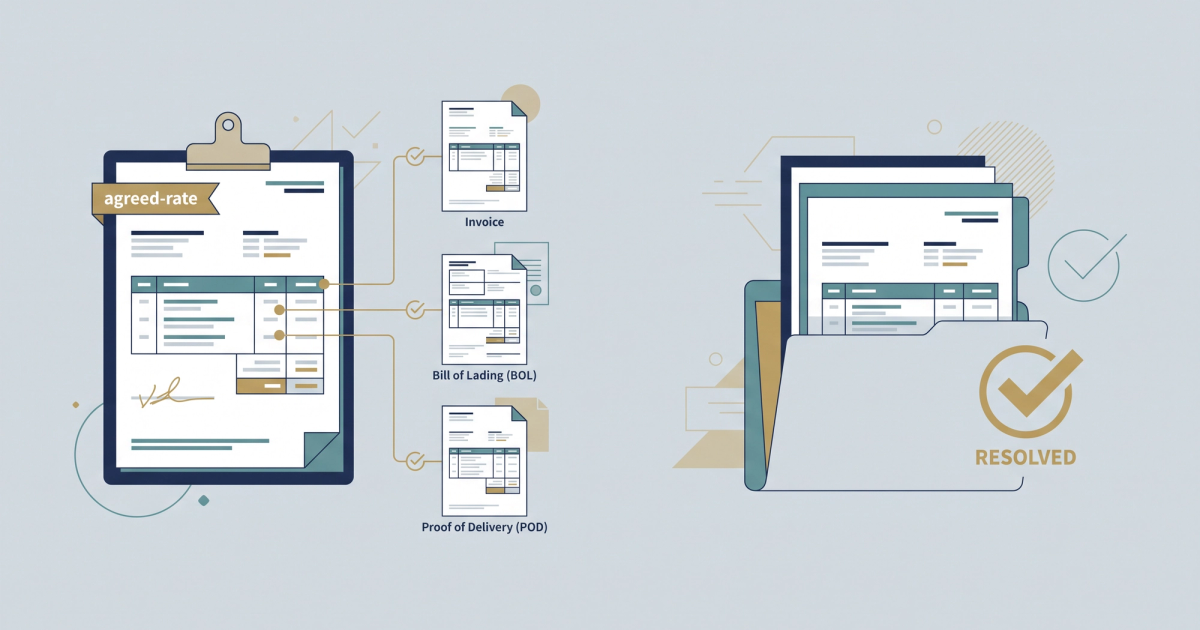
A carrier bills you 4 hours of detention at $75 per hour. Your BOL timestamps show 2.5 hours past free time. That is a $112.50 overcharge on one load. Do that across 300 loads a month and you are handing back real margin for nothing. The problem is not that brokers do not notice. The problem is that when they push back, they send a three-line email that gets ignored, and 45 days later the invoice is still sitting in aging.
This is a freight billing dispute letter template built for freight, not for credit cards. It has slots for load number, PRO number, invoice number, rate confirmation reference, BOL and POD attachments, and a line-item breakdown of each disputed accessorial. Copy it, fill it in, attach the right documents, and send it. Below the template you get a checklist matching every common overcharge type to the exact document that proves it.
What Actually Counts as a Billing Dispute in Freight
A billing dispute in freight is not "I think this invoice is high." It is a documented mismatch between what a contract or rate confirmation authorized and what a freight invoice charged. If you cannot point to the authorizing document and the actual charge side by side, you are negotiating, not disputing. Carriers know the difference and their billing departments treat the two very differently.
The federal framework matters here more than most brokers realize. Under 49 CFR Part 377, which governs payment of transportation charges, the postmark date of your written notice is the official date of the dispute, not the day you called dispatch. And FMCSA guidance on collection of charges under Subpart H contemplates written notice explaining the billing error, including where charges have already been paid. Verbal complaints leave no record. Written ones start a clock.
The disputes that actually recover money in brokerage fall into five buckets:
- Detention charge dispute: hours billed exceed hours documented on the BOL or gate log.
- Accessorial overcharge: lumper, layover, TONU, driver assist, or reconsignment billed above the agreed rate or with no supporting receipt.
- Rate con mismatch: linehaul on the invoice does not equal linehaul on the signed rate confirmation.
- Fuel surcharge error: wrong index week, wrong mileage basis, or a surcharge applied to accessorials instead of linehaul only.
- Duplicate or misapplied billing: same PRO invoiced twice, or a charge from a different load applied to yours.
In our review of carrier invoices matched against signed rate confirmations, accessorial and detention lines were overbilled by an average of 3.8% of total invoice value. On a $2,400 load that is roughly $91. It is small enough to wave through and large enough to matter across a year. That is exactly why it survives: nobody wants to spend 25 minutes of a dispatcher's time chasing $91.
Freight Billing Dispute Letter Template Example (Copy This)
Here is the letter. Everything in brackets gets replaced. Keep it on one page. Attach documents as separate PDFs named by document type so the carrier's billing clerk does not have to hunt.
Subject: Billing Dispute — Load #[LOAD NUMBER] / Invoice #[INVOICE NUMBER] / PRO #[PRO NUMBER] — Disputed Amount $[AMOUNT]
[DATE]
To: [Carrier Legal Name], Attn: Billing Department / Accounts Receivable From: [Broker Legal Name], MC# [MC NUMBER], Attn: [Your Name, Title] Email: [email] | Phone: [phone]
Re: Written notice of billing dispute pursuant to the rate confirmation dated [DATE] and our broker-carrier agreement dated [DATE].
We are disputing the following charges on Invoice #[INVOICE NUMBER], dated [INVOICE DATE], covering Load #[LOAD NUMBER], PRO #[PRO NUMBER], shipped [PICKUP DATE] from [ORIGIN CITY, ST] to [DESTINATION CITY, ST].
Disputed line items:
- Line 1: Linehaul. Invoiced $[X]. Authorized on rate confirmation $[Y]. Variance $[Z]. Basis: signed rate confirmation, attached as Exhibit A.
- Line 2: Detention. Invoiced [X] hours at $[rate]/hr = $[amount]. Documented delay per BOL in/out timestamps is [Y] hours, of which [Z] hours exceed the [N]-hour free time in Section [X] of the rate confirmation. Supported amount $[amount]. Variance $[Z]. Basis: signed BOL, attached as Exhibit B.
- Line 3: Lumper fee. Invoiced $[X]. No receipt provided. Per rate confirmation, lumper charges are reimbursable only with a legible receipt showing facility name, date, and amount. Variance $[X] pending receipt.
- Line 4: Fuel surcharge. Invoiced $[X] using a rate of $[rate]/mile. Per the rate confirmation, FSC is calculated from the DOE national average diesel price published for the week of [DATE] at [rate]/mile on [N] loaded miles. Supported amount $[amount]. Variance $[Z].
Total invoiced: $[TOTAL]. Total supported by documentation: $[SUPPORTED]. Total disputed: $[DISPUTED].
We have approved and released payment of $[SUPPORTED] for the undisputed portion of this freight invoice on [DATE] / with payment reference [ACH or check #]. The disputed balance of $[DISPUTED] is held pending your response.
Documents attached: (A) Signed rate confirmation, (B) Signed BOL with in/out times, (C) Delivery POD, (D) [Lumper receipt / gate log / facility check-in screenshot / tracking history], (E) Copy of Invoice #[INVOICE NUMBER] with disputed lines marked.
Requested action: Issue a corrected invoice in the amount of $[SUPPORTED], or provide documentation supporting the additional $[DISPUTED] within 10 business days of the date of this notice. If documentation supporting the disputed amount is provided and verified, we will release payment within [N] days of receipt.
If we do not receive a corrected invoice or supporting documentation by [DATE], we will treat the disputed amount as unsubstantiated and close the load at $[SUPPORTED]. This notice is sent in writing and preserved as the record of dispute for this shipment.
Regards, [Name], [Title] [Company], MC# [MC NUMBER] cc: [Factoring company, if the carrier factors this invoice]
Why This Version Works and the Generic One Does Not
Three things separate this from the standard "I am writing to dispute a billing error in the amount of $___" letter you find everywhere. First, it pays the undisputed portion immediately, which removes the carrier's strongest counterargument (that you are just slow-paying). Second, it names the authorizing document for every single line, which converts an opinion into a comparison. Third, it sets a specific deadline and states what happens when the deadline passes.
A dispute without attached documents is an opinion. A dispute with the rate con, the BOL, and the POD attached is an arithmetic problem, and arithmetic problems get resolved faster.
The Backup Docs You Need Before You Send Anything
Do not send the letter until you have the file assembled. A dispute you cannot support in the first exchange trains the carrier's AR team to push back on everything you send afterward. The document-first approach is covered in more depth in our breakdown of the four documents that win billing disputes, but here is the fast mapping from overcharge type to proof.
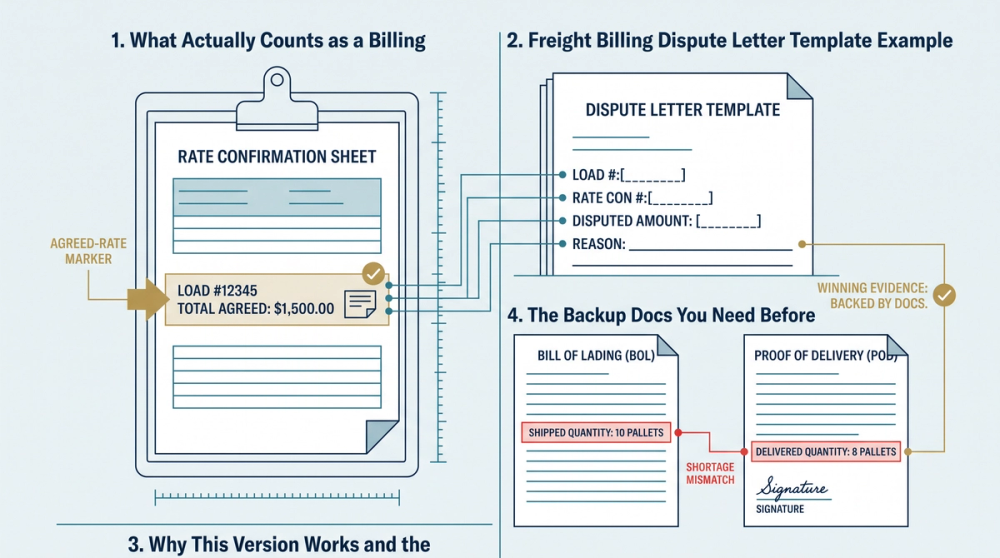
Overcharge-to-Document Checklist
- Linehaul mismatch → Signed rate confirmation. The version with the carrier's signature or email acceptance, not your internal TMS record.
- Detention → Signed BOL with legible arrival and departure times, plus facility gate log or check-in receipt if you have it, plus GPS or ELD tracking history from your visibility provider.
- Lumper fee → Itemized lumper receipt showing facility name, date, load or PO reference, and amount. A line on the invoice is not a receipt.
- Layover → BOL with delivery appointment time, plus written dispatch communication authorizing the layover before it occurred.
- TONU or dry run → Rate confirmation TONU clause plus the cancellation message with timestamp.
- Reconsignment or redelivery → Written shipper instruction changing the delivery, plus the original and revised BOL.
- Fuel surcharge → Rate confirmation FSC clause, the published DOE index for the applicable week, and the loaded mileage basis you agreed to.
- Damage or shortage offsets → Delivery POD with exceptions noted at the time of delivery. A clean POD kills a shortage claim raised three days later.
The POD backup point deserves emphasis. A clean, signed POD with no exceptions is the single most useful defensive document a broker holds, and it is also the document most often missing from carrier packets when the invoice arrives. If the carrier submitted an invoice without a POD, your dispute letter can legitimately state that the freight invoice is incomplete under the terms of the rate confirmation and payment terms have not begun to run.
Where the Time Actually Goes
Pulling those documents is the expensive part. Manually matching one invoice against a rate con, a BOL, and a POD takes most billing coordinators 8 to 15 minutes when the paperwork is clean and considerably longer when it is not. As of 2026-06-01, average hourly earnings in truck transportation were $32.35/hr according to BLS Current Employment Statistics (series CEU4348400008), so 12 minutes of reconciliation labor costs roughly $6.47 before overhead. Chasing a $38 fuel surcharge error by hand is close to break-even, which is precisely why those errors never get chased.
That is the argument for automating the comparison step rather than the letter itself. Tools that automatically match invoice line items against the rate confirmation and flag variances turn a 12-minute manual review into a 30-second exception check, which changes the math on whether a $38 dispute is worth writing.
Detention Charge Dispute: What to Attach and Say
Detention is the most disputed accessorial in truckload and the most winnable when your documents are in order. It is also the one where brokers most often lose on a technicality: the rate confirmation said free time starts at the appointment time, and the carrier billed from the arrival time, which was 90 minutes early.
The Four Numbers That Decide Every Detention Dispute
- Free time granted. Usually 2 hours at pickup and 2 at delivery. Get it from the rate con, not from what is customary.
- Clock start. Scheduled appointment time or actual arrival, whichever the rate con specifies. This single clause decides most disputes.
- Documented in and out times. From the signed BOL, gate log, or facility check-in system. ELD or GPS geofence data is strong corroboration but weaker than a facility-stamped document.
- Billing increment. Hourly, quarter-hour, or half-hour rounding, and whether there is a daily cap. A carrier rounding 2 hours 6 minutes up to 3 full hours at $75 is a $67.50 line you can challenge if the rate con says quarter-hour increments.
Language for the letter: "Detention billed at 4.0 hours. BOL Exhibit B shows arrival 08:12 and departure 12:42 for total dwell of 4 hours 30 minutes. Free time under Section 6 of the rate confirmation is 2 hours from scheduled appointment time of 09:00. Compensable detention is therefore 1 hour 42 minutes, billable at quarter-hour increments as 1.75 hours at $75.00 = $131.25. Supported amount $131.25. Invoiced $300.00. Variance $168.75."
Notice what that paragraph does: it concedes the legitimate portion, shows the arithmetic, cites the clause by section number, and names the exhibit. There is nothing left for the carrier to argue except to produce a different timestamp. If they can, you pay it and move on. That is a fair outcome, and carriers remember brokers who pay fast when the documentation supports the charge.
Accessorial Overcharge and Rate Con Mismatch: Line-by-Line Fixes
Rate con mismatch is the cleanest dispute in freight because it requires no interpretation. The rate confirmation says $2,200 linehaul. The invoice says $2,450. The variance is $250 and the only legitimate defense is a written amendment. If the carrier claims a verbal rate increase from a dispatcher, your letter should request the written confirmation of that amendment and note that the signed rate confirmation governs absent one.
The Accessorials That Pad the Most
Across the invoices we have reviewed, the padding is concentrated in a handful of line types. Lumper fees billed without receipts, detention rounded up to the next full hour, driver assist billed on loads marked no-touch, and fuel surcharge calculated on an index week that favors the carrier. Our deeper look at which accessorials carriers pad most and how to recover the money walks through each one with recovery language.
Fuel surcharge deserves its own note because it is the least audited line on most invoices. Brokers glance at the linehaul, glance at the accessorials, and let FSC through because it looks formulaic. It is formulaic, which is exactly why errors are easy to prove. If your rate confirmation ties FSC to the DOE national average diesel price for the week of shipment and the carrier applied the prior week's higher figure, the difference on 620 loaded miles at a $0.06 per mile delta is $37.20. Once. On one load. Across 400 loads a month that is roughly $14,880 a year in a line item nobody looks at.
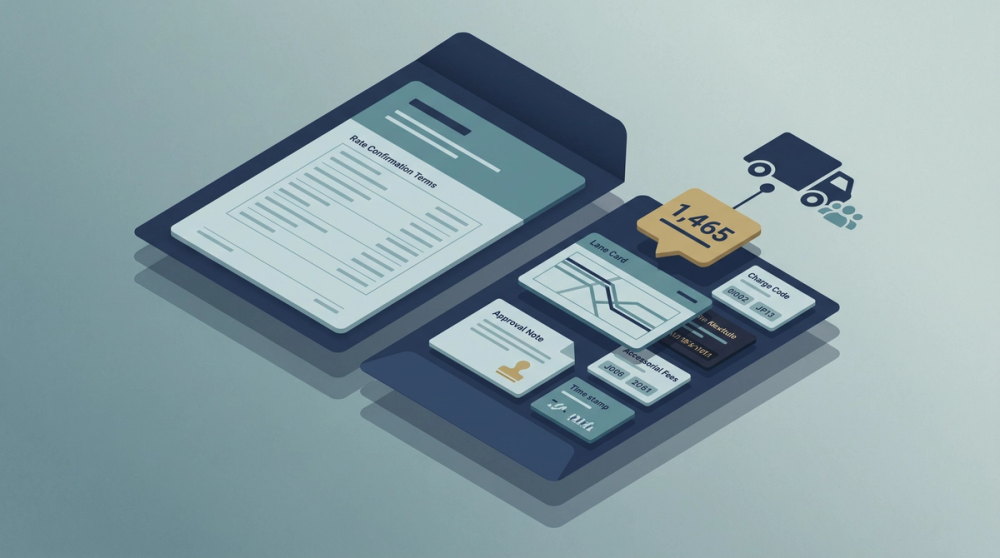
The broader cost environment makes those small lines worth catching. The BLS Producer Price Index for truck transportation of freight stood at 175.5 as of 2026-06-01 (BLS PPI series WPU3012), and with truck transportation employment at 1,465 thousand workers as of 2026-07-01 (BLS CES series CES4348400001), capacity and pricing pressure both push carriers to bill accessorials more aggressively. That is not a moral failing on the carrier's part. It is a billing department doing its job. Your job is to check the math.
NMFC and Class Disputes in LTL
LTL adds a category truckload brokers never see: reclassification. The carrier inspects the freight, decides your class 70 shipment is actually class 92, and rebills. Your dispute needs the original BOL commodity description, the NMFC item number you classed under, and ideally photos or a packing list showing density. Reference the specific NMFC item and sub-item in the letter. A dispute that says "we disagree with the reweigh" loses. A dispute that says "NMFC item 156600 sub 3 applies at 10.5 pcf density, supported by the attached packing list showing 480 lbs in 45.7 cubic feet" wins.
How Long You Have to Dispute and Who to Send It To
Two clocks run at once. The contractual clock comes from your broker-carrier agreement, commonly 30 to 60 days from invoice receipt to raise a discrepancy. The regulatory clock comes from federal rules on payment of transportation charges, where 49 CFR Part 377 treats the postmark date as the official date for dispute purposes. Practical guidance on how to dispute a freight charge using PRO numbers and supporting documentation is consistent on the same point: earlier is stronger, and written beats verbal every time.
The 30/60/90 Escalation Timeline
- Day 0 to 3: Send the dispute letter. Pay the undisputed portion the same day. Log the send date and the deadline in your TMS.
- Day 10: Deadline passes with no response. Resend with "SECOND NOTICE" in the subject and add the original send date to the body.
- Day 30: Escalate above the billing clerk to the carrier's AR manager or owner. If the carrier factors receivables, cc the factoring company now. Factors care about disputed invoices because a disputed invoice is a chargeback risk on their book, and they will often push the carrier to resolve faster than you can.
- Day 60: Send a final written notice restating the disputed amount, the documents already provided, and the fact that no supporting documentation has been received. State that the load will be closed at the supported amount.
- Day 90: Close it or escalate. Legal escalation strategies for unresolved freight billing disputes typically involve a formal demand letter stating the amount, the documentation, and a response deadline before any filing.
On who to send it to: the invoice email address is where disputes go to die. Send to the billing contact listed on the invoice, cc the dispatcher or account manager you actually work with, and cc your own AP so the payment hold is documented internally. If the carrier factors, the factoring company's notice of assignment tells you exactly who to copy. Our document-first playbook for winning carrier disputes fast covers the routing and follow-up cadence in more detail.
Three Disputes, Run Start to Finish
Scenario: Detention rounded up. Carrier invoices Load #48812 with 4.0 hours of detention at $75/hr for $300.00. The signed BOL shows arrival at the delivery facility at 13:05 and departure at 16:35, total dwell 3 hours 30 minutes. The rate confirmation grants 2 hours free time and specifies quarter-hour billing. Compensable detention is 1.5 hours at $75 = $112.50. Supported $112.50, invoiced $300.00, variance $187.50. You pay linehaul plus $112.50 the same day, send the letter with the BOL as Exhibit B, and the carrier issues a corrected invoice in four days. If you had only caught the free-time overage and not the rounding, you would have left $112.50 on the table, which is where the original headline number comes from.
Scenario: Lumper with no receipt. Carrier bills a $175.00 lumper at a grocery DC. The invoice packet contains a rate confirmation, a BOL, and a POD, but no lumper receipt. The rate con states lumper reimbursement requires an itemized receipt. Your letter states: "Line 3, lumper fee $175.00. No receipt provided. Reimbursement requires an itemized receipt per Section 8 of the rate confirmation. Please provide a POD-stamped or facility-issued lumper receipt showing facility name, date, and amount. Payment of this line is held pending receipt." Two outcomes: the receipt arrives and it is $145.00, recovering $30.00, or no receipt arrives and the line comes off entirely. Both are wins, and both take ninety seconds to write once the packet is in front of you.
Scenario: Rate con mismatch plus fuel surcharge error on the same load. Rate confirmation shows $2,200.00 linehaul. Invoice shows $2,450.00, a $250.00 mismatch, with the carrier's dispatcher claiming a verbal bump for a late reschedule. Same invoice shows FSC of $0.44/mile on 620 loaded miles = $272.80, but the DOE index for the shipment week supports $0.38/mile = $235.60, a $37.20 error. Total disputed: $287.20 on a load whose supported total is $2,435.60. Your letter concedes nothing and requests two things: written confirmation of the linehaul amendment, and the index week the carrier used for FSC. In practice the FSC line gets corrected almost immediately because it is objectively verifiable, and the linehaul line resolves based on whether a written amendment exists. If the dispatcher's text message authorizing $2,450 exists, you pay it and update your process so verbal bumps get papered before the truck moves. Related walkthroughs of these packet-level fights are in our guide to winning invoice disputes fast with the right docs.
Frequently Asked Questions
What is an example of a billing dispute letter?
The template earlier in this article is a freight-specific example: it opens with load number, invoice number, and PRO number in the subject line, lists each disputed line item with the invoiced amount, the supported amount, and the authorizing document, states the total disputed figure, confirms payment of the undisputed portion, and sets a 10-business-day response deadline. Generic consumer versions, including the FTC's sample letter for disputing card charges, are useful for structure but have no place for a rate confirmation, a BOL timestamp, or an accessorial breakdown, which is what the argument actually turns on in freight.
How do you write a formal letter of dispute?
Keep it to one page, state the reference numbers in the subject line, dispute by line item rather than in aggregate, cite the specific contract clause and exhibit that supports each number, and give a dated deadline for response. Do not include tone, history, or complaints about past loads. A billing clerk with 60 emails in the queue resolves the one that requires the least thinking, so make yours the easiest to close.
How do you write a letter for a billing error after you already paid?
The structure is the same, but you request a credit memo or refund rather than a corrected invoice, and you reference the payment date and reference number. FMCSA guidance on collection of charges under Subpart H contemplates written notice explaining the error after payment has been made, so put it in writing and keep the postmark or send timestamp. Overpayments recovered after the fact are harder than holds, which is the argument for auditing before the ACH goes out rather than after.
What is a 609 dispute letter and does it apply to freight?
A 609 letter refers to Section 609 of the Fair Credit Reporting Act and is used by consumers to request information from credit reporting agencies. It has nothing to do with freight billing, carrier invoices, or accessorial charges. It ranks for dispute-letter searches because the consumer credit space is crowded, but sending anything resembling a 609 letter to a carrier's AR department will get you ignored.
Should I withhold the entire invoice while a dispute is open?
No. Pay the undisputed portion immediately and hold only the disputed amount. Withholding the full invoice gives the carrier a legitimate complaint, invites a factoring company to escalate against you, and damages a relationship over money you were always going to pay. Partial payment with written notice is the stronger position and it is also the faster path to a corrected freight invoice.
Sources
- Collection of Charges (Subpart H) — Federal Motor Carrier Safety Administration
- 49 CFR Part 377 — Payment of Transportation Charges — Electronic Code of Federal Regulations
- How To Dispute a Freight Charge — Simple Forwarding
- Freight Billing Disputes: Legal Strategies for Quick Resolution — Freight Collection Solutions
- Sample Letter for Disputing Credit and Debit Card Charges — Federal Trade Commission
- Current Employment Statistics, average hourly earnings, truck transportation (series CEU4348400008), $32.35/hr as of 2026-06-01 — U.S. Bureau of Labor Statistics
- Producer Price Index, truck transportation of freight (series WPU3012), 175.5 as of 2026-06-01 — U.S. Bureau of Labor Statistics
- Current Employment Statistics, truck transportation employment (series CES4348400001), 1,465 thousand as of 2026-07-01 — U.S. Bureau of Labor Statistics
Close the Loop Before the Payment Goes Out
The letter is the easy part. The hard part is catching the variance before the invoice clears AP, because recovering an overpayment takes five times the effort of holding one. Every dispute in this article started the same way: someone put the freight invoice next to the rate confirmation, the BOL, and the POD, and did the arithmetic. Detention rounded to the next hour, a lumper with no receipt, a $250 linehaul mismatch, a fuel surcharge pulled from the wrong index week. None of it is exotic. All of it is invisible if nobody checks.
If your team is doing that comparison by hand across a few hundred loads a month, the labor cost of catching small errors exceeds the errors themselves and the padding survives on that math alone. Laneproof reads the invoice, the rate con, the BOL, and the POD, matches them line by line, and flags the variance with the supporting document already attached, so the dispute letter writes itself in under two minutes. See plans and pricing and run your next 30 days of invoices through it before you approve them.