Freight Audit Companies: What You Actually Get for the Money
Researched and written with AI assistance. Reviewed by the Laneproof team.

A broker running 800 loads per month at a $1,400 average linehaul who gets overbilled on detention at a 4.2% rate is bleeding roughly $47,000 per year. That is before lumper fee padding, fuel surcharge miscalculations, or TONU overcharges even enter the picture. Freight audit companies exist to catch these errors, but here is the problem: most brokers sign with an audit provider based on brand recognition or a sales pitch, not on whether the service actually covers the billing categories where they lose the most money. According to FreightWaves' breakdown of freight invoice audits, the core purpose of a freight audit is to review, verify, and correct freight invoices so companies only pay for legitimate, agreed-upon charges. That sounds simple. In practice, the gap between what audit companies promise and what they actually catch can cost you thousands per quarter.
What Does a Freight Auditor Actually Do? (And What Most of Them Miss)
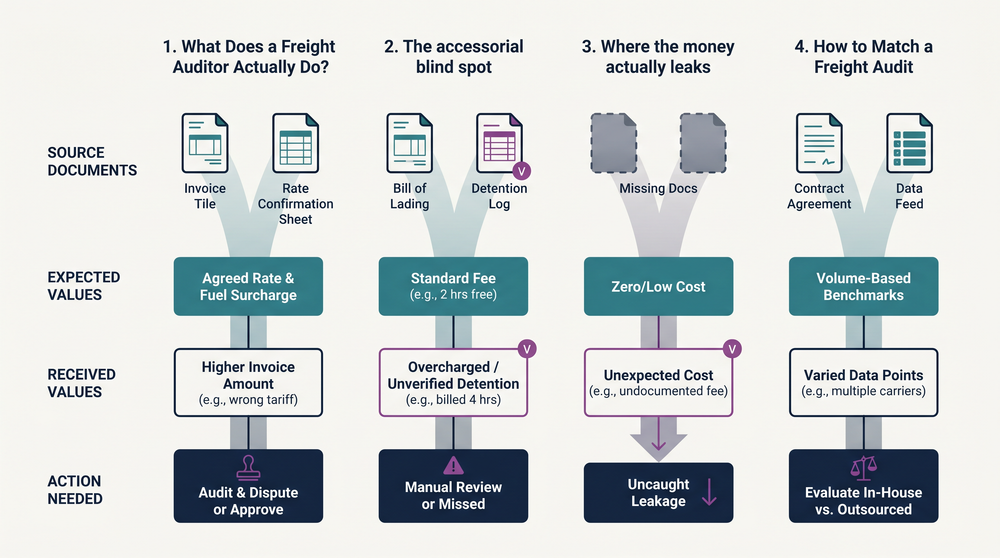
A freight auditor reviews carrier invoices against rate confirmations, bills of lading, and proof of delivery documents to verify that every charge matches the contracted terms. The goal is to catch billing errors before payment goes out. Core responsibilities include:
- Rate accuracy verification: matching the invoiced linehaul, fuel surcharge, and accessorial charges against the rate con
- Duplicate charge detection: flagging invoices submitted more than once for the same load
- Accessorial validation: confirming that detention, lumper, layover, and TONU charges have proper documentation (timestamps, signed receipts, BOL annotations)
- GL code assignment: ensuring charges are categorized correctly for accounting and cost analysis
- Claims resolution: managing disputes with carriers when discrepancies are found
That is the standard pitch. Here is what most freight audit companies actually miss in practice.
The accessorial blind spot
Most audit providers are built around linehaul rate verification. They are good at matching an invoiced rate against a rate con. But accessorial charges (detention, lumper fees, TONU, layover, dry run, drayage surcharges) require a different kind of verification. You cannot just match a number to a contract. You need to cross-reference timestamps on the BOL and POD, check for signed lumper receipts, and validate that the accessorial even qualifies under the contracted terms. According to Trimble Transportation's freight audit insights, freight auditing helps teams understand true transport costs and evaluate carriers more effectively, but that only works if the audit actually covers the full invoice, not just the linehaul. Many mid-market brokers find that their audit company catches rate discrepancies but waves through accessorial charges because manual document review is too labor-intensive for the provider's margin model.
Where the money actually leaks
If you are a broker processing 500 to 2,000 loads per month, your biggest exposure is probably not on linehaul. It is on the 15 to 30 accessorial line items that show up across those loads each week: a detention charge without matching timestamps, a lumper fee without a signed receipt, a fuel surcharge calculated against the wrong base rate. These are the charges that compound. A $50 overcharge on a single load is easy to ignore. That same $50 overcharge across 200 loads per month is $10,000 per month, or $120,000 per year. When evaluating freight audit companies, the first question is not "what do you catch?" It is "show me exactly which line items you verify, and which ones you pass through." If you want a primer on which invoice line items deserve attention first, start there before you even talk to a vendor.
How to Match a Freight Audit Company to Your Shipment Volume
The freight audit and payment market is growing fast. Per Mordor Intelligence's market sizing report, the freight audit and payment market is estimated at USD 0.97 billion in 2025 and is expected to reach USD 1.89 billion by 2030, at a CAGR of 14.2%. That growth means more options for brokers, but also more noise. Not every provider is built for your volume tier.
Under 500 loads per month
At this volume, most enterprise-grade freight audit companies will not give you priority. Their pricing models assume high volume, and their SLAs reflect that. You are better served by either a specialized SMB audit provider or by building an in-house process with software assistance. The math: if your average linehaul is $1,200 and your total freight spend is around $600,000 per month, even a 2% overbilling rate means $12,000 per month in exposure. That is enough to justify a dedicated review process, but probably not enough to attract premium audit firms that target $5M+ monthly spend.
500 to 2,000 loads per month
This is the sweet spot where freight audit companies compete hardest for your business. Your spend is large enough to generate meaningful recoveries (which funds their percentage-based fees), but you are probably still running lean enough that you do not have a full-time audit team in-house. At this tier, prioritize providers who offer TMS integration (not just CSV uploads), accessorial-level auditing (not just linehaul), and a clear SLA with turnaround times measured in hours, not days. Ask for a sample audit report from a client at similar volume. If they cannot produce one, that tells you something.
Over 2,000 loads per month
At high volume, the economics shift. You can likely justify a full-time billing coordinator or even a small audit team. The question becomes whether an external audit company catches enough incremental errors beyond what your team finds to justify the fee. Many brokers at this tier use a hybrid model: in-house team for first-pass reconciliation, external audit for exception handling and carrier dispute resolution. Gartner's freight audit and payment provider reviews can help you compare enterprise-grade options, but read the verified reviews carefully. Star ratings do not tell you which accessorial categories a provider actually audits.
Where Freight Audit Companies Fall Short on Accessorials and Detention
Accessorial charges are where freight billing discrepancies hide in plain sight. Detention, lumper fees, TONU, and fuel surcharges all require document-level verification that many audit companies skip or handle inconsistently. Let's walk through the most common failures.
Lumper fees without receipts
Scenario: A carrier adds a $250 lumper charge to invoices. This happens on 60 loads per month. None of the invoices include a signed lumper receipt, and there is no BOL annotation confirming the lumper was required or used. That is $3,000 per month ($36,000 per year) in completely unverified charges. A basic freight audit that only checks rate con versus invoice will not catch this, because the lumper fee is an add-on that requires a separate document (the signed receipt) to validate. If your audit company does not have a process for requesting and verifying lumper receipts, those charges sail through every time.
Detention billing without timestamp proof
Scenario: A carrier bills 3 hours of detention at $75 per hour ($225 per load). But when you pull the BOL and POD timestamps, the actual wait time was only 1.5 hours. The legitimate charge is $112.50, meaning the carrier overbilled by $112.50 on that single load. Now scale it: if 5% of your 800 monthly loads carry detention charges with inflated hours, that is 40 loads per month. At $112.50 in overage per load, your monthly exposure is $4,500, or $54,000 per year. Catching this requires someone (or something) to actually pull the timestamps from the BOD and POD and compare them against the billed hours. Most freight audit companies flag detention charges that exceed a dollar threshold, but fewer actually verify the underlying time documentation. The Federal Motor Carrier Safety Administration (FMCSA) tracks detention as a systemic industry issue. For context on how large carriers operate under FMCSA oversight, as of 05/30/2026, JB Hunt Transport Inc's operating status was AUTHORIZED FOR Property, HHG (SAFERWEB, USDOT 264184), and the company holds a Satisfactory FMCSA safety rating as of 02/20/2003 (SAFERWEB, USDOT 264184). Even top-rated carriers can have invoicing errors, especially on accessorials. The issue is systemic, not about bad actors.
TONU overcharges above rate con caps
Scenario: Your rate con caps TONU charges at $150. But carriers bill $300 to $450 per incident, knowing that in a manual reconciliation process, the billing coordinator may not cross-reference each TONU against the specific rate con. If you see 10 to 15 TONUs per month, and the average overage is $200 per incident, your monthly exposure is $2,000 to $3,000. An automated system that flags any TONU charge exceeding the rate con cap catches this instantly. A manual process? It depends on whether the billing coordinator has time to open the rate con for every single TONU, which at 11 hours per week of total reconciliation work, they probably do not.
Fuel surcharge miscalculations
Scenario: Your contract specifies that the fuel surcharge is calculated as a percentage of the net linehaul rate. The carrier applies 28% against the gross linehaul instead. On a $1,400 gross linehaul where the contracted net rate is $1,250, the difference looks like this: 28% of $1,400 = $392. 28% of $1,250 = $350. That is a $42 overcharge per load. Across 200 loads per month, it compounds to $8,400 per month, or $100,800 per year. This type of freight overbilling is subtle. The fuel surcharge percentage itself is correct. The base rate it is applied against is wrong. Catching it requires the audit to reference the specific contract language, not just the surcharge table. Many audit companies verify the FSC percentage but do not validate whether the carrier applied it to the correct base figure.
Red Flags to Catch Before You Sign an Audit Contract
Not all freight audit contracts are structured to protect you. Here are the specific clauses and terms that should make you pause before signing.
SLA language that buries exceptions
Example: An audit company's SLA promises a 72-hour turnaround on invoice reviews. That sounds tight. But buried in the contract appendix, there is a clause allowing 10 business days for "accessorial disputes requiring additional documentation." Since accessorial disputes are where most of your money leaks, that 72-hour promise covers the easy stuff (linehaul matching), while the hard stuff (detention verification, lumper receipt requests) gets pushed to a timeline that may exceed your carrier payment terms. If your carrier payment terms are net 30 and an accessorial dispute takes 10 business days just to initiate, you are paying the carrier before the dispute is even opened. That means you are chasing refunds instead of withholding payment, which flips the leverage entirely.
Percentage-of-recovery fee structures without a cap
Many freight audit companies charge 25% to 30% of recovered overcharges. On the surface, this seems aligned: they only get paid when they save you money. But without a cap or a declining scale, this model can get expensive fast. If they recover $200,000 in overcharges in a year, a 28% fee means you are paying $56,000 for the audit service. At that point, you need to ask: could you have caught 60% to 70% of those errors with a $28-per-hour billing coordinator and the right software? We will do that math in the next section. Also watch for "minimum recovery fees" that guarantee the audit company a payment even if they find nothing. That shifts risk entirely onto you. If you need a quick checklist for catching carrier billing errors before you even engage a third party, start there.
No integration with your TMS or accounting system
If the audit company requires you to export CSVs, email invoice PDFs, or manually upload documents to their portal, you are adding labor to a process that is supposed to save you time. The best freight audit providers connect directly to your TMS via API, pull invoices and rate cons automatically, and push resolved exceptions back into your workflow. If the provider's "integration" is a shared Dropbox folder, that is a red flag. You will spend hours per week feeding their system, which defeats the purpose.
Vague reporting with no line-item detail
Ask to see a sample monthly report before you sign. If the report shows "total recovered: $14,200" without breaking it down by category (linehaul, detention, lumper, FSC, TONU, duplicates), you have no way to evaluate what the audit is actually catching. You need line-item detail to know whether the audit is finding real errors or just flagging easy wins while missing the expensive stuff.
In-House vs. Outsourced Freight Auditing: The Real Trade-Offs
This is where most guides get vague. Let's put real numbers on it.
The cost of in-house auditing
Example: Your billing coordinator spends 11 hours per week on manual invoice reconciliation. At a fully loaded cost of $28 per hour (salary plus benefits plus overhead), that is $308 per week, or $16,016 per year in labor dedicated to carrier invoice review. What does that 11 hours actually cover? Typically: pulling carrier invoices from email or a portal, matching them against rate cons in the TMS, checking for obvious overcharges on linehaul, occasionally verifying an accessorial charge when something looks off, and entering approved amounts for payment. What it usually does not cover: systematic verification of every accessorial line item, fuel surcharge base rate validation, timestamp cross-referencing for detention, or lumper receipt verification. In other words, $16,016 per year buys you linehaul matching and spot-checks. It does not buy you a comprehensive freight audit.
The cost of outsourced auditing
Using a percentage-of-recovery model at 28%, here is what different recovery levels cost you: If the audit company recovers $50,000 per year, your fee is $14,000. If they recover $100,000, your fee is $28,000. If they recover $200,000, your fee is $56,000. The break-even question: at what point does the outsourced audit cost more than the in-house labor? If your in-house billing coordinator costs $16,016 per year, the outsourced audit breaks even when recoveries hit approximately $57,200 (since 28% of $57,200 ≈ $16,016). Below $57,200 in recoveries, in-house is cheaper. Above it, you are paying more for the audit company than you would for the labor. But, and this is the critical nuance, the audit company should be catching errors that the billing coordinator misses entirely. If the coordinator catches $30,000 in errors and the audit company catches $100,000, paying $28,000 for the audit still nets you $72,000 versus $30,000 from in-house effort alone. The question is not which is cheaper in absolute terms. It is which catches more relative to its cost.
The hybrid approach
The most effective model for brokers in the 500 to 2,000 loads per month range is usually a combination: use software to automate first-pass reconciliation (rate con matching, duplicate detection, threshold-based accessorial flags), then route exceptions to either an in-house coordinator or an external audit service. This approach keeps your labor costs focused on judgment calls, not data entry, and ensures that the easy catches do not eat up expensive audit-company hours. As Inbound Logistics notes in their coverage of freight bill audit and payment, the key to supply chain clarity is a structured audit process, not just throwing bodies or vendors at the problem. If you are still weighing whether to audit at all, the real cost of skipping a freight audit might sharpen your decision.
The question is not 'which is cheaper?' It is 'which catches more relative to its cost?' A $16,016 in-house process that misses $70,000 in accessorial errors is not actually saving you money.
Laneproof's reconciliation engine checks each of these fields automatically, flagging variances before payment goes out. It covers linehaul matching, accessorial validation against supporting documents, fuel surcharge base rate verification, and duplicate detection, so your billing coordinator focuses on resolving exceptions instead of hunting for them.
Putting It All Together: ROI Calculation Template

Here are three concrete scenarios to help you benchmark your own situation.
Example 1: Detention overbilling baseline
Scenario: A broker processes 800 loads per month at an average linehaul of $1,400. Detention overbilling occurs at a rate of 4.2% of total freight spend. Monthly freight spend: 800 × $1,400 = $1,120,000 Annual freight spend: $13,440,000 Annual detention overbilling at 4.2%: $13,440,000 × 0.042 = $564,480 in total detention charges If even 8.3% of those detention charges are overbilled (inflated hours, missing documentation), that is roughly $47,000 per year in recoverable overpayments. At a 28% audit fee, recovering that $47,000 costs you $13,160, netting $33,840 in savings.
Example 2: Unverified lumper fees
Scenario: A $250 lumper charge appears on 60 invoices per month with no signed receipt and no BOL annotation confirming the service. Monthly unverified lumper exposure: 60 × $250 = $15,000 Annual unverified lumper exposure: $180,000 Not all of these are fraudulent. Some are legitimate charges where the paperwork was simply not attached. But if 30% turn out to be invalid upon document request, that is $54,000 per year in charges you should not be paying. The first step is not even auditing. It is requiring signed lumper receipts as a condition of payment. Any freight audit company that does not enforce this document requirement is leaving money on the table.
Example 3: Fuel surcharge base rate error
Scenario: A carrier applies a 28% fuel surcharge against the gross linehaul ($1,400) instead of the contracted net rate ($1,250). Overcharge per load: ($1,400 × 0.28) minus ($1,250 × 0.28) = $392 minus $350 = $42 At 200 loads per month: 200 × $42 = $8,400 per month Annual exposure: $100,800 This is a single billing error on a single contract term, and it generates six figures in annual overcharges. An audit that only verifies the FSC percentage (28%, correct) without checking the base rate ($1,400 gross vs. $1,250 net) will miss this entirely. When you evaluate freight audit companies, ask specifically: "Do you validate the base rate used for fuel surcharge calculations, or only the percentage?" If they hesitate, you have your answer.
Frequently Asked Questions About Freight Audit Companies
What does a freight auditor do?
A freight auditor reviews every carrier invoice against the rate confirmation, bill of lading, and proof of delivery to verify that charges match contracted terms. This includes linehaul rate verification, fuel surcharge validation, duplicate charge detection, and accessorial review for items like detention, lumper fees, and TONU. The goal is to catch freight billing discrepancies before payment, not after. Per FreightWaves, a freight invoice audit reviews, verifies, and corrects freight invoices to ensure companies only pay for legitimate, agreed-upon charges.
How much do freight audit companies charge?
Most freight audit companies use one of two models: a percentage of recovered overcharges (typically 25% to 30%) or a flat per-invoice fee ($1.50 to $5.00 per invoice). The percentage model means you only pay when savings are found, but costs can escalate quickly if your overbilling exposure is high. A flat-fee model gives you predictable costs but does not align the provider's incentive with your savings. At 800 loads per month with a per-invoice fee of $3.00, you would pay $2,400 per month ($28,800 per year) regardless of what the audit finds.
When should a broker outsource freight auditing versus doing it in-house?
The break-even point depends on your billing coordinator's fully loaded cost and your total overbilling exposure. If your in-house reconciliation labor costs $16,016 per year and an outsourced audit at 28% of recoveries costs $14,000 per year (based on $50,000 in recoveries), outsourcing is cheaper and catches more. But if your exposure is under $40,000 per year, the in-house approach with software support is usually more cost-effective. The hybrid model (software for first-pass automation, human review for exceptions) tends to be the best fit for brokers in the 500 to 2,000 loads-per-month range.
What SLA turnaround time should I expect from a freight audit company?
For linehaul rate verification, expect 24 to 48 hours. For accessorial disputes that require document retrieval (detention timestamps, lumper receipts), 3 to 5 business days is reasonable. Be wary of any SLA that promises a single turnaround time for all invoice types. Linehaul matching is fast. Accessorial verification is not. Make sure the contract specifies separate SLAs for each category, and confirm that accessorial dispute timelines fit within your carrier payment terms.
Do freight audit companies integrate with TMS platforms?
The better ones do. Look for API-based integrations with your TMS that pull invoices and rate cons automatically and push resolved exceptions back into your payment workflow. Providers that rely on manual uploads (CSV exports, emailed PDFs, portal submissions) add labor to your process instead of removing it. Before signing, ask for a technical spec on their integration with your specific TMS. If they support "custom integrations" only, budget 4 to 8 weeks for setup and expect ongoing maintenance.
The Bottom Line on Choosing a Freight Audit Company
Freight audit companies are not all built the same. The difference between a provider that saves you $30,000 per year and one that saves you $150,000 comes down to whether they audit accessorials at the document level, integrate with your TMS without adding manual work, structure SLAs that match your payment terms, and provide reporting with enough detail to show you exactly what they catch and what they miss.
Before you sign with any provider, run the numbers from this guide against your own load volume, average linehaul, and accessorial exposure. You may find that a freight bill audit process using the right software catches 70% of errors at a fraction of the cost of a full-service audit company.
If you want to see what automated invoice reconciliation looks like for your specific volume tier, Laneproof's plans are built for brokers running 100 to 5,000 loads per month, with line-item accessorial verification included at every level. No percentage-of-recovery fees. No buried SLA exceptions.
Sources
- Freight Invoice Audits and Why They Matter — FreightWaves
- Freight Audit Insights: The Truth About Freight Spend — Trimble Transportation
- Best Freight Audit and Payment Providers Reviews 2026 — Gartner
- Freight Audit and Payment Market Size & Growth to 2030 — Mordor Intelligence
- Freight Bill Audit & Payment: The Key to Supply Chain Clarity — Inbound Logistics
- SAFERWEB Carrier Data — JB Hunt Transport Inc — FMCSA
Related: Freight Audit and Payment Jobs: What These Roles Actually Catch
Related: Freight Audit Software for Brokers: What Actually Recovers Money
Related: Freight Auditor Salary vs. Software: What SMB Brokers Actually Pay