Detention Charges Calculator: Build the Number Yourself
Researched and written with AI assistance. Reviewed by the Laneproof team.

A single detention invoice for $450 hits your inbox. The carrier says the driver sat at the shipper dock for 6 hours. Your BOL says otherwise. But without a detention charges calculator you can run yourself, you are stuck choosing between paying the bill or spending 45 minutes digging through timestamps, rate cons, and carrier packets to prove the number is wrong. Most ops teams pay the bill. According to Fleetworks' accessorial charges guide, detention rates generally range from $50 to $100 per hour, varying significantly by carrier and region. That means a single miscalculated hour costs you $50 to $100. Across 200 loads a month, even a 5% overbill rate on detention adds up to thousands of dollars walking out the door. This guide gives you the formula, the free time thresholds, the tiered rate structures, and the dispute method to build your own number from scratch, no carrier-specific tool or booking number required.
What Is a Detention Charge and Why Your Invoice Is Probably Wrong
A detention charge is a fee assessed when a truck or container is held beyond the allotted free time at a pickup or delivery location. In trucking, detention typically starts after the driver checks in at the dock and the free time window expires. For containers, detention applies when equipment is kept outside the port or terminal beyond the carrier's allowed number of free days.
The concept is simple. The billing rarely is. According to Shapiro's detention and demurrage resource, detention charges are calculated based on the number of days (or hours) a container or trailer is held beyond free time, multiplied by the applicable rate. The formula looks clean on paper: (Time Beyond Free Time) × (Rate) = Total Detention Charge. But when the carrier controls the clock and the rate, and you do not have your own calculation to compare against, you are trusting their math.
Here is where it goes wrong:
- The carrier starts the detention clock at driver arrival, not at the scheduled appointment time
- Free time thresholds vary by carrier, facility, and lane type, but invoices do not specify which threshold was applied
- Tiered rate escalation means the hourly or daily rate increases the longer detention lasts, and those tiers are often buried in the carrier packet
- Fuel surcharges, weekend premiums, or accessorial stacking get added on top without rate con authorization
The Federal Maritime Commission (FMC) addressed some of these issues with its Interpretive Rule on detention and demurrage practices, effective May 2024. The rule requires ocean carriers and marine terminal operators to clearly define free time, provide transparent billing, and ensure that detention charges serve their intended purpose of incentivizing cargo movement rather than functioning as a revenue tool. For brokers and ops managers working intermodal or port drayage lanes, referencing this rule gives you a regulatory foothold in any written dispute. If you want a deeper breakdown of how carriers exploit these gray areas, read how carriers overbill on detention and how to fight back.
How to Calculate Detention Charges: The Formula and a Worked Example
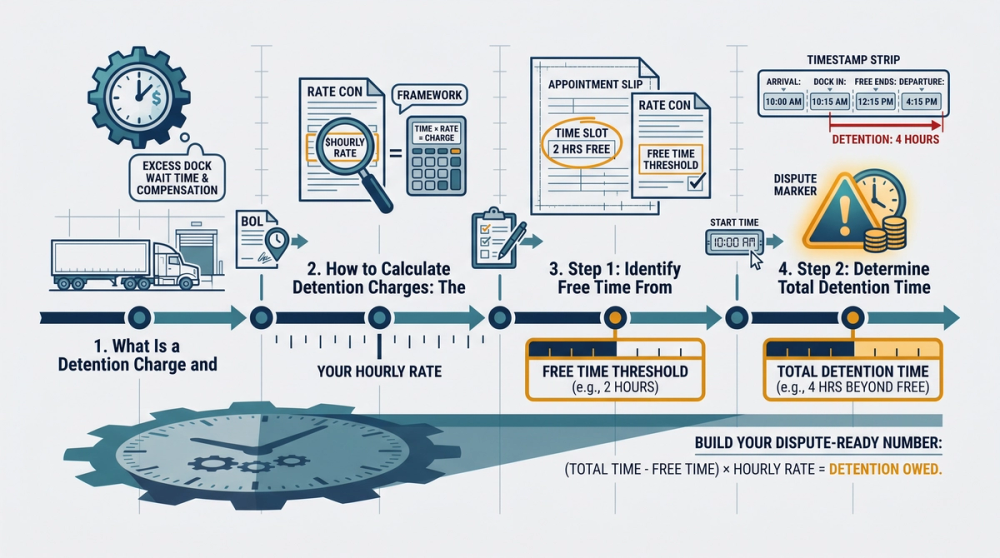
Every detention calculation follows the same core structure, whether you are dealing with a truckload sitting at a receiver dock or a container parked outside a port. The formula is:
(Total Detention Time − Free Time) × Applicable Rate = Detention Charge
The variables change depending on the carrier, the rate con, and the facility. But the structure does not. Here is how to apply it step by step.
Step 1: Identify Free Time From Your Rate Con or Carrier Packet
Your rate confirmation or carrier agreement will specify free time, usually in hours for truckload and in calendar days for containers. If it does not, your carrier packet or tariff schedule should. Common truckload free time is 2 hours. Container free time depends on the steamship line and port, typically ranging from 3 to 5 calendar days. Write this number down. It is the starting point for every calculation.
Step 2: Determine Total Detention Time Using BOL and Driver Timestamps
Pull the check-in time from the BOL, the facility log, or the driver's ELD data. Then pull the check-out or gate-out time. The difference is total time at the facility. For containers, use the gate-out date from the terminal and the return date. These timestamps are your evidence. Without them, you have no dispute.
Step 3: Apply the Rate
Your rate con should list the detention rate, either per hour or per day. If the rate con is silent on detention, the carrier packet or tariff schedule governs. Per Drip Capital's detention calculation guide, a sample carrier rate of $75 per day provides a baseline, though rates for truckload detention commonly run $50 to $100 per hour depending on market and region.
Example: Truckload detention at a shipper dock
- Rate con free time: 2 hours
- Driver check-in (per BOL): 08:00
- Driver released (per facility log): 12:30
- Total time at facility: 4 hours 30 minutes (4.5 hours)
- Billable detention time: 4.5 − 2.0 = 2.5 hours
- Rate con detention rate: $75/hour
- Total detention owed: 2.5 × $75 = $187.50
This is the number you put on paper. If the carrier invoices $225 for the same load, you now have a documented calculation that shows a $37.50 discrepancy, and you have the timestamps to back it up.
Free Time Is Not Standard: Here Is What It Actually Looks Like by Lane Type
One of the most common mistakes ops teams make is assuming free time is the same everywhere. It is not. Free time thresholds vary by carrier, facility type, lane type, and even by specific shipper agreements. According to Terminal Industries' guide on detention charges, free time represents the grace period a carrier allows before detention charges begin accruing, and that period is anything but universal.
Free Time by Lane Type: A Side-by-Side Comparison
- Standard truckload (dry van, reefer): 2 hours is the most common free time window. Some carriers offer 1 hour; a few high-volume shippers negotiate 3 hours.
- Intermodal drayage: Pickup windows are often tighter. 1 hour of free time at the ramp is typical. Miss it by 30 minutes and you are looking at $37.50 to $50 in detention at standard rates.
- Port container pickup: Steamship lines typically provide 3 to 5 calendar days of free time, varying by port, trade lane, and container type. Hapag-Lloyd, for instance, publishes a detention and demurrage calculator that lets importers check container-specific free time by booking number.
- Transload facility: Free time is often 90 minutes. These facilities handle high volumes with tight scheduling, and detention accrues quickly once the window closes.
The 30-Minute Miss That Costs Real Money
Consider a drayage driver who arrives at an intermodal ramp with 1 hour of free time. The facility is backed up. The driver clears the gate 90 minutes after check-in. That is 30 minutes of billable detention. At $75/hour, the charge is $37.50. Across 80 drayage loads a month, if even 10% of them run 30 minutes over, that is $300/month in detention on half-hour overages alone. Most teams do not catch these because the amounts feel small on individual invoices. They are not small at scale.
For a deeper look at what you are actually paying per day on container detention across major carriers, see container detention charges per day.
How Detention Rates Escalate Across Billing Tiers (And What Carriers Count On You Missing)
Flat-rate detention is becoming less common, especially for container and intermodal moves. Many carriers now use tiered rate structures where the daily or hourly rate increases the longer the equipment is held. This is where carriers make their real margin on detention, because most brokers and ops managers calculate using the Tier 1 rate and never check whether the invoice reflects escalation.
Tiered Rate Escalation Example: 12-Day Container Detention
Here is a real-world tiered structure pulled from a common carrier tariff:
- Days 1 to 4: $150/day
- Days 5 to 9: $200/day
- Days 10+: $250/day
Now apply this to a container held for 12 days beyond free time:
- Days 1 to 4: 4 × $150 = $600
- Days 5 to 9: 5 × $200 = $1,000
- Days 10 to 12: 3 × $250 = $750
- Total: $2,350
If you had calculated this at a flat $150/day (the Tier 1 rate), your estimate would have been $1,800. The actual tiered total is $2,350, a difference of $550. Now flip it: if the carrier invoices $2,350 and you assumed $1,800, you might dispute a legitimate charge. Or worse, if they invoice $2,600 using incorrect tier boundaries, you would not catch the $250 overbill without running the tiers yourself.
Per C.H. Robinson's detention and demurrage guide, proactive management of these charges requires understanding the specific tier structures in each carrier agreement before the invoice arrives. Do not wait for the bill to learn how escalation works.
Demurrage vs. Detention: Where Tiers Overlap
Tiered escalation applies to both demurrage (charges for container sitting inside the port/terminal) and detention (charges for container held outside the port). Some carriers stack both, meaning you could be paying demurrage on days the container sat at the port waiting for pickup AND detention on days it sat at your warehouse after pickup. The total bill combines two separate tiered calculations. If you are dealing with both charges on the same shipment, review our guide to demurrage and detention charges for a walkthrough on separating and auditing each.
Building a Dispute-Ready Detention Number From Your BOL and Rate Con
Calculating the number is only half the job. Making it dispute-ready means documenting every input so the carrier cannot push back on your math. Here is how to build a number that holds up.
What You Need Before You Start
- Rate confirmation: Must show the agreed detention rate and free time. If it is silent, pull the carrier packet or tariff schedule.
- BOL with timestamps: Check-in and check-out times at the facility. If the BOL does not have them, use facility gate logs or ELD data.
- Carrier detention invoice: The line-item bill you are disputing.
- Facility appointment confirmation: If the driver had a scheduled appointment, the confirmation email or dispatch note matters.
Dispute Scenario: Late Arrival Knocks Out Free Time
Scenario: A carrier invoices $450 in detention on a truckload delivery. The rate con specifies 2 hours of free time and a $75/hour detention rate. The carrier's invoice shows 6 hours of billable detention (8 hours at dock minus 2 hours free time). But the BOL timestamp shows the driver arrived 18 minutes late to a scheduled appointment.
Here is what happened: the facility started the detention clock at the scheduled appointment time (10:00 AM), not the driver's actual arrival (10:18 AM). The driver was not in the queue during those 18 minutes. The facility then held the driver until 6:18 PM. But the carrier billed as if the driver arrived at 10:00 AM and the full 8 hours counted.
Your calculation:
- Actual arrival: 10:18 AM
- Actual release: 6:18 PM
- Total time at facility: 8 hours
- Free time: 2 hours
- But: the first 18 minutes of facility time are attributable to driver lateness, not shipper/receiver delay. Many rate cons specify that free time begins at the scheduled appointment or actual arrival, whichever is later. If the driver arrived late, free time starts at arrival, not at appointment time.
- Adjusted billable time: 8 hours − 2 hours free time = 6 hours. However, the carrier also should not bill the 18-minute gap. Depending on rate con language, this can reduce billable hours.
- Dispute position: reduce billable detention from 6 hours to 3 hours (accounting for appointment window and rounding per rate con terms)
- Disputed charge: 3 × $75 = $225 (vs. carrier's $450)

That is $225 saved on a single load. The key evidence: the BOL timestamp proving late arrival and the rate con language defining when the clock starts.
Dry Run vs. Detention: Catching Double Billing
Scenario: A carrier invoices $300 as a TONU (truck ordered, not used) on a load that was cancelled, and also invoices $300 in detention for the same load, claiming the driver waited at the shipper dock before the cancellation.
This is double billing. A TONU applies when a load is cancelled after dispatch but before pickup. Detention applies when the driver is at the facility and waiting. They can overlap in rare circumstances, but they should not both be billed at full rate for the same time window. Check the rate con: it will typically define TONU as a flat fee for a cancelled load, separate from any detention accrued during wait time. If the load was cancelled and the driver left, the TONU covers the carrier's cost. Detention on top of that for the same time period is a $300 overbill.
Fuel Surcharge Stacked on Detention: Is It Authorized?
Scenario: A carrier adds a 12% fuel surcharge on top of a $600 detention invoice, bringing the total to $672. That $72 add-on seems small, but is it contractually valid?
Check the rate con. Most rate confirmations define fuel surcharges as applying to linehaul charges only. Detention is an accessorial, not linehaul. Unless the rate con or carrier packet explicitly states that fuel surcharges apply to accessorial charges including detention, the $72 is not authorized. Flag it. As of 2026-05-01, the Producer Price Index for truck transportation of freight stood at 178.2 (BLS, PPI series WPU3012), meaning fuel-related costs are a real factor in carrier pricing. But that does not mean every accessorial gets a fuel surcharge applied. The rate con governs.
How to Reduce Detention Charges Before the Clock Even Starts
The cheapest detention charge is the one that never accrues. Per Vizion API's guide on calculating and mitigating demurrage and detention, the most effective approach to detention management is proactive: calculate last free days in advance, set alerts, and build operational habits that prevent charges from starting.
Operational Tactics That Actually Work
- Confirm appointments 24 hours in advance. Dock congestion is the leading cause of detention in truckload. A confirmed appointment with a specific dock number reduces wait time.
- Track free time expiration dates for every container. As of 2026-05-01, average hourly earnings in truck transportation were $32.26/hr (BLS, Current Employment Statistics series CEU4348400008). Every hour a driver sits idle costs both parties. Know when free time expires and schedule pickups accordingly.
- Negotiate free time in the rate con, not after the fact. If your facility averages 3 hours of unload time, negotiate 3 hours of free time upfront. Asking for a retroactive adjustment after the invoice arrives is a losing position.
- Set up automated alerts. Technology solutions like CocoonDEM's demurrage and detention platform offer real-time container tracking with proactive alerts before free time expires. Even a simple calendar reminder system helps.
- Document everything at the facility. Gate-in/gate-out times, dock assignment delays, lumper coordination wait times. If a dispute arises, your documentation is your leverage.
FMCSA and FMC: Know Your Regulatory Footing
The FMCSA regulates trucking operations and driver hours, which indirectly affects detention time and who controls the clock. If a driver is approaching HOS limits because of excessive detention, the shipper or receiver may bear liability. On the ocean freight side, the FMC's Interpretive Rule on detention and demurrage (effective May 2024) requires carriers to clearly define free time, provide transparent invoicing, and ensure charges incentivize cargo movement. In any written dispute, citing the applicable FMCSA or FMC regulation signals to the carrier that you know the rules and are prepared to escalate.
Frequently Asked Questions About Detention Pay and Carrier Invoices
How do you calculate detention charges?
Subtract the free time from the total time the driver or container was held, then multiply by the applicable rate. The formula is: (Total Detention Time − Free Time) × Rate = Detention Charge. For example, 4.5 hours at a dock with 2 hours of free time at $75/hour equals $187.50 in detention. Always pull your inputs from the BOL timestamps and rate con, not from the carrier's invoice.
How much are detention charges?
For truckload, detention rates typically range from $50 to $100 per hour, according to Fleetworks' 2025 accessorial charges guide. Container detention rates vary by steamship line and port, commonly running $75 to $250 per day with tiered escalation. The actual cost depends on your rate con, the carrier's tariff, and how long the detention lasts.
How do you reduce detention charges?
Confirm dock appointments in advance, negotiate longer free time windows in your rate con, track container free time expiration dates, and document all facility timestamps. The biggest savings come from catching charges that should not have been billed at all, including double-billed TONUs, unauthorized fuel surcharges on accessorials, and incorrect clock start times.
What is the difference between detention and demurrage?
Detention applies when a container or trailer is held outside the port or terminal beyond free time (e.g., at your warehouse). Demurrage applies when a container sits inside the port or terminal beyond free time. Both use similar calculation formulas but come from different parties and have different rate structures. On the same shipment, you can be billed for both.
Can you dispute a carrier detention invoice?
Yes. Build your own calculation using BOL timestamps, the rate con detention rate, and the applicable free time threshold. Compare your number to the carrier's invoice line by line. If the numbers do not match, send a written dispute with your calculation, supporting documents (BOL, facility logs, rate con), and a reference to any applicable FMCSA or FMC regulation. Most carriers will negotiate when presented with documented evidence.
Conclusion: Your Number, Your Proof
Every detention invoice is a math problem. The carrier has their version of the inputs. Now you have a framework to build your own. Pull the free time from the rate con. Pull the timestamps from the BOL. Run the formula. Check for tiered escalation, unauthorized surcharges, and clock start discrepancies. The number you calculate is the number you dispute with.
If you process more than 50 carrier invoices a week, running these calculations manually gets unsustainable. Tools that automatically match invoices against rate confirmations can flag detention discrepancies before you pay them, catching the overbills covered in this guide without the spreadsheet work.
But whether you run the numbers by hand or with software, the principle is the same: never pay a detention invoice you have not calculated yourself.
Sources
- Accessorial Charges in Freight: Complete Guide for 2025 — Fleetworks
- Detention and Demurrage Charges — Shapiro
- What is Demurrage and Detention in the Shipping Industry? — Drip Capital
- Detention & Demurrage Guide — C.H. Robinson
- Detention Charges in Logistics: Causes, Costs & Reduction Tips — Terminal Industries
- The Basics of D&D: Demurrage Calculation & More — Vizion API
- Detention and Demurrage Calculator — Hapag-Lloyd
- Demurrage & Detention Calculator — CocoonDEM