Container Detention Charges Per Day: What You're Actually Paying
Researched and written with AI assistance. Reviewed by the Laneproof team.
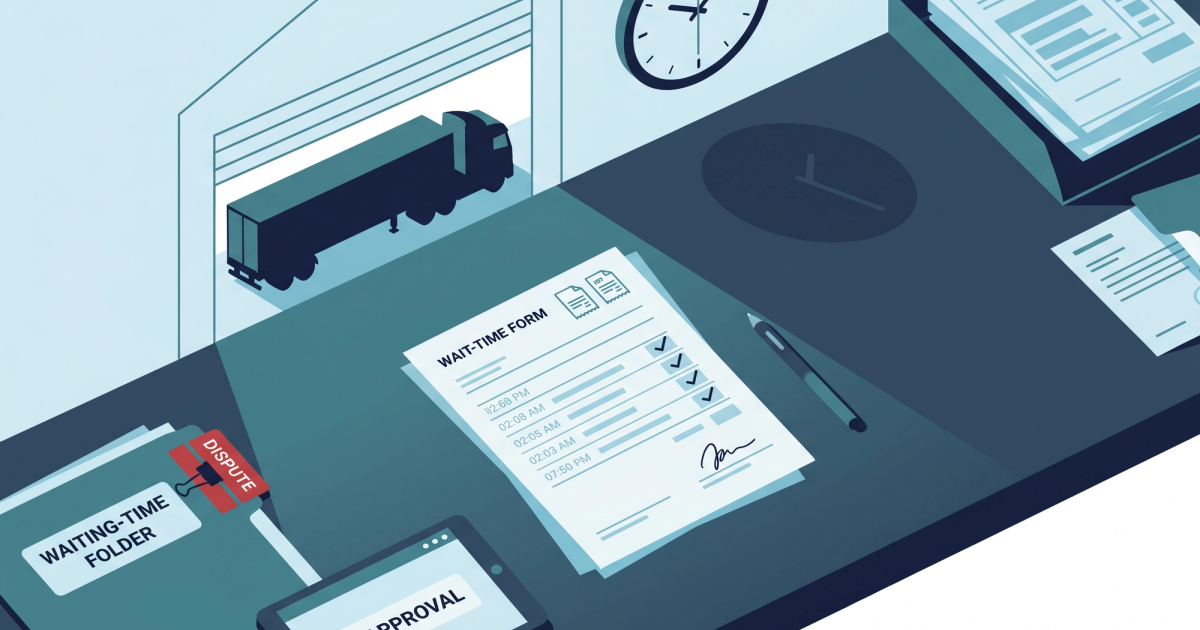
Container detention charges per day range from $75 to $300 for most ocean carriers in 2025, according to current detention and demurrage fee data from Yardview. Some carriers push that to $350 per day after 10 days. That's not the problem. The problem is that carriers routinely bill more days than you actually used. They miscount free time, ignore early returns, and apply flat rates instead of tiered ones. In our review of carrier invoices at Laneproof, the most common detention overbilling issue isn't a wrong daily rate. It's a wrong day count. A single miscounted day at $250 is easy to miss on a busy Monday morning. Multiply that across 20 containers a month and you're looking at $5,000 in charges you never owed.
What Container Detention Charges Per Day Actually Cover (And What They Don't)
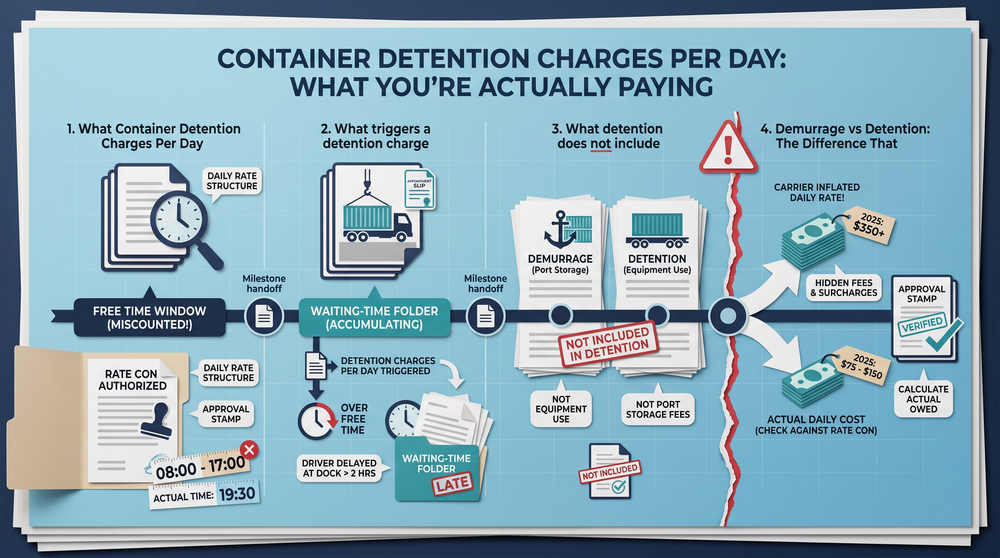
Container detention is the daily fee a carrier charges when you hold their container outside the port or terminal beyond the allotted free time. According to Shapiro's breakdown of detention and demurrage charges, the charge is calculated by multiplying the number of days beyond free time by the carrier's daily rate. That's it. It's rent on the box.
What detention does not cover: port storage (that's demurrage), chassis rental, per diem fees charged by the terminal itself, or any accessorial tied to loading and unloading. If a carrier invoice lumps chassis fees into a detention line item, that's a red flag. If it includes charges for days the container was at the port rather than at your warehouse, that's demurrage mislabeled as detention.
What triggers a detention charge
The clock starts when the container is picked up from the port (gate-out) or, in some carrier tariffs, when the container is first available for pickup. This distinction matters enormously. If a vessel is delayed 48 hours and the carrier starts free time at "first available" instead of gate-out, you're burning free time days before you've even touched the container. More on that calculation below.
The clock stops when the empty container is returned to an approved depot and scanned in. Not when your driver drops it at the gate. Not when the trucker calls dispatch and says it's done. When the terminal system records the return. If the terminal gate closes at 4pm and your driver arrives at 4:15pm, the container isn't returned until the next business day. That's an extra day of detention at $150 to $300.
What detention does not include
- Demurrage (storage charges while the container sits at the port or terminal)
- Chassis rental or usage fees billed separately by chassis pools
- Per diem charges from terminals (which are sometimes different from carrier detention)
- Lumper fees, TONU, or any other accessorial unrelated to container holding time
If any of these show up on a detention invoice line, you have grounds to challenge it. Understanding exactly how carriers overbill on detention charges starts with knowing what the charge is supposed to cover.
Demurrage vs Detention: The Difference That Changes What You Owe
Demurrage and detention are two different charges for two different locations. Confusing them isn't just a vocabulary issue. It changes what you owe and who you can dispute with.
Demurrage is the charge for a container sitting at the port or marine terminal beyond the free time. The container hasn't been picked up yet. You're paying the terminal or carrier for occupying space. Detention is the charge for holding the carrier's container outside the terminal, at your warehouse, distribution center, or anywhere else, beyond the allotted free time. According to Weber Logistics' guide on detention charges in shipping, daily container detention rates typically range from $125 to $175 per container per day for standard containers, though 2025 rates on many lanes run higher.
The Federal Maritime Commission's (FMC) report on detention and demurrage rules, rates, and practices addresses both charges and the regulatory framework governing them. Under the Ocean Shipping Reform Act of 2022, carriers are required to refund detention or demurrage charges when the delay is caused by port congestion or carrier equipment issues outside the shipper's control. This is a real dispute lever that most brokers don't use.
Why the distinction matters on invoices
If a carrier bills you for "detention" on a container that was never picked up from the port, that's demurrage. The rates are different, the free time windows are different, and the responsible party may be different. Some brokers pay these without checking because both charges look the same on an invoice: a container number, a date range, and a dollar amount. Line-by-line verification against the BOL and gate-out records is the only way to confirm which charge actually applies.
How Free Time Gets Miscounted — And How Much That Costs You
Free time is the window (usually 3 to 7 days, depending on carrier and trade lane) during which you can hold the container without incurring detention charges. Carriers define free time in their tariff or in the booking confirmation. It sounds simple, but the calculation is where most overbilling happens.
The gate-out vs first-available trap
Some carriers start the free time clock at gate-out, when the trucker physically removes the container from the terminal. Others start it at "first available for pickup," the moment the container is discharged and cleared for release. If a vessel arrives two days late but the carrier starts free time based on the original estimated arrival, you're burning free time days before the box is even reachable.
Scenario: A container is listed as first available on Monday. A vessel delay means it's not actually gate-out until Wednesday. The carrier starts free time on Monday. Your 4-day free time window now expires Friday instead of Sunday. You return the container on Saturday. The carrier bills 1 day of detention. But using gate-out as the start, Saturday would still be within free time. That's $150 to $250 you don't owe, and the only way to prove it is with your BOL, vessel tracking data, and terminal gate records.
Weekends and holidays in the free time window
Some carriers count weekends and holidays as part of free time. Others exclude them. Maersk, for instance, typically offers 3 to 5 calendar days of free time (including weekends). MSC offers 4 to 7 days on select lanes, and their policies on weekend inclusion vary by port. If you pick up a container on Thursday with 4 calendar days of free time, it expires Monday. If weekends are excluded, it expires the following Tuesday. That's a two-day difference worth $300 to $600 at 2025 average rates of $150 to $250 per day per FreightAmigo's analysis.
The cost of getting this wrong: Same shipment, same container, same return date. Book with a carrier offering 3 days of free time vs one offering 7 days and the difference is $450 or more in detention fees. Check the tariff before you book, not after the invoice arrives.
2025 Per-Day Detention Rate Ranges by Carrier and Container Type
Detention rates are not flat. Most major carriers use tiered structures where the per-day rate escalates the longer you hold the container. According to iContainers' breakdown of tiered detention schedules, a typical structure looks like this:
- Days 1–3 past free time: approximately $100 to $150 per day
- Days 4–10 past free time: approximately $200 to $250 per day
- Days 11+: approximately $300 to $350 per day
Per Freightos' detention and demurrage fee guide, the broad range across carriers is $75 to $300 per container per day, with significant variation by port, carrier, and container type. Reefer containers and specialized equipment (open-top, flat-rack) often carry higher daily rates.
CMA CGM per diem escalation example
CMA CGM publishes a per diem schedule that escalates aggressively. Based on publicly available tariff data, a representative structure runs approximately $150 per day for days 1 through 3, $200 per day for days 4 through 7, and $350 per day for day 8 onward.
Example: You hold a container for 10 days past free time. The correct tiered calculation: (3 days × $150) + (4 days × $200) + (3 days × $350) = $450 + $800 + $1,050 = $2,300 total. But if the carrier invoices the entire 10 days at the highest tier rate of $350, the bill comes to $3,500. That's $1,200 in overcharges from applying a flat rate instead of the correct tiered structure. This is one of the most common billing errors we see.
Carrier comparison: how the same shipment costs more or less
Scenario: A standard 40-foot dry container held 6 days past free time. With Maersk (assuming 3 days free time), you're 6 days over, but the tiered structure might yield something like (3 × $125) + (3 × $200) = $975. With MSC on a lane offering 7 days free time, that same 6-day hold is within free time. Total detention: $0. Same shipment, same timeline, $975 cost difference based purely on who you booked with. Knowing carrier free time policies before booking is worth more than any dispute after the fact.
On the trucking side of detention (distinct from container per diem), the economics look different but the overbilling patterns are similar. According to Truckstop.com's breakdown of trucking detention pay, carrier detention fees in trucking average approximately $85 per hour. As of 2026-04-01, average hourly earnings in truck transportation were $32.41 per hour (BLS Current Employment Statistics, series CEU4348400008), meaning the detention rate includes significant overhead beyond driver pay. Understanding who controls the detention clock and who pays is critical on both the ocean and trucking sides.
How to Check a Detention Invoice Against Your Rate Con Step by Step
This is the section that saves you money. Every detention invoice can be verified against documents you already have. Here's the step-by-step process.
Step 1: Pull the booking confirmation and carrier tariff
Your rate confirmation (rate con) or booking confirmation should specify the number of free days included. If it doesn't, pull the carrier's published tariff for that trade lane and container type. Write down three numbers: (1) free time days, (2) whether weekends/holidays count, and (3) the tiered per diem rate schedule.
Step 2: Confirm the actual gate-out and gate-in dates
Get the terminal gate-out receipt (when the container was picked up) and the gate-in receipt (when the empty was returned). These are your timestamps. The carrier's invoice will show date ranges, but the terminal's records are the source of truth. If the dates on the invoice don't match the gate receipts, you have a discrepancy.
Example: Container picked up Monday at 2:00 PM. Free time is 4 calendar days, ending Thursday at 11:59 PM. Container returned Friday at 8:00 AM. Billable detention days: 1 day (Friday). The carrier invoices 2 days. How? Some carriers round up partial days or start counting from the morning after gate-out rather than the actual timestamp. The dollar difference: $175 to $300 for that phantom second day, depending on the carrier rate.
Step 3: Calculate the correct billable days
Subtract the free time days from the total hold time (gate-out to gate-in). If the result is zero or negative, you owe nothing. If positive, apply the tiered rate structure day by day. Don't accept a flat rate calculation unless your tariff specifies a single flat per diem.
Step 4: Match each line item to the rate schedule
Compare the carrier's per-day rate on the invoice to the tariff schedule. If they've applied the day-8+ rate to day-4 charges, flag it. If they've used a flat rate instead of a tiered one, recalculate using the published tiers and note the difference.
Step 5: Document everything before you pay
Build a one-page summary: gate-out date and time, gate-in date and time, free time window, correct billable days, correct tiered calculation, carrier's invoiced amount, and the variance. Attach the gate receipts, BOL, and tariff page. This is your dispute file.
Most detention overbilling happens in the free time calculation, not the daily rate. Check the day count first.
According to the FMCSA's study on driver detention time impacts, commercial vehicle drivers experience detention on approximately 1 in every 10 stops, with an average duration of 1.4 hours per incident. While this data focuses on trucking stops rather than container per diem, it establishes how routine detention events are across the freight industry, and how quickly those events turn into disputed invoices when documentation is thin.
How to Dispute a Detention Charge Before You Pay It
Paying a detention invoice and disputing afterward is harder and slower than disputing before payment. Here's how to build a dispute that holds up.
Use the Ocean Shipping Reform Act as a dispute lever
The Ocean Shipping Reform Act (OSRA) of 2022 includes provisions requiring carriers to refund detention and demurrage charges when the delay is caused by port congestion, carrier equipment shortages, or other factors outside the shipper's control. Most brokers don't cite OSRA in their disputes. They should. If a vessel arrived late, if the terminal was congested, or if the carrier didn't have chassis available, reference OSRA and the specific delay cause in your dispute letter. The FMC has enforcement authority here.
The dispute email template
Keep it factual. No emotion, no threats. Include:
- Container number and booking reference
- Gate-out date/time (with terminal receipt attached)
- Gate-in date/time (with terminal receipt attached)
- Free time days per tariff or rate con
- Your calculated billable days and total owed
- The carrier's invoiced days and total
- The dollar variance
- If applicable, OSRA reference and the specific carrier or port delay that caused the overage
Scenario: Terminal gate closure adds a phantom day. A retail drayage shipment with a container due back on day 5. The driver arrives at the return depot at 4:45 PM. The gate closed at 4:00 PM. The carrier counts the return as day 6, triggering an extra $250 charge. But the BOL and driver's GPS timestamp show arrival before gate closure. The terminal's own system may confirm the attempt. This is a winnable dispute. Attach the timestamp evidence and cite the specific gate hours from the terminal's posted schedule. For more on proving when the detention clock actually started, see how to prove the clock started and get paid.
Negotiate free time before you book, not after
The best dispute is the one you never have to file. Before booking, ask the carrier for their free time allowance on the specific lane and container type. If you're shipping volume, negotiate 5 to 7 days instead of the standard 3 to 4. A two-day extension at $200 per day per container across 15 containers a month saves $6,000 monthly. That's $72,000 a year in charges you avoided entirely.
As of 2026-04-01, the Producer Price Index for truck transportation of freight stood at 174.6 (BLS PPI series WPU3012), reflecting elevated cost pressures across the freight sector. In this environment, carriers are less likely to discount published per diem rates voluntarily. But free time extensions are a negotiation point that costs the carrier less than a rate reduction, making them more likely to agree.
Track return deadlines proactively
Set calendar reminders for every container's free time expiration. This sounds basic, but a missed return deadline on a single container can cost $500 to $1,000 in a week. Tracking return deadlines in a spreadsheet works for 5 containers. At 20 or more, you need a system. Know the depot gate hours for every return location. Know which depots are closed on weekends. Build that into your return planning. Learning to catch overbilling on detention charges is important, but preventing the charge in the first place is cheaper.
Real-World Detention Charge Examples With Full Math
Let's run through three concrete scenarios with actual calculations.
Example 1: 40-foot dry container held 6 days with 4 days free time
Setup: Standard 40-foot dry container. Carrier offers 4 days free time. Container held for a total of 6 days (gate-out to gate-in). Per the carrier tariff, detention is $150 per day for days 1 to 3 past free time and $250 per day for days 4 and beyond.
Correct calculation: 6 total days minus 4 free days = 2 billable days. Both fall in the first tier. 2 × $150 = $300 owed.
What the carrier billed: 6 days × $150 = $900, counting from gate-out instead of from free time expiration. Unauthorized overcharge: $600. The fix: compare the invoice day count to the gate-out receipt and the tariff's free time window. The carrier billed all 6 days as if free time didn't exist.
Example 2: Tiered rate billed as flat rate (CMA CGM structure)
Setup: Container held 10 days past free time. CMA CGM's published per diem tiers: $150/day (days 1–3), $200/day (days 4–7), $350/day (day 8+).
Correct blended calculation: (3 × $150) + (4 × $200) + (3 × $350) = $450 + $800 + $1,050 = $2,300 total.
What the carrier billed: 10 × $350 = $3,500, applying the highest tier to all days. Overcharge: $1,200. This happens more often than you'd expect, particularly when the invoice is generated by an automated billing system that defaults to the current tier rate rather than calculating cumulatively. Always request the tiered breakdown.
Example 3: 48-hour vessel delay eats free time
Setup: Container was supposed to be available Monday. Vessel delay pushes availability to Wednesday. Carrier starts free time on Monday ("first available" per original ETA). Free time is 4 days. Shipper picks up Wednesday, returns Sunday.
Carrier's calculation: Free time started Monday, expired Friday. Return on Sunday = 2 billable days. At $200/day = $400.
Correct calculation (gate-out based): Container gate-out was Wednesday. Free time should start Wednesday and expire Sunday. Return on Sunday = 0 billable days. $0 owed. Under the Ocean Shipping Reform Act, if the vessel delay was the carrier's responsibility, the shipper has grounds to dispute the full $400. Attach the vessel tracking showing the delay, the actual gate-out receipt from Wednesday, and reference OSRA Section 7.
Frequently Asked Questions About Container Detention Charges
What is a detention charge for a container?
A container detention charge is a daily fee assessed by an ocean carrier when their container is held outside the port or terminal beyond the agreed free time period. It covers the carrier's cost of having equipment out of circulation. Per Yardview's 2025 fee analysis, these charges range from $75 to $300 per container per day in 2025, with rates escalating the longer the container is held.
How much are container detention charges per day?
In 2025, container detention charges per day typically range from $75 to $300 for standard containers. According to FreightAmigo's 2025 analysis, the average falls between $150 and $250 per day. Reefer and specialty containers run higher. Most major carriers use tiered pricing where the rate increases the longer you hold the container, with rates of $300 to $350 per day common after 7 to 10 days.
What's the difference between demurrage and detention charges?
Demurrage is charged when a container sits at the port or terminal beyond free time. Detention is charged when the container is held outside the terminal (at your warehouse, DC, or anywhere else) beyond free time. They apply to different locations in the supply chain, have different rate schedules, and often have different free time windows. Getting them confused on an invoice can mean paying the wrong charge at the wrong rate.
What is 14 days free detention and demurrage?
"14 days free detention and demurrage" means the carrier is offering a combined 14 calendar days during which no storage (demurrage) or holding (detention) charges apply. This is typically a negotiated term, not a default. Standard free time is usually 3 to 7 days. A 14-day window is common on long-haul trades, project cargo, or volume commitments. Always confirm whether the 14 days applies separately to demurrage and detention or is a combined total, as the answer changes your cost exposure significantly.
Can I dispute detention charges under federal law?
Yes. The Ocean Shipping Reform Act of 2022 requires carriers to establish clear, consistent policies on detention and demurrage. Under this law, carriers must refund charges when delays are caused by circumstances outside the shipper's control, such as port congestion or carrier equipment shortages. You can file a complaint with the FMC if a carrier refuses to adjust charges that were caused by their own operational failures.
Stop Paying for Days You Didn't Use
Container detention charges per day are a legitimate cost of doing business. Paying for days you didn't use is not. The three most common ways carriers inflate detention invoices are: miscounting free time, applying flat rates instead of tiered ones, and starting the clock before gate-out. Every one of those errors can be caught with a five-step check against your rate con, gate receipts, and published tariff.
Before you pay the next detention invoice that crosses your desk, run it through the process in this guide. Pull the gate-out time, confirm the free time window, calculate the correct billable days, and check the tiered rate. If the numbers don't match, don't pay the difference.
If your team processes more than 50 invoices a week and doesn't have time to run every detention charge through a manual check, automated invoice reconciliation tools can flag the discrepancies covered in this guide before they hit your AP queue.
Sources
- Impact of Driver Detention Time on Safety and Operations — FMCSA
- Detention and Demurrage Charges — Shapiro
- Average Detention & Demurrage Fees & Definitions — Yardview
- Per-Diem and Detention Charges in Shipping — Weber Logistics
- What is Demurrage: Meaning, Charges & Detention — Freightos
- Understanding Trucking Detention Pay for Carriers and Freight Brokers — Truckstop.com
- What are demurrage, detention, and per diem fees? — iContainers
- Report: Rules, Rates, and Practices Relating to Detention, Demurrage, and Free Time — Federal Maritime Commission
- Demurrage and Detention in Shipping: Understanding and Minimizing Costs — FreightAmigo
Related: How to Automate Detention Charge Review Before You Pay
Related: Detention Charge Validation Software: What Manual Review Misses
Related: Detention Charges in Logistics: How Carriers Overbill and How to Fight Back
Related: Detention Charges Calculator: Build the Number Yourself