Demurrage and Detention Charges: Who's Overbilling You
Researched and written with AI assistance. Reviewed by the Laneproof team.
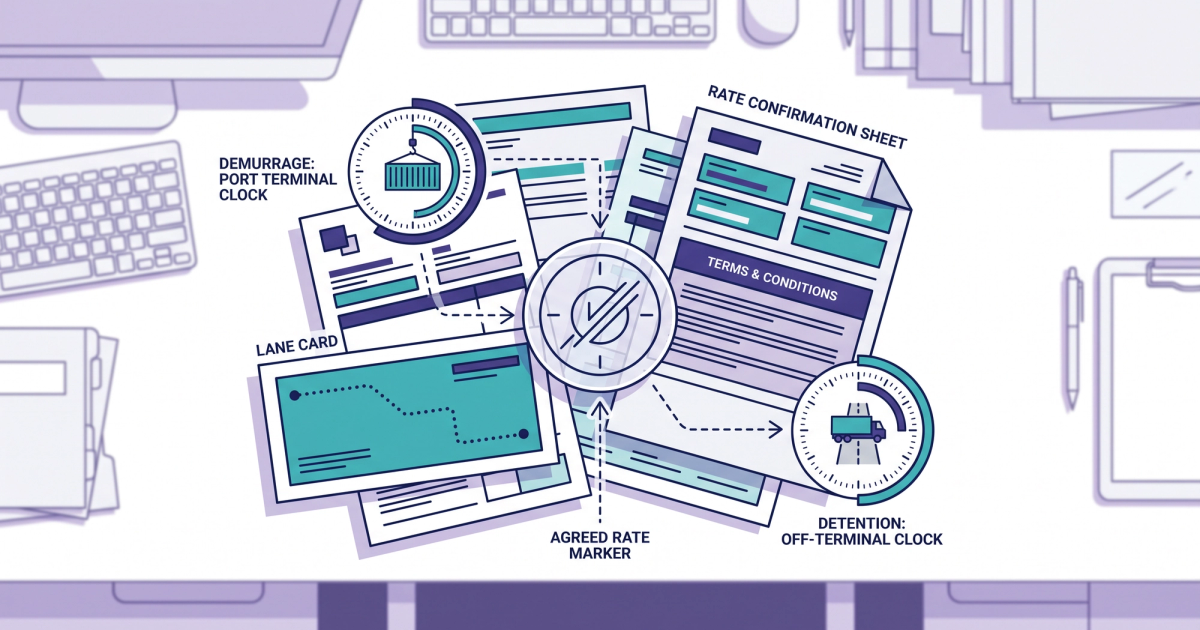
Demurrage is a charge for a container sitting too long at a port terminal. Detention is a charge for holding a container too long outside the terminal. That two-sentence distinction matters because carriers blur the line on invoices, and the confusion costs real money. According to Macropoint's analysis of ocean carrier financials, nine carriers collectively collected $12.9 billion in demurrage and detention charges from 2020 onward. FIATA reported a 104% average increase in D&D charges during the same period. Those numbers are not just a container shipping problem. Brokers handling intermodal and drayage loads see these charges flow straight through to their carrier invoices, often padded and rarely audited. This guide walks through exactly how demurrage and detention charges appear on invoices, how carriers manipulate free time, and the step-by-step process to dispute charges before you pay a dollar you do not owe.
Demurrage vs. Detention: Here's the Actual Difference (With a Real Dollar Example)
The terms get used interchangeably in ops calls and carrier emails. That is exactly the problem. Each charge has a different trigger, a different clock, and a different party responsible for the delay. Confusing them means you cannot dispute either one effectively.
Demurrage: the port terminal clock
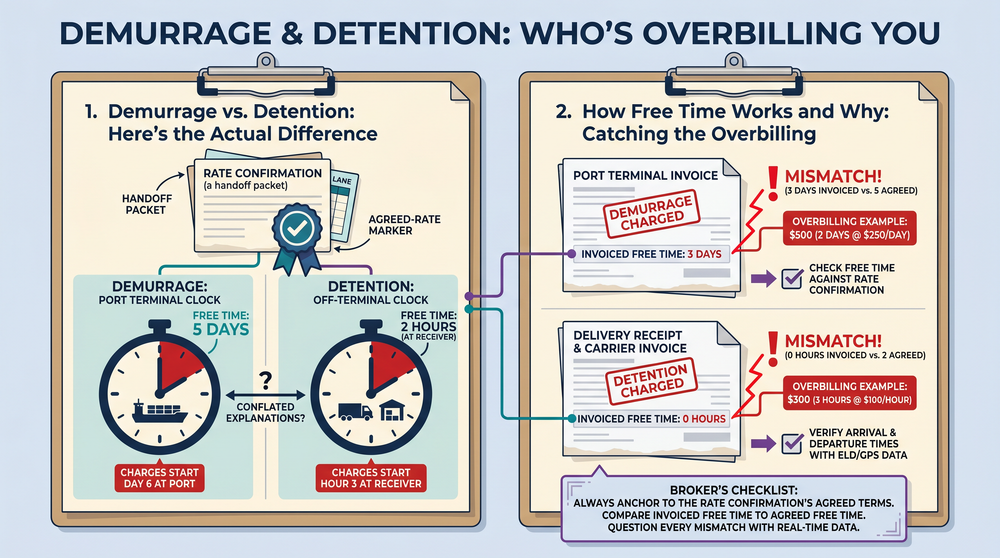
Demurrage accrues when a container remains inside a port terminal or rail yard beyond the allotted free time. The container has been discharged from the vessel, but nobody has picked it up. Per Descartes' operational definition, demurrage is the terminal storage charge assessed by the ocean carrier or terminal operator. Rates vary by port, carrier, and container size, but Freightos reports average demurrage charges of $75 to $300 per container per day. Many carriers use tiered pricing, so the daily rate escalates the longer the container sits.
Example: 40-foot container at the Port of Los Angeles. The carrier offers 4 days of free time after discharge. The importer does not arrange pickup until day 10. Here is the day-by-day breakdown using a common tiered rate structure:
- Days 1 through 4: Free time, $0
- Day 5: $75 (Tier 1 rate begins)
- Day 6: $75
- Day 7: $75
- Day 8: $75
- Day 9: $150 (Tier 2 rate kicks in)
- Day 10: $150
Total demurrage: $600 across 6 billable days. But some carriers at LA/Long Beach charge $150 per day from day 5, escalating to $350 or more past day 9. Under those rates, the same scenario produces a charge of $2,700. The exact amount depends on the carrier's published tariff, your contract terms, and the container size. That is why checking the rate con and tariff schedule against the invoice matters on every single load.
Detention: the off-terminal clock
Detention starts after the container leaves the terminal. The trucker has picked it up, but the container has not been returned empty to the designated location within the allowed time. According to Portcast's rate benchmarks, detention rates typically run $50 to $250 per container per day. For a deeper breakdown of how carriers bill detention and where they overbill, see our guide on how carriers overbill detention and how to fight back.
In trucking (non-containerized), detention charges work on a similar principle: the driver is held at a shipper or receiver location beyond the agreed free time, and the carrier invoices for each additional hour. The BOL (bill of lading) and rate confirmation should specify the free time window and per-hour rate. If they do not, you are already at a disadvantage in any freight billing dispute.
How Free Time Works and Why Carriers Count It Differently Than You Think
Free time is the window (measured in days or hours) before demurrage or detention charges begin. It sounds simple. It is not. Carriers calculate free time using different starting points, exclude different days, and bury exceptions in tariff footnotes.
When the clock starts
For demurrage, most ocean carriers start the clock when the container is discharged from the vessel, not when the vessel arrives at port. That distinction can add one to three days before you even receive a cargo availability notice. For detention, the clock starts when the container leaves the terminal gate (gate-out timestamp). Some carriers start it when the container is loaded onto the chassis, which can be hours earlier. These differences are rarely spelled out in the rate con. They live in the carrier's tariff, which most brokers never read until they are fighting a charge.
What '14 days free detention at destination' actually means
A common question brokers and importers ask: what is 14 days free detention at destination? It means the consignee has 14 calendar days from the gate-out event to return the empty container before daily detention fees apply. But here is where it gets operational.
Scenario: A container arrives at the terminal on March 1. The trucker picks it up on March 12 (day 12 of free time). The container is stripped and returned empty on March 14. Under a 14-day free detention policy, no charges should apply. But the terminal does not log the gate-out until March 15 due to a documentation lag. The carrier's system now shows the container was out for 15 days, and they invoice $1,350 (3 days at $150/day, counting from what they consider the start of detention, plus a penalty for exceeding the 14-day window by one day). That charge is 100% disputable, but only if you have the trucker's GPS data or gate receipt showing the actual return date. This is exactly the kind of scenario covered in our piece on who controls the detention clock and who pays.
Calendar days vs. business days
Some carriers count free time in calendar days. Others exclude weekends and holidays. A "5 days free" policy that excludes weekends gives you 7 calendar days. A "5 days free" policy on calendar days gives you exactly 5. Confirm which method your carrier uses before booking. It changes the math on every load.
What Demurrage and Detention Charges Look Like on an Invoice — and Where the Padding Hides
D&D charges rarely appear as clean, single line items. They get bundled with accessorial billing, split across multiple invoice lines, or labeled with vague codes. Here is what to look for.
Common invoice line items
- DEM or DEMURRAGE: port terminal storage beyond free time
- DET or DETENTION: container held beyond free time outside the terminal
- PER DIEM: sometimes used interchangeably with detention, sometimes a separate chassis rental charge
- STORAGE: terminal or warehouse storage, distinct from demurrage in some carrier systems but identical in others
- LATE RETURN FEE: a detention charge under a different name
The padding hides in the overlap. A carrier might bill demurrage for days 5 through 8 at the terminal, then bill detention starting on day 5 as well (the day the container left the gate). That creates a double-billing window where you are paying both charges for the same days. This is not theoretical. It is one of the most common freight billing dispute triggers on intermodal loads.
TONU plus detention: the double-bill you should always dispute
Scenario: A carrier dispatches a truck for pickup. The shipper cancels the load after the driver arrives. The carrier invoices a TONU (truck order not used) fee of $350, which is standard. But on the same invoice, they also bill 3 hours of detention at $85/hour ($255) for the time the driver waited before the cancellation was confirmed. The total invoice: $605.
Here is the problem: TONU compensates the carrier for a wasted dispatch. Detention compensates for time spent waiting beyond free time on an active load. If the load was cancelled, there was no active load to detain against. You should dispute the detention portion with this language:
"Per our rate confirmation dated [date], the TONU fee of $350 covers the cost of the dispatched and unused truck. Detention charges require an active load with a completed pickup or delivery. Since the load was cancelled prior to pickup, no detention event occurred. We are approving the $350 TONU and disputing the $255 detention charge. Please provide documentation showing the load was picked up and delivered if you believe detention applies."
That exact framing resolves the dispute in your favor the majority of the time. For more on proving detention clock timestamps, see our guide on how to prove the clock started and get paid.
Carrier-by-Carrier Free Time Policies and Daily Rate Ranges You Should Know
Every ocean carrier sets its own free time allowances and D&D rate tiers. The differences are significant. Here is a side-by-side comparison of three major carriers' published policies for destination containers in the United States. Note: rates are approximate and vary by port, contract, and equipment type. Always verify against your specific tariff or service contract.
Comparison: Maersk vs. Hapag-Lloyd vs. MSC
Demurrage (free time at destination terminal):
- Maersk: Typically 4 to 5 free days. Days 5 through 9: approximately $185/day for a 40-foot container. Days 10 and beyond: approximately $370/day.
- Hapag-Lloyd: Typically 4 free days. Days 5 through 7: approximately $165/day for a 40-foot container. Days 8 and beyond: approximately $280/day.
- MSC: Typically 5 free days. Days 6 through 10: approximately $150/day for a 40-foot container. Days 11 and beyond: approximately $325/day.
Detention (free time after gate-out):
- Maersk: Typically 4 to 7 free days depending on contract. 20-foot container: $100 to $150/day. 40-foot container: $150 to $225/day.
- Hapag-Lloyd: Typically 4 to 6 free days. 20-foot container: $80 to $130/day. 40-foot container: $120 to $200/day.
- MSC: Typically 4 to 7 free days. 20-foot container: $90 to $140/day. 40-foot container: $130 to $210/day.
These numbers shift based on congestion, season, and port. The point is not to memorize them. The point is that you cannot audit an invoice without knowing your specific carrier's tariff schedule. Download or screenshot the tariff page before you book. It is much harder to get after a dispute starts.
Negotiating free time extensions
If you move consistent volume with a carrier (100 or more containers per quarter), you have leverage to negotiate extended free time. A common ask: 7 days free demurrage and 7 days free detention instead of the standard 4 to 5. Even two extra free days across 100 containers at an average rate of $175/day saves $35,000 per quarter. Put the extended free time in your service contract, not in an email thread.
How to Audit a D&D Invoice Before You Pay: A Step-by-Step Check
Most brokers pay D&D invoices reactively. The charge shows up, the carrier pushes for payment, and the broker cuts the check to keep the relationship intact. That is how margin disappears. Here is a repeatable audit process you can hand to your billing coordinator today.
Step 1: Match the invoice to the rate confirmation
Pull the rate con for the load. Confirm the agreed free time (hours for trucking detention, days for container demurrage and detention). If the carrier invoice charges begin before the free time expires, that is an immediate dispute.
Step 2: Verify timestamps against the BOL and POD
The BOL should show the pickup appointment and actual arrival. The POD (proof of delivery) should show delivery completion. Compare these against the detention hours or demurrage days on the invoice. If the carrier bills 6 hours of detention but the BOL shows the driver arrived at 8:00 AM and the POD is stamped at 10:15 AM, that is a 2-hour, 15-minute window, not 6 hours.
Example: A carrier invoices detention at $85/hour starting at hour 3, billing 6 hours on a load where the BOL shows a 2-hour live unload. The charge is $510 (6 × $85). The correct charge, if any, is $0 (the unload completed within the 2-hour free time typically agreed in the rate con). Dispute savings per load: $510. At 40 loads per month with the same pattern, that is $20,400 per month in recoverable overcharges. Even at a more conservative $255 per-load overcharge (3 excess hours billed), 40 loads means $10,200/month.
Step 3: Check for double billing
Look for overlapping date ranges between demurrage and detention. Look for TONU plus detention on the same load. Look for "storage" charges that duplicate the demurrage line. Each one is a separate dispute.
Step 4: Confirm the daily rate matches the tariff tier
Carriers sometimes bill at the Tier 2 or Tier 3 rate from day one, skipping the lower-tier rate entirely. Pull the tariff schedule and verify the rate for each day billed. A $50/day difference across 6 days is $300. Multiply that by your monthly container volume.
Step 5: File the dispute within the 30-day window
Under the FMC's 2024 final rule codified at 46 CFR Part 541, billing parties must issue demurrage or detention invoices within 30 calendar days of the charge being incurred. Billed parties then have 30 calendar days from invoice receipt to contest the charges. Missing that 30-day window weakens your position significantly. As the FMC stated in its rule announcement, these requirements are designed to ensure billing transparency and give billed parties a clear path to contest charges.
At 500 loads per month, catching a 3.8% overbilling rate on accessorials including D&D at an average freight invoice of $2,200 means $83.60 per load, or $41,800 per month, left on the table without an audit process.

Who Is Actually Liable — Shipper, Consignee, Forwarder, or Trucker?
Liability for demurrage and detention charges is one of the most contested areas in freight billing. The answer depends on the Incoterms, the contract, and (increasingly) the regulatory environment.
The general rule
- Demurrage is typically the responsibility of the consignee or the party listed on the bill of lading as the notify party, since they control when the container is picked up from the terminal.
- Detention is typically the responsibility of the party in physical possession of the container, usually the consignee or their trucker.
- Freight forwarders and brokers are generally not liable unless their contract explicitly assumes D&D risk or they are the named shipper on the BOL.
The FMC regulatory shift (and the 2025 court reversal)
The FMC's 2024 rule under 46 CFR Part 541 was intended to clarify billing practices and require that invoices go to the party that contracted for the service. However, a federal appeals court partially overturned the rule in October 2025, reinstating trucker liability for certain charges even in cases where the trucker may not have controlled the delay. This means truckers and motor carriers are once again potentially on the hook for demurrage and detention charges, even when port congestion or shipper delays caused the problem.
For brokers, the takeaway is clear: do not assume the FMC rule fully protects you or your carriers. Read your contracts. Know your FMCSA obligations for trucking-side detention. And document every delay with timestamps, gate receipts, and driver check-in logs. For more on when to pay demurrage and when to push back, see our breakdown on demurrage charges and dispute strategy.
FMC dispute fact pattern
Scenario: A shipper receives a $3,200 demurrage invoice from an ocean carrier for a container that sat at the terminal for 12 days after discharge. The shipper's contracted free time was 5 days. However, the carrier did not send the cargo availability notice until day 3 after discharge, and the invoice was issued 45 days after the last charge accrued.
Under 46 CFR Part 541, the shipper disputes on two grounds: (1) the carrier failed to provide timely notice of free time commencement, effectively reducing the shipper's usable free time, and (2) the invoice was issued outside the 30-day billing window required by the rule. The shipper files the dispute within 30 days of receiving the invoice, citing the specific regulatory provisions. Resolution timeline: 15 to 45 days depending on the carrier's internal process. Outcome: the carrier voids the invoice in full. Not every dispute ends this cleanly, but the regulatory framework gives you real footing when the facts support your case.
As of 2026-04-01, average hourly earnings in truck transportation were $32.41/hr according to BLS Current Employment Statistics (series CEU4348400008). When a driver sits at a facility for 4 excess hours waiting beyond free time, that is $129.64 in direct labor cost before the carrier even adds their detention fee margin. Understanding the cost on both sides of the transaction makes your disputes more credible and your negotiations more grounded.
Frequently Asked Questions About Demurrage and Detention Charges
What is the difference between detention charges and demurrage charges?
Demurrage is charged when a container stays at a port terminal or rail yard beyond the free time window. Detention is charged when a container is held outside the terminal (at a warehouse, shipper facility, or chassis yard) beyond the allowed time. Demurrage is a terminal storage fee. Detention is an equipment usage fee. Both are billed by the ocean carrier or equipment provider, and both should be verified against the rate confirmation and tariff before payment.
How much is demurrage per day?
According to Freightos, average demurrage charges range from $75 to $300 per container per day. Rates depend on the port, carrier, container size (20-foot vs. 40-foot), and how many days past free time the container has been sitting. Most carriers use tiered pricing, so the daily rate increases the longer the container stays. At busy US ports, rates on the higher end ($200 to $350/day) are common for 40-foot containers past the first tier.
What is 14 days free detention at destination?
It means the consignee has 14 calendar days from the container's gate-out event (when it leaves the terminal) to return the empty container to the designated drop-off point before detention charges begin. This is a negotiated term, not a universal standard. Some carriers offer only 4 to 7 free days by default. If you are moving enough volume, negotiate for 14 days in your service contract. The distinction between calendar days and business days matters: confirm which one your carrier uses.
Can you dispute a demurrage or detention invoice?
Yes. Under the FMC's 2024 rule (46 CFR Part 541), billed parties have 30 calendar days from invoice receipt to formally contest demurrage or detention charges. Your dispute should reference the specific invoice, the contracted free time, supporting timestamps (gate receipts, BOL, POD), and the regulatory basis for your claim. Carriers are required to respond. The key is acting within the 30-day window and having documentation ready.
Who pays demurrage and detention — the shipper or the carrier?
It depends on the contract terms, Incoterms, and who caused the delay. Generally, demurrage falls on the consignee (since they control pickup scheduling), and detention falls on whoever holds the container past free time. A 2025 federal court ruling reinstated trucker liability for some charges even when truckers did not cause the delay. Brokers should confirm liability allocation in their service contracts and rate confirmations before accepting loads with D&D risk.
Conclusion: Stop Paying Charges You Don't Owe
Demurrage and detention charges are real costs of moving freight. Some of them are legitimate. Many are not. The difference between the two is knowing your free time terms, checking every invoice against actual timestamps, and filing disputes within the 30-day window the FMC gives you.
The math is straightforward. As of 2026-05-01, the truck transportation sector employs 1,465 thousand workers according to BLS (series CES4348400001), and every one of those drivers generates data (arrival times, gate receipts, BOL stamps) that can prove or disprove a detention charge. The audit process in this guide works whether you run 50 loads a month or 5,000. The hard part is doing it consistently on every invoice.
If your team processes more than 50 carrier invoices a week, manually checking each one against rate cons and timestamps is not sustainable. That is where tools that automatically flag invoice discrepancies make the difference between catching $41,800 a month in overbilling and letting it walk out the door.
Sources
- 46 CFR Part 541 — Demurrage and Detention Billing Requirements — Electronic Code of Federal Regulations
- FMC Publishes Final Rule on Detention and Demurrage Billing Practices — Federal Maritime Commission
- Demurrage and Detention Billing Requirements, Federal Register — Federal Register
- Truckers back on the hook for demurrage and detention charges — Land Line Media
- What Are Detention and Demurrage in Logistics? — Descartes
- Demurrage & Detention in Ocean Freight: Reduce Charges — Macropoint
- Demurrage and detention charges reach record highs — FIATA
- Detention and Demurrage: New FMC Regulations and the Role of Visibility — Portcast
- What is Demurrage: Meaning, Charges & Detention — Freightos
Related: How to Automate Detention Charge Review Before You Pay
Related: Detention Charges in Logistics: How Carriers Overbill and How to Fight Back
Related: Detention Charges in Shipping: How Carriers Miscalculate and What It Costs You