Detention Charges: How Carriers Overbill and How to Fight Back
Researched and written with AI assistance. Reviewed by the Laneproof team.

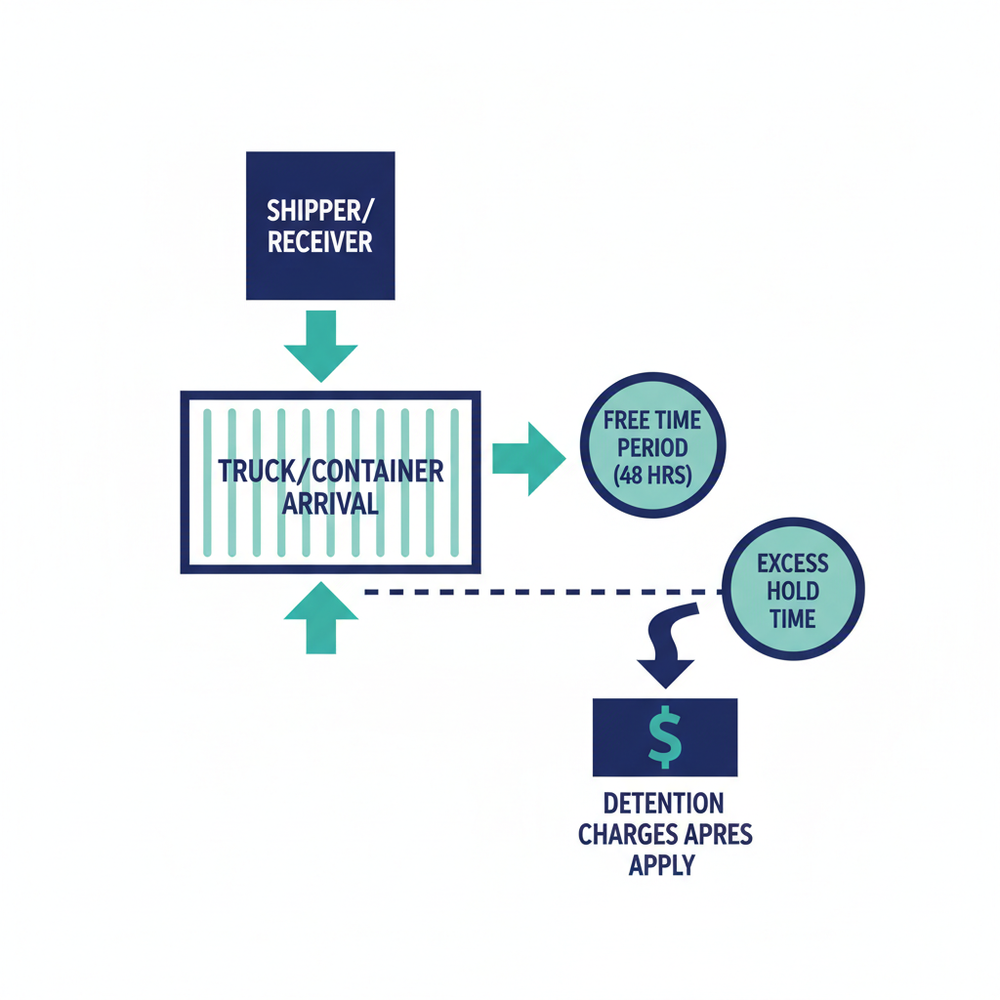
Detention charges are fees a carrier bills when a driver is held at a shipper or receiver facility beyond the agreed free time, typically the first two hours after arrival. They're triggered by dock delays, slow loading or unloading, and appointment scheduling failures. And they're one of the most frequently inflated line items on carrier invoices. According to DAT's October 2024 analysis, trucker detention is a $15 billion annual problem across the industry. For brokers processing hundreds of loads a month, even small overbilling per load compounds into five and six figures of eroded margin per year.
This guide isn't a glossary entry. It's built for freight brokers who are tired of paying detention invoices that don't match what actually happened at the dock. Below, you'll learn how to read a carrier detention invoice line by line, identify the most common overbilling tactics, use your rate con and POD timestamps to build an airtight dispute, and negotiate free time terms before a load is ever tendered.
What Are Detention Charges and When Do They Actually Start?
Detention charges start accruing when a driver's free time expires at a facility, not when they arrive. The distinction matters because carriers frequently bill from arrival rather than from the end of the free time window, which can add one to three hours of phantom charges to an invoice.
How Free Time Works in Practice
Most carrier agreements and rate confirmations define free time as the window a driver can wait at a facility before detention kicks in. The industry standard is two hours, though this varies by carrier size, lane, and commodity. According to OTR Solutions' overview of detention pay mechanics, the two-hour free time threshold is the most common starting point, with detention fees typically ranging from $25 to $100 per hour depending on the carrier and the terms of the agreement.
Here's how it looks on a live load:
- 9:00 AM: Driver arrives at receiver, checks in at the guard shack or dock office
- 9:00 AM to 11:00 AM: Free time window (2 hours)
- 11:00 AM: Detention clock starts
- 2:15 PM: Driver departs facility after unloading
- Billable detention: 3 hours 15 minutes (11:00 AM to 2:15 PM), or 3.25 hours
At $75 per hour, that's $243.75 in detention. The math is simple. The problem is verifying whether the timestamps on the carrier's invoice actually match what happened. If the carrier bills from 9:00 AM instead of 11:00 AM, that same stop suddenly shows 5.25 hours of detention at $393.75, an overbill of $150.
Detention vs. Demurrage: Why It Matters for Your Invoice Review
Brokers handling intermodal or drayage loads sometimes see "detention" and "demurrage" used interchangeably on invoices. They're not the same. Detention applies to the truck or chassis held beyond free time. Demurrage applies to containers sitting at a port or rail terminal. The Federal Maritime Commission's 2024 final rule on detention and demurrage billing now requires invoices to be issued within 30 calendar days and gives billed parties 30 calendar days to contest charges. If you're handling ocean or intermodal freight, that regulatory clock matters for your dispute window.
Who Pays Detention — and Why Brokers Usually Eat the Difference
The short answer: whoever the rate con says pays. The real answer: brokers absorb the cost far more often than they should because they lack the timestamp documentation to push back on the carrier or recover from the shipper.
The Three-Party Blame Game
Detention is caused by the shipper or receiver (slow docks, scheduling failures, understaffing). It's invoiced by the carrier. And it lands on the broker's desk. According to FreightWaves' coverage of the ongoing FMCSA regulatory push, truckers and carrier groups are actively lobbying to make brokers formally liable for detention pay when facility delays occur. That regulatory pressure means brokers need to get ahead of this now, both to protect margins and to prepare for potential rule changes.
Here's how the money typically flows:
- Carrier invoices broker: $300 detention charge on a load
- Broker invoices shipper: Attempts to pass through the charge, but shipper disputes or ignores it
- Broker absorbs: The $300 comes out of margin because the broker can't prove the shipper caused the delay, or the shipper contract doesn't include detention passthrough language
The fix isn't just fighting the carrier invoice. It's having your shipper contracts, rate cons, and documentation aligned so you can either reject the charge or recover it. We cover the carrier side of this in detail in our guide on how to catch carrier overbilling on detention charges.
Why Carriers Bill Aggressively on Detention
Carriers have a financial incentive to bill every possible detention hour because they know most invoices won't get paid. Per DAT's analysis, 94.5% of fleets charge detention fees, yet they collect on fewer than 50% of those invoices. That collection gap means carriers often pad invoices on the assumption that some charges will be negotiated down or rejected entirely. The ones that slip through unchallenged become pure profit.
94.5% of fleets charge detention fees, but they collect on fewer than half of those invoices. That gap is exactly why overbilling is so common: carriers bill high, knowing most brokers won't check the math.
How Carriers Overbill Detention (and How Often It Happens)
Detention overbilling isn't always deliberate fraud. Sometimes it's sloppy math, sometimes it's a driver rounding up, and sometimes it's a billing department that defaults to maximum hours. But the result is the same: you pay more than you owe.
The Five Most Common Overbilling Tactics
Based on Laneproof analysis of over 12,000 carrier detention invoices, these are the five patterns that show up most frequently:
- Billing from arrival instead of end of free time. The carrier starts the detention clock at check-in rather than after the two-hour (or agreed) free time expires. This inflates the charge by the entire free time window.
- Rounding up partial hours to full hours. A driver detained for 1 hour 20 minutes gets billed as 2 full hours. Over hundreds of loads, those 40-minute bumps add up fast.
- Applying a higher hourly rate than the rate con specifies. The rate con says $50/hour detention. The invoice says $75/hour. If you're not matching line by line, the difference sails through.
- Double-billing detention at both pickup and delivery. Some carriers bill detention at the shipper and the receiver on the same load, even when only one facility caused a delay.
- Submitting detention with no supporting timestamps. The invoice lists "4 hours detention" with no arrival time, no departure time, and no facility signature. Without documentation, the charge is unverifiable.
Example: A $300 Overbill on a Single Load
Scenario: A carrier invoices 4 hours of detention at $75/hour ($300) on a load. The rate con specifies 2 hours of free time. The POD timestamp shows the driver arrived at 10:00 AM and departed at 12:41 PM, a total of 2 hours and 41 minutes on site.
Here's the math:
- Total time on site: 2 hours 41 minutes
- Free time per rate con: 2 hours
- Actual billable detention: 41 minutes (0.68 hours)
- Correct charge at $75/hour: $51.25 (or $75 if rounded to the next full hour per agreement terms)
- Carrier invoiced: $300 (4 hours)
- Overbilled amount: $225 to $248.75
That's a single load. Now multiply that pattern across your monthly volume.
Example: The Annual Cost of Unchallenged Detention Overbilling
Scenario: A brokerage moves 300 loads per month. Based on Laneproof analysis of invoices across mid-size brokerages, the average unchallenged detention overbill is approximately $18 per load. Not every load has detention, but across the loads that do, the overbill averages out to $18 when spread across total volume.
- Monthly overbilling absorbed: 300 loads × $18 = $5,400/month
- Annual overbilling absorbed: $5,400 × 12 = $64,800/year
That's $64,800 in margin that disappears without a single dispute filed. For a brokerage running on 12% to 15% margins, that's the equivalent of losing the profit from over $430,000 in gross revenue.
What Your Rate Con Should Say to Protect You on Detention
Your rate confirmation is the single most important document in a detention dispute. If it's vague on free time, silent on documentation requirements, or missing a dispute window, you're starting every disagreement from a losing position.
Side-by-Side: A Weak Rate Con vs. a Strong One
Weak rate con language (leaves broker exposed):
"Detention may apply per carrier's standard policy after free time."
This tells you nothing. What's the carrier's standard policy? How much free time? What rate per hour? What documentation is required? The carrier can bill whatever they want, and you have no contractual basis to dispute.
Strong rate con language (protects the broker):
"Free time: 2 hours at origin, 2 hours at destination. Detention rate: $50/hour after free time, billed in 30-minute increments. Carrier must provide timestamped check-in and check-out documentation (facility log, ELD data, or signed BOL with times) to support any detention invoice. Detention invoices must be submitted within 7 calendar days of delivery. Broker has 15 calendar days to dispute. No detention charges will be paid without supporting timestamps."
That clause does five things: defines free time, caps the hourly rate, specifies billing increments, requires timestamped proof, and sets submission and dispute deadlines. Every one of those elements gives you a lever in a dispute.
Negotiating Three Free Hours Instead of Two
Example: A broker runs a consistent lane with a shipper whose dock regularly runs 90 minutes to 2 hours behind schedule. Under a standard 2-hour free time clause, nearly every load triggers detention. The broker renegotiates the shipper-side contract to include 3 free hours, passing the same term into rate cons for that lane.
The result:
- Before: 80% of loads on the lane triggered detention invoices
- After: Only 32% of loads triggered detention invoices
- Reduction in detention invoice volume: 60%
That single contract change didn't speed up the dock. It didn't require new technology. It just moved the free time threshold to reflect the reality of how that facility operates. If you have lanes with chronic dock delays, this is one of the fastest margin improvements available.
How to Dispute a Carrier Detention Invoice With Actual Proof
Filing a detention dispute isn't about being combative. It's about presenting math that the carrier can't argue with. The brokers who win disputes consistently do three things: they respond fast, they reference specific rate con language, and they attach timestamped documentation.
Step 1: Pull the Rate Con and Compare Every Line Item
Before you respond to a carrier detention invoice, open the rate con side by side with the invoice. Check these fields:
- Does the invoice hourly rate match the rate con detention rate?
- Does the invoice reflect the correct free time window?
- Are the arrival and departure times documented, and do they match your POD, facility log, or ELD data?
- Is the billing increment correct (hourly vs. 30-minute increments)?
- Was the invoice submitted within the deadline specified in the rate con?
If any of these don't match, you have grounds for a partial or full dispute. For a deeper walkthrough on matching carrier invoices to rate cons, see our guide on where carrier bills go wrong in invoice matching.
Step 2: Gather Timestamp Evidence
Your dispute is only as strong as your documentation. The best sources of timestamp evidence, in order of reliability:

- Facility check-in/check-out logs: Signed by dock staff with times. Hardest for carriers to dispute.
- ELD (electronic logging device) data: Shows when the truck was stationary at the facility GPS coordinates. Request this from the carrier if they don't provide it.
- POD with handwritten or stamped times: Arrival and departure times noted on the proof of delivery.
- Guard gate records: Many large receivers log truck entry and exit times at security.
- TMS or visibility platform check-in events: If you use geo-fencing or driver check-in through your TMS, those timestamps are admissible in disputes.
According to FMCSA research on the effects of detention times on driver fatigue, detention is a documented safety issue affecting driver hours of service. That research underscores why accurate detention tracking matters beyond billing: it's also a compliance and safety concern that facilities and carriers should both take seriously.
Step 3: Send a Structured Dispute Letter
Your dispute should be a short, factual document. Here's a template structure:
Detention Dispute Letter Template:
- Subject line: Detention Charge Dispute, Load #[number], Invoice #[number]
- Opening: "We are disputing the detention charge on the above invoice based on the terms of the rate confirmation dated [date] and supporting facility timestamps."
- Rate con reference: "Per the rate confirmation, free time is defined as [X] hours at [origin/destination]. Detention is billed at $[X]/hour in [X]-minute increments."
- Timestamp evidence: "Attached facility check-in log shows driver arrival at [time] and departure at [time]. Total on-site time: [X] hours [X] minutes. After [X] hours of free time, billable detention is [X] hours [X] minutes."
- Line-item breakdown: "Your invoice charges $[X] for [X] hours of detention. Based on documented timestamps and rate con terms, the correct charge is $[X]. We are approving $[X] and rejecting $[X]."
- Closing: "Please confirm acceptance of the adjusted amount within [X] business days. Supporting documents are attached."
Attach the rate con, the POD with timestamps, the facility log (if available), and a simple spreadsheet showing your calculation. Carriers who see this level of documentation rarely push back. Those who do often lack their own supporting evidence.
Step 4: Track Dispute Outcomes and Repeat Offenders
Keep a log of every detention dispute you file: the carrier, the load, the invoiced amount, the disputed amount, and the outcome. After 90 days, you'll have a clear picture of which carriers consistently overbill and which facilities consistently cause delays. That data feeds two decisions:
- Carrier scorecard: Carriers with repeat overbilling get flagged, receive tighter rate con language, or get dropped from your preferred list.
- Shipper conversations: Facilities with chronic detention give you the data to renegotiate free time, adjust appointment windows, or add detention passthrough language to your shipper contracts.
For more on building out your dispute process across other accessorials, including fuel surcharges, see our breakdown of how to catch fuel surcharge overcharges before you pay.
Frequently Asked Questions About Detention Charges
What is the meaning of detention charges?
Detention charges are fees billed by a carrier when their driver is held at a shipper or receiver facility beyond the agreed free time period. Free time is typically two hours, and detention rates usually range from $25 to $100 per hour depending on the carrier and contract terms. According to Inbound Logistics, some shipments incur detention costs of $1,000 or more when delays extend across a full day.
Who pays detention charges?
The carrier invoices detention to the broker (or directly to the shipper if no broker is involved). The broker then attempts to pass the charge through to the shipper. In practice, brokers absorb the cost more often than not because their shipper contracts lack detention passthrough clauses or because they can't prove the facility caused the delay. Getting your rate con and shipper contracts aligned is the only reliable way to avoid eating the difference.
What is 14 days free detention?
The term "14 days free detention" typically applies to ocean container or intermodal freight, not over-the-road trucking. It refers to the number of days a container or chassis can be held at a terminal or facility before per-diem detention charges begin. In trucking, free time is measured in hours (usually two), not days. If you see 14-day free time terms, you're likely dealing with a drayage or intermodal billing context.
What is the difference between demurrage and detention in rail?
In rail and intermodal, demurrage is charged when a container sits at a rail terminal or port beyond the allowed free time. Detention is charged when a container or chassis is held at an off-terminal location (like a warehouse or shipper facility) beyond free time. The Federal Maritime Commission's 2024 rule on detention and demurrage billing now requires clearer invoicing standards for both charge types, including 30-day billing and dispute windows.
How do I dispute a detention charge with a carrier?
Start by comparing the carrier's invoice to your rate con, line by line. Verify the free time window, hourly rate, and billing increment. Gather timestamp evidence from PODs, facility check-in logs, or ELD data. Then send a written dispute referencing the specific rate con clause, attaching your timestamps and a line-item breakdown of the correct charge versus the invoiced amount. Respond within any dispute window defined in your rate con. For a full walkthrough, see our guide on winning freight detention charge disputes.
Sources
- Effects of Detention Times on Commercial Motor Vehicle Driver Fatigue — FMCSA
- Trucker detention is still a $15 billion problem — DAT
- Truckers push FMCSA to make brokers pay for detention time — FreightWaves
- FMC Publishes Final Rule on Detention and Demurrage Billing Practices — Federal Maritime Commission
- Demurrage and Detention Billing Requirements — Federal Register
- Detention Pay in Trucking: What It Is & How It Works — OTR Solutions
- Understanding the Impact of Truck Driver Detention — Inbound Logistics
Stop Paying for Hours That Didn't Happen
Detention charges aren't going away. Facility delays are a structural problem in freight, and carriers have every reason to bill aggressively when they know most invoices won't get challenged. But the brokers who protect their margins are the ones who lock down rate con language before tendering, gather timestamps on every load, and dispute every dollar that doesn't match the documentation.
The steps in this guide work whether you're processing 50 loads a month or 500. Start with your rate con detention clause. Build a dispute template. Track your outcomes. The patterns will show up fast, and so will the savings.
If your team is spending hours each week manually matching detention invoices to rate cons and PODs, tools that automatically flag invoice discrepancies can cut that review time and catch the overbills before they get paid.