Detention Time in Trucking: Who Controls the Clock and Who Pays
Researched and written with AI assistance. Reviewed by the Laneproof team.
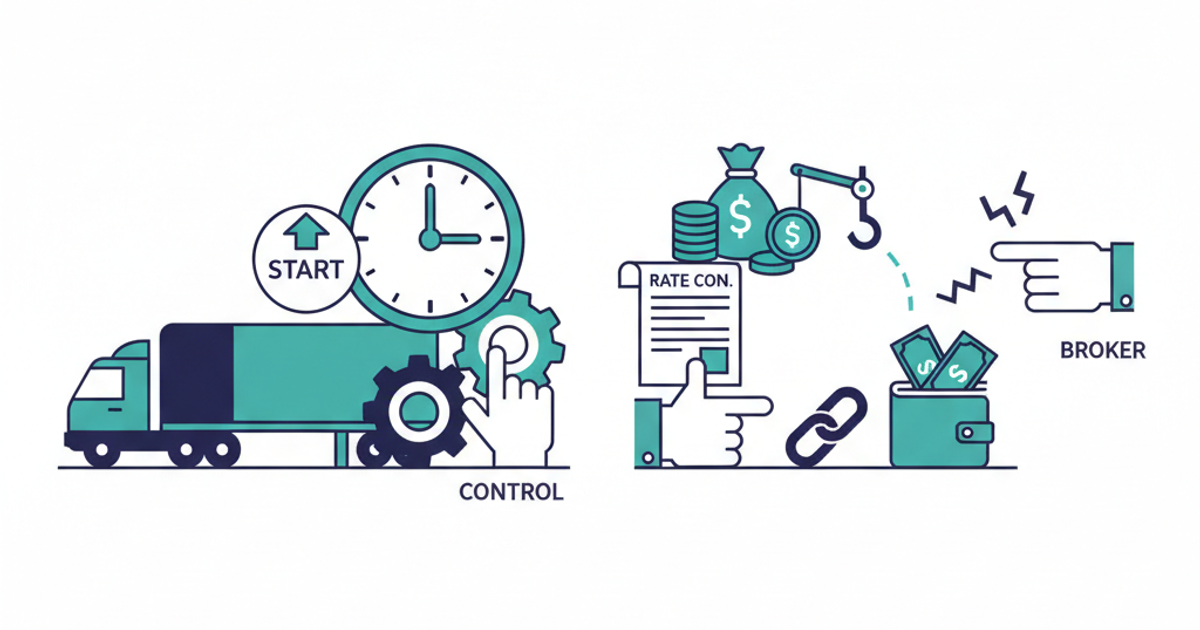
The trucking industry lost approximately $15 billion to driver detention in 2023, according to DAT's analysis of detention costs. That total breaks down to $3.6 billion in direct expenses and $11.5 billion in lost productivity. If you're a freight broker running 200 to 500 loads a month, detention time isn't an abstract industry problem. It's a line item on carrier invoices that keeps showing up, often for amounts you never agreed to and can't always verify. This guide covers exactly how the detention clock starts, what carriers actually put in their policies, and how you can dispute a detention invoice with documentation that holds up. No water treatment math. No two-sentence glossary definitions. Just the operational detail that determines whether you pay or push back.
What Detention Time Actually Means in Trucking (Not the Water Treatment Definition)
If you search "detention time" right now, half the results are about water treatment basins and hydraulic engineering. Here's the freight-specific definition that actually matters to your business:
Detention time in trucking is the period a commercial driver is held at a shipper or receiver facility beyond the agreed-upon free time window, waiting to be loaded or unloaded. It's measured in hours (or fractions of hours), and it's billed as a charge to the broker or shipper when the wait exceeds whatever free time threshold was established, typically on the rate confirmation or in the carrier's standard policy.
Two factors determine detention time: the length of free time allowed and the total time the driver spends at the facility. If free time is 2 hours and the driver is held for 4.5 hours, the billable detention is 2.5 hours. That's it. The complexity isn't in the formula. It's in who defines those two inputs and what documentation backs them up.
According to a 2014 FMCSA study on driver detention, CMV drivers experienced detention on approximately 1 in every 10 stops, for an average of 1.4 hours beyond the standard 2-hour free time window. For-hire truckload carriers faced detention odds nearly 5 times greater than private carriers. That disparity hasn't narrowed much in the years since, and it's a core reason why detention charges land disproportionately on brokers who work with for-hire carriers.
Why Detention Matters Beyond the Invoice
Detention isn't just a billing issue. It's an Hours of Service (HOS) issue. A driver sitting at a dock for 4 hours is burning on-duty time without moving freight. That eats into their available drive time, which can force an unplanned layover, a missed pickup at the next stop, or a late delivery that triggers another charge. For brokers, this creates a cascading problem: one late unload at a receiver can generate detention on the current load and a TONU or dry run claim on the next one.
How the Detention Clock Starts — and Why That Moment Is Always Disputed
The single most disputed element in any detention charge is when the clock started. Not how long the driver waited, not the rate per hour, but the exact minute the facility acknowledged the driver's arrival. This moment determines everything downstream: whether free time is exhausted, how many billable hours accumulate, and whether the invoice amount is legitimate or inflated.
Arrival vs. Check-In vs. Appointment Time
There are three different "start" times that carriers, brokers, and shippers each reference, and they almost never align:
- Arrival time: When the driver physically pulls into the facility lot. Some carriers argue detention should start here.
- Check-in time: When the driver signs in at the guard shack or receiving office and gets a dock assignment. Most shippers track this as the official start.
- Appointment time: The scheduled pickup or delivery window on the rate con. Some carrier detention policies state the clock starts at the appointment time regardless of when the driver actually arrives.
Here's where this gets expensive for brokers:
Example: A carrier arrives at 10:45 AM for an 11:00 AM appointment. The dock doesn't release the driver until 2:30 PM. Free time is 2 hours per the rate con. If the clock starts at the 11:00 AM appointment time, free time runs until 1:00 PM, and billable detention is 1 hour 30 minutes. But if the carrier's own policy says the clock starts at arrival (10:45 AM), they'll calculate free time ending at 12:45 PM, making billable detention 1 hour 45 minutes. That 15-minute gap costs the broker $18.75 to $25.00 at standard rates. Multiply that across 30 or 40 detention events a month and you're looking at real money.
The Documentation Gap
The reason this moment is "always disputed" isn't because people are dishonest. It's because documentation at the facility level is inconsistent. Some warehouses use digital check-in kiosks that timestamp to the minute. Others hand the driver a paper slip. Some don't record check-in at all and only stamp the BOL at release. When a carrier sends you a detention invoice claiming 3 hours of billable time, and the only facility record you can get is a BOL with a single timestamp, you're in a weak position to dispute. That's why cross-referencing the driver's HOS log against the BOL is often the fastest path to validating or rejecting a claim. More on that in the dispute section below.
How to Calculate Detention Time and What It Will Cost You
The math itself is simple. The variables that feed the math are where brokers get burned. Here's the step-by-step calculation:
Step 1: Identify the clock start time (check-in, appointment, or arrival, depending on what the rate con specifies). Step 2: Add the agreed free time window (usually 1 to 2 hours for pickup, 1 to 2 hours for delivery). Step 3: Identify the release time (when the driver gets their signed BOL or POD and leaves the dock). Step 4: Subtract the end of free time from the release time. That's your billable detention. Step 5: Multiply by the detention rate, accounting for the billing increment (hourly, 30-minute, or 15-minute).
Free Time Calculation Example
Scenario: Scheduled appointment is 8:00 AM. Driver checks in at 8:00 AM. Free time is 2 hours per the rate con. The detention clock starts at 10:00 AM. The driver is released at 11:45 AM. Billable detention is 1 hour 45 minutes. At $75/hour billed in 15-minute increments, that's 7 increments at $18.75 each, totaling $131.25 owed.
Industry average detention pay rates run $75 to $100 per hour after free time expires, with many carriers billing in 15-minute increments after the first full hour. Some carriers use flat-rate detention (a single charge for any detention event regardless of duration), but that's less common on spot market loads.
What 12% Detention Looks Like Over a Year
Scenario: A broker moves 300 loads per month. If 12 percent of those loads generate a detention invoice averaging $120, that's 36 invoices per month at $120 each: $4,320 per month in detention charges. Over a year, that's roughly $51,840 before any dispute process. According to the OOIDA 2023 Detention Time Survey, motor carriers collectively lose approximately $250.6 million to $302.9 million in net income every year due to detention time. That cost pressure flows directly to brokers in the form of higher base rates, stricter detention policies, and more aggressive invoicing.
What Carriers Put in Their Detention Policies That Brokers Miss
Every carrier has a detention policy. The problem is that most brokers never read it until they're already disputing a charge. Carrier detention policies are typically buried in the carrier packet, sometimes as a standalone document and sometimes as a clause within a broader terms-of-service agreement. Here's what those policies commonly include that catches brokers off guard:
Free Time That's Shorter Than You Expected
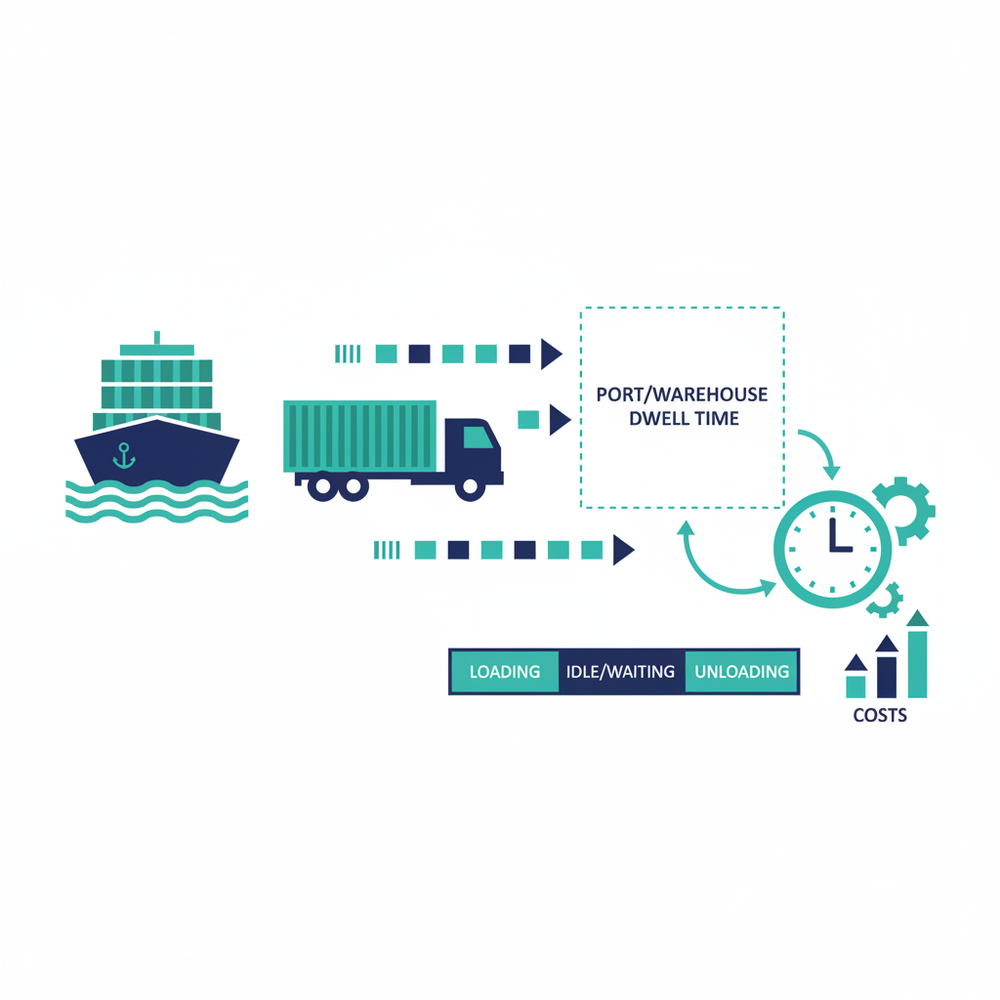
Many rate confirmations specify 2 hours of free time for both pickup and delivery. But the carrier's own policy might state 1 hour of free time. If the rate con doesn't explicitly override the carrier's standard terms, or if the carrier packet was signed without the broker reviewing the detention clause, the carrier has a contractual argument for billing based on their shorter free time window.
Scenario: A carrier detention policy states free time is 1 hour. The rate con says 2 hours. The carrier bills based on their policy. The broker has no countersignature on the carrier packet acknowledging the rate con terms as controlling. The carrier invoices $150 in detention, and the broker loses the dispute because the carrier packet, signed first, contained the controlling language. That $150 was never budgeted, and the broker has no recourse.
Billing Increments and Minimum Charges
Some carriers bill detention in 15-minute increments. Others bill by the half-hour or full hour. A few carriers include a minimum detention charge (often 1 full hour) that applies the moment free time is exceeded, even if the actual overage was only 10 minutes. If the rate con is silent on billing increments, the carrier's policy controls, and you may not know what that policy says until the invoice arrives.
Automatic Escalation Rates
A growing number of carriers include escalation clauses: $75/hour for the first 2 hours of detention, then $100/hour after that. Some add daily maximums (e.g., $500 per day), which sounds protective until you realize a layover at a facility that spans two calendar days could generate two separate daily charges. Review the carrier packet before dispatch. If their detention terms conflict with your rate con, get that conflict resolved in writing before the driver arrives at the facility.
For a deeper breakdown of how these policy details show up on actual invoices, see how carriers overbill on detention charges and how to fight back.
How Brokers Get Stuck Paying Detention They Never Agreed To
This is the section that matters most if you're the person cutting checks. Brokers pay detention charges they never agreed to for a few specific, avoidable reasons. None of them are exotic. All of them happen every week.
The Rate Con Is Silent on Detention
If your rate confirmation doesn't address detention (free time window, hourly rate, billing increment, maximum charge), the carrier's standard terms fill that gap. Many brokers use rate con templates that include a line for detention, but leave it blank on spot loads because the focus is on getting the truck covered quickly. That blank space isn't neutral. It's an invitation for the carrier to apply their own policy, which is almost always more expensive.
Lumper Fees and Detention Stacking on the Same Invoice
Scenario: A lumper fee of $180 and a detention charge of $200 appear on the same carrier invoice. Neither was on the rate con. Without a signed accessorial authorization or shipper confirmation, the broker is now disputing $380 at once. This scenario happens on roughly 1 in 8 loads at high-volume warehouses with slow unload times. The lumper fee might be legitimate (the shipper required a third-party unload service), but if you didn't pre-authorize it, you're in a dispute. The detention charge might also be legitimate (the driver waited 4 hours), but if the rate con didn't specify terms, the carrier is billing at their rate, not yours.
The compounding effect is what kills margins. It's not one $200 detention charge that matters. It's 36 of them a month, plus lumper fees, plus the occasional TONU, all hitting your reconciliation queue at the same time. If you want to understand how these stacked charges create overbilling patterns, this breakdown of how to catch carrier overbilling on detention charges covers the specific red flags to look for.
No Dispute Process Documented
Some brokers pay detention invoices they shouldn't because they don't have a documented dispute process. The carrier sends an invoice with a detention line item, the billing coordinator can't find a rate con that addresses it, and after 20 minutes of digging they approve payment to keep the carrier relationship intact. That decision, repeated 10 or 15 times a month, is how $51,000 a year disappears from your bottom line.
How to Fight a Detention Invoice Before You Cut the Check
Disputing a detention invoice isn't about being adversarial with your carriers. It's about verifying that the charge matches what was agreed to and what actually happened at the facility. Here's the process that holds up:
Step 1: Check the Rate Con First
Pull the rate confirmation for the load. Does it specify free time, detention rate, billing increment, and maximum charge? If yes, compare every line on the detention invoice against those terms. If the rate con says 2 hours free time at $75/hour and the carrier is billing for 3 hours at $100/hour with only 1 hour of free time, you have a clear, documented basis to dispute.
Step 2: Cross-Reference the BOL and HOS Logs
Example: A driver's HOS log shows they were on duty but not driving for 3.5 hours at a shipper facility. That same window on the BOL shows a check-in time and a release time. Cross-referencing those two documents is the fastest way to validate or reject a detention invoice. If the BOL shows check-in at 9:00 AM and release at 12:30 PM (3.5 hours total), and free time is 2 hours, billable detention is 1.5 hours. If the carrier invoiced for 2.5 hours, you have a 1-hour discrepancy to dispute.
According to ATRI research published in 2024, truck drivers were detained between 117 and 209 hours per year depending on sector, with 135 million total productive hours lost industry-wide in a single year. That volume of detention creates massive invoicing volume, and with it, inevitable errors and overbilling.
Step 3: Request Facility Documentation
If the BOL doesn't have clear check-in and release timestamps, contact the shipper or receiver for their facility records. Many warehouses, especially larger distribution centers, maintain gate logs or yard management system records that show exactly when a truck entered, when it was assigned a dock door, and when it departed. This documentation is your strongest evidence in a dispute, because it comes from a third party (the facility), not from either side of the broker-carrier relationship.

Step 4: Respond in Writing Within 48 Hours
Don't let detention invoices sit in a queue. The longer you wait to dispute, the weaker your position. Respond to the carrier in writing (email is fine) within 48 hours of receiving the invoice. State the specific discrepancy: "Rate con specifies 2 hours free time at $75/hour. Your invoice bills 3 hours at $100/hour with 1 hour free time. Attached: signed rate con, BOL with timestamps, and facility gate log." That level of specificity ends most disputes before they escalate.
For a complete playbook on winning these disputes consistently, see how to win every freight detention charge dispute.
If 12 percent of your loads generate detention invoices averaging $120 each, that's $51,840 per year in detention charges before any dispute process. The brokers who cut that number in half aren't paying less. They're catching more.
Step 5: Track Patterns by Carrier and Facility
One detention charge is a cost of doing business. Fifteen detention charges from the same carrier at the same facility in a quarter is a pattern. Track detention invoices by carrier, by facility, and by whether they were on the rate con or not. This data gives you three things:
- Negotiating leverage: If Carrier X bills detention on 30% of loads and Carrier Y bills on 8%, you know where to focus your rate con language.
- Facility intelligence: If a specific warehouse generates detention on 40% of deliveries, you can negotiate detention terms into the shipper contract or adjust appointment scheduling.
- Audit accuracy: When you can show a carrier that 11 of their last 15 detention invoices had discrepancies, the conversation shifts from "please pay this" to "let's fix this process."
Frequently Asked Questions About Detention Time in Freight
What is the meaning of detention time in trucking?
Detention time is the period a truck driver is held at a shipper or receiver facility beyond the agreed-upon free time window, waiting to be loaded or unloaded. It's measured from the end of free time (usually 1 to 2 hours after check-in) to the moment the driver is released with a signed BOL or POD. Carriers bill brokers or shippers for this wait at rates typically ranging from $75 to $100 per hour.
How is detention time calculated?
Detention time is calculated by subtracting the end of the free time window from the driver's actual release time. For example, if a driver checks in at 8:00 AM, free time is 2 hours, and the driver is released at 11:45 AM, the detention clock ran from 10:00 AM to 11:45 AM, producing 1 hour and 45 minutes of billable detention. The total charge depends on the hourly rate and billing increment specified on the rate con or in the carrier's detention policy.
What two factors determine detention time?
The two factors are the length of the free time window and the total time the driver spends at the facility. Free time is typically defined on the rate confirmation or in the carrier's standard policy, usually ranging from 1 to 2 hours. Total facility time is measured from check-in (or appointment time, depending on the agreement) to release. Billable detention is the difference between total facility time and free time.
Who is responsible for paying detention charges?
Responsibility depends on the contract. In most broker-carrier arrangements, the broker pays the carrier for detention and then recovers the cost from the shipper or absorbs it. According to FreightWaves reporting on FMCSA regulatory discussions, there is an active push from carriers and owner-operators for FMCSA to mandate that brokers pay detention directly. Currently, the rate con and carrier packet govern who pays and how much.
Can a broker refuse to pay a detention invoice?
Yes, if the charge wasn't agreed to on the rate confirmation and the broker can document the discrepancy. The strongest refusals are backed by three pieces of evidence: (1) a rate con that specifies detention terms the carrier didn't follow, (2) BOL or facility timestamps that contradict the invoiced hours, and (3) a written dispute sent to the carrier within 48 hours. Without documentation, refusing payment risks damaging the carrier relationship with no resolution.
Sources
- Impact of Driver Detention Time on Safety and Operations — FMCSA
- 2023 Detention Time Survey — OOIDA
- Trucker detention is still a $15 billion problem — DAT
- Truckers push FMCSA to make brokers pay for detention time — FreightWaves
- How Detention Time Impacts Truck Drivers — Motor Carrier HQ
- New Research Documents Substantial Financial and Safety Impacts from Truck Driver Detention — ATRI
- Driver Detention Times in Commercial Motor Vehicle Operations — FMCSA/BTS
The Bottom Line on Detention Time
Detention time isn't going away. Facilities will keep running slow, drivers will keep waiting, and carriers will keep invoicing for it. What you can control is whether your rate cons address detention terms before the load moves, whether your team cross-references every detention invoice against timestamps and facility records, and whether you catch discrepancies before they become approved payments.
The brokers who keep detention costs under control aren't lucky. They have a process: clear rate con language, consistent documentation requirements, and a dispute workflow that runs in hours, not weeks. If your team processes more than 50 invoices a week and detention charges keep slipping through, tools that automatically match invoices against rate con terms can catch the discrepancies covered in this guide before they hit your bottom line.