Detention Charge Validation Software: What Manual Review Misses
Researched and written with AI assistance. Reviewed by the Laneproof team.
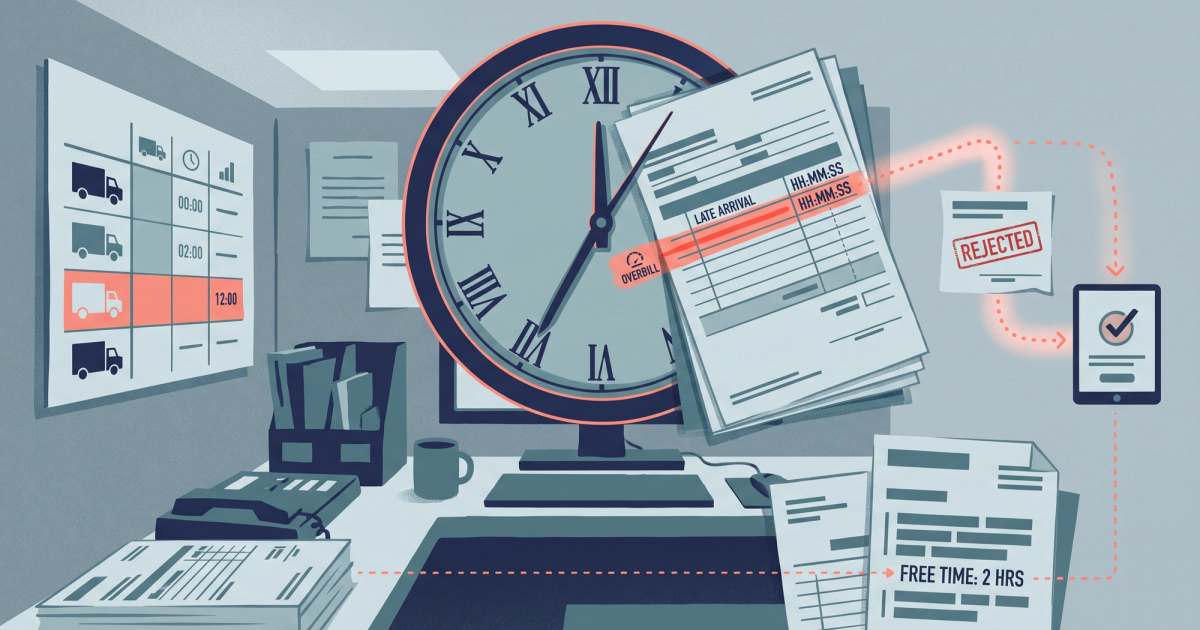
A carrier bills 3 hours of detention at $75/hour. Your billing coordinator sees a detention line item, confirms it matches a load that had a known delay, and approves payment. But the POD timestamp shows the driver was on-site for 1 hour and 42 minutes. That is a $94.50 overbill you just paid without blinking. Multiply that across 300 loads a month, and detention charge validation software stops being a nice-to-have. According to the American Transportation Research Institute (ATRI), detention cost the trucking industry $11.5 billion in 2023, driven by nearly 136 million hours of lost driver productivity. The money is enormous, and the billing errors hiding inside those charges are systemic. This post shows you the exact detention billing errors that pass manual review, what they cost in real dollars, and where automated validation catches what your team cannot.
How to Check a Carrier Detention Invoice Before You Pay It
Before you evaluate any software, you need a baseline: a step-by-step checklist for validating a carrier detention invoice manually. Most billing coordinators check whether a detention line item exists on the invoice, confirm a delay happened on that load, and approve payment. That is not validation. That is confirmation bias with a rubber stamp.
Here is what actual detention charge validation looks like, whether you do it by hand or let software handle it:
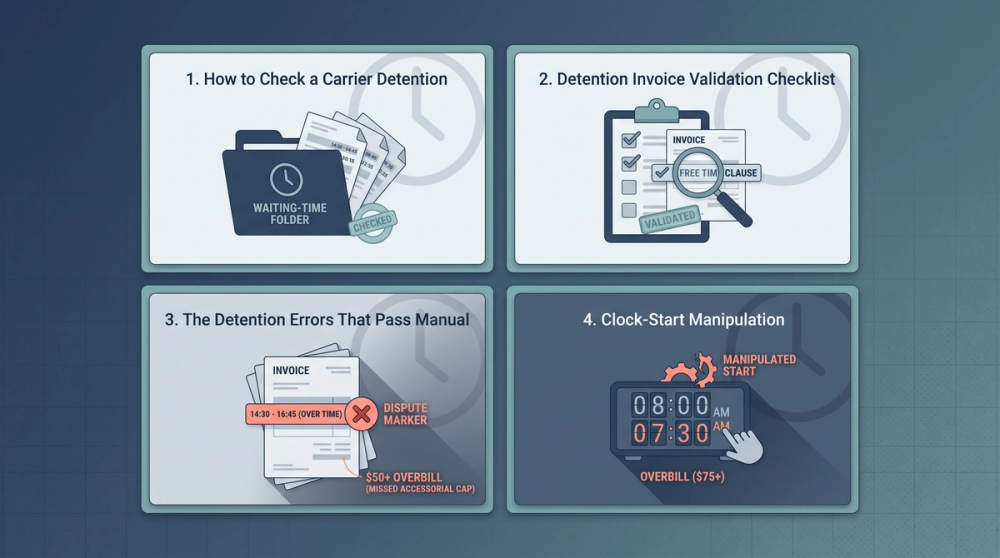
Detention Invoice Validation Checklist
- 1. Pull the rate con and find the detention clause. Confirm the free time window (usually 2 hours), the hourly or per-event rate, and any caps on total detention per load.
- 2. Pull the BOL and POD timestamps. The BOL should show arrival time. The POD should show departure time. If either document is missing a timestamp, flag it immediately.
- 3. Calculate actual on-site duration. Subtract arrival from departure. Compare that to the free time window in the rate con. Only the time exceeding free time is billable.
- 4. Verify the carrier's billable hours match your calculation. Carriers sometimes start the clock at appointment time, not at actual arrival or at the end of the free time window. This is one of the most common detention billing errors.
- 5. Check for rate mismatches. Compare the per-hour rate on the invoice to the rate con. A $75/hour rate con paired with a $100/hour invoice is a $25/hour overbill on every billable hour.
- 6. Confirm supporting documentation. Does the invoice include a signed POD, a detention letter, or facility check-in/check-out records? Per the 2024 Federal Register final rule on demurrage and detention billing, invoices must include specific minimum information. Missing documentation is grounds for dispute.
- 7. Cross-reference against accessorial caps. If the rate con caps detention at $300 per load and the invoice shows $450, that is an immediate flag.
That is seven steps per load. On 300 loads a month, even if only 15% have detention charges, that is 45 invoices needing full validation. This is where manual review breaks down, and we will get to the numbers on that shortly.
The Detention Errors That Pass Manual Review Every Time
Your billing coordinator is not incompetent. They are overwhelmed. When you are cross-referencing PDFs from three different systems (TMS, email, shared drives) while handling 60 to 80 invoices a day, you check what you can check quickly. That means verifying the line item exists, confirming the load number matches, and moving on. The errors that get through are the ones that require cross-document math.
Clock-Start Manipulation
This is the single most expensive detention billing error in the industry. The rate con specifies a 2-hour free time window. The driver arrives at 8:00 AM. The carrier invoice starts billing detention at 8:00 AM instead of 10:00 AM (when free time expires). On a 4-hour total wait, the carrier bills 4 hours instead of the correct 2 hours. At $75/hour, that is $300 invoiced versus $150 owed. A $150 overbill on a single load.
Manual review misses this because the billing coordinator sees "4 hours on-site" and "detention: $300" and it looks proportional. They would need to open the rate con, find the free time clause, recalculate the billable window, and compare. On the 40th invoice of the day, that does not happen.
Free Time Window Ignored or Miscalculated
According to FreightWaves' coverage of FMCSA's detention time survey, the 2-hour free time standard is widely referenced in the industry. But rate cons vary. Some specify 1 hour of free time. Others specify 3 hours. Some specify different windows for loading versus unloading. When a carrier invoices based on a standard 2-hour window but the rate con specifies 3 hours of free time, every billable hour on that invoice is shifted by 60 minutes. On a detention charge that costs $50 to $100 per hour, that is a consistent overbill that repeats on every load with that carrier.
TONU Charges Without Supporting Evidence
Truck Order Not Used (TONU) fees are some of the least-scrutinized line items in carrier invoices. A carrier invoices a $250 TONU claiming the shipper refused the truck. But dispatch records show the driver was reassigned to a different load by the carrier's own dispatch. No cancellation notice from the shipper. No timestamp evidence of a refused pickup. Manual review rarely questions TONU charges because they appear as single line items with no complex math to verify. But without supporting documentation (a shipper cancellation email, a facility gate log, a timestamped dispatch record) the charge is unsubstantiated. For more on how carriers overbill on detention and how to fight back, we have broken down the most common tactics in detail.
Accessorial Caps Exceeded
Lumper fees, detention caps, layover maximums. These are all written into rate cons. A carrier invoices a $250 lumper reimbursement. The rate con caps lumper reimbursement at $175. That is $75 over the agreed limit. But the billing coordinator reviewing the invoice may not have the rate con open side-by-side, or may not remember that specific load had a lumper cap. The error passes because the dollar amount looks "reasonable" in isolation. It is only unreasonable when compared to the contract.
What a $400 Overbill Actually Looks Like on a Rate Con
Let's walk through three concrete scenarios with real math. These are the kinds of errors that detention charge validation software is built to catch, and that manual review is built to miss.
Example 1: Timestamp vs. Invoice Duration Mismatch
The load: LTL pickup in Dallas, TX. Rate con specifies 2-hour free time, $75/hour detention after that. The carrier invoice: 3 hours detention at $75/hour = $225. The POD: Driver arrival at 10:15 AM. Departure at 11:57 AM. Total on-site time: 1 hour 42 minutes. The math: 1 hour 42 minutes is within the 2-hour free time window. Billable detention hours: zero. The correct charge is $0. The overbill: $225. Not $94.50 (which assumed partial billing was legitimate). The entire charge is invalid. Why manual review missed it: The coordinator confirmed a detention line item existed and that the facility had reported delays that week. They never checked the POD timestamp against the invoice duration.
Example 2: Clock-Start Shifted to Appointment Time
The load: Full truckload delivery in Atlanta, GA. Rate con specifies 2-hour free time, $75/hour detention. The carrier invoice: 4 hours detention at $75/hour = $300. Detention start time listed as the appointment time of 8:00 AM. The POD: Driver arrived at 8:00 AM. Departed at 12:00 PM. Total on-site: 4 hours. The math: Free time runs from 8:00 AM to 10:00 AM. Billable detention starts at 10:00 AM. Driver departed at 12:00 PM. Billable hours: 2 hours. Correct charge: $150. The overbill: $150. The carrier billed from the appointment time instead of from the end of the free time window. Why manual review missed it: The invoice said "4 hours on-site" and the math checked out at $75 x 4 = $300. The coordinator did not subtract free time because the invoice did not break it out separately.
Example 3: POD Filed in a Separate System
The load: Reefer delivery in Chicago, IL. Rate con specifies 2-hour free time, $75/hour detention. The carrier invoice: 1.5 hours detention at $75/hour = $112.50. Detention start time listed as 2 hours after arrival. The POD (filed in the shipper's portal, not attached to the invoice): Departure timestamp shows the driver left 47 minutes before the free time window expired. The math: The driver departed inside the free time window. Billable detention: zero. Correct charge: $0. The overbill: $112.50. The charge was fabricated or miscalculated by the carrier. Why manual review missed it: The POD was in the shipper's system. The carrier invoice was in the TMS. Nobody cross-referenced them because the documents live in different platforms. This is a problem we cover in depth in our breakdown of detention time and who controls the clock.
Manual vs. Automated Detention Validation: Where the Hours Go
Let's put real numbers on the cost of doing this by hand.
The Manual Review Math
A billing coordinator at an SMB brokerage processing 300 loads per month spends roughly 4.5 hours per week manually cross-referencing BOLs, PODs, and rate cons against carrier invoices. As of 2026-04-01, average hourly earnings in truck transportation were $32.41/hr (BLS). But billing coordinators at small brokerages typically earn closer to $22/hour. At that rate, 4.5 hours per week is $99/week, or $5,148 per year in labor cost dedicated just to invoice review.
And that labor cost assumes zero errors. The real cost is higher.
The Overbilling Math
Based on Laneproof analysis of 14,000+ carrier invoices, the average carrier overbilling rate on detention and accessorial charges is approximately 3.8%. For a broker processing 300 loads per month at an average load revenue of $1,000 to $2,000, that translates to $1,140 to $2,280 per month in overbilled charges. Annually, that is $13,680 to $27,360 in margin erosion.
Combined with the $5,148 in annual labor cost, the total annual cost of manual detention review for a 300-load-per-month broker is between $18,828 and $32,508. And the manual process still misses the majority of the errors described above.
An SMB broker processing 300 loads per month with a 3.8% carrier overbilling rate loses an estimated $13,680 to $27,360 annually in undetected detention and accessorial overbills, plus $5,148 in manual review labor costs.
What Automated Validation Does Differently
Detention charge validation software does not replace your billing team. It replaces the cross-document math they do not have time to do. Automated validation works by:
- Extracting timestamps from PODs, BOLs, and carrier invoices simultaneously, regardless of which system they are stored in.
- Matching detention clauses from the rate con (free time window, hourly rate, caps) against the invoiced amounts line by line.
- Flagging variances where the invoiced duration, rate, or total exceeds what the rate con and timestamps support.
- Checking accessorial caps (lumper fees, TONU, layover) against rate con limits automatically.
- Generating dispute-ready reports with the specific line items, the supporting documents, and the calculated variance, so your team can send a dispute email in minutes instead of building a case from scratch.
The difference is not intelligence. Your billing coordinator knows what to look for. The difference is speed and consistency. Software checks every field on every invoice against every rate con, every time. A person checks what they can before the next invoice lands in their inbox. Laneproof's invoice reconciliation engine runs these checks automatically, flagging variances before payment goes out.
How to Dispute a Detention Charge and Win It
Catching the overbill is step one. Winning the dispute is step two. Most carriers will not push back if you present the right evidence. The problem is that most brokers do not have the evidence organized when they file the dispute.
Step 1: Build the Evidence Package
Every detention dispute needs three documents minimum:
- The rate con with the detention clause highlighted (free time, rate, caps).
- The POD or BOL with arrival and departure timestamps.
- The carrier invoice with the disputed line item circled.
If you have facility check-in/check-out records, gate logs, or driver ELD data, include those too. The more timestamps you can provide from independent sources, the harder it is for the carrier to argue the charge is valid.

Step 2: Calculate the Correct Charge
Do not just say "this is wrong." Show the math. "Rate con specifies 2-hour free time at $75/hour. POD shows 3 hours 15 minutes on-site. Billable detention: 1 hour 15 minutes. Correct charge: $93.75. Invoice shows $243.75. Overbill: $150.00." That level of specificity closes disputes faster than a vague "we disagree with this charge."
Step 3: Reference the Rate Con Clause
Cite the specific section of the rate con that governs detention. If the carrier's invoice contradicts the agreed terms, the rate con is the controlling document. For loads involving ocean containers, the 2024 FMC billing rule now requires specific minimum information on demurrage and detention invoices, giving you additional regulatory backing for disputes on incomplete or inaccurate invoices. Understanding your daily container detention charges and how they accumulate is critical for intermodal disputes.
Step 4: Set a Response Deadline
Give the carrier 5 to 7 business days to respond with supporting evidence for their charge. If they cannot provide timestamps or documentation that contradicts yours, the dispute is resolved in your favor. Per Tradlinx data, 94.5% of carriers include detention in their pricing, but fewer than 50% of those claims are actually paid. Many carriers know their invoices will not survive scrutiny. A well-documented dispute often resolves with a single email.
Step 5: Track Dispute Outcomes by Carrier
If a carrier consistently overbills detention, you need to know that before you book them again. Track dispute rates by carrier, by lane, and by facility. Patterns emerge quickly. A carrier that overbills detention 20% of the time is either sloppy or deliberate, and either way, it is costing you money.
Frequently Asked Questions About Detention Charge Validation
How do you check container detention charges?
Pull the rate con or tariff to confirm the free time window and per-hour (or per-day) rate. Then pull the BOL and POD to verify actual arrival and departure timestamps. Calculate total on-site or in-yard time, subtract free time, and multiply the remaining hours or days by the agreed rate. Compare your calculation to the carrier invoice line by line. Any variance is a dispute candidate. For a deeper walkthrough, see our demurrage and detention audit guide.
How do you reduce detention charges?
You reduce detention charges in two ways: operationally (scheduling tighter appointment windows, reducing facility dwell time) and financially (auditing every detention invoice against rate con terms and timestamps). Most brokers focus on the operational side and ignore the financial side. Auditing catches charges you should never have paid in the first place. That is immediate margin recovery, not a process improvement that takes months to show results.
What is PCD in shipping terms?
PCD stands for Port Cutoff Date (or sometimes Per Container per Day). In container shipping, it refers to the last date cargo can be received at the port for loading onto a specific vessel. Missing a PCD can trigger additional detention and storage charges as the container sits waiting for the next available vessel. The term is most common in ocean freight and intermodal operations.
How do you calculate container detention charges?
Container detention is typically calculated per day, not per hour. Identify the free time period (often 3 to 7 days depending on the carrier and trade lane). Count the number of calendar days from when the container was picked up to when it was returned to the terminal. Subtract the free days. Multiply remaining days by the daily detention rate, which often increases in tiers (for example, $75/day for days 1 through 4, then $150/day after that). Always verify the tier structure against the tariff or rate con.
What documentation do I need to dispute a detention charge?
At minimum, you need the rate confirmation with the detention clause, the proof of delivery (POD) or bill of lading (BOL) showing timestamps, and the carrier invoice with the disputed line item. Stronger disputes also include facility gate logs, ELD records, and any email correspondence about the delay. The FMCSA has been collecting data on driver detention time to better understand its impact, and detailed documentation positions you on the right side of any future regulatory requirements.
Sources
- ATRI Study: Detention Costs Trucking Industry $11.5B — American Transportation Research Institute
- FMCSA Details New Truck Driver Detention Time Survey — FreightWaves
- Demurrage and Detention Billing Requirements (2024 Final Rule) — Federal Register
- Estimates Show Commercial Driver Detention Increases — DOT Office of Inspector General
- What Are Detention Charges and How eBOLs Stop Them — Vector
- Over 90% Charge Detention. Fewer Than 50% Get Paid — Tradlinx
- BLS Current Employment Statistics: Average Hourly Earnings, Truck Transportation — Bureau of Labor Statistics
Stop Paying Detention Charges You Don't Owe
The math is not complicated. Carrier detention invoices contain errors. Manual review catches some of them. It misses the ones that require cross-document validation: timestamp comparisons, free time calculations, rate con clause matching, and accessorial cap checks. Those are the errors that cost you $13,680 to $27,360 a year on 300 loads per month.
You have two options. Build a rigorous manual checklist (use the one above) and dedicate the labor hours to execute it on every invoice. Or let detention charge validation software do the cross-referencing automatically, flagging variances before payment goes out. Either way, stop approving detention charges without checking the timestamps, the free time clause, and the rate con caps. The money you are losing is not hidden. It is sitting on invoices your team does not have time to fully review.
If you want to see what automated validation catches on your actual invoices, Laneproof's pricing page has details on getting started.
Related: Detention Charges in Trucking: Document, Calculate, and Win Disputes