Detention Billing: How to Prove the Clock Started and Get Paid
Researched and written with AI assistance. Reviewed by the Laneproof team.
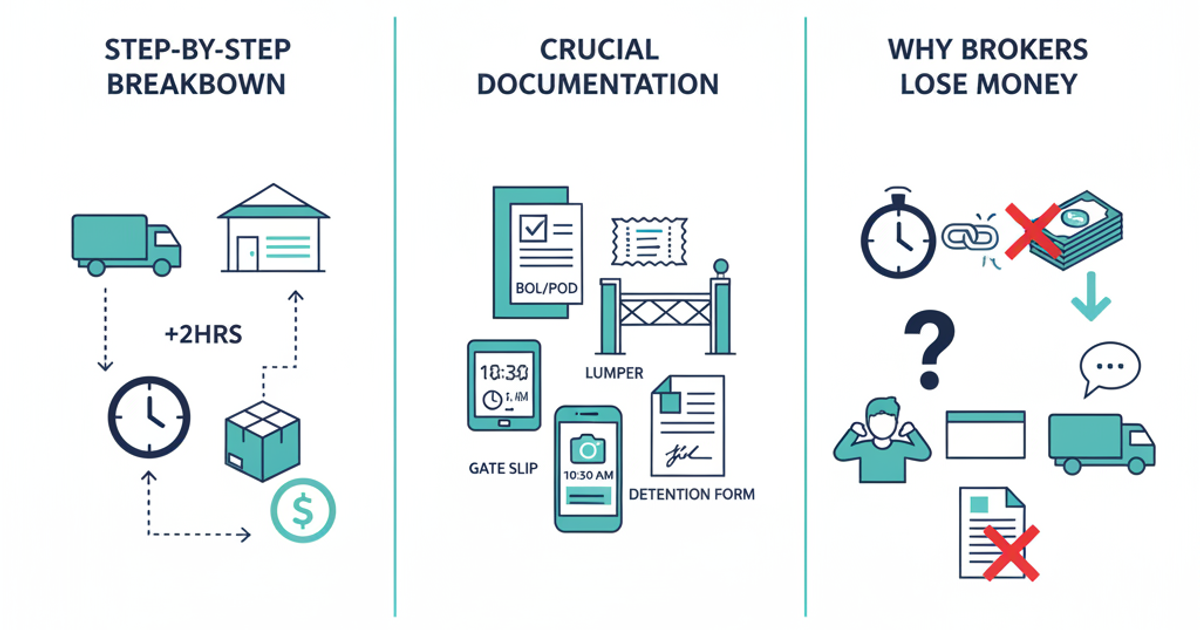
Detention billing is the process of invoicing for time a truck driver spends waiting at a shipper or receiver facility beyond the agreed free time window, typically two hours. It is the single most disputed accessorial charge in trucking, and for good reason: the for-hire trucking industry lost 135.9 million hours to detention in 2023, equating to $11.5 billion in lost revenue, according to PrePass Alliance. Yet most brokers who try to bill for detention or fight a carrier detention invoice lose the dispute, not because the time was not spent, but because they cannot prove when the clock started or stopped. This guide changes that. You will learn exactly what to collect at the dock, how to calculate the charge down to the minute, and how to build a detention invoice that neither carriers nor shippers can easily reject.
What Is Detention Billing and When Does the Clock Actually Start?
Detention billing covers the cost of holding a driver and truck at a facility past the contractually allowed free time. In most rate confirmations, free time is two hours from either the scheduled appointment time or the driver's check-in time, depending on the language in the rate con. According to OTR Solutions' breakdown of detention pay mechanics, the industry standard is two hours of free time before detention charges begin accruing. That distinction, appointment time versus check-in time, is where most disputes start.
Appointment Time vs. Check-In Time
If your rate confirmation says "free time begins at scheduled appointment," a driver who shows up 30 minutes early does not start the detention clock early. Free time begins at the appointment hour. If the rate con says "free time begins at check-in," the clock starts the moment the driver signs in at the guard shack or dock office. This matters more than most brokers realize. A carrier who invoices detention starting at arrival time when the rate con specifies the appointment time as the trigger can overbill by $75 to $150 per load. We will walk through exactly this scenario later in the article.
Who Is Responsible for Paying Detention Charges?
Responsibility depends on the contract chain. Brokers typically owe detention to carriers when the carrier's rate confirmation includes detention terms and the wait was caused by the shipper or receiver. Shippers or receivers owe the broker (or the carrier directly, depending on the arrangement) when their facility caused the delay. As FreightWaves reported, truckers are actively pushing FMCSA to make brokers pay for detention time more consistently, which means regulatory pressure on brokers to pay carriers is increasing. If you are a broker, this means you need to be equally aggressive about billing shippers, or you absorb the cost. Understanding who controls the clock and who pays for detention time is the foundation of protecting your margin.
Detention vs. Demurrage: The Difference That Decides Who Pays
These two terms get used interchangeably in casual conversation, but they are legally and operationally different. Confusing them can cost you a dispute.
Detention: Over-the-Road Trucking
Detention applies to trucking. It is the charge for holding a driver at a pick-up or delivery facility beyond the free time window. The driver stays with the truck. The meter runs. According to Truckstop.com's industry benchmark data, the average detention fee is approximately $85 per hour, intended to cover driver pay and carrier operating costs during the wait.
Demurrage: Ocean and Intermodal
Demurrage applies to containers at ports or rail yards. It is the charge for keeping a container on terminal property beyond the allotted free time. The Federal Register's final rule on demurrage and detention billing requirements established specific invoicing standards for ocean carriers and marine terminal operators, including content requirements and a 30-day issuance deadline. The corresponding 46 CFR § 541.7 regulation codifies the requirement that demurrage and detention invoices must be issued within 30 calendar days of the charge being incurred.
For brokers handling drayage, this distinction matters because a single shipment can incur both demurrage (at the port) and detention (at the warehouse). You need separate documentation for each, and different rules govern each charge. If you are dealing with over-the-road freight exclusively, detention is your concern, and the rest of this guide focuses there.
What You Need to Collect at the Dock Before You Can Bill Anything
This is where most brokers fail. Not because they do not know what detention is, but because they do not collect the right proof at the right time. A driver calls and says, "I've been sitting here for three hours." You believe them. But belief does not win disputes. Timestamps do.
Here is the documentation checklist, in order of priority:
The Non-Negotiable Documents
- Check-in timestamp: The facility's sign-in sheet, gate log, or guard shack record showing the exact time the driver arrived and checked in. Digital check-in systems (like those at major DCs) are ideal because they are harder to dispute.
- Dock release timestamp: The time the driver was released from the dock, either on the BOL, the delivery receipt, or the facility's outbound log. This is the single most important piece of paper in a detention dispute.
- Rate confirmation with detention terms: The rate con must specify: free time duration, when free time starts (appointment vs. check-in), the hourly or flat detention rate, and any cap on total detention charges.
- BOL or POD with timestamps: The bill of lading or proof of delivery should show arrival, loading/unloading start, and completion times. If your BOL does not have a timestamp field, add one to your template today.
The Documents That Strengthen Your Case
- Driver's ELD or GPS data: Electronic logging device records showing the truck was stationary at the facility coordinates during the claimed detention period.
- Facility appointment confirmation: An email or system screenshot proving the scheduled appointment time, which anchors your free time calculation.
- Photos of the check-in board or dock assignment screen: Many large receivers have digital boards showing driver queue position and estimated wait times.
- Communication records: Texts, emails, or TMS notes between the driver, dispatcher, and facility showing real-time updates on the wait.
Every minute you cannot prove is a minute you cannot bill. Train your drivers and dispatchers to treat dock check-in like a crime scene: document everything with timestamps and photos before leaving the facility.
How to Calculate a Detention Charge and Build an Invoice That Holds Up
Calculating detention is straightforward math. Building an invoice that survives a dispute requires precision in how you present that math.
The Basic Detention Calculation
Example: A driver arrives at a grocery DC at 10:00 AM for a scheduled 10:00 AM appointment. The rate confirmation specifies 2 hours of free time and a detention rate of $75/hour. The dock release timestamp on the delivery receipt shows 2:47 PM.
- Free time window: 10:00 AM to 12:00 PM (2 hours)
- Billable detention starts: 12:00 PM
- Dock release: 2:47 PM
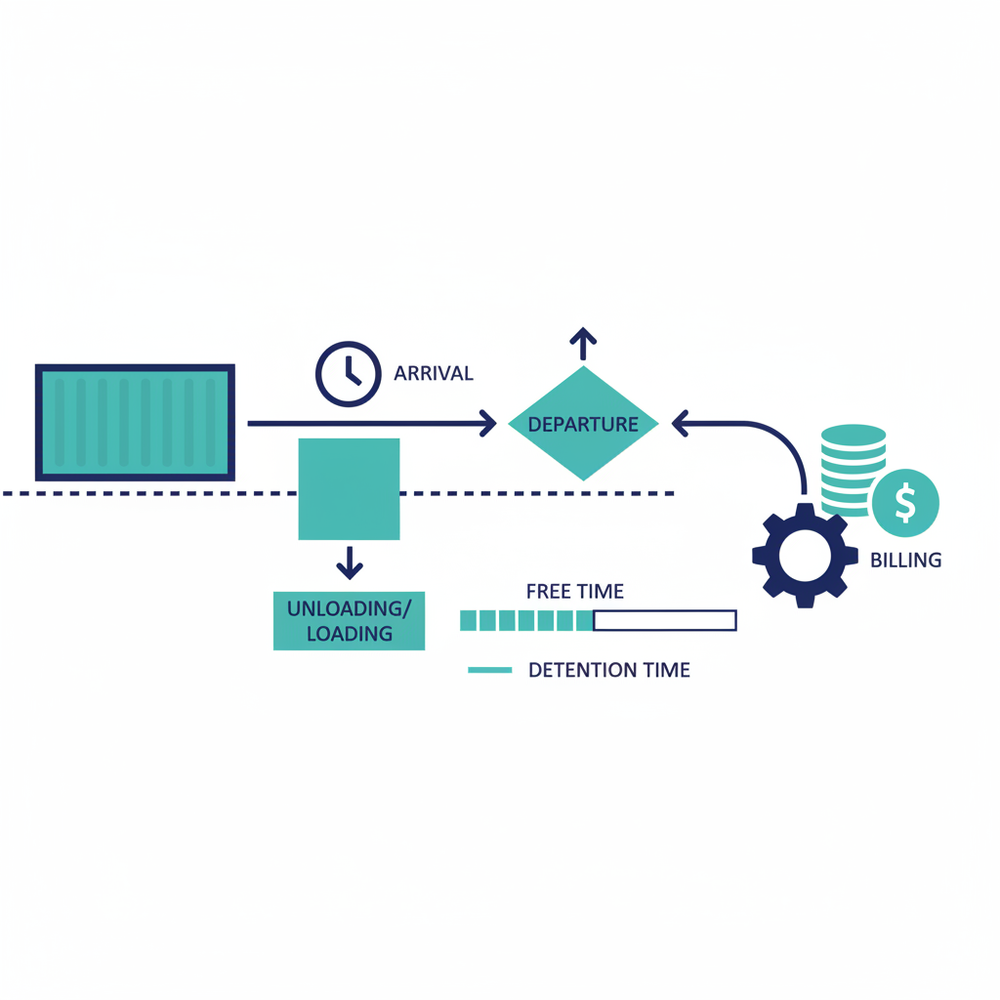
- Total billable time: 2 hours and 47 minutes
- Calculation: 2.78 hours × $75/hour = $208.75
Your invoice should show each of these line items explicitly: arrival time, free time start, free time end, detention start, release time, total billable hours, rate, and total charge. Attach the check-in log and dock release receipt as supporting documents.
What a Compliant Invoice Looks Like vs. What Most Carriers Send
Scenario: A reefer load arrives at a grocery DC. The driver checks in at 7:15 AM for a 7:00 AM appointment. The shipper does not release the driver until 10:45 AM. The rate con specifies 2 hours of free time starting at appointment time and an $85/hour detention rate.
A compliant detention invoice includes:
- Appointment time: 7:00 AM (with appointment confirmation attached)
- Free time window: 7:00 AM to 9:00 AM
- Detention start: 9:00 AM
- Release time: 10:45 AM (with timestamped delivery receipt attached)
- Billable hours: 1 hour 45 minutes (1.75 hours)
- Total charge: 1.75 × $85 = $148.75
What most carriers actually send: A single line item saying "Detention: $255" with no timestamps, no supporting documents, and detention calculated from the 7:15 AM check-in time instead of the 7:00 AM appointment time. That is an overbill of $106.25 on a single load. Multiply that across hundreds of loads per month and the margin erosion is significant. Learning how carriers overbill on detention charges and how to catch it is essential for protecting your bottom line.
Why Most Brokers Lose Detention Revenue (It Is Not the Carrier Refusing to Pay)
According to Tradlinx industry data, 94.5% of carriers include detention or accessorial fees in their pricing, yet fewer than 50% of those claims are actually paid. The gap is not because shippers and receivers flat-out refuse to pay. It is because the claims are poorly documented, filed late, or calculated incorrectly.
94.5% of carriers charge detention, but fewer than 50% of those claims are actually paid. The problem is not refusal. It is proof.
The Three Reasons Detention Claims Die
1. No timestamps on the BOL or delivery receipt. A driver's verbal statement that they waited three hours is not evidence. Without a facility check-in log or a timestamped BOL, your claim has no foundation. This is the most common failure.
Scenario: A broker files a $340 detention claim. The driver waited over four hours at a receiver in Atlanta. The only proof is the driver's call to dispatch saying "I've been here since 8 AM and they just now unloaded me." There is no check-in timestamp on the BOL. No dock release time on the delivery receipt. No gate log. The shipper's accounting team rejects the claim in one email: "No documentation of arrival or release time." $340 gone.
2. The invoice does not match the rate con terms. If the rate con says free time starts at the appointment and the invoice calculates from check-in, the math is wrong and the claim is rejected. If the rate con caps detention at 4 hours and the invoice bills for 5, the entire invoice gets kicked back instead of just the overage.
3. The claim is filed too late. Many shipper contracts require detention claims within 7 to 30 days of delivery. According to the OOIDA's 2023 Detention Time Survey, motor carriers lose between $250.6 million and $302.9 million in net income every year due to detention. A significant portion of that loss comes from claims that are technically valid but filed past the contractual deadline.
The Hidden Cost: Reconciliation Labor
Scenario: A broker processing 300 loads per month has a 12% detention dispute rate. That is 36 disputed loads per month. Each dispute requires pulling the BOL, matching it against the rate con, checking timestamps, and building a response. At roughly 10 minutes per dispute, that is 6 hours per week of manual reconciliation work. At $25/hour for a billing coordinator, that comes to $7,800 per year spent just on pulling documents and verifying timestamps. Not resolving disputes. Just gathering proof.
The problem scales with volume. At 500 loads per month with the same dispute rate, you are looking at over $13,000 per year in reconciliation labor. That is before you count the detention revenue you lose because the proof was not there.
How to Dispute a Detention Invoice When You Are on the Receiving End
Sometimes you are not billing detention. You are receiving a carrier detention invoice and need to verify whether it is accurate. Here is how to audit one in under five minutes.
Step 1: Compare the Rate Con Against the Invoice
Pull the rate confirmation and check three things:
- Free time trigger: Does the rate con say free time starts at appointment time or check-in time? If the carrier invoiced from check-in but the rate con says appointment, recalculate.
- Detention rate: Does the invoiced rate match the rate con? A carrier billing $100/hour when the rate con says $75/hour is a simple catch, but it happens more often than you would expect.
- Detention cap: Does the rate con cap total detention at a certain number of hours or dollar amount? If the invoice exceeds the cap, you have grounds to reject the overage.

Step 2: Match Timestamps Against Facility Records
Scenario: A carrier invoice shows detention starting at arrival time of 9:30 AM. The rate confirmation specifies free time begins at the scheduled appointment time of 10:00 AM. Two hours of free time means detention should not start until 12:00 PM. The carrier's own check-in log confirms a 10:00 AM appointment. The dock release time is 1:00 PM.
The carrier billed: 9:30 AM to 1:00 PM minus 2 hours free time = 1.5 hours at $100/hour = $150. The correct calculation: 12:00 PM to 1:00 PM = 1 hour at $100/hour = $100. That is a $50 overbill on one load, but across 20 similar loads per month, it adds up to $1,000 in monthly overbilling. For a deeper breakdown of how to fight back against detention charge overbilling, including common carrier tactics, see our full guide.
Step 3: Check for Ambiguous Accessorial Language
Example: A lumper delay adds 90 minutes to dock time. The carrier's detention invoice includes that 90 minutes. But the rate con says detention covers "wait time due to shipper or receiver delays." Is a lumper delay a receiver delay? If the rate con does not explicitly include lumper-related wait time in the detention definition, you have grounds to dispute that 90 minutes. At $85/hour (the average detention fee per Truckstop.com), that ambiguity costs you approximately $127.50 per load. Across disputed loads, brokers lose an average of $180 per occurrence to this kind of vague accessorial billing language.
The fix is preventive: add explicit language to your rate confirmations defining what types of delays count toward detention and what does not. List lumper time, weather delays, and equipment inspections specifically. Ambiguity always favors whoever did not write the contract.
Step 4: Respond in Writing Within the Dispute Window
Do not call the carrier to negotiate. Put your dispute in writing (email) with the following attached:
- The rate confirmation highlighting the relevant detention terms
- The facility check-in log or timestamped BOL
- Your recalculation with line-by-line math
- A clear statement of the amount you accept (if any) and the amount you dispute
Written disputes create a paper trail. Phone calls do not. If the dispute escalates, your email chain is your evidence. For more detail on how to win freight detention charge disputes, including templates and escalation strategies, we cover the full process separately.
Frequently Asked Questions About Detention Billing
What is detention billing?
Detention billing is the process of invoicing for time a truck driver spends waiting at a pick-up or delivery facility beyond the contractually agreed free time period. Most rate confirmations allow two hours of free time before detention charges begin. The charge compensates the carrier for lost productivity while the driver and equipment sit idle.
What is the difference between detention and demurrage?
Detention applies to trucking and covers wait time at shipper or receiver facilities. Demurrage applies to ocean containers and covers time a container sits at a port or terminal beyond the allotted free time. A single drayage shipment can incur both charges. The FMC's demurrage and detention billing requirements govern ocean-side billing standards, while trucking detention is governed by the terms in your rate confirmation and carrier-broker agreement.
What is the final rule on demurrage and detention billing requirements?
The FMC's final rule, published in the Federal Register in February 2024, requires ocean carriers and marine terminal operators to issue demurrage and detention invoices within 30 calendar days of the charge being incurred. Per 46 CFR § 541.7, invoices must include specific content such as the container number, dates of free time, and the basis for the charges. While this rule applies to ocean shipping, not over-the-road trucking, it sets a precedent for billing transparency that many in the trucking industry reference when arguing for clearer detention invoicing standards.
Who is responsible for paying detention charges?
The party responsible depends on the contract chain. In a brokered load, the broker typically owes the carrier per the rate confirmation terms, and the broker then bills the shipper or receiver per their contract. The party that caused the delay (usually the shipper or receiver facility) is ultimately responsible, but collecting depends entirely on your documentation. According to Inbound Logistics reporting, drivers were detained at 39.3% of all stops in 2023, which means the billing volume, and dispute volume, is enormous.
How much does detention pay typically cost?
According to Truckstop.com, the average detention fee is approximately $85 per hour. Rates vary by carrier, lane, and contract. Some rate confirmations use flat fees (e.g., $200 for any detention beyond free time), while others use hourly rates ranging from $50 to $150 per hour. The rate should be specified in the rate con before the load is dispatched, not negotiated after the fact.
Stop Losing Detention Revenue to Bad Documentation
Detention billing is not complicated math. It is a documentation discipline. The brokers who collect detention consistently are the ones who treat every dock visit as a potential dispute and prepare accordingly. Get the check-in timestamp. Get the dock release timestamp. Match everything against the rate con. File the claim within the deadline. Put disputes in writing.
The 94.5% of carriers who charge detention but fail to collect half the time are not losing because shippers are dishonest. They are losing because they cannot prove the clock. The same applies to brokers billing shippers. If your team processes more than 50 carrier invoices per week and spends hours pulling BOLs and matching timestamps, automated tools that flag detention invoice discrepancies against rate confirmation terms can cut that reconciliation time significantly and catch the overbills covered in this guide before they hit your margin.
Sources
- 2023 Detention Time Survey — OOIDA
- Truckers push FMCSA to make brokers pay for detention time — FreightWaves
- Demurrage and Detention Billing Requirements — Federal Register
- 46 CFR § 541.7 - Issuance of demurrage and detention invoices — Cornell Law Institute
- Understanding Trucking Detention Pay for Carriers and Freight Brokers — Truckstop.com
- Understanding the Impact of Truck Driver Detention — Inbound Logistics
- Addressing the Ongoing Problem of Driver Detention — PrePass Alliance
- Over 90% Charge Detention. Fewer Than 50% Get Paid — Tradlinx
Related: Detention Charges in Trucking: Document, Calculate, and Win Disputes
Related: Demurrage Charges: When to Pay and When to Push Back