How to Win Freight Invoice Disputes Without Burning Carriers
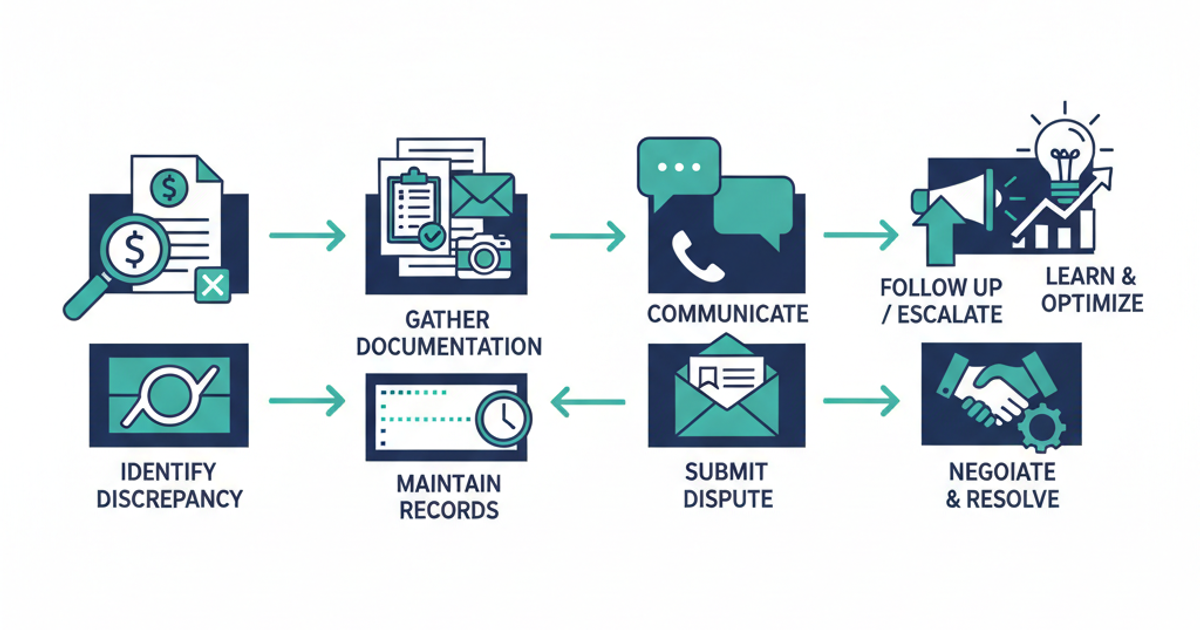
A broker running 800 loads per month finds that 3.8% of carrier invoices contain billing variances. That works out to roughly 30 invoices every month, averaging $127 per discrepancy, or $3,810 in margin leak that never shows up as a line item on anyone's P&L. Over a year, that's $45,720 gone. Not because the loads went sideways. Because nobody had a freight invoice dispute process that could catch it, document it, and recover the money before the carrier moved on. The frustrating part: most of these variances are recoverable. Detention overcharges, lumper fees with no receipts, accessorials that weren't on the rate con. But only if you dispute them fast, with the right documentation, and through a process that doesn't turn every billing disagreement into a relationship problem. This guide gives you that process, from first flag to final resolution, with email scripts, escalation timelines, KPIs, and the benchmarks that tell you whether your dispute workflow is actually working.
How Much Are Invoice Disputes Actually Costing Your Brokerage?
Most brokers know they're losing money to carrier billing discrepancies. Few know exactly how much. The problem isn't a single $250 detention overcharge. It's the compounding effect of dozens of small variances across hundreds of loads, none of which seem worth fighting individually, all of which add up to a material dent in gross margin.
Here's how the math works at different scales. At 200 loads per month with a 3.8% discrepancy rate, you're looking at about 7 to 8 disputed invoices per month. At $127 average per discrepancy, that's roughly $950 per month, or $11,400 per year. At 800 loads per month, those numbers climb to $3,810 monthly and $45,720 annually. At 2,000 loads, you're approaching $10,000 per month in billing variances. These aren't theoretical numbers. They come from aggregated audit data across small and mid-size brokerages.
The real cost goes beyond the dollar amount on the invoice. Every unresolved dispute carries hidden overhead: the time your billing coordinator spends pulling up rate cons and BOLs, the back-and-forth emails with carrier AP departments, the delayed payments that create friction with carriers you actually want to keep using. And here's what makes it worse. When you don't have a documented freight invoice dispute process, you end up making ad hoc decisions about which disputes to pursue and which to let go. That inconsistency signals to carriers that your shop doesn't audit closely, which, intentionally or not, invites more billing variances over time.
Step 1: Catch the Discrepancy Before You Pay It
The single most important rule in dispute management: do not pay an invoice you haven't matched against the rate con, BOL, and POD. It sounds obvious, but when your billing coordinator is processing 40 to 60 invoices a day, the default becomes pay now, audit later. And "later" almost never happens.
What to Match on Every Invoice
Every incoming carrier invoice should be checked against three documents: the signed rate confirmation, the bill of lading, and the proof of delivery. Specifically, you're matching the linehaul rate on the invoice to the agreed rate on the rate con. You're comparing any accessorial charges (detention, lumper, TONU, layover) against what was authorized. You're verifying detention hours by comparing carrier claimed time against BOL and POD timestamps. And you're confirming that any lumper fees have attached receipts that match the invoiced amount.
Here's a real example. A carrier submits an invoice billing 6 hours of detention at $75 per hour, totaling $450. Your billing coordinator pulls the BOL and sees the arrival timestamp was 10:15 AM. The POD shows departure at 12:55 PM. That's 2 hours and 40 minutes, not 6 hours. The correct detention charge is $200. That's a $250 overcharge caught by a single document comparison. Another common scenario: a lumper fee billed at $350 with no receipt attached, on a load where the rate con shows $0 lumper authorized. That's a full $350 recovery waiting to happen with a single email referencing the signed rate confirmation.
Manual Matching vs. Automated Flagging
A billing coordinator manually cross-referencing invoices against rate cons and BOLs typically spends 6 to 8 hours per week on this task. That's for a brokerage doing 400 to 800 loads per month. At higher volumes, it becomes a full-time job, and accuracy drops as fatigue sets in. Automated document extraction tools can flag variances in under 2 minutes per load by pulling data from scanned rate cons, BOLs, and invoices, then comparing amounts automatically. If your team is spending more time finding discrepancies than resolving them, that's a sign the detection layer needs to change. Laneproof's document extraction tool at /tools/document-extract was built specifically for this: pulling structured data from freight documents so variances get flagged before anyone clicks "approve."
Step 2: Build a Dispute File That Carriers Can't Push Back On
Catching the discrepancy is step one. But if you send a vague email saying "this invoice doesn't look right," expect to get ignored. Carriers push back on disputes that lack documentation. They accept disputes that are backed by evidence they can verify in 60 seconds.
What Goes in a Dispute File
Every dispute file should include five things. First, the original carrier invoice with the disputed line item highlighted or clearly identified. Second, the signed rate confirmation showing the agreed rate and any authorized accessorials. Third, the BOL and POD with timestamps visible, especially for detention disputes. Fourth, a brief written summary stating the specific discrepancy: what was billed, what should have been billed, and the dollar difference. Fifth, any supporting communication, such as dispatch notes, check call logs, or emails where the carrier acknowledged specific conditions.
The goal is to make it easy for the carrier's AP team to verify your claim without needing to research anything. Carrier AP departments process hundreds of disputes. The ones that get resolved fastest are the ones where every relevant document is attached in a single email, with the dollar discrepancy stated clearly in the subject line. Package it tight, reference specific numbers, and you'll recover faster than 90% of brokers who send incomplete dispute emails and then wonder why they get ghosted.
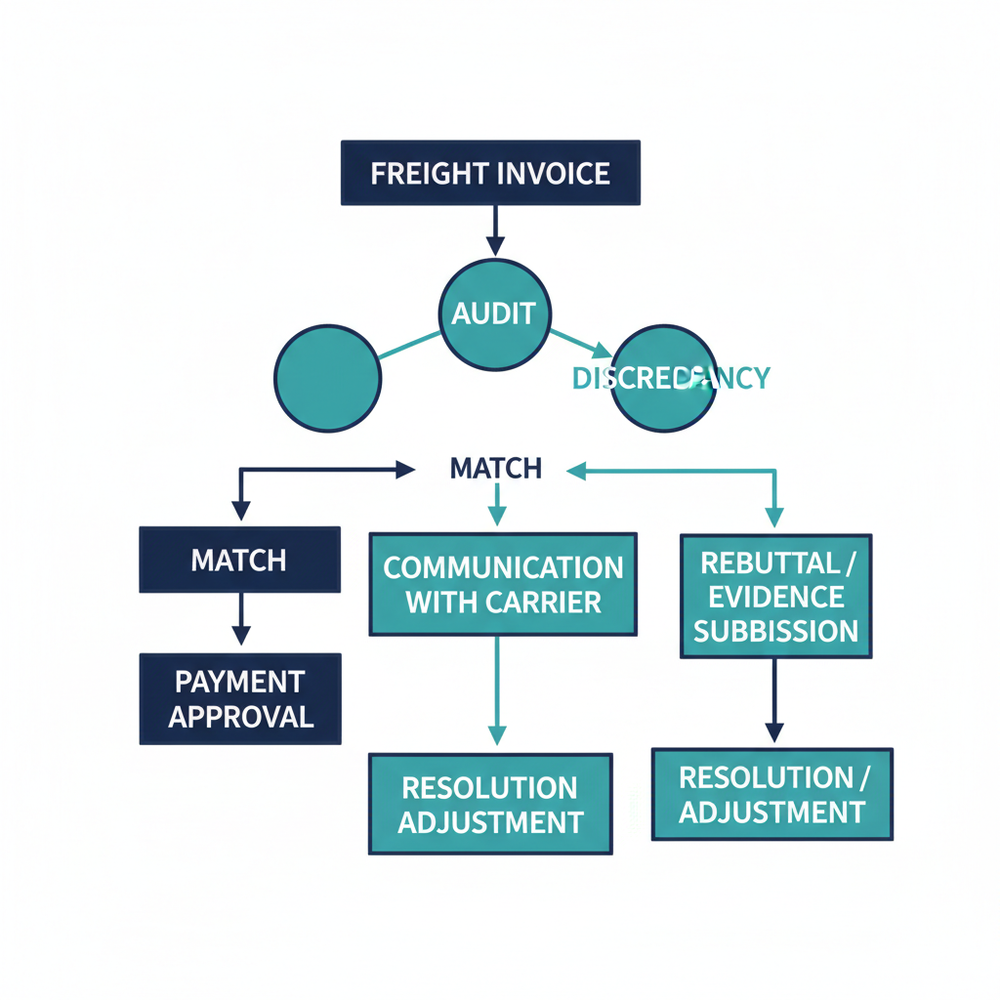
Step 3: Send the Dispute: Email Scripts That Get Responses, Not Ghosted
Tone matters. You want to be firm, factual, and professional. Not aggressive. Not apologetic. The carrier is a business partner you may need again next week. The email should make it easy for them to say "you're right, we'll credit it" rather than feel attacked.
Dispute Email Template: Detention Overcharge
Subject: Invoice Dispute, [Your Company] / Load [Load Number], $250 Detention Variance. Body: Hi [Carrier AP Contact], we're reviewing invoice [Invoice Number] for load [Load Number], picked up [date] at [origin] and delivered [date] at [destination]. The invoice includes a detention charge of $450 (6 hours at $75/hr). Per the BOL and POD timestamps attached, actual facility time was 2 hours 40 minutes. Based on the agreed detention rate of $75/hr, the correct charge is $200. We're requesting a corrected invoice reflecting a $200 detention charge, or a credit memo for $250. Attached: original invoice, signed rate confirmation, BOL with timestamps, POD with timestamps. Please confirm receipt and expected timeline for resolution. Thank you, [Your Name].
Dispute Email Template: Unauthorized Lumper Fee
Subject: Invoice Dispute, [Your Company] / Load [Load Number], $350 Lumper Fee Not Authorized. Body: Hi [Carrier AP Contact], invoice [Invoice Number] for load [Load Number] includes a lumper fee of $350. The signed rate confirmation (attached) does not authorize lumper fees for this load, and no lumper receipt was provided with the invoice. We're requesting removal of the $350 lumper charge and a corrected invoice or credit memo. Attached: original invoice, signed rate confirmation. Please confirm receipt. Thank you, [Your Name].
Notice the pattern. Both emails state the specific dollar amount in the subject line, reference the exact documents that prove the discrepancy, attach everything the carrier needs to verify, and ask for a specific resolution (corrected invoice or credit memo). No accusations. No lengthy explanations. Just facts and documents.
Step 4: What to Do When a Carrier Denies Your Dispute
Not every dispute gets accepted on the first email. Some carriers will push back, claim different timestamps, or simply not respond. You need an escalation path that's consistent and documented.
A Four-Stage Escalation Timeline
Here's an escalation path that works for most brokerages. Day 1: send the initial dispute email to the carrier's AP contact with full documentation. Day 7: if no response, send a follow-up email to the same AP contact, reply to the original thread so they can see the full history, and add a line: "Please confirm receipt of this dispute. If we don't hear back by [date], we'll escalate to your operations team." Day 14: escalate to the carrier's ops manager or owner. Forward the original email thread with a brief note explaining that the dispute has been unresolved for two weeks and you're requesting their direct involvement. Day 30: if still unresolved, send written notice that you will offset the disputed amount against the next scheduled payment to that carrier. Cite the specific rate con clause that supports this (most rate cons include offset language). Important: always provide written notice before offsetting. Surprise offsets without documentation are the fastest way to destroy a carrier relationship and invite legal headaches.
Brokerages that file disputes within 5 business days of invoice receipt recover 74% of disputed dollars. When disputes are filed after 15 or more days, recovery drops to 41%. Speed is the single biggest factor in dispute resolution success.
That benchmark alone should reshape your dispute workflow. If your process has invoices sitting in a queue for a week before anyone even looks at them, you're leaving recoverable dollars on the table every single day.
Step 5: Track Every Dispute: The KPIs That Tell You If Your Process Is Working
Filing disputes without tracking outcomes is just paperwork. You need a small set of KPIs that tell you whether your freight invoice dispute process is actually recovering money and reducing future overbilling.
The Dispute KPI Dashboard You Should Be Running
Here are the metrics that matter. Disputes filed per month: how many invoices are you flagging? If this number is zero, you're not auditing. If it's climbing every month, you either have a carrier quality problem or you're getting better at catching variances. Average days to resolution: from the date you file the dispute to the date you receive a credit memo or corrected invoice. Target: under 14 days. Recovery rate percentage: of the total dollars disputed, what percentage did you actually recover? A healthy benchmark is 65% to 80%. Below 50% means your documentation is weak or your escalation process isn't working. Top 5 carriers by dispute volume: which carriers are generating the most billing discrepancies? This is the list that feeds directly into your carrier scorecards and re-negotiation conversations. Total dollars recovered per quarter: the bottom line number. This is the figure that justifies investing time and tools into your dispute process. When your team can point to $15,000 recovered last quarter, nobody questions why you're spending time on invoice audits.
Track these in a spreadsheet if you have to. But if you're running more than 300 loads per month, a dedicated reconciliation workflow saves significant time. Laneproof's reconciliation tool at /tools/reconcile tracks dispute status, resolution timelines, and recovery amounts automatically, so your team spends time resolving disputes instead of updating spreadsheets.
Step 6: Feed Dispute Data Back Into Carrier Scorecards and Rate Negotiations
Dispute data is operational intelligence. Most brokerages treat it as a billing cleanup task. The smart ones use it to make better carrier decisions.
How Dispute History Changes the Conversation
When you sit down to renegotiate rates with a carrier, knowing that they've had 12 billing discrepancies in the last quarter, totaling $1,900 in overcharges, changes the dynamic entirely. You're not guessing about reliability. You have data. Build dispute history into your carrier scorecards alongside on-time performance, claims ratio, and communication responsiveness. A carrier that's cheap on linehaul but consistently overbills on detention and accessorials might actually be more expensive than a carrier with a slightly higher rate and clean invoices.
This also works as a retention and improvement tool. Share dispute data with carriers you want to keep. Frame it as: "We want to keep using you on this lane. Here's what we're seeing on the billing side. Can we fix this?" Most good carriers will tighten up their invoicing when they know you're tracking it. The ones who don't are telling you something about how they run their back office, and that information is worth knowing before you commit more volume.
Manual vs. Automated Dispute Workflows: When to Switch
If you're running under 200 loads per month and your billing coordinator has bandwidth, a manual process with good templates and a tracking spreadsheet can work. You'll spend 6 to 8 hours per week on it. The ROI is there as long as someone is actually doing the work consistently.
Where Manual Breaks Down
Manual breaks down at around 400 to 500 loads per month. At that volume, invoice matching alone eats 8 to 10 hours per week, and the billing coordinator starts triaging, only auditing invoices above a certain dollar threshold or only checking carriers they've had problems with before. That selective auditing means smaller variances ($50 to $100 range) go undetected. Across 400 loads, those small misses add up fast.
Automated workflows change the equation by handling the detection layer. Instead of a person manually opening each invoice, pulling the rate con, and comparing line items, the system extracts data from both documents and flags mismatches automatically. The human still reviews the flagged items and decides whether to dispute. But they're spending 15 to 20 minutes per day on dispute decisions instead of 8 hours per week on document comparison. That's the difference between a dispute process that runs consistently and one that only runs when someone has time.
Signs It's Time to Automate
You should consider moving to automated matching when any of the following are true: your billing coordinator is spending more than 6 hours per week on invoice matching, your dispute filing is inconsistent (some weeks you catch everything, some weeks you catch nothing), you're processing over 400 loads per month, you can't produce dispute KPIs because you're not tracking outcomes systematically, or carriers are submitting invoices with scanned or image-based documents that slow down manual comparison. If three or more of those apply, you've outgrown a spreadsheet. Check Laneproof's pricing at /pricing to see what automated matching and dispute tracking looks like at your load volume.
Your Freight Invoice Dispute Process Checklist
Here's the full process distilled into a repeatable checklist. Print it, pin it next to your billing coordinator's monitor, and run every invoice through it.
- Match every carrier invoice against the signed rate con before approving payment - Compare detention hours on the invoice against BOL and POD timestamps - Verify that all invoiced accessorials (lumper, TONU, layover, fuel surcharge) were authorized on the rate con - Require lumper receipts for any lumper fee billed; reject invoices missing receipts - Build a dispute file with the invoice, rate con, BOL, POD, and a written summary of the discrepancy - Send the dispute email within 5 business days of invoice receipt to maximize recovery rate - Use a clear subject line that includes the load number and disputed dollar amount - Follow up at 7 days if no response from carrier AP - Escalate to the carrier ops manager or owner at 14 days - Send written offset notice at 30 days if the dispute remains unresolved - Track disputes filed per month, average days to resolution, recovery rate, and total dollars recovered - Review the top 5 carriers by dispute volume monthly and incorporate findings into carrier scorecards - Use dispute history in rate renegotiations as documented evidence of billing reliability - Evaluate your detection method (manual vs. automated) quarterly based on load volume and time spent
A freight invoice dispute process only works if it runs on every load, not just the ones that look suspicious. The variances you don't catch are the ones that cost the most, precisely because nobody's looking. If your current setup can't keep up with your load volume, Laneproof's document extraction and reconciliation tools at /tools/document-extract and /tools/reconcile handle the matching and flagging so your team can focus on the disputes that actually need human judgment. That's where the recoverable dollars are.
Full guide: Invoice Reconciliation for Freight Brokers: Stop Paying Carrier Overbills
Related: Automated Freight Billing Software: Errors It Catches That You're Missing
Related: Best Invoice Reconciliation Tools for Freight Brokers (2026)
Full guide: Freight Invoice Reconciliation Process: Stop Losing Hours