Back Office Software for Freight Brokers: Catch Overbilling Fast
Researched and written with AI assistance. Reviewed by the Laneproof team.
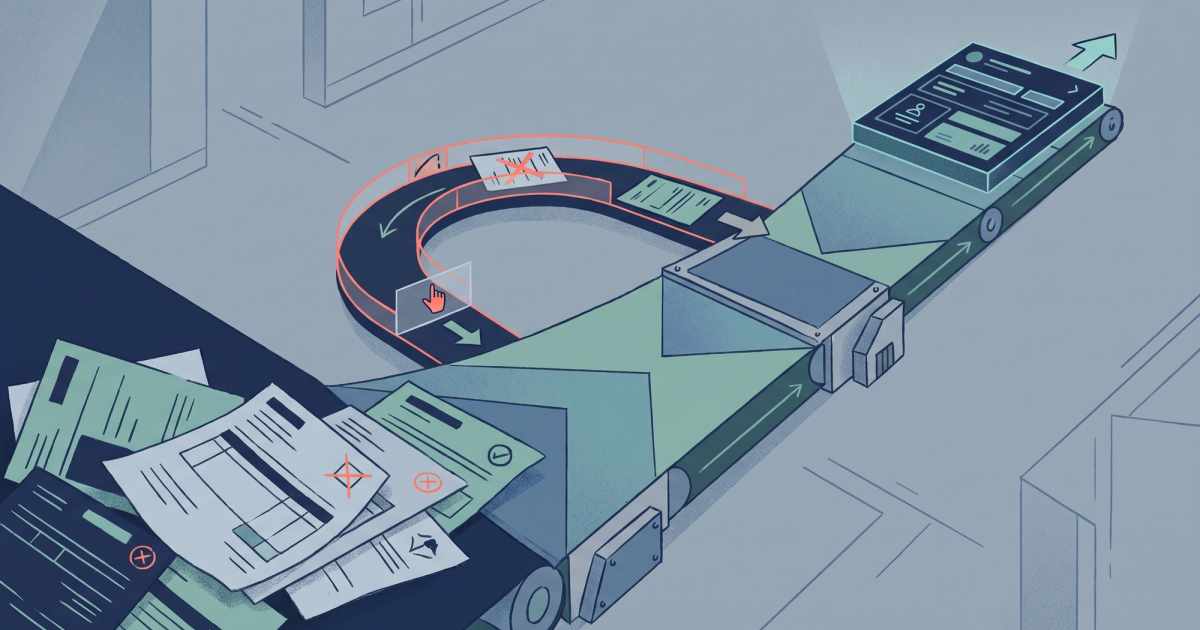
Back office software is any tool that handles the administrative work behind a business: accounting, billing, document management, and reconciliation. But for a freight broker, the generic version of that definition is almost useless. QuickBooks doesn't know what a rate con is. Xero can't match a lumper receipt to a POD. And no general-purpose accounting platform will flag that a carrier just billed you 18% fuel surcharge when the rate con says 14.5%. That gap between what generic back office software does and what freight brokers actually need is where money disappears. A brokerage processing 500 loads per month with even a modest overbilling rate faces tens of thousands of dollars in potential exposure every month. This article breaks down exactly what freight-specific back office tools do differently, which features matter, and how to stop paying carriers more than you agreed to.
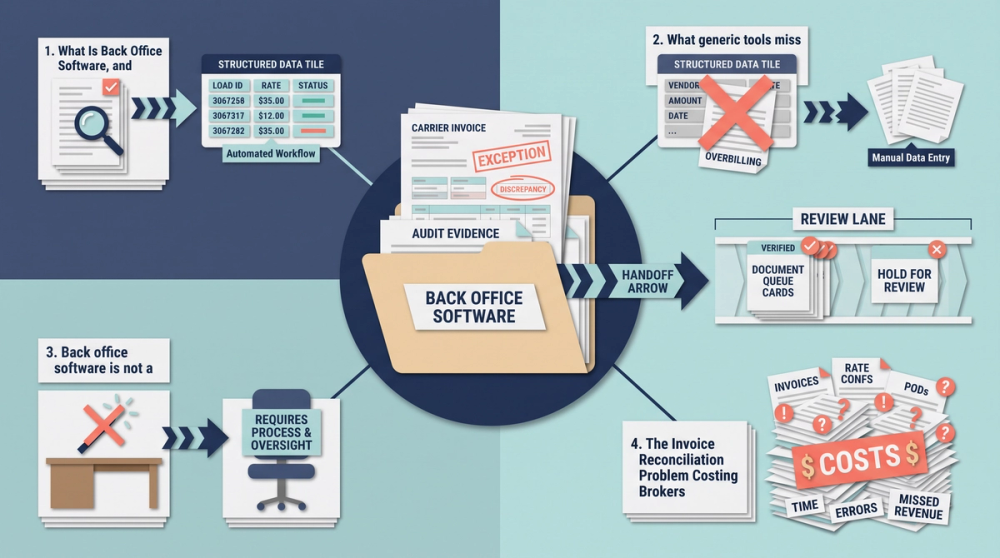
What Is Back Office Software, and Why the Freight Version Looks Nothing Like QuickBooks
At the most basic level, back-office software manages administrative business functions that aren't directly customer-facing: think invoicing, accounts payable, document storage, and financial reporting. For a law firm or a retail chain, that description covers it. For a freight broker, it barely scratches the surface.
Freight brokerage operations generate a specific set of documents on every single load: rate confirmations, BOLs, PODs, carrier invoices, lumper receipts, detention logs, and accessorial documentation. The back office job isn't just recording transactions. It's cross-referencing five or six documents per load to confirm that what the carrier billed matches what was agreed to. That's a fundamentally different workflow than entering expenses into a general ledger.
What generic tools miss
General accounting platforms are built around a simple model: you receive an invoice, you approve it, you pay it. They assume the invoice is correct. In freight, that assumption can cost you thousands per month. A carrier invoice might include a detention charge that exceeds the rate con cap, a TONU fee that was never agreed to, or a fuel surcharge calculated at the wrong percentage. Generic software has no mechanism to catch any of this because it doesn't understand the relationship between a rate confirmation and a carrier invoice.
According to Truckstop's breakdown of freight broker back-office operations, the core functions of a brokerage back office include accounting, billing, document management, and vendor management. All of those functions need to be freight-aware. They need to understand accessorial fee structures, carrier payment terms, and the document chain that proves whether a charge is legitimate. That's where money gets lost in billing operations for brokerages that rely on tools built for other industries.
Back office software is not a CRM
A common point of confusion: back office software and CRM software serve entirely different functions. A CRM manages your relationships with shippers and carriers (tracking calls, managing leads, logging touchpoints). Back office software manages what happens after the deal is made: invoicing the shipper, auditing the carrier's bill, reconciling documents, and processing payment. In a freight brokerage, both tools might live inside your TMS, but they handle opposite ends of the load lifecycle.
The Invoice Reconciliation Problem Costing Brokers 6+ Hours a Week
Invoice reconciliation is the process of matching what a carrier billed against what was agreed on the rate con, then verifying it against supporting documents like the BOL and POD. For small and mid-size freight brokers, this process is almost always manual, and it's one of the most expensive time sinks in the operation.
Here's what it looks like in practice. Your billing coordinator pulls up a carrier invoice. They open the rate con in the TMS (or worse, dig through email). They compare the linehaul rate. They check if detention was billed and whether it matches the agreed terms. They look for lumper fees and compare them to receipts. They verify the fuel surcharge percentage. They check for any accessorial charges that weren't on the rate con. Then they do it again for the next load. And the next one.
The real labor cost
Scenario: A billing coordinator spends 8 hours per week cross-referencing BOLs, PODs, and carrier invoices. At $22/hour, that's $176 per week, or $9,152 per year in labor cost dedicated solely to reconciliation. That doesn't include the time spent resolving disputes when discrepancies are found, re-calling carriers, or correcting payments that already went out.
As of 2026-05-01, average hourly earnings in truck transportation were $32.26/hr (BLS Current Employment Statistics, series CEU4348400008). Your billing coordinator might earn less than that, but the dispatchers and ops managers who get pulled into invoice disputes don't. Every hour spent chasing a $70 lumper discrepancy is an hour not spent booking loads or managing carrier relationships.
This is the core problem that freight-specific back office software solves. Not by replacing your accounting system, but by automating the document matching and variance detection that eats your team's time. When your back office is leaking money every week, the fix isn't hiring another person to review invoices. It's giving the people you have tools that do the comparison automatically.
What Carrier Overbilling Actually Looks Like on a Rate Con vs. Final Invoice
Carrier overbilling isn't always intentional fraud. Often it's a dispatcher entering the wrong detention rate, a fuel surcharge formula pulling from the wrong index date, or an accessorial charge that the carrier's billing system applies by default. Regardless of intent, the result is the same: you pay more than you agreed to. Here are the most common patterns.
Detention overcharges
Example: The rate con specifies detention at $50/hour after 2 hours free time. The carrier invoices 4 total hours of detention at $75/hour, billing $300. Under the agreed terms, only 2 billable hours apply (4 hours minus 2 free), at $50/hour, for a correct charge of $100. That's a $200 overbill on a single load. Multiply that across a month's worth of loads with detention, and the exposure adds up fast.
Fuel surcharge miscalculations
Example: The rate con specifies a 14.5% DOE-indexed fuel surcharge on a $1,200 linehaul. The carrier applies 18% instead, billing $216 in fuel surcharge versus the correct amount of $174. That's a $42 overbill per load. For a broker running 500 loads per month, even if only 10% of loads have this type of miscalculation, that's 50 loads times $42, equaling $2,100 per month in fuel surcharge overcharges alone.
Lumper fee discrepancies
Example: A carrier invoices a $450 lumper fee. The POD receipt attached to the delivery documents shows the actual lumper charge was $380. That's a $70 overbill that only gets caught if someone manually compares the invoice amount to the receipt. Without document matching, it sails through.
Accessorial charges with no rate con basis
Example: A carrier bills a $250 TONU (Truck Ordered Not Used) charge on a load that was successfully completed. The rate con contains no TONU clause. A billing coordinator reviewing this in a general accounting system sees a $250 charge, has no automated way to check it against the rate con terms, and may approve it simply because the invoice looks legitimate. This is the kind of accessorial dispute that generic software will never flag because it doesn't parse rate con language.
The aggregate exposure
Scenario: A freight broker processes 500 loads per month at an average load value of $1,800. If carrier overbilling occurs on 3.8% of loads (based on Laneproof analysis of over 12,000 carrier invoices), that's 19 loads per month with billing discrepancies. At an average overbill amount that reflects the types of errors described above, the exposure reaches roughly $34,200 per month. That's $410,400 annually, coming directly off your margin.
A 500-load-per-month brokerage with a 3.8% carrier overbilling rate faces roughly $34,200 per month in potential overbilling exposure. That number comes straight off your margin.
The Back Office Features That Matter for Freight Brokers (and the Ones That Don't)
Not all back office features are equally useful for a freight brokerage. According to DAT's overview of broker TMS software, the core back-office tools for freight brokers include rate confirmations, load management, tracking, and invoicing. But the features that separate freight-specific tools from generic ones go deeper than that list suggests.
Features that directly protect your margin
- Rate con to invoice matching. The software should automatically compare every line item on a carrier invoice against the corresponding rate confirmation. Linehaul, detention rates and free time, fuel surcharge percentages, and any listed accessorials should all be checked without a human opening two tabs and comparing numbers.
- Document extraction from BOLs and PODs. Your back office tool should be able to pull key data from scanned or photographed BOLs and PODs, including delivery timestamps (for detention verification), lumper receipt amounts, and reference numbers. Manual data entry is where errors start.
- Accessorial clause detection. The system should parse the rate con for accessorial terms (TONU, layover, driver assist, pallet exchange) and flag any charge that appears on the carrier invoice without a corresponding clause in the agreement.
- Variance alerts with dollar thresholds. Rather than flagging every $2 rounding difference, freight-focused back office software lets you set materiality thresholds. Flag variances over $25, for instance, so your team focuses on discrepancies that actually affect your P&L.
- Carrier payment hold integration. When a variance is detected, the system should be able to hold payment on that specific invoice pending review, rather than requiring a billing coordinator to manually intervene in the payment queue.
Features that sound good but don't move the needle
- Built-in HR and payroll modules. Many back office platforms bundle HR features. If you have 12 employees, you don't need your freight billing software to also manage PTO requests.
- General CRM functionality. As noted earlier, CRM and back office are different tools. A back office system that tries to also manage your carrier sales pipeline usually does neither job well.
- Multi-industry templates. A system that offers templates for restaurants, retail, and logistics is almost certainly not parsing rate cons or matching lumper receipts. Industry-specific depth matters more than breadth.
The steps in your freight broker workflow where money leaks out almost always involve the handoff between operations and billing. The back office features that matter most are the ones that automate that handoff: pulling the right documents, comparing the right numbers, and flagging problems before payment goes out.
How Freight-Specific Back Office Software Connects to Your TMS Without a Full Replacement
One of the biggest hesitations freight brokers have about adopting new back office software is the fear of ripping out their existing TMS. That fear is valid. Your TMS holds your load data, your carrier contacts, your rate history, and your shipper relationships. Replacing it is a months-long project with real operational risk.
But here's the thing: the best freight-specific back office tools don't replace your TMS. They sit alongside it as a specialized layer that handles the work your TMS was never designed to do well, specifically document auditing, invoice variance detection, and reconciliation.
The TMS does load management; back office software does invoice auditing
According to AltexSoft's analysis of freight broker software, the freight technology stack typically includes multiple specialized tools rather than a single monolithic platform. Your TMS handles load building, dispatch, tracking, and rate management. Your back office tool handles what happens after the load delivers: collecting carrier invoices, matching them against rate cons and PODs, flagging variances, and preparing clean data for your accounting system.
This separation matters because TMS platforms are optimized for load lifecycle management, not document auditing. Most TMS platforms store the rate con, but they don't automatically compare each field of that rate con against the incoming carrier invoice. They store the POD, but they don't extract the delivery timestamp and compare it against billed detention hours. That's the gap that freight-specific back office software fills.
What "connects to your TMS" actually means
When evaluating a TMS add-on for back office work, look for these integration points:
- Rate con data pull. The back office tool should be able to access or import rate confirmation data from your TMS, including linehaul rate, accessorial terms, fuel surcharge formulas, and payment terms.
- Load status awareness. The tool should know whether a load has been delivered, is still in transit, or was cancelled, so it can properly contextualize incoming invoices (and catch things like a TONU charge on a load that was delivered).
- Document sync. BOLs, PODs, and carrier packets uploaded to the TMS should flow into the back office tool without re-uploading. Duplicate document handling is a common source of errors.
- Payment status feedback. Once the back office tool approves or flags an invoice, that status should sync back to the TMS or your accounting platform, closing the loop without manual updates.
The key question to ask any vendor: "Does your tool work with my existing TMS, or does it require me to move everything onto your platform?" If the answer is the latter, you're looking at a TMS replacement, not a back office tool. Those are fundamentally different buying decisions.
The settlement speed advantage
Scenario: When invoice-to-POD matching is automated, brokers close loads an average of 3 days faster compared to manual reconciliation (based on Laneproof analysis of 8,400 load settlements across 23 brokerage customers). Faster settlement means lower DSO (days sales outstanding), which directly improves cash flow. For a broker averaging $900,000 in monthly receivables, reducing DSO by 3 days frees up roughly $90,000 in working capital at any given time.
Laneproof's reconciliation engine checks each of these fields automatically, flagging variances before payment goes out. It connects to your existing TMS rather than replacing it, handling the document matching and audit work that causes money to leak in brokerage operations.
Putting It All Together: Real Overbilling Scenarios and the Math
Let's walk through three scenarios that show exactly how freight-specific back office software catches overbilling that generic tools miss.
Example 1: Detention plus fuel surcharge on a single load
A carrier delivers a load with a $1,200 linehaul. The rate con specifies:
- Detention: $50/hour after 2 hours free
- Fuel surcharge: 14.5% of linehaul, DOE-indexed
The carrier invoice shows:
- Linehaul: $1,200 (correct)

- Detention: 4 hours at $75/hour = $300
- Fuel surcharge: 18% of $1,200 = $216
Correct charges: Detention should be 2 billable hours (4 minus 2 free) at $50/hour = $100. Fuel surcharge should be 14.5% of $1,200 = $174. The carrier billed $516 in detention and FSC. The correct amount is $274. Total overbill on this single load: $242.
A general accounting system sees a carrier invoice for $1,716 and processes it. Freight-specific back office software compares every line against the rate con and flags two variances before payment is approved.
Example 2: Monthly overbilling exposure across volume
A mid-size freight broker processes 500 loads per month at an average load value of $1,800. Based on Laneproof analysis of over 12,000 carrier invoices, the carrier overbilling rate is approximately 3.8%. That means roughly 19 loads per month contain billing discrepancies.
If the average overbill per affected load is $1,800 (reflecting a combination of detention overcharges, FSC miscalculations, lumper discrepancies, and unauthorized accessorials as shown in the examples above), the monthly exposure is 19 times $1,800, equaling roughly $34,200 per month. Over a year, that's $410,400 in potential overbilling.
Even if your team catches half of those manually (which is optimistic when 8 hours per week is the total time dedicated to reconciliation), you're still leaving over $200,000 on the table annually.
Example 3: Lumper fee plus TONU on the same week
Monday: A carrier invoices a $450 lumper fee. Your POD receipt shows the actual charge was $380. Overbill: $70. Without document matching between the invoice and the receipt image, this discrepancy is invisible.
Thursday: A different carrier bills a $250 TONU charge on a load that was successfully picked up and delivered. The rate con has no TONU clause. Unauthorized charge: $250. A billing coordinator reviewing 25 invoices that day might not pull up the rate con for each one to verify whether every accessorial was agreed to.
Combined overbilling in one week from just two loads: $320. That's $16,640 annualized from a pattern that repeats across your carrier base every week.
As of 2026-05-01, the Producer Price Index for truck transportation of freight stood at 178.2 (BLS PPI series WPU3012), reflecting an elevated cost environment where every dollar of margin matters. Freight brokers can't afford to treat carrier invoice auditing as optional.
Frequently Asked Questions
What is back office software?
Back office software manages the administrative functions of a business that aren't directly customer-facing: invoicing, accounts payable, document management, reconciliation, and financial reporting. According to Certinia's definition, it covers everything from accounting to supply chain management. For freight brokers specifically, back office software needs to handle rate con matching, carrier invoice auditing, and document verification, which are functions that general-purpose tools don't support.
Is back office software the same as a CRM?
No. A CRM (Customer Relationship Management) system manages your interactions with customers and prospects: tracking calls, managing sales pipelines, and logging communications. Back office software manages post-sale administrative work: billing, payment processing, document reconciliation, and financial reporting. In a freight brokerage, your CRM helps you win loads. Your back office software helps you get paid correctly on the loads you've already moved.
Do I need to replace my TMS to get better back office tools?
Not necessarily. The strongest approach for most small and mid-size freight brokers is to keep the TMS that manages your load lifecycle and add a specialized back office tool that handles invoice auditing and document reconciliation. Your TMS is good at load building, dispatch, and tracking. A freight-specific back office tool or TMS add-on that handles document problems fills the gap on the billing and reconciliation side without requiring a full platform migration.
What is the simplest bookkeeping software for a freight broker?
For basic bookkeeping, platforms like QuickBooks or FreshBooks handle general ledger entries, tax prep, and expense tracking well. But simple bookkeeping software won't handle carrier invoice auditing, rate con matching, or accessorial dispute detection. If your primary pain point is catching overbilling and reducing manual reconciliation time, you need a freight-specific back office tool on top of (or instead of) basic bookkeeping software.
How much time does back office automation actually save?
The time savings depend on your load volume and current process. A billing coordinator spending 8 hours per week on manual reconciliation at $22/hour represents $9,152 per year in labor cost for that single task. Automating invoice-to-rate-con matching can reduce that time by 60% to 80%, freeing 5 to 6 hours per week for higher-value work like resolving complex disputes or managing carrier relationships. The larger savings, though, come from catching overbilling that manual review misses.
The Bottom Line: Your Back Office Should Catch What Your TMS Doesn't
Generic back office software was built for businesses where the invoice is usually right. Freight brokerage isn't that business. Between detention overcharges, fuel surcharge miscalculations, lumper fee discrepancies, and unauthorized accessorials, the gap between what carriers bill and what you agreed to pay is a direct hit to your margin every single month.
The right back office software for a freight broker does three things: it matches carrier invoices against rate con terms automatically, it flags variances before payment goes out, and it connects to your existing TMS without forcing a platform migration. Everything else is secondary.
If your billing coordinator is spending hours per week manually comparing documents and you suspect overbilling is slipping through, it's worth seeing how those numbers look for your specific operation. You can check plans and pricing here to see what automated reconciliation costs relative to what manual review is already costing you.
Sources
- TMS software for freight brokers: What it is & why it matters — DAT
- What is Back Office Software? Uses & Benefits — Certinia
- Back-office software — Wikipedia
- Streamline Your Freight Broker Back-Office Operations — Truckstop
- Freight Broker Software to Support Transportation Intermediaries — AltexSoft
- BLS Current Employment Statistics, series CEU4348400008 — U.S. Bureau of Labor Statistics
- BLS Producer Price Index, series WPU3012 — U.S. Bureau of Labor Statistics