Billing Operations in Freight: Where the Money Gets Lost
Researched and written with AI assistance. Reviewed by the Laneproof team.
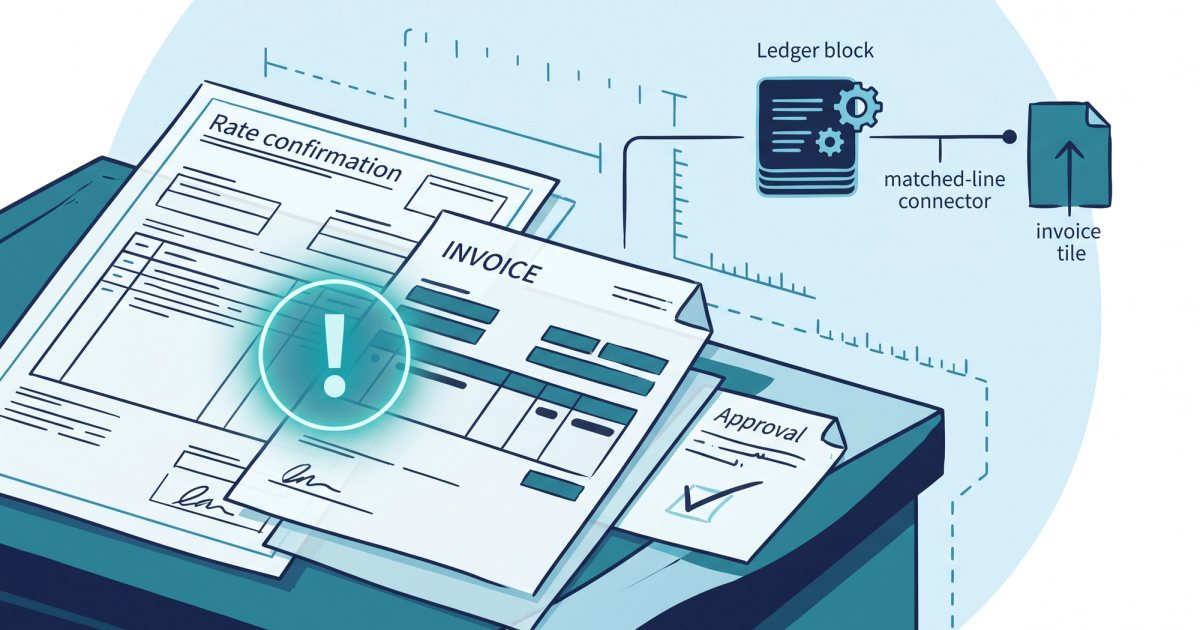
Billing operations in freight are the end-to-end processes that get a carrier paid and a broker's books closed after a load delivers. That includes matching carrier invoices to rate confirmations, verifying accessorial charges against BOLs and PODs, reconciling detention and lumper fees, posting payments, and resolving disputes before they age out. In a brokerage running 300 or more loads per month, billing ops is where margin either holds or quietly erodes.
According to Transportation Insight, a typical freight bill audit finds that between 3 and 6 percent of invoices contain errors, most commonly in accessorial charges. On a book of 300 loads per month at an average carrier invoice of $1,800, even the low end of that range means you are exposed to over $1,200 in monthly overbilling, or more than $15,000 per year, that walks out the door unless someone catches it. Most SMB brokers and small carriers do not have a dedicated billing team. The person catching these errors is often the same person dispatching loads or managing customer relationships. That is the reality this guide is written for.
What Billing Operations Actually Means in Freight (Not the Accounting Textbook Version)
If you search "billing operations," most of what you find is generic SaaS content about subscription invoicing or NetSuite workflows. None of that applies to a freight broker trying to figure out why a carrier invoiced $275 for a lumper fee with no receipt, or why a detention charge showed up for four hours when the BOL timestamps show two and a half.
In freight, billing operations cover everything that happens between "the truck delivered" and "the carrier got paid." Specifically:
- Invoice receipt and intake: Receiving carrier invoices (paper, email, EDI, or portal) and logging them against load numbers
- Rate confirmation matching: Comparing the invoiced linehaul, fuel surcharge, and accessorials to what the rate con actually says
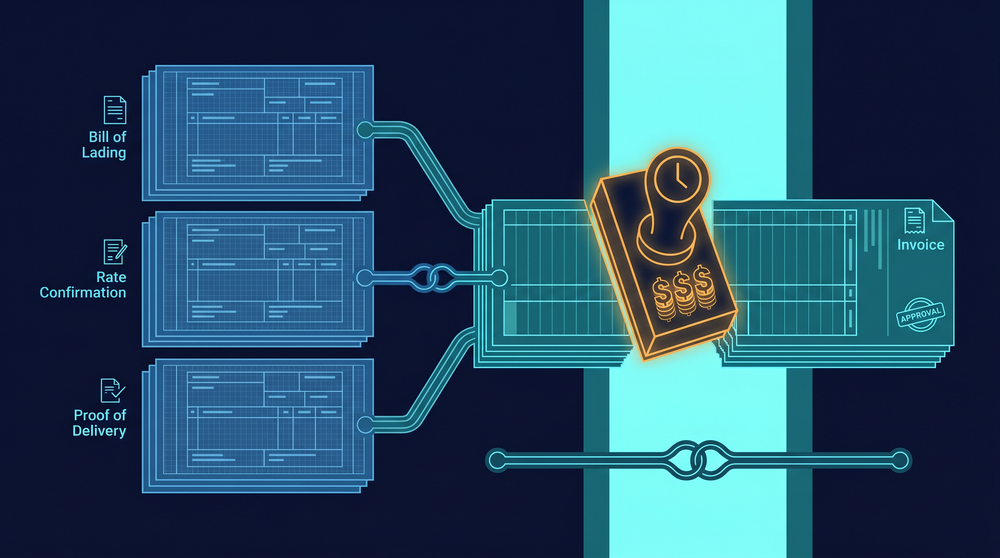
- Document verification: Checking that BOLs, PODs, lumper receipts, and detention logs support the charges billed
- Accessorial reconciliation: Line-by-line review of detention, lumper fees, TONU charges, layover, and other accessorials against agreed terms
- Dispute management: Flagging discrepancies, communicating with carriers, and tracking resolution
- Payment execution: Posting approved invoices for payment within terms (typically net 30)
- Audit and reporting: Tracking error rates, dispute outcomes, and payment cycle times to spot patterns
The American Trucking Associations estimated the nation's trucking freight bill at $906 billion in gross freight revenues in 2024. Even a fraction of a percent in billing errors across that total represents billions in misallocated payments industry-wide. For an individual brokerage, the math is smaller but the pain is the same: every uncaught error comes directly off your margin.
I2C vs O2C: Where Freight Billing Fits
In accounting, billing operations typically sit within one of two cycles. Invoice-to-Cash (I2C) covers the shipper-facing side: you invoice your customer, collect payment, and reconcile what you are owed. Order-to-Cash (O2C) is a broader term that includes everything from load booking through final payment. For freight brokers, the carrier-facing side (receiving and verifying carrier invoices, then paying them) is where the most uncontrolled cost leakage happens. That carrier-side process is the focus of this guide, because it is where most SMB brokers lack both time and tools.
Where Manual Freight Billing Breaks Down, Step by Step
Most freight brokers running under 1,000 loads per month are doing some or all of their billing operations manually. That means spreadsheets, email inboxes, and a billing coordinator toggling between a TMS, a PDF viewer, and an accounting tool. Here is where that process breaks, in the order it usually happens.
Step 1: Invoice Intake Is Scattered
Carrier invoices arrive by email, fax, carrier portal, or sometimes as a photo of a handwritten document. According to Denim, at least 75% of freight bills are now delivered electronically, but "electronically" does not mean "structured." A PDF attached to an email still requires someone to open it, read the numbers, and type them into your TMS or accounting system. That manual data entry step is where transposition errors start, and where invoices get lost in inboxes for days before anyone touches them.
Step 2: Rate Con Matching Happens in Someone's Head
Once the invoice is open, a billing coordinator has to pull up the rate confirmation for that load and compare numbers. Linehaul, fuel surcharge percentage, agreed accessorials, any special terms. In a manual workflow, that comparison is visual: eyes on a screen, flipping between two documents. At 300 loads per month, that is 300 individual comparisons, each taking two to five minutes. The errors are not always obvious. A fuel surcharge billed at 24% instead of the agreed 18% looks normal unless you check it. This is a breakdown point explored in detail in the common spots where freight broker workflows leak money.
Step 3: Accessorial Documentation Gets Skipped
Detention charges, lumper fees, and TONU fees all require supporting documentation to verify. But when your billing coordinator is processing 15 to 20 invoices per day, the temptation is to approve charges that look "close enough" rather than hunt down a missing lumper receipt or confirm detention timestamps against the BOL. That is how small overbills ($50 here, $112 there) become an annual problem. The math on this adds up fast, as we will break down in the examples section below.
Step 4: Disputes Age Out Before They Get Filed
Per FMCSA Subpart H regulations on collection of charges, motor carriers must present a freight bill within 15 days (excluding weekends and federal holidays) of shipment delivery. But on the broker side, once a carrier invoice is in the system, disputes often languish because nobody has time to gather the documentation needed to push back. A $112 detention overbill is not worth 45 minutes of back-and-forth unless you have the timestamped proof ready to go. Most brokers do not, so they pay it. This is one of the core problems covered in how to prove detention billing with proper documentation.
The Carrier Invoice Errors That Cost Brokers the Most
Not all invoice errors are equal. Some are $10 rounding issues. Others are $200+ overbills that repeat load after load. Here are the categories that show up most frequently in freight billing operations, ranked by how much they typically cost.
Detention Overbilling
Detention charges are the single most disputed accessorial in freight. The problem is straightforward: carriers bill for hours at the shipper or receiver facility, but the actual detention time (measured from arrival to departure) is often shorter than invoiced. Without timestamped BOLs, check-in logs, or geofence data, the broker has no documentation to dispute the charge. As of 2026-02-01, average hourly earnings in truck transportation were $31.94/hr (BLS), which gives you context for how carriers price detention. Most detention rates land between $50 and $100 per hour, making even a one-hour discrepancy a meaningful hit on a single load.
Fuel Surcharge Discrepancies
Fuel surcharge (FSC) errors are common because the FSC percentage varies week to week based on the DOE fuel index, and the rate con may specify a different basis than what the carrier applies. On a $2,200 linehaul, the difference between an 18% FSC and a 24% FSC is $132 on a single load. Multiply that across dozens of loads per month with the same carrier and you are looking at thousands in overbilling that only shows up if someone checks the FSC against the DOE table for the delivery week.
Lumper Fee Inflation
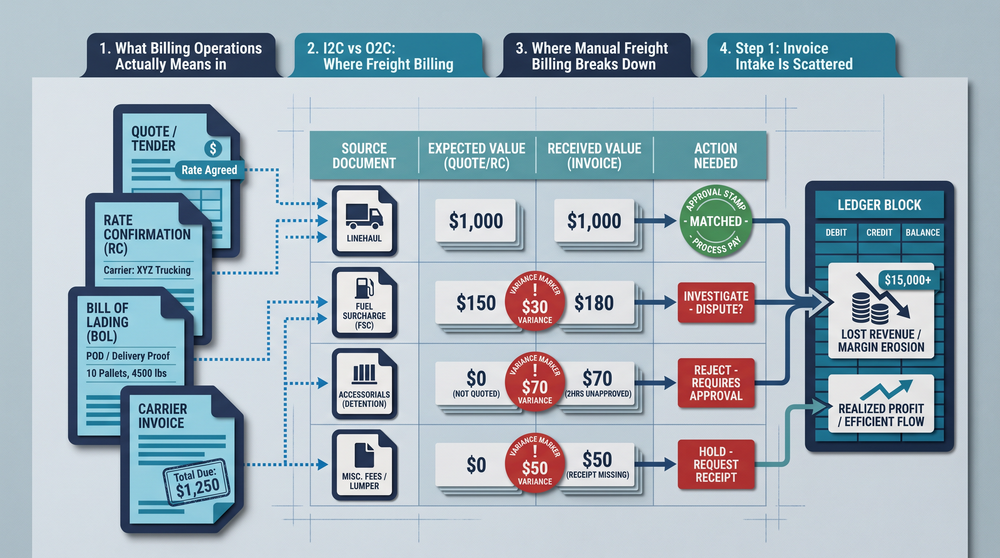
Lumper fees are charged by third-party labor at delivery facilities to unload freight. The standard practice is that the carrier pays the lumper at the dock, gets a signed receipt, and invoices the broker for reimbursement. The problem: carriers sometimes invoice lumper charges without attaching the receipt, or invoice an amount higher than what the receipt shows. Without a matched lumper receipt on file, the broker has no way to verify the charge. This is one of the places where back office billing leaks quietly drain brokerage margins.
TONU and Dry Run Charges
A truck order not used (TONU) fee compensates a carrier when a load is cancelled after dispatch. Most rate confirmations include a cancellation window (often one to two hours). If the broker cancels within that window, no TONU is owed. But if the rate con is not timestamped or the cancellation time is not documented, the broker has no proof and typically pays the $250 to $400 TONU charge rather than fight it.
Accessorial Charges Not on the Rate Con
This is the catch-all category. Carriers occasionally invoice for accessorials (liftgate, inside delivery, appointment scheduling) that were never agreed to on the rate confirmation. If the broker's billing process does not include a line-by-line match of invoiced accessorials against the rate con, these charges slip through. According to Transportation Insight, accessorial charges are the most common source of freight invoice errors in audits.
How to Build a Tighter Billing Workflow Without Adding Headcount
You probably do not have the budget to hire a dedicated billing analyst. Most SMB brokers and carriers running 100 to 1,000 loads per month are handling billing ops with one or two people who also do dispatching, customer service, or load planning. The goal is not to build a billing department. The goal is to tighten the process so fewer errors slip through and disputes are resolved faster with less labor.
Standardize Your Invoice Intake
Set a single channel for carrier invoice submission. Whether that is a dedicated billing email address, a TMS portal, or a carrier-facing upload tool, the point is to eliminate invoices arriving in dispatchers' personal inboxes or via text message. Every invoice that is not in your central system is an invoice nobody is tracking.
Match Before You Approve
Build a mandatory matching step into your workflow: no carrier invoice gets approved for payment until it has been compared against the rate confirmation and supporting documents. This does not have to be exhaustive on every load. A tiered approach works: auto-approve invoices that match the rate con exactly on linehaul and FSC, and flag anything with accessorial charges or amounts that differ by more than a set threshold (e.g., $25 or 2%) for manual review.
Require Documentation for Every Accessorial
Make it a policy: no detention payment without a timestamped BOL or facility log, no lumper reimbursement without a signed receipt, no TONU payment without a documented cancellation timeline. Communicate this clearly to carriers during onboarding as part of the carrier packet. Most carriers will comply if the expectation is set upfront. The ones who push back are often the ones padding charges.
Set Dispute Deadlines
If a carrier invoice has a discrepancy, it should be disputed within 48 hours of receipt. The longer a dispute sits, the less likely it is to be resolved in your favor. Track open disputes in a spreadsheet or your TMS and assign a weekly review to ensure nothing ages past 7 days without action. Per 49 CFR Part 373, which governs receipts and bills for motor carriers, both parties have documentation obligations. Knowing the regulatory framework strengthens your position in any dispute.
Use Your TMS as the Source of Truth
Your TMS should hold the rate confirmation, carrier invoice, and all supporting documents for every load. If your billing coordinator has to leave the TMS to find a BOL in email or a lumper receipt in a shared drive, the process is already broken. Centralize documents at the load level so that reconciliation is a comparison within one system, not a scavenger hunt across three.
The Numbers You Should Be Tracking in Your Billing Ops
If you are not measuring your billing operations, you are guessing at how much money you are losing. Here are the metrics that matter most for an SMB freight broker or carrier.
Invoice Error Rate
What percentage of carrier invoices contain a discrepancy from the rate confirmation? Based on industry data from Transportation Insight, the benchmark is 3 to 6 percent. If your rate is higher, your carrier vetting or rate con process needs work. If you do not know your rate, that is the first problem to solve.
Average Discrepancy Value
Knowing that 4% of your invoices have errors is not enough. You need to know the average dollar value per error. If your average discrepancy is $112 across 300 loads per month, that is roughly $1,344 in monthly exposure (300 × 4% × $112). Track this monthly and watch for carriers or lanes that consistently produce higher-value discrepancies.
Reconciliation Time per Invoice
How long does it take your team to reconcile a single carrier invoice? If the answer is "I don't know," time it for a week. Many billing coordinators spend an average of three to five minutes per clean invoice and 15 to 20 minutes on invoices with discrepancies. Multiply that across your load volume to get a real labor cost number. As of 2026-03-01, the truck transportation sector employed 1,464 thousand workers (BLS), and back-office billing staff represent a significant share of that workforce. Their time is not free.
Dispute Win Rate
Of the invoice discrepancies you flag, what percentage are resolved in your favor? If your dispute win rate is below 50%, you either lack documentation or your dispute process is too slow. A strong billing operation should resolve 70% or more of flagged discrepancies in the broker's favor, assuming the rate con and supporting docs are clear.
Days to Payment
Track the average number of days from invoice receipt to carrier payment. Slow payment cycles often signal a bottleneck in reconciliation. If your average is above 25 days on net-30 terms, your billing workflow is the likely cause, and it may also be damaging carrier relationships and your reputation on load boards.
Real-World Examples: How Billing Errors Add Up
The numbers below are based on common scenarios SMB brokers encounter. Each one is built from rates and charge structures that show up daily in freight billing operations.
Example: Annual Overbilling Exposure at 300 Loads Per Month
A broker processing 300 loads per month at an average carrier invoice of $1,800. If 3.8% of those invoices contain errors averaging $112 each (consistent with the 3 to 6% error rate cited by Transportation Insight), the math works out to: 300 loads × 3.8% = 11.4 invoices with errors per month. At $112 per error, that is $1,277 per month in overbilling exposure. Over 12 months: $15,326 per year walking out the door. That is not a rounding error. That is a salary.
Example: Detention Overbilling Without Timestamp Proof
A carrier invoices 4 hours of detention at $75/hour ($300 total). The BOL timestamp shows the driver arrived at 08:15 and departed at 10:45, which is 2.5 hours. At $75/hour, the accurate charge is $187.50, making the overbill $112.50 on a single load. But without that timestamped BOL on file and matched to the load in your TMS, the billing coordinator has no evidence to dispute. The carrier gets paid $300, and you eat the difference.
Example: Lumper Fee Without a Receipt
A carrier invoices a $275 lumper charge. No signed lumper receipt is attached. The broker's billing coordinator sees the charge, checks the load file, finds no receipt, but the invoice is already five days old and there are 18 other invoices to process today. The $275 gets approved. This happens once or twice a week across a busy brokerage. At two occurrences per week, that is $28,600 per year in unverified lumper charges.
Example: Fuel Surcharge Overbill
The rate confirmation specifies an 18% fuel surcharge based on the DOE table for the delivery week. The carrier applies 24% FSC against a $2,200 linehaul. At 18%, the FSC should be $396. At 24%, the carrier bills $528. That is a $132 overbill on a single load. On a lane where you run 10 loads per month with the same carrier, that compounds to $1,320/month if nobody checks.
Example: The Hidden Cost of Manual Reconciliation Time
A billing coordinator spends 90 minutes per day reconciling carrier invoices manually, toggling between email, your TMS, and PDF files. Over a five-day week, that is 7.5 hours. At a fully loaded rate of $22/hour (including benefits and overhead), that is $165 per week, or $8,580 per year, in labor cost dedicated solely to reconciliation. That does not include the cost of errors that slip through because the coordinator is rushing to keep up.
"A freight bill audit typically finds 3 to 6 percent of invoices contain errors, most commonly in accessorial charges." — Transportation Insight
Frequently Asked Questions About Freight Billing Operations
What do billing operations do?
In freight, billing operations cover every step between a load delivering and a carrier getting paid. That includes receiving and logging carrier invoices, matching them to rate confirmations, verifying accessorial charges against BOLs and PODs, managing disputes, and posting approved payments. The goal is to ensure the broker or carrier only pays what was agreed to, with documentation to support every charge.
What is the difference between I2C and O2C?
Invoice-to-Cash (I2C) refers to the process of issuing invoices to your customers and collecting payment. Order-to-Cash (O2C) is broader, covering everything from receiving a customer order through delivery and final payment. For freight brokers, I2C is the shipper-facing side (billing your customers), while the carrier-facing side (receiving and verifying carrier invoices, then paying carriers) is where most billing operations problems live.
What are the three types of billing?
In freight, the three most relevant billing types are: (1) pre-billing, where invoices are created based on the rate confirmation before delivery confirmation is received; (2) post-delivery billing, where invoices are generated after POD is confirmed; and (3) accessorial billing, which covers supplemental charges like detention, lumper fees, fuel surcharges, and TONU fees invoiced separately from linehaul. Most billing errors occur in the third category.
What does a billing operations manager do?
A billing operations manager oversees the entire invoicing and payment workflow. In a freight brokerage, that means setting policies for invoice approval, managing dispute resolution, tracking metrics like error rate and days-to-payment, and ensuring carrier payments go out on time. At SMB brokerages, this role is often filled part-time by an ops manager or dispatcher rather than a dedicated hire.
How do I reduce carrier invoice disputes?
Start with clear rate confirmations that spell out linehaul, FSC calculation method, and which accessorials are pre-approved. Require documentation (timestamped BOLs, signed lumper receipts) for all accessorial charges as part of your carrier packet onboarding. Most disputes originate from vague rate cons or missing documents, not from carrier dishonesty. Fix the inputs and you reduce the disputes.
Where This Leaves You
Billing operations in freight are not a back-office afterthought. They are where your margin either holds or disappears, one unverified detention charge and one inflated fuel surcharge at a time. The brokers and carriers who protect their margins are the ones who match every invoice to a rate con, require documentation for every accessorial, and track their error rates so they can see problems before they compound.
You do not need a billing department to do this well. You need a tighter process, clear policies for carriers, and a system that keeps your rate cons, BOLs, and invoices in one place. If your team is processing more than 50 invoices per week and still reconciling manually, automated document extraction and matching tools can catch the discrepancies covered in this guide, before they close and before the money is gone.
Sources
- FMCSA Subpart H: Collection of Charges — Federal Motor Carrier Safety Administration
- 49 CFR Part 373: Receipts and Bills — Electronic Code of Federal Regulations
- Economics and Industry Data — American Trucking Associations
- Freight Audit and Payment: Protecting Profit in Soft Rates — Transportation Insight
- 6 Freight Payment Best Practices — Denim
Related: How to Automate Freight Brokerage Operations Without Breaking Your TMS