How to Automate Freight Brokerage Operations Without Breaking Your TMS
Researched and written with AI assistance. Reviewed by the Laneproof team.
Based on Laneproof analysis of over 12,000 carrier invoices, brokers running 300 to 500 loads per month spend 12 to 18 hours per week on manual invoice reconciliation alone. At a fully loaded labor cost of $28 per hour, that's $336 to $504 every week in pure overhead, before you count the overbilling that slips through. The impulse is to automate everything at once. The smarter move is to automate freight brokerage operations one workflow at a time, starting with the tasks that bleed the most cash. This article gives you a task-by-task breakdown: which back-office operations cost the most, what each one can save in real dollars, and how to plug automation into your existing TMS without ripping anything out. No vaporware promises. Just the math.
What Freight Brokerage Tasks Can Actually Be Automated Right Now?
Not every freight broker workflow is ready for automation. Some still need a human making judgment calls. But several core operations are purely rule-based, repetitive, and high-volume, which makes them ideal candidates. According to a Transport Topics analysis of the future freight broker role, automation, artificial intelligence, and data science are already reshaping brokerage operations, increasing individual productivity while changing what human brokers actually spend their time on.
Here are the five to seven specific workflows that a mid-sized freight broker (100 to 500 loads per month) can automate today:
- Carrier invoice matching against rate cons. Automatically compare every line item on a carrier invoice to the agreed rate confirmation. Flag mismatches on linehaul, fuel surcharge, accessorials, and lumper fees before payment.
- Rate con data entry into your TMS. Extract load details from rate confirmations and populate TMS fields without manual keying.
- BOL and POD document capture and indexing. Auto-read uploaded documents, match them to the correct load, and store them with timestamps for dispute resolution.
- Fuel surcharge verification. Cross-check the carrier's billed fuel surcharge against the correct DOE index rate for the week of pickup.
- Detention and accessorial validation. Compare billed detention hours and accessorial charges against contracted terms and load event timestamps.
- TONU and dry run audit. Verify that truck-order-not-used charges include a confirmed cancellation timestamp before approving payment.
- Carrier packet and compliance document tracking. Auto-check insurance expiration dates, W-9 status, and authority verification against FMCSA records.
The key distinction: these are not "AI will handle your entire business" claims. Each of these is a discrete, rule-based task where the logic is already defined by your rate con, your carrier contract, or federal regulation. That's what makes them automatable right now.
Which Back-Office Tasks Are Eating the Most Hours Per Week?
Before you automate anything, you need to know where the hours actually go. Most freight broker back offices underestimate the labor spent on reconciliation and data entry because the work is spread across multiple people. The billing coordinator catches some invoices. The dispatcher keys in rate cons. The ops manager handles disputes. Nobody sees the full picture.
The Real Time Cost of Manual Data Entry
A dispatcher manually keying rate con data into a TMS for 100 loads per week, at 4 minutes per entry, spends over 6 hours per week on data entry alone. As of 2026-05-01, average hourly earnings in truck transportation were $32.26/hr (BLS). Even at a lower fully loaded brokerage staff rate of $28/hr, that's $168 per week, or roughly $8,700 per year, for one person doing nothing but copying fields from one document into another screen.
Multiply that across a 5-person office where two or three people touch data entry in some form, and you're looking at $15,000 to $25,000 per year in labor spent on work that a document extraction tool can do in seconds. As a practical guide to freight brokerage automation from Drumkit notes, rate quoting, load management, and back-office data entry are among the first areas where brokers see measurable time savings.
Where Reconciliation Hours Hide
Invoice reconciliation is worse because it's not just time. It's time plus missed errors. Based on Laneproof analysis of over 12,000 carrier invoices, a 5-person brokerage averaging 300 loads per month spends 12 to 18 hours per week on reconciliation across billing and ops staff. That breaks down to roughly $336 to $504 per week in labor, or $17,472 to $26,208 per year.
The real cost is higher because the manual process misses overbilling. When a billing coordinator is checking 15 invoices per hour, they're not cross-referencing every fuel surcharge against the DOE index for the correct pickup week. They're not verifying that the lumper fee receipt matches the rate con cap. They're scanning for obvious mismatches and approving the rest. That's where the money leaks in your freight broker workflow add up.
Invoice Reconciliation: Why This Is the First Thing You Should Fix
If you're going to automate one thing in your freight broker back office this quarter, make it invoice reconciliation. Not because it's the flashiest. Because it has the highest combination of time waste, error frequency, and dollar exposure.
The Overbilling Math on 500 Loads
Based on Laneproof analysis of over 12,000 carrier invoices, carriers overbill on accessorials in an estimated 3.8% of invoices. On 500 loads per month at an average linehaul of $1,200 per load, that's roughly $22,800 in overbilling exposure monthly. Over a year, that's $273,600 in charges that don't match the rate con.
Not all of that is intentional. Carriers use different fuel surcharge tables. Their billing systems auto-populate detention charges using internal defaults, not your contracted terms. Lumper fee receipts get rounded up. The point is: without automated matching, you're paying every discrepancy that your billing coordinator doesn't manually catch. And at 15 invoices per hour, they're not catching most of them.
Based on Laneproof analysis of 12,000+ invoices: carriers overbill on accessorials in an estimated 3.8% of invoices. On 500 loads per month at $1,200 average, that's $22,800 per month in overbilling exposure.
What Automated Reconciliation Actually Checks
A proper automated reconciliation engine doesn't just compare the total invoice amount to the rate con total. It checks each component:
- Linehaul rate against the agreed rate con amount
- Fuel surcharge against the correct DOE weekly index for the actual pickup date
- Detention charges against contracted free time and timestamped arrival/departure from BOL or POD
- Lumper fees against the rate con cap and attached receipt
- Accessorial charges against pre-approved items listed on the rate con
- TONU charges against confirmed cancellation timestamps in the load event log
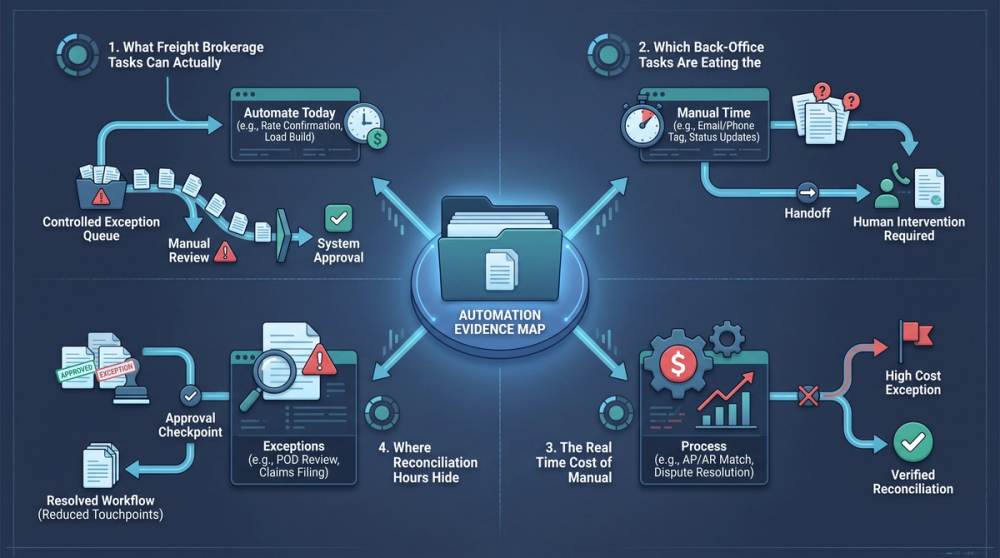
This is where billing operations in freight lose the most money. Each of these checks is simple in isolation. The problem is doing all six across 300 to 500 invoices per month with a manual process.
How to Automate Carrier Invoice Auditing Without Replacing Your TMS
Here's where most automation pitches lose freight brokers: they assume you're going to rip out your TMS and start fresh. You're not. You have a TMS that works. Maybe it's clunky. Maybe the reporting is limited. But your dispatchers know it, your carriers are integrated with it, and migration would cost you weeks of downtime and retraining.
The better approach is layering automation tools on top of your existing TMS. According to a Turvo analysis of TMS automation benefits, the real gains come from reducing overhead and minimizing manual errors that lead to revenue loss, not from replacing the entire system.
Step 1: Map Your Current Document Flow
Before you add any tool, document exactly how carrier invoices move through your office right now. Where do they arrive (email, portal, fax)? Who touches them first? What gets checked against the rate con, and what doesn't? Where do approved invoices go for payment? Most brokers find that their document flow has three to five handoff points where errors enter. A rate con gets saved in one folder, the invoice arrives in a different inbox, and the billing coordinator has to manually find and match them. That matching step is the first thing to automate.
Step 2: Automate Document Ingestion and Matching
The lowest-friction automation you can add is a document ingestion layer that reads incoming carrier invoices (from email, PDF upload, or portal), extracts key fields (load number, linehaul, fuel surcharge, accessorials), and matches them to the corresponding rate con in your system. This doesn't require TMS replacement. It requires an integration point, usually an API connection or even a shared folder where your TMS exports rate con data. The automation layer sits between your inbox and your TMS, doing the matching before your billing coordinator ever opens the invoice.
Step 3: Set Rules for Auto-Approve vs. Flag for Review
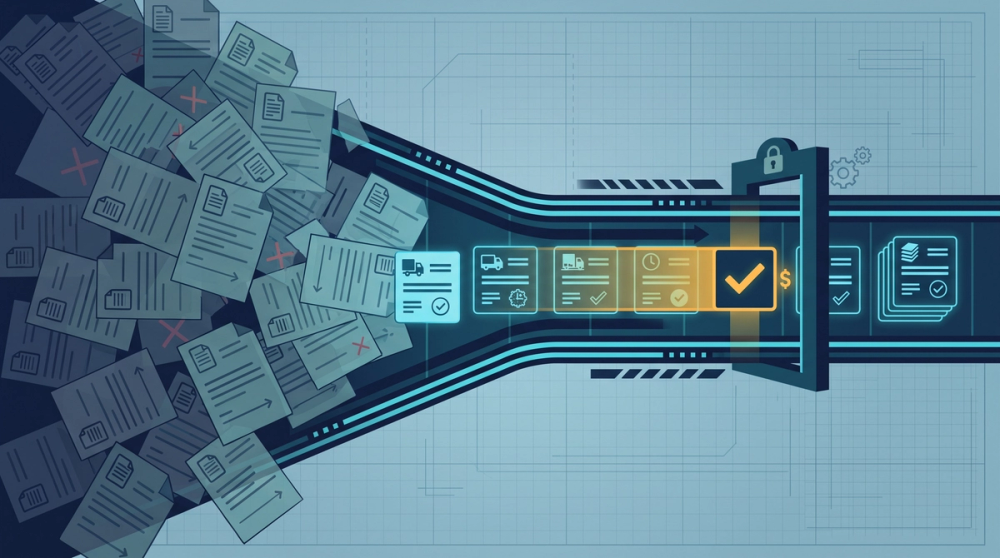
Not every invoice needs human review. If the carrier invoice matches the rate con on linehaul, fuel surcharge (within $5 tolerance), and has no accessorials beyond what's pre-approved, it can be auto-approved for payment. Set dollar thresholds and variance rules. Based on Laneproof analysis of broker workflows, most operations find that 60% to 70% of invoices are clean matches that can flow straight to payment. The remaining 30% to 40% get flagged with the specific line item that doesn't match, so your billing coordinator only reviews the exceptions, not every single invoice.
This is where the time savings get real. Instead of reviewing 300 invoices per month, your billing coordinator reviews 90 to 120 flagged exceptions. That cuts reconciliation time by 60% or more.
Real-World Scenarios: What Automation Catches (and What It Saves)
Theory is fine. Here's what this looks like with actual numbers.
Scenario 1: Fuel Surcharge Miscalculation
A carrier bills a fuel surcharge based on a DOE index from two weeks before pickup. The correct index for the actual pickup week is $0.04 per mile lower. On a 1,100-mile haul, that's $44 overbilled on a single load. Based on Laneproof analysis of carrier invoices, fuel surcharge miscalculations tied to outdated DOE index references cost brokers an average of $40 to $90 per load when not audited against the correct weekly rate at time of pickup. A broker running 400 loads per month with even a 5% incidence rate of fuel surcharge errors faces $800 to $1,800 per month in overpayment. An automated audit checks the pickup date, pulls the correct DOE index, calculates the contracted surcharge formula, and flags any variance over the set tolerance.
Scenario 2: Lumper Fee Overbilling
A carrier invoices a $450 lumper fee. The rate con caps lumper reimbursement at $350 and requires a receipt. Without an automated flag, the broker pays $100 over on every missed check. Based on Laneproof analysis, this pattern repeats across 2% to 4% of loads involving lumper-required facilities. For a broker handling 200 loads per month at lumper-eligible destinations, that's 4 to 8 overbilled lumper charges per month, or $400 to $800 per month in excess payments. Automated reconciliation compares the invoiced lumper amount to the rate con cap and checks for an attached receipt. If either condition fails, the invoice gets flagged before payment.
Scenario 3: Detention Disputes Without Documentation
A carrier bills 4 hours of detention at $75 per hour ($300). The broker's contracted free time is 2 hours, so the valid charge should be $150. But the broker can't produce a timestamped POD or BOL showing actual arrival and departure times. Without documentation, the broker has no grounds to dispute and writes off the full $300. Based on Laneproof analysis, detention disputes where the broker cannot produce timestamped documentation result in an average write-off of $175 to $350 per incident. Brokers handling 20 or more disputed loads per month face $3,500 to $7,000 in monthly margin erosion from detention alone. Automated document capture and indexing solves this by timestamping every uploaded BOL and POD, matching it to the load, and making it instantly retrievable when a dispute arises.
Scenario 4: TONU Charges Without Cancellation Proof
A carrier bills a TONU charge of $200. Your dispatcher remembers cancelling the load, but there's no timestamped record in your TMS or load event log. Based on Laneproof analysis, TONU charges billed without a confirmed cancellation timestamp cost brokers an average of $150 to $250 per incident and are among the hardest to dispute without automated load event logging. On 10 TONU disputes per month, that's $1,500 to $2,500 in charges you're paying because you can't prove your side. Automated load event logging captures every status change with a timestamp, giving you the documentation to dispute invalid TONU charges in minutes rather than hours.
Scenario 5: The Full Reconciliation Time Savings
Based on Laneproof analysis, a mid-sized broker automating carrier invoice matching against rate cons reduced reconciliation time from 14 hours per week to under 3 hours in the first 30 days. That saved approximately $308 per week in labor at a $28 per hour rate, or roughly $16,000 per year. The broker didn't replace their TMS. They layered a reconciliation tool on top that ingested carrier invoices, matched them to rate cons, and routed only the exceptions to their billing coordinator. Implementation took less than two weeks. Laneproof's reconciliation engine checks each of these fields automatically, flagging variances before payment goes out.
The Automation Mistakes That End Up Costing Brokers More Than They Save
Automation isn't free. And done wrong, it creates new problems. Here are the failure modes that freight brokers hit most often.
Mistake 1: Automating Before You Standardize
If your rate cons don't consistently include fuel surcharge formulas, lumper fee caps, or detention free time terms, no automation tool can check against data that isn't there. Before you automate reconciliation, make sure your rate con template captures every field that your billing coordinator would need to verify an invoice. This means: linehaul rate, fuel surcharge formula and index source, detention free time and per-hour rate, lumper fee cap and receipt requirement, and all pre-approved accessorials. Without standardized inputs, automation just processes garbage faster.
Mistake 2: Auto-Approving Everything Under a Threshold
Some brokers set up automation rules that auto-approve any invoice variance under $50. This sounds efficient until you realize that a carrier consistently overbilling by $35 per load across 200 loads per month is costing you $7,000 per month. Small variances add up. Set your tolerance thresholds low (we recommend $5 to $10 per line item) and review the patterns in flagged invoices monthly. The goal isn't zero human review. It's targeted human review on the exceptions that matter.
Mistake 3: Ignoring Carrier Communication
Automating invoice rejection without explaining why creates carrier relationship problems. If your system auto-rejects an invoice for a $40 fuel surcharge discrepancy and the carrier gets a generic "invoice rejected" notification, they're going to call your office. Now your dispatcher is spending 15 minutes on the phone explaining something the system could have included in the rejection notice. Good automation includes clear, specific dispute communications: "Fuel surcharge billed at $0.42/mile based on DOE index dated 5/12. Correct DOE index for pickup date 5/19 yields $0.38/mile. Adjusted invoice amount: [X]. Please resubmit or confirm." This is where brokerage operations often lose money: not on the automation itself, but on the carrier-facing fallout when it's poorly implemented.
Mistake 4: Skipping Compliance Checks
Automation should include compliance verification, not just financial reconciliation. According to FMCSA broker financial responsibility rules, brokers must maintain a minimum $75,000 surety bond, and operating authority is subject to suspension if it falls below that threshold and is not replenished within 7 calendar days. Automated carrier packet checks that verify insurance, authority status, and bond compliance before load assignment prevent a different category of costly problems.
As of 2026-06-01, truck transportation employed approximately 1,467 thousand workers (BLS). With that many people moving freight, the carriers you work with are constantly changing insurance providers, letting policies lapse, and updating authority information. Manual checks don't scale. Automated compliance monitoring does.
Building Your Automation Priority List
You can't automate everything at once, and you shouldn't try. Here's how to prioritize based on the ROI math above.
Week 1 to 2: Invoice reconciliation. This is the highest-dollar, highest-hour task. Automate carrier invoice matching against rate cons first. Expected savings: 60% to 75% reduction in reconciliation hours, plus recovery of overbilled accessorials.
Week 3 to 4: Document capture and indexing. Automate BOL and POD ingestion so every document is timestamped, matched to a load, and retrievable in seconds. This directly reduces detention and TONU dispute write-offs.
Month 2: Fuel surcharge auditing. Layer in automated DOE index lookups tied to actual pickup dates. This catches the $40 to $90 per load miscalculations that manual review misses.
Month 3: Rate con data entry. Automate extraction of load details from rate cons into your TMS. This saves your dispatcher 6+ hours per week on 100 loads.
Month 4: Carrier compliance monitoring. Automate insurance, authority, and bond verification checks against FMCSA records. This prevents a different class of risk entirely.
According to GM Insights freight brokerage market data, the global freight brokerage market was valued at $51.7 billion in 2023 and is growing at a 6% CAGR through 2032. Mid-sized brokers who build efficient back-office operations now are the ones positioned to grow with this market, not get squeezed out of it.
Your freight broker back office is likely leaking money every week across multiple workflows simultaneously. The priority list above lets you plug the biggest leaks first and measure results before moving to the next one.
Frequently Asked Questions
How much does it cost to automate freight broker invoice reconciliation?
Costs vary by provider and load volume, but most reconciliation automation tools for mid-sized brokers (100 to 500 loads per month) run between $200 and $800 per month. Compare that to the $17,000 to $26,000 per year in manual reconciliation labor and the $22,800 per month in potential overbilling exposure on 500 loads. Most brokers see a positive ROI within the first 30 to 60 days. You can review Laneproof's pricing for specifics on what fits your load volume.
Do I need to replace my TMS to automate carrier invoice auditing?
No. The best approach is layering automation tools on top of your existing TMS through API connections, shared data exports, or email-based ingestion. Your dispatchers keep using the TMS they know. The automation layer handles document matching, variance detection, and exception routing. No migration, no retraining, no downtime.
What percentage of carrier invoices typically have billing errors?
Based on Laneproof analysis of over 12,000 carrier invoices, approximately 3.8% of invoices contain accessorial overbilling. When you include fuel surcharge miscalculations, detention overcharges, and lumper fee discrepancies, the total error rate climbs higher. On 500 loads per month at an average of $1,200 per load, even a 3.8% accessorial error rate creates $22,800 per month in overbilling exposure.
How long does it take to implement carrier invoice automation?
For a mid-sized broker using a layered approach (not replacing the TMS), implementation typically takes one to two weeks. The first step is mapping your current document flow. The second is connecting the automation tool to your invoice intake (email or portal) and your rate con data source. Most brokers are running automated reconciliation within 10 business days and see measurable time savings by the end of the first month.
Will automation hurt my carrier relationships?
Only if you implement it poorly. Auto-rejecting invoices without clear, specific explanations creates friction. Good automation includes detailed dispute communications that tell the carrier exactly what didn't match and what the correct amount should be. Most carriers actually prefer this because it speeds up resolution. The problems come from generic rejection notices that force carriers to call your office for information the system already has.
The Bottom Line: Start With Reconciliation, Then Build Out
You don't need a full digital overhaul to automate freight brokerage operations. You need to know which workflows cost you the most in hours and errors, then fix them one at a time with tools that sit on top of what you already use.
Invoice reconciliation is the starting point because it combines the highest labor cost (12 to 18 hours per week) with the highest error exposure (3.8% overbilling rate across accessorials). Automating it first gives you measurable results in 30 days and frees up the time and budget to tackle document capture, fuel surcharge auditing, and data entry next.
If you want to see how automated reconciliation works against your actual carrier invoices, tools that automatically flag invoice discrepancies can show you what you're missing in your current process. Start with the math. The math makes the decision easy.
Sources
- Broker and Freight Forwarder Financial Responsibility Rule Overview — FMCSA
- The Freight Broker of the Future — Transport Topics
- Getting Started with Freight Brokerage Automation — Drumkit
- Scaling Smarter: The Real Benefits of TMS Automation — Turvo
- Freight Brokerage Market Size & Share, Growth Trends 2032 — GM Insights