Rate Confirmation Trucking Template: Fields Most Brokers Miss
Researched and written with AI assistance. Reviewed by the Laneproof team.

A carrier invoices you $275 for detention. Your rate confirmation trucking template listed no free time window and no per-hour cap. You have zero written basis to dispute it, so you pay in full. On the same week, another carrier tacks on $160 for a lumper fee you never approved, plus a $300 TONU charge for a load you cancelled four hours before pickup. None of those scenarios required the carrier to fabricate anything. They just found the gaps in your rate con. The problem isn't dishonest carriers. It's incomplete templates. Most rate con templates floating around the internet are missing four to six fields that directly create billing disputes. This article names every field that belongs on a rate confirmation, explains the specific overbilling scenario each one prevents, and covers what actually makes a rate con enforceable when a carrier pushes back.
What a Rate Confirmation Actually Is (and What It Has to Do)
A rate confirmation is a legally binding agreement between a freight broker and a carrier that establishes the terms of a specific load before dispatch. It is not a quote. It is not a handshake. According to Optym's rate confirmation overview, a rate con functions as a contract that locks in the linehaul rate, accessorial terms, and load specifications between broker and carrier. Truckstop's freight broker documents guide describes the rate confirmation as one of the essential legal documents governing the relationship between brokerage, shipper, and carrier.
The rate con does two jobs simultaneously. First, it tells the carrier exactly what they're hauling, where, and for how much. Second, it sets the boundaries for every charge the carrier can submit after delivery. When a field is missing from the rate con, that boundary doesn't exist. And carriers, whether intentionally or by default, will invoice at rates that favor them when there's nothing in writing to say otherwise.
Why This Document Matters More Than Your Carrier Packet
Your carrier packet sets general terms: insurance minimums, indemnification clauses, payment schedules. But the rate confirmation governs the specific load. When a dispute hits your desk, the first document anyone looks at is the rate con for that shipment. If a carrier factors their invoice through a third party, that factoring company checks the rate con. If the dispute escalates, the rate con is the primary evidence. Per Apex Capital's freight billing guide, carriers submitting freight bills to brokers typically need three documents together: an invoice, a rate confirmation sheet, and a Bill of Lading (BOL). The rate con is the financial anchor. Without it (or with an incomplete one), you're building your billing process on sand.
There's also a regulatory dimension worth knowing. FMCSA's proposed rule under Docket No. FMCSA-2023-0257 signals increased scrutiny on broker-carrier financial transparency. While the rule focuses on transaction records brokers must provide upon request, the direction is clear: document everything, document it in writing, and make it specific to the load.
The Fields Most Rate Con Templates Are Missing
According to Fulfill.com's rate confirmation component breakdown, a complete rate confirmation must include a load or reference ID, commodity description, weight, piece count, and any special handling requirements. That's the baseline. But many templates, including popular free ones, stop there. Here are the fields that most templates leave out, and the billing disputes each one creates.
Detention Clause with Free Time and Per-Hour Cap
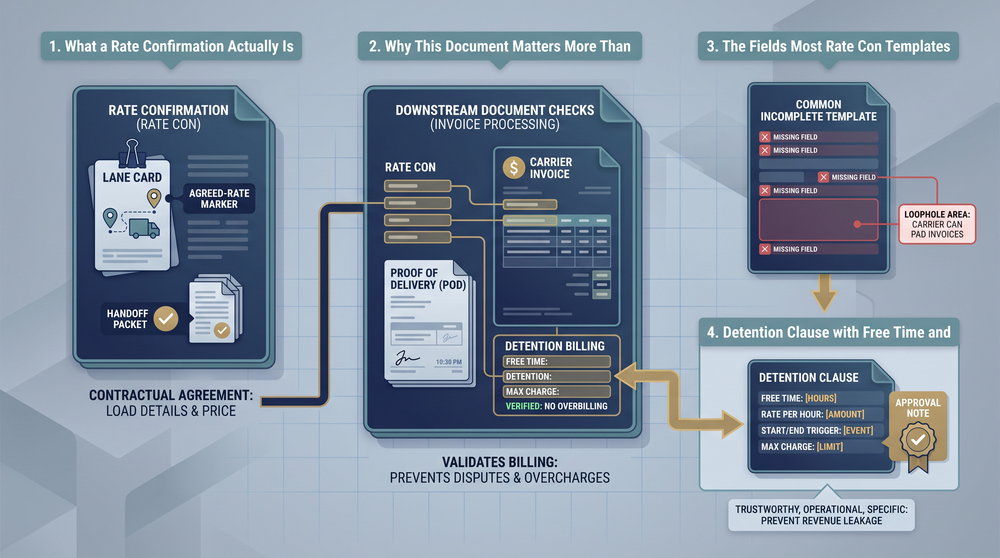
If your rate con does not specify a free time window (typically two hours at origin and two at destination) and a per-hour detention rate with a daily maximum, you have no written basis to dispute a detention charge. Period.
Scenario: A carrier invoices $275 for detention on a load where the rate con listed no free time window and no per-hour cap. The broker has no documented language to push back. The carrier gets paid in full, even though the actual wait time was 90 minutes, which would have fallen within a standard two-hour free time window. That $275 comes straight off the broker's margin. Multiply that across 15 to 20 loads a month and the annual cost is real. For more on how specific rate con fields create overbilling opportunities, see rate con fields carriers use to overbill you.
Fuel Surcharge Basis
Does your fuel surcharge calculate off DOE national average? Regional average? Is it a flat percentage of linehaul or cents-per-mile? If the rate con doesn't specify, the carrier picks whichever method produces the highest number.
Scenario: A 1,400-mile load goes out with no fuel surcharge basis documented. The broker assumed a flat rate inclusive of fuel. The carrier invoices fuel as a separate line item at $0.14/mile, adding $196 to the invoice. The broker disputes it. The carrier points to industry-standard FSC tables. Neither side has documentation. The dispute takes three emails, two phone calls, and a week to resolve. The broker settles at $190 to avoid further delay.
TONU (Truck Ordered Not Used) Terms
If you cancel a load after a carrier has dispatched a truck, you owe something. The question is how much. Without a TONU clause in the rate con, the carrier sets that number.
Scenario: A broker cancels a load four hours before pickup. No TONU language exists in the rate con. The carrier claims a $300 dry run fee. The broker has no documented agreement to refuse it. A written TONU clause might have capped the fee at $150 or $200 with a specific cancellation window (e.g., 'TONU applies only if cancelled within two hours of scheduled pickup').
Lumper Fee Pre-Approval Language
Lumper fees at receiving facilities are common, especially for grocery and retail loads. But without a clause requiring prior broker approval before the carrier pays a lumper, you lose control of the cost.
Scenario: A carrier pays $160 at the door for a lumper and invoices the broker. The rate con has no lumper pre-approval requirement. The broker absorbs the cost because there's no written basis to reject it and no shipper recourse since the broker-to-shipper agreement may not have anticipated the fee either.
Accessorial Cap
Even when individual accessorial lines are documented, many rate cons lack a total accessorial cap per load. This creates 'accessorial creep,' where small charges stack up beyond what the linehaul profit can absorb.
Scenario: A carrier adds $85 for layover, $275 for detention, and $45 for a scale ticket on a single load. Total accessorial creep: $405. The broker's margin on the load was $350. With no written cap to reference, the broker is now upside down on the load by $55. A simple clause like 'Total accessorials not to exceed $300 per load without prior written approval' would have given the broker standing to reject the excess charges.
Payment Terms and Factoring Acknowledgment
If your rate con doesn't specify net-30 or net-15 terms, you may face pressure from factoring companies operating on the carrier's behalf. Include a field that states payment terms and a clause acknowledging that any factored invoice is subject to the same rate con terms. This prevents a factoring company from escalating disputes that the carrier already accepted.
Digital Signature Field
An unsigned rate con is a suggestion, not a contract. More on this in the enforceability section below.
For a full breakdown of the most common rate confirmation mistakes and what they cost, read what brokers get wrong about rate confirmations.
Broker-to-Carrier vs. Broker-to-Shipper: These Are Not the Same Document
This is a distinction that costs brokers real money when they get it wrong. A broker-to-carrier rate confirmation governs what you pay the carrier. A broker-to-shipper rate confirmation (sometimes called a load confirmation or booking confirmation) governs what the shipper pays you. These documents contain different rates, different terms, and different liabilities. They should never be interchangeable, and they should never live in the same template without clear labeling.
What Happens When You Send the Wrong One
Scenario: A broker sends a carrier the broker-to-shipper rate con by mistake. The document shows the shipper rate, exposing the broker's margin. The carrier now knows the broker is making $400 on a $2,200 load. This doesn't just create an awkward conversation. It gives the carrier negotiating ammunition on future loads, and in some cases, carriers have used exposed margins to negotiate directly with shippers, cutting the broker out entirely.
This happens more often than brokers admit. It's usually a filing error or a template mix-up in a TMS where documents aren't tagged by type. The fix is straightforward: maintain separate templates with clear headers ('Carrier Rate Confirmation' vs. 'Shipper Load Confirmation'), different color schemes or formatting, and access controls so dispatchers only see carrier-facing documents.
Key Differences Between the Two Documents
The broker-to-carrier rate con includes: linehaul rate paid to carrier, carrier-specific accessorial terms, detention and TONU clauses carrier must agree to, payment terms (net-30, quickpay options), and carrier MC number and insurance references. The broker-to-shipper document includes: linehaul rate charged to shipper, shipper-specific accessorial billing, claims liability and cargo value limits, shipper payment terms, and any volume commitment references. Mixing these fields, or worse, using one template for both, is how margins get exposed and disputes get complicated. If you're also reviewing carrier rate sheets to verify pricing, here's how to read a carrier rate sheet before it costs you money.
How to Write Detention, Accessorial, and TONU Language That Holds Up
Having the right fields on your rate confirmation trucking template is only half the job. The language in those fields determines whether your terms hold up in a dispute. Vague language favors the carrier. Specific language protects the broker.
Detention Clause Example
Weak language: 'Detention may apply.' This says nothing. It doesn't define when detention starts, how much it costs, or who approves it.
Strong language: 'Detention applies after two (2) hours of free time at origin and two (2) hours of free time at destination. Detention rate: $50/hour, not to exceed $250 per occurrence. Detention must be reported to broker dispatch within 30 minutes of free time expiration. Carrier must provide timestamped BOL or facility check-in/check-out documentation to support any detention claim.'
That second version closes every gap: it defines free time, caps the rate, requires timely notification, and demands documentation. A carrier can't invoice $275 when your cap is $250, and they can't claim detention without a timestamped BOL to prove it.
Accessorial Language Example
Weak language: 'Accessorials billed as incurred.' This is a blank check.
Strong language: 'No accessorial charges will be paid unless (a) pre-approved in writing by broker prior to incurrence, (b) documented with supporting receipts or facility records, and (c) submitted within 48 hours of delivery. Total accessorial charges per load not to exceed $300 without prior written broker authorization. Approved accessorial categories: detention (per clause above), lumper fees (with receipt and pre-approval), scale tickets (with receipt). All other accessorial charges are excluded unless added by written amendment to this rate confirmation.'
This language does three things: it requires pre-approval, it caps total accessorials, and it defines an exclusive list of approved categories. Anything not on the list requires an amendment. That eliminates accessorial creep.
TONU Clause Example
Strong language: 'In the event broker cancels this load after carrier has confirmed and dispatched, a TONU fee of $200 applies, provided cancellation occurs within two (2) hours of scheduled pickup. No TONU fee applies if cancellation notice is given more than two (2) hours before scheduled pickup. Carrier must provide proof of dispatch (driver assignment, GPS log, or dispatch confirmation) to claim TONU.'
Without this clause, you're negotiating TONU fees after the fact, with no written leverage. With it, you've set a cap, a window, and a documentation requirement. For additional detail on how vague agreement language creates billing gaps, see rate agreement gaps carriers use to overbill you on every load.
When a Carrier Invoices Above the Rate Con: What You Can Do
It happens every week in most brokerage back offices. A carrier invoice comes in higher than the rate con. The question is whether you have the documentation to push back or whether you absorb the difference.
Step 1: Check the Rate Con for the Disputed Line Item
Pull the rate confirmation for the load. Does it address the specific charge the carrier added? If your rate con includes a detention clause with a $250 cap and the carrier invoiced $275 in detention, you have a written basis to reject the excess $25. If your rate con is silent on detention, you have no basis to dispute any detention amount.
Step 2: Match the Rate Con Against the BOL
The BOL is your delivery receipt. It captures what actually happened: timestamps, piece counts, weight, and sometimes notes about wait times or facility issues. Compare the BOL data against the rate con terms. If the carrier claims three hours of detention but the BOL shows a 90-minute window from check-in to loading, you have documentation to dispute the charge.
Step 3: Verify Signature and Enforceability
Scenario: An unsigned rate con is submitted as evidence in a payment dispute. The broker's position depends entirely on the email thread showing the carrier accepted the load at the stated rate. Reconstructing that evidence takes three to four hours per incident, pulling emails, matching timestamps, confirming dispatch records.
A signed rate con eliminates that reconstruction entirely. But the signature method matters. Rate cons signed via non-compliant tools may not satisfy ESIGN Act requirements, creating enforceability risk in collections or factoring scenarios. Use signature tools that capture signer identity, timestamp, and intent to sign. PDF tools that simply let someone type their name in a text field may not meet the standard.
A rate con without a detention clause is a blank check for the carrier. A rate con without a signature is a suggestion, not a contract.
Step 4: Document and Respond in Writing
Never dispute a carrier invoice by phone alone. Send a written dispute referencing the specific rate con clause, the load number, and the BOL data that contradicts the carrier's charge. This creates a paper trail that protects you if the carrier escalates to their factoring company or pursues collections.
Turing IT Labs' analysis of freight rate confirmation workflows identifies manual rate confirmation processing as a significant operational drain for freight brokers. The time spent reconstructing disputes, matching documents, and chasing email approvals is time your team isn't spending on booking loads. This is where the real cost of incomplete rate cons shows up: not just in the overbilled charges themselves, but in the hours spent fighting them.
Complete Rate Confirmation Trucking Template Field Checklist
Here is every field that belongs on a broker-to-carrier rate confirmation, organized by category. If your current template is missing any of these, you have a billing gap.
Load Identification
- Broker load/reference number
- Carrier name, MC number, and DOT number
- Broker name, MC number, and contact info
- Driver name and phone (or 'TBD, must be confirmed before dispatch')
Load Details
- Commodity description
- Weight and piece count
- Equipment type (van, reefer, flatbed, etc.)
- Temperature requirements (if applicable)
- Special handling instructions (hazmat, high-value, team required)
Pickup and Delivery
- Origin address with facility name and contact
- Pickup date and appointment time (or window)

- Destination address with facility name and contact
- Delivery date and appointment time (or window)
- Number of stops (if multi-stop, list each with separate address and time)
Financial Terms
- Linehaul rate (flat or per-mile, clearly stated)
- Fuel surcharge basis (DOE average, percentage, CPM, or included in linehaul)
- Detention clause: free time, per-hour rate, daily cap, documentation requirements
- TONU clause: fee amount, cancellation window, proof-of-dispatch requirement
- Lumper fee pre-approval requirement
- Approved accessorial categories with individual and total caps
- Payment terms (net-30, net-15, quickpay discount if offered)
- Factoring acknowledgment clause
Legal and Compliance
- Digital signature field (ESIGN Act compliant)
- Date of agreement
- Reference to master carrier agreement (if applicable)
- Dispute resolution clause (optional but recommended)
- Governing law / jurisdiction
FreightAmigo's 2025 guide on trucking rate confirmation templates recommends clear, unambiguous language on every field and cautions against generic templates that lack customization for specific operational needs. ArkTMS offers free freight broker templates that cover many of these fields, though brokers should review them against the full checklist above and add any missing clauses before use.
Frequently Asked Questions About Rate Confirmation Documents
Is a rate confirmation legally binding without a signature?
It depends on the evidence. An unsigned rate con can still be enforceable if you can prove the carrier accepted its terms through conduct (e.g., dispatching a truck, picking up the load) or through email correspondence confirming agreement. However, proving this takes significant time, often three to four hours per incident to reconstruct from email threads. A signed rate con, especially one with an ESIGN Act-compliant digital signature, is far stronger in disputes and is typically required by factoring companies.
What's the difference between a rate confirmation and a carrier agreement?
A carrier agreement (also called a carrier packet or broker-carrier agreement) sets the general terms of the ongoing relationship: insurance requirements, indemnification, double brokering prohibitions, and standard payment terms. A rate confirmation is load-specific. It governs the rate, accessorials, and terms for one shipment. Think of the carrier agreement as the constitution and the rate con as the specific law for each load. Both are needed. Neither replaces the other.
Can a carrier charge for something not listed on the rate con?
Technically, a carrier can invoice for anything. Whether you have to pay it depends on what the rate con says. If your rate con includes language like 'No accessorial charges will be paid unless pre-approved in writing,' you have a written basis to reject unapproved charges. If the rate con is silent on a specific charge category, you're in a gray area that usually gets resolved in the carrier's favor because they performed the work and can argue the cost was necessary.
Should my rate con include a fuel surcharge if the rate is all-in?
Yes. Even if you quote an all-in rate (linehaul plus fuel), your rate con should explicitly state: 'Rate is inclusive of fuel surcharge. No separate fuel surcharge will be paid.' Without this language, a carrier can argue the rate was linehaul-only and submit a separate fuel surcharge line. Stating it explicitly closes that gap.
How long should I keep rate confirmations on file?
FMCSA requires brokers to retain transaction records for a minimum of three years. Given that cargo claims and payment disputes can surface well after delivery, many brokers retain rate cons, BOLs, and PODs for five years. Digital storage makes this cost-effective. The more important question is whether you can retrieve a specific rate con quickly when a dispute hits your desk, not just whether it exists somewhere on a hard drive.
Conclusion: Close the Gaps Before They Cost You
Every missing field on your rate confirmation is an open door for a billing dispute you can't win. Detention without a cap, fuel surcharge without a basis, accessorials without pre-approval, TONU without a clause: these aren't edge cases. They're the charges that show up on carrier invoices every week and eat your margin load by load.
Use the field checklist in this article to audit your current template. Add the missing clauses. Write specific language for detention, accessorials, and TONU. Make sure every rate con goes out signed. And label your broker-to-carrier and broker-to-shipper documents separately so you never accidentally expose your margin.
If your team processes more than 50 invoices a week, matching each one against its rate con and BOL manually is where the real time drain lives. Automated document extraction tools can pull rate con fields, flag mismatches against carrier invoices, and surface the discrepancies covered in this guide before they become disputes you have to fight by hand.
Sources
- FMCSA Docket No. FMCSA-2023-0257: Transparency in Property Broker Transactions — Federal Motor Carrier Safety Administration
- Free Freight Broker Templates — ArkTMS
- What Is Rate Con? — Optym
- Rate Confirmation: Definition, Components & Best Practices — Fulfill.com
- Freight Broker Documents: 10 Important Forms — Truckstop
- Mastering the Trucking Rate Confirmation Template — FreightAmigo
- Freight Rate Confirmations: Why They Drain Time and How to Automate — Turing IT Labs
- How to Build a Freight Bill Like A Pro — Apex Capital