How to Read a Carrier Rate Sheet Before It Costs You Money
Researched and written with AI assistance. Reviewed by the Laneproof team.
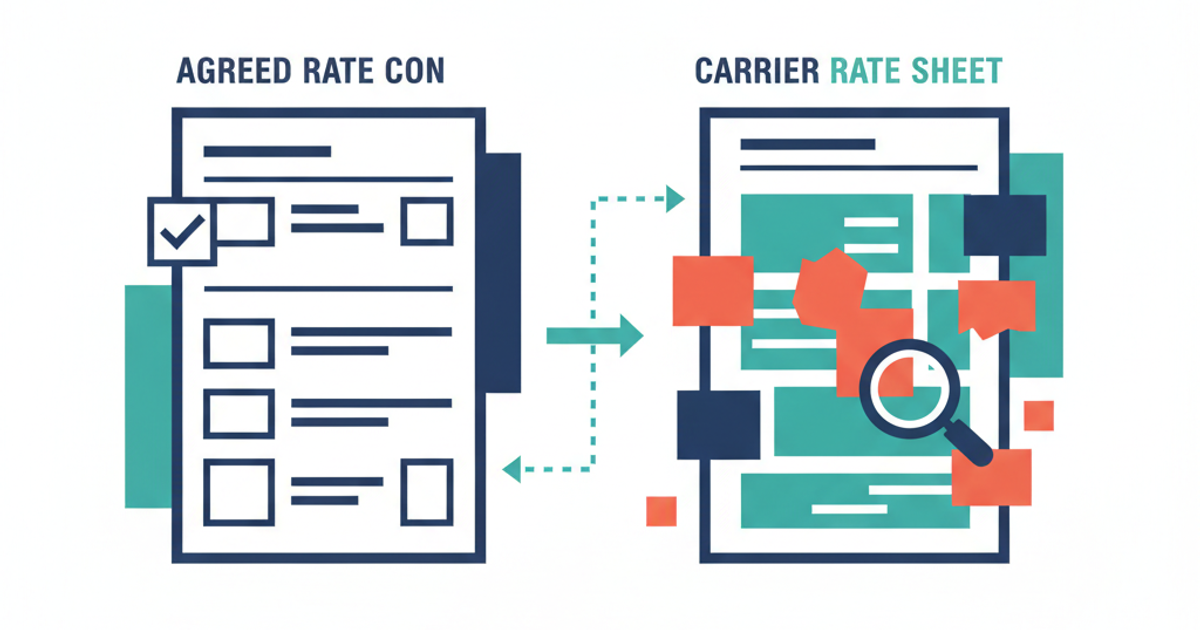
A broker running 300 loads a month who catches an average overbilling of $47 per load on just 12% of invoices recovers roughly $1,692 every month. Over a year, that's $20,304 back in margin, just from reading documents more carefully. The carrier rate sheet is where most of those discrepancies start, and it's also where most brokers stop paying attention. They glance at the linehaul number, confirm it matches the rate con, and move on. But the charges that eat your margin aren't hiding in the linehaul. They're buried in the accessorial lines, the fuel surcharge calculations, and the detention terms that don't match what you agreed to.
This guide walks through a carrier rate sheet line by line, the way a billing coordinator should, not the way a sales rep does. You'll learn which fields get disputed most, how to cross-reference them against your rate confirmation, and how to build the documentation you need to push back when a carrier invoice doesn't match the deal.
What Is a Carrier Rate Sheet and Why Most Brokers Don't Read It Carefully Enough
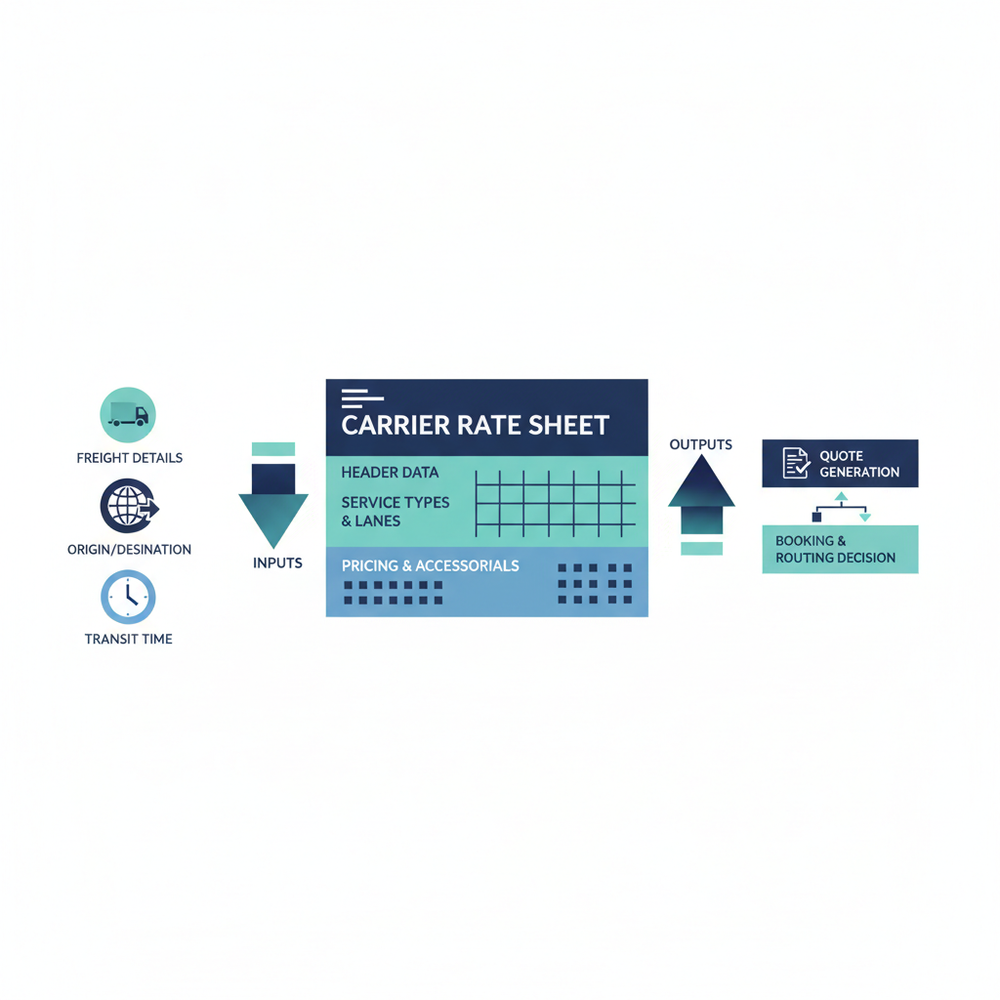
A carrier rate sheet is the document a carrier uses to lay out their pricing structure: linehaul rates, fuel surcharges, accessorial charges, detention policies, and any other fees tied to hauling a load. It's separate from the rate confirmation, which is the agreed-upon price for a specific load. The rate sheet is the carrier's menu. The rate con is your order. The problem is that most brokers treat them as the same thing, or worse, ignore the rate sheet entirely once the rate con is signed.
According to the American Trucking Associations' industry data, trucks moved roughly 72.7% of the nation's freight by weight in 2024. That volume means millions of carrier invoices cross broker desks every week. Each one references a rate sheet, whether explicitly or implicitly. When you don't read the rate sheet before signing the rate con, you're accepting terms you may not have agreed to, because the carrier's default accessorial schedule often gets applied to your invoice unless the rate con explicitly overrides it.
The rate sheet vs. the rate con: where confusion starts
Here's the distinction that matters operationally. The carrier rate sheet is the carrier's standard pricing document. It includes their base per-mile rates by equipment type, their default fuel surcharge formula, their accessorial fee schedule (detention, lumper, layover, TONU), and any minimum charges. The rate confirmation is the contract for a single load. It should specify the agreed linehaul rate, any included or excluded accessorials, the fuel surcharge (flat or formula), and the payment terms.
When a carrier sends an invoice that includes charges from their rate sheet that weren't on the rate con, you have a dispute. But if your rate con didn't explicitly exclude or cap those charges, the carrier has a stronger argument. That's why reading the rate sheet before you negotiate the rate con is the single most important thing you can do to protect your margin on every load. For more on where these gaps show up, see how rate agreement gaps let carriers overbill on every load.
What Is the Going Rate for Freight Per Mile Right Now
As of March 2026, national spot trucking rates per mile break down as follows, according to current per-mile freight rate data from Dynamic Logistix:
- Dry Van: $2.47 per mile (typical range: $1.80 to $2.40 on contract, higher on spot)
- Reefer: $2.88 per mile (typical range: $2.20 to $3.10)
- Flatbed: $2.95 per mile (typical range: $2.50 to $3.30)
These are national averages. High-demand corridors like Southeast to Midwest or California outbound will run 10% to 20% above these benchmarks, especially during produce season or holiday surges. You can track weekly fluctuations using DAT Trendlines spot market data, which provides rate benchmarks by equipment type and lane.
Why does this matter for reading a carrier rate sheet? Because if a carrier's rate sheet shows a linehaul of $2.10/mile for a dry van load on a lane where DAT shows spot rates averaging $2.47, that gap tells you one of two things: the carrier is pricing aggressively to win the lane, or they plan to make up the difference in accessorials. Both scenarios require you to read the full rate sheet, not just the linehaul line.
How brokers should benchmark carrier rate sheets against market data
Every time a carrier sends you a rate sheet, your first step should be comparing their per-mile rates against current market benchmarks. According to OOIDA's 2024 Freight Rate Survey, carrier-reported rates often reflect present-day conditions that differ significantly from annual averages. This means a rate sheet from six months ago may already be outdated, and a carrier who hasn't updated their sheet may be padding accessorials to compensate for a linehaul rate that no longer covers their costs.
As Boxaloo's guide on how freight brokers set rates explains, brokers calculate their rates relative to what carriers charge, which means understanding the carrier's rate sheet structure is foundational to setting your own margins accurately. If you're guessing at what the carrier's total cost will be, you're guessing at your own margin.
The Line Items Carriers Slip In That Don't Match the Rate Con
This is where money disappears. A carrier rate sheet might list 15 to 20 line items. Your rate con for a specific load might reference three or four. The charges that show up on the carrier invoice but weren't on the rate con are where disputes happen, and where your margin erodes if you don't catch them.
Fuel surcharges that get unbundled
Example: You book a dry van load at $2.10/mile on the rate con. You and the carrier agreed on an all-in rate. The carrier invoice arrives showing $2.10/mile linehaul plus a $175 fuel surcharge listed separately. The carrier's rate sheet has a standard fuel surcharge policy, and since the rate con didn't explicitly say "all-in, no fuel surcharge," the carrier bills it.
On a 1,200-mile load, the agreed cost was $2,520. The invoice shows $2,695. That's a $175 difference on a single load. Multiply that across 300 loads a month, and even if it only happens on 5% of loads, you're losing $2,625 monthly.
The fix: your rate con must explicitly state whether the rate is all-in or whether a fuel surcharge applies. If a surcharge applies, specify whether it's a flat fee or a percentage of linehaul. This is one of the most common rate con fields carriers use to overbill, and it's entirely preventable.
Fuel surcharge as a percentage vs. flat fee
Example: Your rate con specifies a flat $95 fuel surcharge. The carrier's rate sheet calculates fuel surcharges as 8% of linehaul. On a load with a $2,400 linehaul, 8% is $192, not $95. The carrier invoice shows $192 because their billing system applied the rate sheet formula, not the rate con terms.
That's a $97 discrepancy on one load. If your billing coordinator doesn't catch it, you've just donated $97 to the carrier's bottom line. The rate con controls the deal, but only if you flag it. If you pay the invoice as submitted, you've effectively accepted the rate sheet terms.
TONU charges outside the cancellation window
Example: A load gets cancelled, and the carrier submits a TONU (Truck Ordered Not Used) charge of $150. But the rate con specifies a 2-hour free cancellation window, and your dispatch records show the load was cancelled 45 minutes after booking. The carrier's rate sheet has a flat $150 TONU policy with no free cancellation window, and their billing team applied the rate sheet default.
Timestamp documentation kills this dispute instantly. Pull the cancellation email or TMS record showing the time, compare it to the booking confirmation time, and send both to the carrier. If the rate con says free cancellation within 2 hours and you cancelled at 45 minutes, the $150 charge doesn't hold up.
How to Cross-Check a Carrier Rate Sheet Against Your Rate Confirmation
Cross-checking isn't optional. It's the single most effective way to prevent carrier invoice disputes from eroding your margin. Here's the process, step by step.
Step 1: Pull the carrier rate sheet before you negotiate
Before you agree on a rate, request the carrier's current rate sheet. Not the one from their carrier packet that's six months old. The current one. Compare their standard per-mile rates against market benchmarks from DAT or Dynamic Logistix. Look at their accessorial schedule and note every fee that could potentially apply to the load you're booking. Pay special attention to fuel surcharge formulas, detention rates, layover policies, and TONU terms.
Step 2: Write a rate con that overrides the rate sheet defaults
Your rate confirmation should explicitly address every charge from the carrier rate sheet that could apply to the load. This means specifying:
- Whether the linehaul rate is all-in or excludes fuel surcharges
- The exact fuel surcharge amount (flat fee) or formula (percentage), if applicable
- Detention rate per hour and free time before detention kicks in
- Whether lumper fees are included, excluded, or reimbursable with receipt
- TONU terms including the free cancellation window
- Layover terms and when they apply
Every item left unaddressed on the rate con is an item where the carrier's rate sheet terms apply by default. For a deeper look at what happens when rate cons leave gaps, read what brokers get wrong on rate confirmations and what it costs.
Step 3: Match every line on the carrier invoice to the rate con
When the carrier invoice arrives, match every line item against the rate con, not the rate sheet. If the invoice includes a charge that isn't on the rate con, check whether the rate con explicitly excluded it. If the rate con is silent on that charge, check the rate sheet to see if it's a standard fee. If it is, you have a weaker dispute position, which is why Step 2 matters so much.
For each discrepancy, document the rate con term, the invoice line, and the dollar difference. Send the dispute to the carrier with all three data points. Carriers resolve disputes faster when you show them exactly where their invoice deviates from the agreed terms, not when you just say "this looks wrong."
The Accessorial Charges That Show Up Most on Disputed Invoices
Not all accessorials cause problems. Some show up on disputed invoices far more than others. Here are the five that brokers fight most often, with real numbers.
1. Detention charges
Example: A carrier bills detention at $75/hour for 3 hours, totaling $225. The rate con specifies a $50/hour detention rate after a 2-hour free period. The load was at the facility for 4 hours total. Under the rate con terms, detention should be 2 billable hours (4 hours minus 2-hour free time) at $50/hour, totaling $100. The carrier billed $225. The discrepancy is $125.
Here's the breakdown:
- Carrier invoice: 3 hours × $75/hour = $225
- Rate con terms: (4 hours total − 2 hours free) × $50/hour = $100
- Overbilling: $125 on a single load
The carrier applied their rate sheet detention policy (no free time, $75/hour) instead of the rate con terms. This is one of the most common disputes in freight billing, and it's entirely avoidable if you specify detention terms on every rate con.
2. Lumper fees billed twice
Example: A carrier submits an invoice with a $350 lumper fee. But the shipper already paid the lumper service directly at the delivery facility. The carrier's driver paid the lumper out of pocket without checking whether it had already been covered, and the carrier added it to the invoice. Now you're looking at a $350 duplicate charge.
The fix: require lumper receipts with every invoice that includes a lumper charge. Cross-reference the receipt against shipper payment records. If the shipper already paid, the carrier's charge is a duplicate, and you dispute with the receipt as documentation. This takes two minutes of checking and saves $350.
3. Layover charges without supporting documentation
Example: A carrier bills a $250 layover charge, claiming the driver had to wait overnight for a next-day delivery appointment. But the BOL shows delivery was completed same-day, and the POD timestamp confirms it. There was no layover. The carrier's billing system may have auto-applied the charge based on the appointment date vs. pickup date, but the actual delivery timestamps tell a different story.
POD timestamps are your best defense against unsupported accessorial claims. When a carrier bills a layover and the POD shows same-day delivery, the charge doesn't survive a dispute. Keep PODs organized and accessible for every load.
4. TONU charges inside the free window
As described earlier, TONU charges submitted on loads cancelled within the free cancellation window are disputable with timestamp documentation. The rate con terms control, and dispatch records prove timing.
5. Fuel surcharges applied incorrectly
Whether it's unbundling an all-in rate or applying a percentage formula instead of a flat fee, fuel surcharge discrepancies are among the most frequent billing errors. They're also among the easiest to miss because the dollar amounts are often small enough to slip through manual review.
A broker managing 300 loads per month who catches an average overbilling of $47 per load on just 12% of invoices recovers roughly $1,692 per month. That's $20,304 per year in margin that would otherwise disappear into carrier overpayments.
What a Full Carrier Rate Sheet Cross-Check Looks Like in Practice
Let's walk through what a complete cross-check looks like, from rate sheet to invoice resolution, on a single load.
Scenario: 800-mile dry van load, Dallas to Atlanta
Rate sheet terms (carrier's standard pricing):
- Linehaul: $2.35/mile
- Fuel surcharge: 8% of linehaul
- Detention: $75/hour, no free time
- TONU: $200 flat
- Lumper: pass-through with receipt
Rate con terms (what you agreed to):
- Linehaul: $2.10/mile, all-in (fuel included)
- Detention: $50/hour after 2-hour free time
- TONU: $150, with 2-hour free cancellation window
- Lumper: shipper-paid, carrier not to invoice
Carrier invoice received:
- Linehaul: 800 miles × $2.10 = $1,680
- Fuel surcharge: 8% × $1,680 = $134.40
- Detention: 3 hours × $75 = $225
- Total invoiced: $2,039.40
What the invoice should show per the rate con:
- Linehaul (all-in, fuel included): 800 × $2.10 = $1,680
- Fuel surcharge: $0 (included in all-in rate)
- Detention: driver was at facility 3.5 hours. Free time: 2 hours. Billable: 1.5 hours × $50 = $75
- Correct total: $1,755
Discrepancy: $2,039.40 − $1,755 = $284.40 overbilled on a single load.
That $284.40 came from two sources: a fuel surcharge that shouldn't have been there ($134.40) and a detention charge calculated using the rate sheet terms instead of the rate con terms ($150 difference). Both are preventable. Both require you to have actually read the rate sheet before negotiating the rate con, and to have written a rate con that explicitly overrides those defaults.
For more examples of rate con errors that cost brokers real money, see common rate confirmation errors freight brokers miss.
Frequently Asked Questions About Carrier Rate Sheets and Freight Billing
What is the going rate for freight per mile?
As of March 2026, national spot rates per mile average $2.47 for dry van, $2.88 for reefer, and $2.95 for flatbed, according to Dynamic Logistix freight rate data. Contract rates tend to run slightly lower. High-demand corridors like Southeast to Midwest or California outbound can push 10% to 20% above national averages. Always benchmark a carrier rate sheet against current market rates before agreeing to terms.
How do I calculate the transport rate on a carrier rate sheet?
Multiply the per-mile linehaul rate by the total miles, then add any applicable accessorials. For example, a 1,000-mile dry van load at $2.10/mile with a flat $95 fuel surcharge totals $2,195. If the carrier rate sheet uses a percentage-based fuel surcharge instead (say 8%), the surcharge would be $168, bringing the total to $2,268. The calculation method matters because it directly affects your margin. As Aljex's guide on how freight brokers calculate rates explains, the carrier's rate structure is the foundation of the broker's own pricing.
What's the difference between a carrier rate sheet and a rate confirmation?
The carrier rate sheet is the carrier's standard pricing menu covering all their rates, surcharges, and accessorial policies. The rate confirmation is the binding agreement for a specific load. The rate con should override the rate sheet wherever the two conflict. If the rate con is silent on a specific charge, the carrier may apply their rate sheet defaults. This is why it's critical to address every potential charge in the rate con before the load moves.
How do I dispute a carrier invoice that doesn't match the rate con?
Pull three documents: the rate con, the carrier invoice, and any supporting timestamps (BOL, POD, dispatch records). For each disputed line item, document what the rate con says, what the invoice shows, and the dollar difference. Send the dispute to the carrier with all three data points attached. Carriers resolve disputes faster when you provide specific documentation rather than a general objection. The rate con is your contract; if the invoice deviates from it, the burden of proof is on the carrier to justify the charge.
How do I create a rate confirmation that prevents billing disputes?
Start by reading the carrier's rate sheet before you negotiate. Identify every accessorial and surcharge that could apply to the load. Then write a rate con that explicitly addresses each one: specify whether the rate is all-in or excludes fuel, set detention rates and free time, define TONU terms and cancellation windows, and note who pays lumper fees. Every term left unaddressed is a potential dispute. As Truckstop's guide on negotiating freight rates points out, carriers use their rate sheets as negotiation tools, so you need to counter with a rate con that's equally specific.
Sources
- 2024 Freight Rate Survey Final Report — Owner-Operator Independent Drivers Association (OOIDA)
- Economics and Industry Data — American Trucking Associations (ATA)
- DAT Trendlines — DAT Freight & Analytics
- Trucking Rates Per Mile 2026: Current Freight Rates — Dynamic Logistix
- How to Negotiate Freight Rates: 13 Tips for Carriers — Truckstop
- How Do Freight Brokers Set Rates? Explained Clearly — Boxaloo
- How Do Freight Brokers Calculate Rates? — Aljex
Stop Paying Invoices You Haven't Actually Checked
The carrier rate sheet isn't a formality. It's the document that determines what shows up on your invoice when the rate con leaves gaps. Reading it before you negotiate, writing a rate con that overrides its defaults, and matching every invoice line against the rate con afterward is how you stop accessorial creep from eating your margin load by load.
The math is simple. If you're processing hundreds of invoices a month, even a small percentage of overbilled loads adds up to thousands of dollars in lost margin. Most of those discrepancies follow the same patterns covered in this guide: unbundled fuel surcharges, inflated detention, duplicate lumper fees, invalid TONU charges. They're predictable, and they're catchable.
If your team processes more than 50 carrier invoices a week, automated document extraction tools can flag the rate discrepancies covered in this guide before you approve payment, catching the $47 average overbill that manual review misses.
Related: How to Extract Data from Rate Confirmations Without Losing Money
Related: Rate Confirmation Automation Software: What It Has to Handle to Be Worth It
Related: Rate Confirmation Generator: The Fields Most Brokers Miss
Related: Rate Confirmation PDF: Every Field That Prevents a Billing Dispute
Related: Rate Confirmation Template Excel: Fields You're Missing
Related: Rate Confirmation Template Free: Fields That Protect You