Orca Freight Audit Reviewed: What SMB Brokers Actually Get
Researched and written with AI assistance. Reviewed by the Laneproof team.
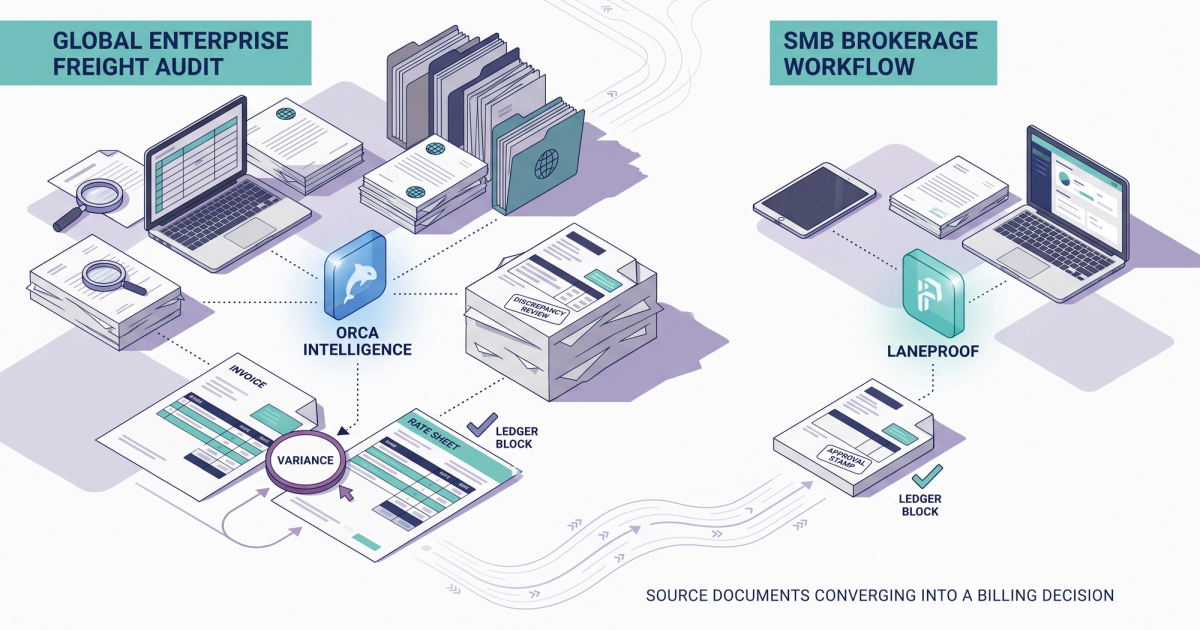
A broker running 500 loads per month at an average linehaul of $1,800 who absorbs a 3.8% overbill rate is losing roughly $34,200 per year, and that's before detention and accessorial charges are counted. According to Trimble's freight audit research, hidden costs from invoice inaccuracies are one of the most common freight spend pitfalls, yet most SMB brokerages still reconcile invoices by hand. If you've searched for "orca freight audit" looking for a solution, you're probably wondering whether it's built for a shop your size. This article gives you a neutral, buyer-side answer: what Orca's freight audit process actually does, where it's designed for enterprise shippers rather than 20-person brokerages, and what to look for in a tool that lets you prove a billing discrepancy on a specific load without waiting days for a report.
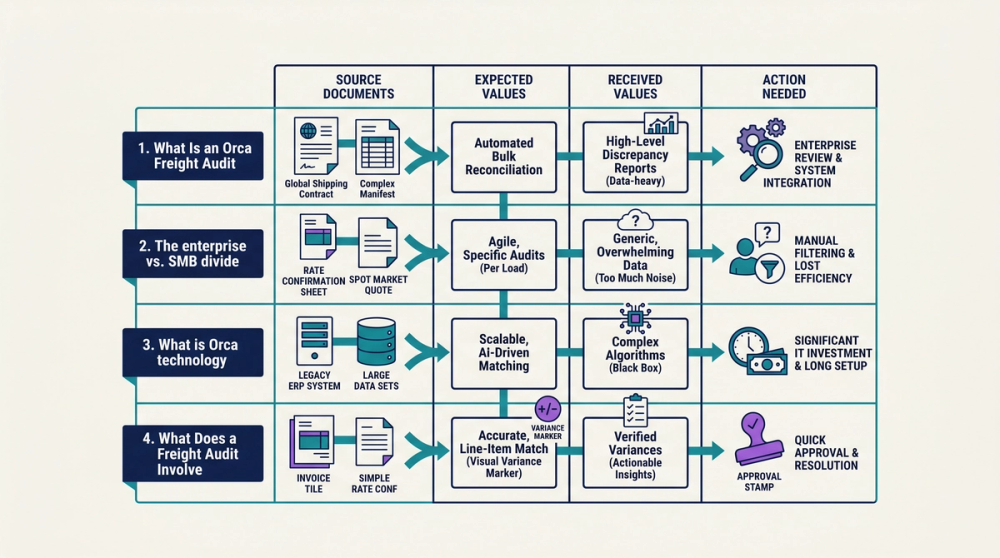
What Is an Orca Freight Audit, and Who Actually Uses It?
An Orca freight audit is a service provided by Orca Intelligence, a platform that automates freight payables by collecting and consolidating transportation data, then validating invoices to identify billing errors across global supply chains. According to Orca Intelligence's own site, the platform delivers real-time invoice auditing, supply chain analytics, and customizable reporting for shippers. The company positions itself as a global freight audit and supply chain analytics provider, handling invoices across multiple modes (truckload, LTL, ocean, air, parcel) and geographies.
That global scope is the first signal for an SMB broker to pay attention to. Orca's client base, based on how they describe their services and how Gartner profiles them as a freight audit and payment provider, skews toward enterprise shippers managing complex, multi-modal supply chains. Think manufacturers, retailers, and distributors processing thousands of invoices across dozens of carriers and countries.
The enterprise vs. SMB divide
If you're a freight broker with 5 to 50 employees moving 100 to 2,000 loads a month, mostly domestic truckload and LTL, you're not the primary audience Orca built for. That doesn't mean the platform can't work for you. It means the features, pricing structure, and onboarding process were designed around a different set of problems: global compliance, multi-currency reconciliation, and supply chain visibility at scale. What you need is probably simpler and more urgent: the ability to pull up a rate con, match it against a carrier invoice, and prove a $35 lumper fee discrepancy in under two minutes.
What is Orca technology?
Orca's technology is a web-based platform that ingests carrier invoices (via EDI, email, or direct upload), normalizes the data, applies audit rules to flag discrepancies against contracted rates, and generates reports and analytics dashboards. It's a freight audit and payment (FA&P) solution, which means it can also manage the payment side: approving clean invoices, holding disputed ones, and routing payments to carriers. For an enterprise shipper moving freight globally, this is a significant operational layer. For a broker running 500 loads a month out of one office, much of that functionality sits unused.
What Does a Freight Audit Involve, Step by Step?
A freight audit is the process of examining shipping invoices and related documents (rate confirmations, BOLs, PODs, accessorial agreements) to verify that every charge on a carrier invoice matches what was actually contracted, delivered, and documented. According to Trax's guide to freight audit, this involves preventing duplicate payments, catching carrier overcharges, and ensuring compliance with contracted rates. Whether you use Orca, another platform, or a spreadsheet, the core steps are the same.
The six steps of a freight audit
- 1. Invoice collection. Carrier invoices arrive via EDI, email, fax, or portal. Automated platforms like Orca ingest these electronically; manual shops retype them into a TMS or spreadsheet.
- 2. Data normalization. Every invoice needs to be in a consistent format so charges can be compared against rate cons. This means extracting linehaul, fuel surcharge, detention, lumper, and accessorial line items into structured fields.
- 3. Rate matching. The audited invoice is compared against the rate confirmation or contract. Does the linehaul match? Is the fuel surcharge calculated correctly? Are accessorial caps respected?
- 4. Document verification. The BOL and POD are checked to confirm the load was picked up, delivered, and received as described. Timestamps on the POD are critical for detention disputes.
- 5. Discrepancy flagging. Any charge that doesn't match the rate con, exceeds a contracted cap, or lacks supporting documentation gets flagged for review or dispute.
- 6. Approval or dispute. Clean invoices are approved for payment. Disputed invoices are sent back to the carrier with documentation of the discrepancy.
This process is straightforward on paper. In practice, at a 20-person brokerage, it's where your ops team loses 10+ hours a week. The question isn't whether you need a freight audit. It's whether the tool you choose is built for the way you actually work: load by load, carrier by carrier, with rate cons in one system and invoices in another.
For a deeper breakdown of which line items to check first, see this guide on which transportation audit line items matter most.
Where Orca's Approach Falls Short for Smaller Operations
Orca Intelligence is a capable platform. Avantiico's 2025 freight invoice auditing software roundup includes Orca alongside other enterprise-grade solutions, noting its global consolidation and analytics strengths. But capability and fit are different things. Here's where SMB brokers consistently run into friction with enterprise-grade freight audit tools.
Pricing opacity
Orca does not publish pricing on its website. That's standard for enterprise SaaS, but it's a red flag for a broker running 300 loads a month who needs to know if they're looking at $500/month or $5,000/month before investing time in a demo. InTek Logistics' 2026 comparison of freight audit companies notes that pricing transparency varies widely across FA&P providers, and enterprise-first platforms tend to price per transaction or per shipment in ways that penalize lower volume. If you're processing 500 loads a month, you want a flat rate you can budget around, not a sliding scale that surprises you in month three.
Onboarding and integration timelines
Enterprise FA&P implementations often take 60 to 120 days. That includes EDI mapping, ERP integration, rate table ingestion, and custom rule configuration. For a brokerage running on a TMS like Tai, McLeod, or even a spreadsheet alongside DAT, that onboarding timeline is a dealbreaker. You need to be catching overbills this week, not next quarter.
Report-level vs. load-level visibility
Enterprise freight audit platforms excel at aggregate reporting: total spend by lane, average cost per mode, quarterly variance analysis. That's useful for a VP of supply chain at a retailer. It's less useful for a dispatcher who needs to pull up Load #47832, see the rate con next to the carrier invoice, and confirm that the detention charge is $112.50 over what the POD timestamps support. SMB brokers need load-level discrepancy proof they can show a carrier in a phone call, not a dashboard they review monthly.
The Billing Errors a Good Freight Audit Has to Catch
Whether you use Orca, a competing platform, or build your own process, the billing errors are the same. According to Trimble's freight spend research, invoice inaccuracies are among the most persistent hidden costs in freight spend. Here are the specific errors your audit process needs to catch, with real math on what each one costs.
Detention overbilling
Scenario: A carrier invoices 2 hours of detention at $75/hour ($150 total) on a load where the POD timestamp shows the truck was at the facility for 47 minutes, well under most 2-hour free time windows. The correct detention charge is $0. The overbill is $150 on that single load. Now multiply: if 60 loads per month carry similar inflated detention charges, even at a more conservative overbill of $112.50 per load (billing 2 hours when only 30 minutes of chargeable time occurred), that's $6,750 per month or $81,000 per year in detention overbilling alone. The Federal Motor Carrier Safety Administration (FMCSA) has published rulemaking around detention time tracking, which makes timestamped POD data even more critical as documentation. Carriers like JB Hunt Transport Inc, as of 05/30/2026 operating with AUTHORIZED status for Property and HHG per FMCSA's SAFERWEB database (USDOT 264184), have sophisticated systems for tracking facility time. Smaller carriers may not, and that's where discrepancies creep in.
Lumper fee overcharges
Scenario: A carrier charges a $185 lumper fee on a load where the rate con capped lumper reimbursement at $150. That's a $35 discrepancy. It takes your billing coordinator 20 minutes to manually pull the rate con, compare it to the invoice, confirm the cap, and file the dispute. At a fully-loaded labor cost of $28/hour, that dispute costs $9.33 in labor for a $35 recovery. The math works, barely. But what if you could flag it in under 90 seconds with timestamped document matching? Now the labor cost drops to $0.70, and your coordinator handles 12 disputes in the time it used to take to process one. For more on how to catch these errors fast, read this freight bill audit guide for catching carrier overbilling.
Fuel surcharge miscalculations
Scenario: A reefer load with a $1,200 linehaul carries a fuel surcharge (FSC) that should be calculated on net weight but is instead calculated on gross weight, inflating the FSC line by 8 to 12%. The carrier invoices the FSC at $168. The correct amount, based on net weight and the contracted FSC table, is $148. That's a $20 discrepancy per load. On 200 reefer loads per month, that's $4,000/month or $48,000/year. Most brokers never catch this because they don't recalculate FSC line by line. An automated accessorial audit flags it instantly.
TONU charges with no supporting data
Scenario: A carrier invoices a $250 TONU (Truck Ordered Not Used) charge on a load that was cancelled. But driver tracking data shows the truck never left the yard. There was no dispatch, no movement, and no fuel burned. The $250 charge is completely unsupported. Without load-level document matching (dispatch records, GPS data, carrier packet), your billing team has no way to dispute this except by calling the carrier and arguing. With timestamped documentation, the dispute is a two-minute conversation backed by data.
What a 5 to 50 Person Shop Actually Needs From an Audit Tool
The freight audit and payment market is growing fast. According to Technavio's market analysis, the global FA&P market is expected to grow by USD $651.2 million from 2026 to 2030, expanding at a CAGR of 11.2%. That growth is driven partly by enterprise shippers adopting more sophisticated analytics, but increasingly by SMB operations that can no longer afford to reconcile invoices manually.
Here's what actually matters when you're choosing a freight audit tool for a brokerage with 5 to 50 people.
Speed to first value
You need to be catching overbills in your first week, not your first quarter. Any tool that requires 60+ days of onboarding before you see results is built for a different buyer. Ask every vendor: how many days from signup to first flagged discrepancy?
Load-level discrepancy proof
You need to pull up a specific load, see the rate con next to the carrier invoice, compare every line item, and generate a dispute-ready document you can send or screen-share. Aggregate dashboards are a bonus. Load-level proof is the requirement. The inability to prove billing discrepancies quickly is the single biggest reason brokers either eat the cost or spend hours building a case manually.
Accessorial coverage
Detention, lumper, layover, dry run, TONU, drayage: your audit tool needs to check every accessorial line, not just the linehaul. Many enterprise platforms focus on contracted rate compliance and treat accessorials as a secondary category. For brokers, accessorials are where the margin erosion happens. A good carrier payment audit checklist should cover every one of these.
Integration with your actual stack
If you run a mid-market TMS, your audit tool needs to pull data from it without a six-figure integration project. If your invoices come in via email, your tool needs to handle that. If your rate cons live in a shared drive, your tool needs to match them. As of 05/30/2026, even large carriers like JB Hunt Transport Inc (FMCSA safety rating: Satisfactory, per SAFERWEB USDOT 264184) use EDI for invoicing. But most of the carriers a 500-load-per-month brokerage works with send invoices via email or portal. Your audit tool needs to handle both.
Transparent pricing
You should know what you'll pay before you book a demo. Per-load pricing needs to be clear. Monthly minimums need to be stated. If a vendor won't tell you the price until after a 45-minute sales call, they're not selling to you. They're selling to someone with a procurement department.
The Real Cost of Doing It Manually
Before evaluating any software, it's worth quantifying what you're spending right now. Most SMB brokerages don't track the labor cost of invoice reconciliation separately. They should.
Example: An ops manager spending 11 hours per week on manual invoice reconciliation at a fully-loaded labor cost of $28/hour. That's $308 per week, or roughly $16,016 per year, just in labor. That doesn't include the overbilled dollars that slip through because the 12th hour of reconciliation didn't happen. It doesn't include the opportunity cost: those 11 hours per week could be spent on load planning, carrier negotiations, or customer retention.
Now add the overbilling. A 3.8% error rate on $900,000 in monthly freight spend (500 loads at $1,800 average linehaul) is $34,200 per year in linehaul overbilling alone. Add detention, lumper, FSC, and TONU discrepancies, and a conservative total is $50,000 to $80,000 per year in combined labor waste and uncaught overbilling. That number is the floor, not the ceiling. For a deeper look at what skipping a freight audit costs an SMB brokerage, see what it costs to skip a freight audit entirely.
A 500-load-per-month brokerage absorbing a 3.8% overbill rate on linehaul alone loses $34,200 per year. Add detention, lumper, and FSC errors, and the real number is $50,000 to $80,000 annually.
How LaneProof Handles Carrier Invoice Review Without the Enterprise Price Tag
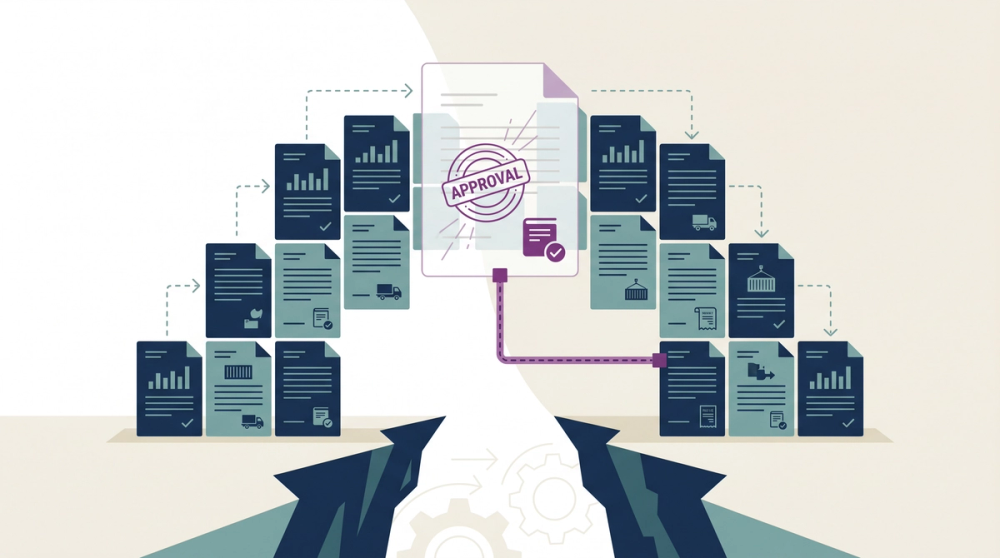
This section is not a feature list. It's a direct comparison of the problems described above and how they get solved at the load level for a brokerage that doesn't have an enterprise budget or a 90-day onboarding runway.
Document-level matching, not just rate-level matching
LaneProof matches carrier invoices against rate confirmations, BOLs, and PODs at the individual load level. When a carrier bills 2 hours of detention on a load where the POD shows a 47-minute facility time, the discrepancy is flagged with the specific timestamps and dollar amounts side by side. You don't run a report and hunt for the outlier. The outlier is presented to you with the evidence attached.
Accessorial audit built for broker workflows
Lumper caps, detention free-time thresholds, TONU validation, FSC recalculation: these aren't add-on modules. They're core to how the platform works because they're core to how brokers lose money. Every accessorial line is checked against the rate con and supporting documents. The $35 lumper overcharge, the $250 unsupported TONU, and the $20 FSC miscalculation are all flagged in the same pass.
Days to value, not months
Onboarding is measured in days. You upload documents, connect your email or TMS, and the platform starts matching and flagging. There's no EDI mapping project, no custom rule configuration phase, and no dedicated implementation manager who schedules your go-live for Q3.
According to Loop's best practices guide for freight audit and payment, the most effective freight audit programs prioritize fast dispute resolution and clear documentation. That's exactly what load-level discrepancy proof delivers: a dispute you can file in 90 seconds with the evidence already assembled.
Frequently Asked Questions About Freight Audit Software
What is an Orca audit?
An Orca audit is a freight audit and payment service provided by Orca Intelligence. The platform collects carrier invoices, normalizes the data, compares charges against contracted rates, flags discrepancies, and manages the payment process. It's designed primarily for enterprise shippers with global, multi-modal supply chains. For SMB freight brokers, the platform's scope may exceed what's needed while missing load-level discrepancy proof that brokers rely on for daily carrier disputes.
What does a freight audit involve?
A freight audit involves collecting carrier invoices, normalizing line item data, matching charges against rate confirmations and contracts, verifying delivery documentation (BOL and POD), flagging discrepancies on linehaul, fuel surcharge, detention, lumper, and other accessorial charges, and then approving clean invoices or disputing errors. The goal is to ensure every dollar paid to a carrier matches what was actually contracted and delivered.
What is the role of a freight audit in the shipping process?
The role of a freight audit is to prevent overpayment. Without one, carriers can overbill on detention, charge unsupported accessorials, miscalculate fuel surcharges, or invoice for services (like a TONU) that never occurred. A freight audit is the financial control layer between receiving a carrier invoice and releasing payment. For brokers, it's also the mechanism for protecting margin on every load.
How do I evaluate freight audit software for a small brokerage?
Focus on four criteria: speed to first value (can you flag discrepancies in your first week?), load-level proof (can you pull up a specific load and see the discrepancy with supporting documents?), accessorial coverage (does it check detention, lumper, FSC, and TONU, or only linehaul?), and transparent pricing (do you know the cost before you demo?). Enterprise platforms score well on analytics and global coverage but often miss on the first three criteria for SMB buyers.
Is freight audit software worth it for a broker running under 1,000 loads a month?
Yes, if the tool is priced and built for your volume. A 500-load-per-month brokerage losing $34,200/year on linehaul overbilling alone (at a 3.8% error rate, per Trimble's freight audit research) has a clear ROI case for a tool that costs a fraction of that. Add the $16,000/year in manual reconciliation labor, and the break-even point for most SMB-focused audit tools is reached within the first month or two.
Conclusion: Match the Tool to the Operation
Orca Intelligence is a legitimate freight audit platform with strong enterprise capabilities. If you're a global shipper managing multi-modal freight across dozens of countries, it belongs on your shortlist. But if you're a freight broker with 5 to 50 people, moving 100 to 2,000 domestic loads a month, and your biggest pain is proving a billing discrepancy on a specific load without burning half a day, you need a different kind of tool.
The errors are the same everywhere: inflated detention, uncapped lumper fees, miscalculated fuel surcharges, unsupported TONUs. The difference is how fast you can find them, prove them, and recover the money. If your team processes more than 50 carrier invoices a week and you're still reconciling manually, automated document matching tools built for broker workflows can catch the discrepancies covered in this guide in a fraction of the time, at a price that makes sense for your volume.
Sources
- Freight Audit Insights: The Truth About Freight Spend — Trimble Transportation
- Orca Intelligence: Global Freight Audit & Supply Chain Analytics — Orca Intelligence
- Orca Freight Audit and Payment Providers Reviews — Gartner
- 2026 Best Freight Audit & Pay Companies — InTek Logistics
- The Best Freight Invoice Auditing Software Platforms — Avantiico
- Freight Audit and Payment Market Size 2026-2030 — Technavio
- The Ultimate Guide to Freight Audit — Trax Technologies
- Freight Audit and Payment Best Practices — Loop