Lumper Service: Who Pays, What It Costs, How to Document It
Researched and written with AI assistance. Reviewed by the Laneproof team.

A broker running 200 loads a month with just $40 in unverified lumper exposure per load is sitting on $8,000 in monthly risk. That's $96,000 a year in potential margin loss from a single accessorial category. Lumper service charges are one of the most disputed line items in carrier invoices, and brokers get stuck with the bill not because they agreed to pay, but because their rate cons, BOLs, and reimbursement workflows leave too many gaps. According to TAWI's 2024 analysis of lumper costs, fees range from $50 for a partial truck to $250 for a full trailer unload. But that range stretches far wider in practice, especially on floor-loaded reefer freight or complex grocery DC deliveries. This guide covers who actually pays, what proper documentation looks like, and how to stop absorbing costs that belong to someone else.
What Is Lumper Service? (And Why Brokers Keep Getting Stuck With the Bill)
What is lumper service? A lumper service is a third-party labor crew that loads or unloads freight at a warehouse, distribution center, or receiving dock. The service is separate from the carrier's transportation obligation, and it exists because many receivers, particularly grocery chains and big-box retailers, do not use their own dock workers to handle inbound freight.
The scope goes well beyond just pulling pallets off a trailer. According to OTR Solutions, lumper services can include sorting, palletizing, shrink wrapping, labeling, and even stocking shelves depending on the facility. That expanded scope is part of why costs vary so dramatically from load to load.
Why brokers absorb lumper costs they shouldn't
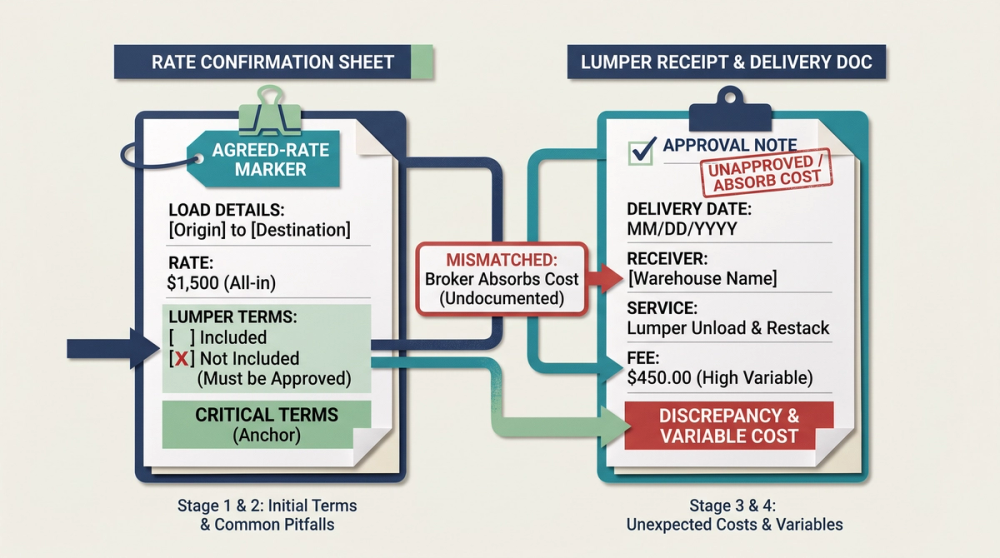
The problem isn't that lumper fees exist. The problem is that the payment responsibility is poorly defined at the point where it matters most: the rate confirmation. When a rate con says "lumper if applicable" without specifying who advances payment, who reimburses, or what the cap is, the broker has created a billing gap. The carrier pays the lumper at the dock, submits a receipt (sometimes handwritten, sometimes a Comchek stub), and sends it as part of their invoice. If the broker can't verify the charge or doesn't have a contractual basis to pass it through to the shipper, they eat it.
This happens on a surprising number of loads. A carrier arrives at a grocery DC, pays $200 in cash to a lumper crew, gets a receipt with a scribbled amount and no company name, and bills the broker. The broker has no rate con language authorizing a cap, no BOL notation confirming the amount, and no way to match the receipt to the actual service performed. The result: margin loss that was entirely preventable with better documentation.
How Much Does Lumper Service Cost Per Load?
How much does lumper service cost? Lumper fees typically range from $25 to over $500 per load, depending on the freight type, unloading complexity, and facility. According to AW Collects, standard loads may run $25 to $100, while complex or heavy freight can push well past $500.
The variables that drive cost differences
The single biggest cost driver is whether the freight is palletized or floor-loaded. A palletized dry van load with 22 standard pallets might cost $85 to $120 in lumper fees at a typical Midwest grocery DC. The lumper crew uses powered jacks, the pallets come off clean, and the whole process takes 30 to 45 minutes.
Now compare that to a 26-pallet floor-loaded reefer load going into the same DC. The lumper crew has to hand-stack cases onto pallets, shrink wrap each one, and stage them for put-away. That job can take 2 to 3 hours and cost $300 to $450 or more. The freight type, not the distance hauled, determines the lumper cost per load.
Side-by-side comparison: A palletized dry van drop at a Midwest DC costs roughly $85 to $120 in lumper fees. A 26-pallet floor-loaded reefer requiring full breakdown at the same facility runs $300 to $450+. Same dock, same DC, completely different cost.
Regional pricing gaps that affect your bids
Geography matters more than most brokers account for. Southern California drayage markets, where port freight often moves through high-volume DCs, tend to run $60 to $120 higher per load than comparable Midwest grocery facilities. A lumper charge that's $150 in Indianapolis could easily be $250 to $270 at a DC in Fontana or Ontario, California.
If you're quoting loads into these markets and using a flat lumper estimate, you're underpricing your bids. The better approach is to build regional lumper cost brackets into your pricing model and adjust per lane. This is one of the areas where factoring lumper charges into your rate strategy can directly protect margin.
Who Pays a Lumper Fee: Shipper, Receiver, Carrier, or Broker?
Who pays a lumper fee? Under federal law (49 U.S.C. 14103), if a shipper or receiver requires a driver to use a lumper service, they must reimburse the driver for that cost. According to the FMCSA's guidance on lumper coercion, drivers cannot be coerced into employing or paying for loading or unloading assistance.
In practice, the payment chain works differently depending on the agreements in place. Here's how it typically flows:
- The receiver requires the lumper service at their facility. Under 49 U.S.C. 14103, they bear the reimbursement obligation when they mandate the service.
- The carrier (or driver) advances the cash at the dock, paying the lumper crew directly. The driver collects a lumper receipt and includes it with their invoice.
- The broker becomes the middleman. If the rate con includes lumper reimbursement language, the broker reimburses the carrier and then invoices the shipper or receiver for the cost.
- The shipper ultimately pays in many arrangements, either through a direct reimbursement process with the carrier or by paying the broker's all-in invoice that includes the lumper charge.
Where the chain breaks down
The most common failure point is between the broker and the receiver. Many receivers mandate lumper services but have no direct payment relationship with the carrier. The carrier pays, bills the broker, and the broker is left to recover the cost from the shipper. If the shipper's contract with the broker doesn't explicitly cover lumper fee reimbursement, the broker absorbs it.
This is why your shipper agreements need language that specifically addresses lumper charges, caps, and the documentation required for pass-through. A verbal "we'll cover it" from a shipper's logistics contact means nothing when their AP department rejects your invoice three weeks later.
The Paper Trail: How to Document a Lumper Fee Before It Becomes a Dispute
Every lumper fee dispute that costs a broker money started the same way: missing or incomplete documentation. The good news is that the documentation requirements are straightforward. The challenge is getting your carriers and dispatchers to follow them consistently on every load.
What a valid lumper receipt must include
A lumper receipt is the single most important document in any lumper reimbursement claim. Without it, you have no proof the charge was incurred, no verification of the amount, and no defense in a dispute. For a detailed breakdown of every required field, see our guide on what a valid lumper receipt must include to win a billing dispute.
At minimum, a valid lumper receipt should include:
- Lumper company name and contact information. A receipt with no company name is unverifiable. If you can't call the lumper company to confirm the charge, you can't approve it.
- Date of service and facility location. This must match the delivery date and destination on the BOL.
- Exact dollar amount charged. Handwritten amounts with no itemization are the number one reason lumper invoices get disputed.
- Description of services performed. Did the crew unload pallets? Break down floor-loaded freight? Sort and stage? The receipt should say.
- Signature or authorization from the facility. Some DCs have the receiving clerk sign or stamp the lumper receipt. This is the strongest proof that the service was required by the receiver.
BOL lumper notation: the field most brokers miss
The BOL is your second layer of proof. When a lumper service is used at delivery, the lumper amount and lumper company name should be noted directly on the BOL, typically in the remarks or accessorial section.
Example of correct BOL lumper notation: "Lumper service required at delivery. Lumper Co: ABC Unloading. Amount: $175.00. Receipt #4421." This notation, written or stamped on the BOL at the time of delivery, ties the charge to the load and creates a verifiable record.
Example of missing notation: The BOL shows a delivery signature and timestamp but no mention of a lumper charge. Three days later, the carrier submits an invoice with a $225 lumper receipt attached. The broker has no BOL-level confirmation that the charge occurred, making it much harder to verify and pass through to the shipper.
The photo documentation step that takes 10 seconds
Train your carriers to photograph the lumper receipt at the dock and send it to dispatch immediately, not folded in an envelope with the POD that arrives a week later. A timestamped photo of the receipt, captured at the delivery location, is harder to dispute than a scanned copy submitted days after the fact. Some brokers now require this as a condition of lumper reimbursement, and it costs nothing to implement.
How to Factor Lumper Costs Into Your Rate Cons and Carrier Agreements
The rate confirmation is where lumper fee disputes are either prevented or created. Vague language costs money. Specific language saves it.
Rate con language that protects you
Your rate con should answer four questions about lumper service charges:
- Is a lumper fee expected on this load? If you know the delivery facility typically requires lumper service, say so. "Lumper fee anticipated at delivery" is better than silence.
- Who advances payment at the dock? Specify whether the carrier advances cash, uses a Comchek, or whether the facility has its own payment process.
- What is the maximum reimbursable amount? A cap of $200 or $250 (whatever matches the facility's typical charges) prevents a $400 surprise.
- What documentation is required for reimbursement? State explicitly: "Lumper receipt with company name, amount, date, and facility signature required for reimbursement."
For more on building lumper language into your carrier agreements, see our breakdown of lumper fee receipt fields and reimbursement requirements.
Scenario: What happens when the rate con is vague
Scenario: A broker books a dry van load into a regional grocery DC. The rate con says "lumper if applicable" but does not specify a cap, who advances payment, or what documentation is needed. The carrier's driver arrives, pays $300 cash to a lumper crew, and receives a handwritten receipt with an amount but no company name. The carrier invoices the broker for the full $300.
The broker can't verify the receipt because there's no company name to call. The shipper's AP team rejects the pass-through because the broker's invoice doesn't include a proper lumper receipt. The broker spends 4 hours going back and forth between the carrier, the DC, and the shipper. The dispute ends with the broker paying the carrier $150 to settle, losing that amount directly from their margin on a load that was already tight.
Total cost of vague rate con language on one load: $150 in direct margin loss plus 4 hours of staff time.
How to price lumper risk into your bids
If you're moving freight into facilities that routinely require lumper service, you need a lumper cost estimate in your bid pricing. Not a guess. A documented estimate based on the facility, freight type, and regional norms.
Calculation example: A broker moves 200 loads per month. Of those, 60 deliver to facilities that typically require lumper service. The average lumper cost on those lanes is $175. If the broker doesn't factor this into their bid pricing and only recovers the lumper charge 70% of the time, the monthly unrecovered cost is: 60 loads × $175 × 30% unrecovered = $3,150 per month in margin loss. Over a year, that's $37,800.
The fix is straightforward: build the average lumper cost into the all-in rate you quote the shipper, or add a lumper surcharge line item on your invoice. Either way, the cost is accounted for before the load moves, not after.

When a Driver Refuses to Advance Lumper Cash
This scenario happens more often than brokers like to admit, and it can turn a routine delivery into a TONU situation.
Scenario: rate con silence causes a TONU
Scenario: A broker books a carrier on a reefer load delivering to a cold storage facility. The rate con says nothing about lumper service or payment responsibility. The driver arrives, the facility requires a lumper crew, and the lumper fee is $275. The driver calls their dispatcher and says they don't have $275 in cash and won't advance payment for a charge they weren't told about.
The driver sits at the dock for 90 minutes while the broker, carrier, and facility try to sort out payment. Eventually, the driver refuses to stay and leaves with the freight still on the trailer. The broker has to rebook the delivery, pay the original carrier a TONU of $350, and cover the lumper fee on the rebooked load. Total cost: $625 plus the rebooked linehaul, all because the rate con was silent on lumper service.
The FMCSA is clear on this point: drivers cannot be coerced into paying for lumper services. If the broker or shipper doesn't arrange payment, the driver is within their rights to refuse. Building lumper payment terms into the rate con eliminates this scenario before the truck ever leaves the shipper.
The $8,000 Monthly Risk You Might Not Be Tracking
The individual lumper fee amounts look small. A $40 discrepancy here, a $60 unverified receipt there. But the cumulative exposure across a full month of freight adds up fast.
Calculation: A broker moves 200 loads per month. On average, 100 of those loads have some lumper service involvement. The average unverified or undocumented lumper exposure per load is $40 (the difference between what the carrier invoices and what the broker can verify or recover). Monthly risk: 200 loads × $40 = $8,000. Annual risk: $96,000.
At $40 in unverified lumper exposure per load across 200 monthly loads, a broker risks $8,000 per month, or $96,000 per year, in potential unrecovered accessorial charges.
This number gets worse when you factor in the staff time spent chasing incomplete receipts, calling DCs to verify amounts, and negotiating with carriers on disputed invoices. A billing coordinator spending 5 hours per week on lumper disputes is spending 260 hours per year on a problem that better documentation would mostly prevent.
The growing demand for lumper services makes this problem harder to ignore. According to CQ Solutions' 2024 industry overview, lumper service usage is expanding with increasing freight volumes and e-commerce growth. More loads touching lumper-required facilities means more invoices to verify and more exposure for brokers who aren't tracking it.
Frequently Asked Questions About Lumper Fees
What is lumper service in freight?
A lumper service is a third-party labor provider that loads or unloads freight at a warehouse or distribution center. The work can include unloading pallets, breaking down floor-loaded freight, sorting, shrink wrapping, and staging freight for put-away. The driver does not perform this work. The lumper crew is hired by or required by the receiving facility, and the cost is billed separately from the linehaul rate.
Who is legally responsible for paying lumper fees?
Under 49 U.S.C. 14103, if a shipper or receiver requires a driver to use a lumper service, they are required to reimburse the driver for the cost. According to AW Collects' analysis of lumper fee responsibility, federal law places the reimbursement obligation on the party that mandates the service. In practice, carriers often advance the payment and then invoice the broker, who passes the cost to the shipper.
How can brokers avoid paying lumper fees they don't owe?
The most effective defense is documentation and rate con language. Specify lumper payment responsibility, reimbursement caps, and required receipt fields in every rate confirmation. Require carriers to submit lumper receipts with the company name, dollar amount, date, and facility signature. Note lumper charges on the BOL at the time of delivery. If you can verify the charge and pass it through with documentation, you don't eat it. For step-by-step verification processes, see our guide on automating lumper fee verification to stop overbills.
Do all delivery facilities require lumper service?
No. Lumper service requirements vary by facility. Large grocery DCs, cold storage facilities, and big-box retail distribution centers are the most common facilities that mandate lumper service. Many smaller warehouses, direct-to-store deliveries, and LTL terminals handle their own dock labor. Brokers should maintain a facility database that notes which delivery locations require lumper service and what the typical cost range is.
Can a driver refuse to pay a lumper fee at the dock?
Yes. The FMCSA's guidance on lumper coercion confirms that drivers cannot be coerced into employing or paying for loading or unloading assistance. If a driver has not been informed about a lumper fee in advance and has no arrangement to cover the cost, they can refuse. This is why brokers must address lumper payment in the rate con before the load picks up.
Stop Losing Margin on Lumper Fees You Can Prove
Lumper service charges are not going away. E-commerce growth and rising freight volumes are pushing more loads through facilities that require third-party unloading crews. For brokers, the question isn't whether you'll encounter lumper fees. It's whether you have the documentation, rate con language, and verification processes to stop absorbing costs that belong to someone else.
The steps are clear: specify lumper terms on every rate con, require complete lumper receipts from carriers, note charges on the BOL at delivery, and build regional lumper cost estimates into your bid pricing. Every one of these steps is free to implement. The cost of not implementing them is $8,000 or more per month for a mid-size brokerage.
If your team is processing hundreds of carrier invoices monthly and lumper receipts are still being verified manually, tools that automatically extract and match document data can catch the discrepancies covered in this guide before they hit your bottom line.
Sources
- May drivers be coerced into employing loading or unloading assistance (lumpers)? — FMCSA
- Lumper Services: Are They Still Cost-Effective? — TAWI
- Lumper Fees and Who is Responsible for Paying Them — AW Collects
- The Ultimate Guide to Lumper Services — CQ Solutions
- Everything You Need to Know about Lumper Fees — OTR Solutions