Freight System Integration: Where It Breaks and What It Costs
Researched and written with AI assistance. Reviewed by the Laneproof team.

Run the math on a 15-load-per-day operation. That is 75 loads a week. If your billing coordinator spends five to six minutes per load re-keying BOL numbers, POD dates, accessorial lines, and reference numbers from your TMS into accounting software, you are burning 6 to 8 hours every week on typing. That is a part-time salary spent moving data between two systems that both already have it.
Freight system integration is supposed to fix that. Most of the time it fixes about 70% of it, and the remaining 30% is where the money leaks. Trucks moved roughly 72.7% of the nation's freight by weight in 2024 according to ATA economics and industry data, which means the volume flowing through your back office is not going down. Neither is the number of systems that need to agree on what a load actually cost.
This is not a "what is an API" explainer. This is where the handoffs break, what the failures cost in real dollars, and how to decide what to fix first.
The Bottleneck Isn't Your TMS. It's the Handoff.
Your TMS is probably fine. It dispatches loads, it stores rate cons, it tracks status. The problem starts the moment a load closes and the data has to move somewhere else: into QuickBooks, into a factoring portal, into a carrier payment run, into a customer's billing portal that wants its own reference format.
Every one of those handoffs is a place where a human either re-types something or checks that a machine typed it correctly. And each handoff has its own failure mode. A wrong load number breaks the invoice match. A missing POD date resets a customer's payment clock by two weeks. An accessorial coded as "OTHER" instead of "DET" means nobody can run a detention report at quarter close.
The scale of the money moving through these handoffs is not small. Per BTS freight transportation and economy data, trucking contributed $611.5 billion to the economy and for-hire transportation services added $244.0 billion. The freight management software market built to handle that flow crossed $17.85 billion in 2025 and is growing at more than 10.2% annually per Research Nester's freight management system market analysis. Plenty of software exists. Very little of it talks to the software sitting next to it without help.
The gap you feel every Friday afternoon is not a technology gap. It is a data agreement gap. Two systems that both know what a detention charge is, but disagree on what to call it, when it applies, and which field holds the number.
What Freight System Integration Actually Means (Not the Vendor Definition)
Freight system integration is the process of connecting the software that plans, executes, documents, and bills freight so that a single piece of data (a load number, a rate, a delivery timestamp) is entered once and stays consistent everywhere it appears. That is the whole definition. Everything else is implementation detail.
Notice what the definition does not say. It does not say "real time." It does not say "API." A nightly CSV export that maps cleanly to your accounting system is better integration than a real-time API feed that dumps accessorials into the wrong field. The measure of integration is whether a human has to touch the data again, not how modern the pipe is.
What are freight systems?
Freight systems are the software platforms that run a shipment from quote to cash. For most SMB brokers and carriers, the stack looks like this:
- TMS (transportation management system): load building, dispatch, carrier assignment, rate cons, tracking.
- Accounting or ERP: QuickBooks, Sage, NetSuite. Holds the AR/AP ledger and the invoice of record.
- Document capture: wherever BOLs, PODs, lumper receipts, and scale tickets land. Often an email inbox and a shared drive.
- Carrier and customer portals: load boards, EDI connections, shipper portals with their own invoice submission rules.
- Factoring or payment platform: if you factor receivables or run quick-pay for carriers.
- Compliance data: insurance certificates, authority status, and driver qualification records. FMCSA's National Registry II rule modernizing how medical certification data flows between examiners and state licensing agencies took full effect June 25, 2025, per FMCSA guidance on the Medical Examiner's Certification Integration final rule. If your carrier packet process still relies on a driver emailing a scan of a med card, that is one more system that does not talk to the others.
What is API integration in logistics?
API integration in logistics means two systems exchange data through a defined request-and-response format instead of a file, an email, or a person. Your TMS asks the carrier's system "where is this truck" and gets a structured answer back. Your accounting system asks the TMS "what loads delivered yesterday" and gets a list with rates attached.
The useful part is that APIs enforce structure. The dangerous part is that they enforce your structure, whether or not it matches the other system's. As industry practitioners note in this breakdown of what it really takes to connect ERPs to freight systems, the connection itself is rarely the hard part. Agreeing on what each field means is.
Integration almost never fails at the API. It fails at the data map, three weeks after go-live, on the accessorial codes nobody reviewed.
The Three Places Your TMS Stops Talking to Everything Else
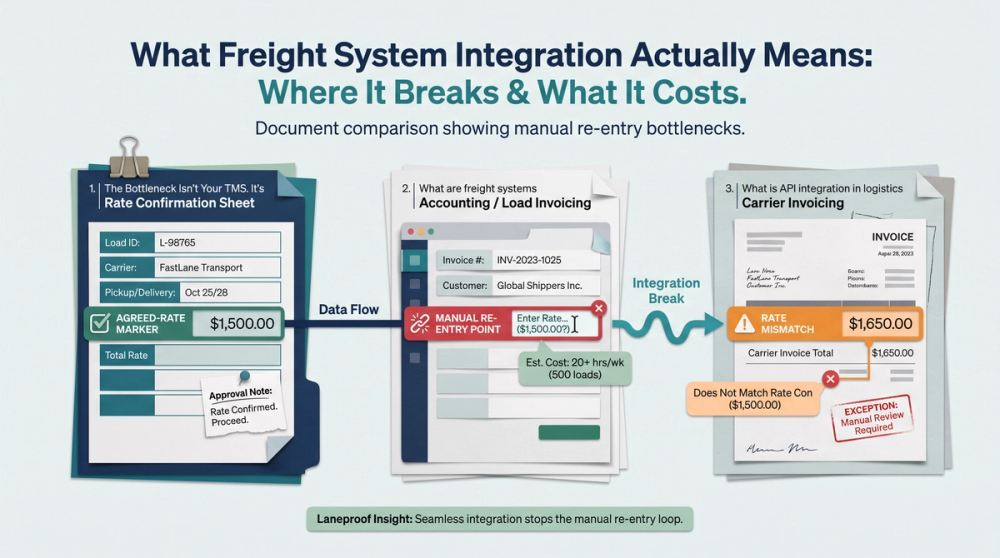
The diagram below maps the handoff points, but you can identify them without a diagram. Look for any step where someone opens two windows side by side.
1. Rate confirmation to carrier invoice
Your TMS holds the agreed rate: linehaul, fuel surcharge, agreed accessorials, and any detention terms. The carrier's invoice arrives days later as a PDF, and nothing in your stack automatically compares the two. Somebody eyeballs it.
This is the single most expensive gap in the stack because it is where padding survives. Detention billed at four hours when the POD timestamp shows two. A lumper fee added with no receipt. A fuel surcharge calculated off a different peg than the rate con specified. We covered the specific line items carriers pad most in freight overcharges and how to recover them, and every one of those recovery plays depends on the rate con and the invoice living in the same comparison view.
2. TMS to accounting
Load closes in the TMS. Now the invoice has to exist in accounting. Depending on your setup, that means an export, an import, a sync, or a person typing. Even when a sync exists, it typically moves the linehaul cleanly and mishandles everything else: accessorials collapse into a single line, customer reference numbers drop, and split loads with multiple stops arrive as one charge.
The result is an AR ledger that does not reconcile to your TMS margin report. When those two numbers disagree at month end, the resolution is manual, and it takes hours.
3. Documents to everything
BOLs, PODs, lumper receipts, scale tickets, and detention logs arrive as PDFs and phone photos. They contain the exact data that proves or disproves every billing dispute you will have this month. And in most SMB operations, that data lives only inside the image until a person reads it and types it somewhere.
This is the handoff that quietly kills the other two. You cannot auto-match an invoice against a POD if nobody has extracted the delivery timestamp from the POD. We walked through the mechanics of this in why retyping BOLs costs you money, and it is worth reading before you scope any integration project, because document data is usually the missing input that makes the rest of the integration work.
Where Manual Re-Entry Is Actually Costing You Hours
Vendors quote integration savings in percentages. Do it in hours, because hours are what you actually pay for.
The arithmetic for a 500-load-per-month broker
500 loads a month is roughly 115 loads a week. Time the actual steps for one load moving from delivered to invoiced:
- Open POD, confirm delivery date and signature: 45 seconds
- Key load number, customer, and reference into accounting: 90 seconds
- Enter linehaul, fuel surcharge, and accessorial lines: 120 seconds
- Attach documents and verify totals against the rate con: 90 seconds
That is about 5.75 minutes per clean load. Multiply by 115 loads: roughly 11 hours a week. And that assumes every load is clean. Add exceptions (missing POD, disputed accessorial, wrong reference number) at even 8% of volume, and you are into a second workday.
Eleven hours a week is 570 hours a year. At a fully loaded billing coordinator cost of $28 an hour, that is roughly $16,000 annually spent moving numbers between two screens. Nothing about that work generates margin. It just prevents errors that would have cost more.
The hidden cost is speed, not labor
The labor number is the one people quote. The bigger number is DSO. If manual invoicing pushes your average bill-out from day one to day four, on $2M of monthly revenue that is roughly $260,000 of cash sitting in a queue at any given moment. For a broker paying carriers on quick-pay terms and collecting in 30 to 45 days, that timing gap is the whole working capital problem.
Research on the information value of logistics platforms in freight matching makes a related point at the network level: the value of a platform comes from the data it consolidates, not the transactions it processes. The same logic applies inside your own four walls. Data trapped in one system has almost no operational value. The same data available to your audit process, your AR process, and your customer reporting has real value.
Build, Buy, or Bolt-On: How to Decide Without an IT Team
You have three real options and one fake one. The fake option is "we'll just be more careful." Skip it.
Option 1: Build a custom connection
A developer writes code that moves data from system A to system B on your rules. Cost is typically five figures upfront plus ongoing maintenance whenever either vendor changes an API version.
Choose this when: you have unusual business logic no product supports (unique settlement rules, a homegrown TMS, a shipper contract with a custom fuel table) and enough volume that the rules are worth encoding. Avoid this when: you have no in-house technical owner. A custom integration with nobody to maintain it becomes a liability in about 14 months.
Option 2: Buy middleware
A platform sits between your systems and handles the translation. It works, and it scales to many connections, but it introduces a third vendor and a mapping layer you now have to own. Overviews of integrating a TMS with other supply chain technologies are accurate about the capability and quiet about the configuration burden.
Choose this when: you have four or more systems that need to exchange data and no single vendor covers the whole map. Avoid this when: you have exactly two systems and one problem. Middleware for a two-system problem is a lot of overhead for one pipe.
Option 3: Bolt on a focused add-on
A purpose-built tool solves one handoff and pushes clean output into your existing systems. A TMS add-on for invoice reconciliation does not replace your TMS. It reads documents, compares invoice lines against the rate con, flags variances, and hands your accounting system a verified record.
Choose this when: one handoff accounts for most of your pain and you want results in weeks. Avoid this when: your underlying data hygiene is so bad (no consistent load numbering, rate cons stored in three places) that any tool will inherit the mess.
The timeline reality nobody puts on a pricing page
Plan on 6 to 10 weeks for a mid-size broker integration, not the plug-and-play weekend the marketing page implies. That is a planning baseline, not a vendor promise, and it breaks down roughly as follows:
- Weeks 1 to 2: field inventory and data mapping. Every accessorial code, every customer reference format, every load status.
- Weeks 3 to 5: build and configure. Usually the shortest phase.
- Weeks 5 to 7: parallel run. Both processes running at once so you can compare outputs on live volume.
- Weeks 8 to 10: exception cleanup and training on the new failure modes.
Cut the parallel run and you will find your mapping errors in production, on customer invoices. That is the most expensive place to find them. The federal framework in the National Freight Strategic Plan makes the same argument at policy scale: system coordination fails on data standards and interoperability long before it fails on infrastructure.
What Breaks After You Go Live (and Nobody Warns You About)
Go-live is not the finish line. Here are the four failures that show up in weeks 2 through 8 after launch.
Accessorial code mismatches
Your TMS calls it DET. The carrier invoicing tool calls it DETENTION. Your accounting chart of accounts calls it 4120-ACC. If the map has a gap, those lines fall into an exception bucket and a human has to sort them.
Even a 4% exception rate on 500 monthly invoices means 20 manual reviews a month. At 12 minutes each, that is 4 hours you thought you had automated away. Worse, exceptions do not distribute evenly. They cluster on the accessorials with the most dollars attached: detention, lumper, layover, and TONU.
Silent sync failures
A connection drops on a Thursday. Nobody notices until Monday, when 60 loads are missing from accounting. Most integrations do not alert on absence, only on error. Build a daily count check: loads delivered in TMS versus invoices created in accounting. If those two numbers diverge by more than two, someone should get pinged the same day.
Duplicate charges from double-entry
During transition, both the old manual process and the new automated one run. If nobody defines which one is authoritative, you get duplicate invoices, duplicate carrier payments, and a very unhappy customer AP contact. Pick a system of record on day one and write it down.

Formula drift
Fuel surcharge tables, detention rate tiers, and per-stop charges change. When they change in the rate con but not in the TMS configuration, every load prices slightly wrong until someone catches it. This is the most expensive failure mode because it is invisible per load and enormous in aggregate. Several of the specific patterns are covered in freight billing mistakes that are costing you real money.
Run the Numbers: Three Integration Failures and What They Cost
These are constructed examples using realistic rates, not survey data. Run the same arithmetic against your own volume.
Scenario 1: The $340 double-billed detention charge
A dry van load delivers in Fort Worth. The driver sits four hours past the two-hour free window. The carrier bills detention at $85 an hour for four hours: $340.
The dispatcher, working the exception in the TMS, also adds a $340 detention accessorial to the customer invoice and to the carrier settlement, because the carrier invoicing system and the TMS both allow the entry and neither checks the other. The carrier gets paid $340 twice: once through settlement, once through the invoice run.
Cost of one occurrence: $340. If this pattern hits 1 in 200 loads at a 500-load-per-month operation, that is 2.5 occurrences a month, or roughly $10,200 a year. The fix is not more attention. It is a duplicate check on load number plus accessorial code plus amount before payment releases.
Scenario 2: The $3,600 fuel surcharge formula mismatch
The rate con specifies a fuel surcharge pegged at $1.25 per gallon with a 6.0 MPG assumption. The TMS was configured a year earlier with a $1.20 peg. The difference works out to about $0.008 per mile on that lane structure. Add a rounding rule mismatch on multi-stop loads and the effective gap lands near $0.04 per mile.
At 30,000 billed miles a month, $0.04 per mile is $1,200 a month. It ran for three months before a customer's AP department flagged it during their own audit: $3,600 of margin, gone, plus a credibility hit with the customer.
Note the detection path. The customer found it, not you. That is the signature of a formula drift problem: it is too small per load to notice and too consistent to be random.
Scenario 3: The 11-hour weekly reconciliation between TMS and QuickBooks
The 500-load broker from earlier runs 115 loads a week at 5.75 minutes of manual handling each, or about 11 hours. Add the exception work from the 4% accessorial mismatch rate (roughly one more hour a week) and you are at 12.
Now price the alternative. If an add-on removes 80% of the clean-load handling but leaves the exceptions, you recover about 8.8 hours a week: 458 hours a year, or roughly $12,800 at $28 an hour. If the tool costs $600 a month ($7,200 a year), the labor math alone clears it, before you count a single recovered overcharge. That is the payback calculation worth building, and it is the same discipline described in what freight audit and payment roles actually catch.
Frequently Asked Questions
What software do freight brokers use?
Most SMB brokers run a TMS for load management, accounting software (QuickBooks is the most common at this size) for the ledger, a load board for capacity, and email plus a shared drive for documents. Larger operations add carrier vetting and monitoring tools, an EDI or API connection to key shippers, and a factoring platform. The stack is rarely the problem. The connections between the pieces are.
What are the top freight forwarding software platforms?
Rankings shift constantly and depend heavily on mode, geography, and whether you handle customs. A more useful question than "which platform is best" is "which platform exports data in a format my accounting system can consume without a human in the middle." Ask any vendor for a sample export file and a documented field list before you look at feature comparisons. If they cannot produce one in a day, that tells you what integration will feel like later.
Do I need to replace my TMS to fix integration problems?
Usually not. Most TMS limitations in freight back offices are about what happens after the load closes: document handling, invoice comparison, and accounting handoff. A focused add-on that reads documents and reconciles invoices addresses those without touching dispatch, which is the part of the TMS your team already knows. Replacing a TMS is a 4 to 6 month disruption. Solve the handoff first and re-evaluate.
How do I know if a freight audit tool actually works with my TMS?
Ask three questions: Can it pull or receive rate confirmations from my TMS without manual upload? Can it write results back, or does someone re-key the outcome? What happens when a field is missing or mismatched, and who sees that exception? A vendor who answers the third question with a specific workflow has built the integration. A vendor who answers with "our system handles that" has not.
How long should an integration project take for a 500-load broker?
Budget 6 to 10 weeks including a live parallel run. The build phase is often only two or three weeks. Data mapping at the front and exception cleanup at the back are what consume the calendar, and skipping either one moves the work into production where mistakes hit customer invoices. If a vendor quotes you one week, ask specifically what they are excluding from that estimate.
Sources
- Economics and Industry Data — American Trucking Associations
- Freight Transportation & the Economy, BTS Data Inventory — Bureau of Transportation Statistics
- Guidance on Medical Examiner's Certification Integration Final Rule — Federal Motor Carrier Safety Administration
- National Freight Strategic Plan (NFSP) — U.S. Department of Transportation
- Freight Management System Market Size, Share & Growth — Research Nester
- The information value of logistics platforms in a freight matching market — European Journal of Operational Research (ScienceDirect)
- Connecting ERPs to Freight Systems: What It Really Takes — LinkedIn industry analysis
- Integrating TMS with Other Supply Chain Technologies — FreightPop
- What Is Logistics System Integration and Why It Matters — eTower Technologies
The Short Version
Freight system integration is not a technology project. It is a data agreement project with a software component attached. The three handoffs that matter are rate con to carrier invoice, TMS to accounting, and documents to both. Map those before you shop for anything.
Price the problem in hours and dollars first. Eleven hours a week of manual reconciliation at a 500-load operation is roughly $16,000 a year in labor, and that is before the double-billed detention charges and drifted fuel surcharge formulas. Then pick the narrowest fix that solves the widest gap. For most SMB brokers, that is a bolt-on, not a rebuild.
And plan for weeks 2 through 8 after go-live, not just go-live. Accessorial code gaps, silent sync failures, and formula drift are where integrations quietly stop working. Build the daily count check on day one.
If the handoff costing you the most is the one between carrier invoices and your rate cons, that is a solvable problem without touching your TMS. Tools that automatically compare invoice lines against the rate confirmation and flag variances before payment releases sit alongside your existing stack and give you the exception list your current process is producing by hand.