Freight Invoice Reconciliation Software: What It Catches Before You Pay
Researched and written with AI assistance. Reviewed by the Laneproof team.
A freight broker running 500 loads per month with a 3.8% average overbilling rate on a $1,500 average linehaul pays $28,500 per month in unchallenged carrier overcharges. That's $342,000 per year walking out the door before anyone notices. Freight invoice reconciliation software exists specifically to catch those charges before payment clears, not after. But most brokers either don't use it or use tools built for enterprise shippers that miss the line-item discrepancies SMB brokerages actually face. This post breaks down the exact billing errors that cost you money every week, shows what manual versus automated reconciliation looks like in real dollars and hours, and tells you what to look for in software that was built for freight brokers, not Fortune 500 supply chain teams.
What Is Freight Invoice Reconciliation and Why Does It Keep Costing You Money
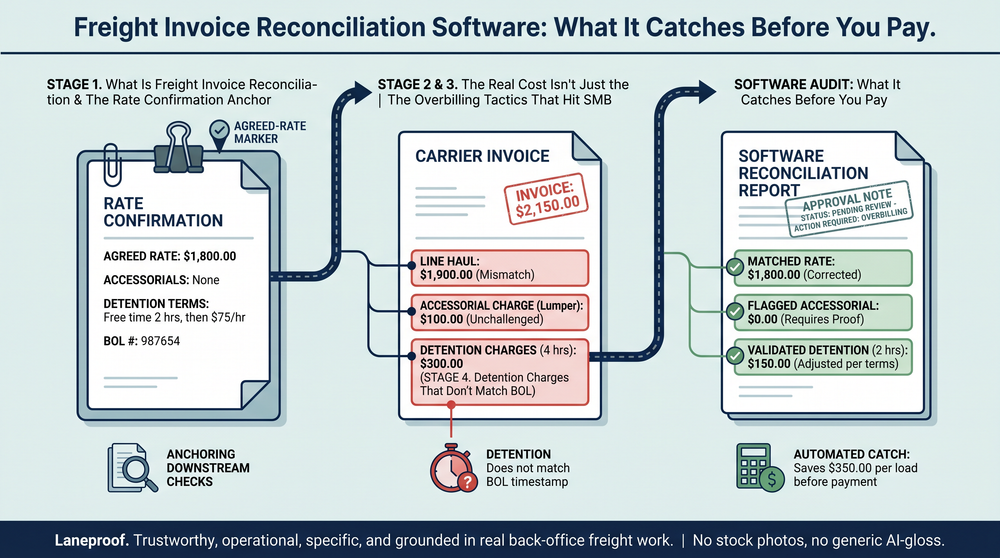
Freight invoice reconciliation is the process of matching every line item on a carrier's freight invoice against the agreed rate confirmation, bill of lading (BOL), proof of delivery (POD), and any approved accessorial charges to confirm the billed amount matches what was actually contracted and delivered. When a discrepancy appears (a detention charge that doesn't match the BOL timestamp, a fuel surcharge percentage that's higher than the rate con, a lumper fee with no receipt), that variance needs to be flagged, disputed, and resolved before payment.
The problem isn't that brokers don't understand this. It's that the process is manual, slow, and inconsistent. According to Mello HQ's analysis of common reconciliation challenges, the rapid growth in freight volume has made manual reconciliation increasingly unsustainable, especially for small and mid-size brokerages where one or two billing coordinators handle hundreds of invoices per week.
The Real Cost Isn't Just the Overcharge
It's easy to focus on the individual overbill. A $93.75 detention overcharge here, a $39.60 fuel surcharge discrepancy there. But the compounding cost is what kills margins. When your billing coordinator is spending 6 to 9 minutes per invoice across 400 invoices per month, that's 40 to 60 hours of labor just on reconciliation. That's a full-time employee's worth of hours spent checking math instead of managing loads, building carrier relationships, or resolving actual exceptions that need human judgment.
And the charges that slip through? According to Nuvo Cargo's research on freight invoice automation, exception handling alone accounts for 30% of total accounts payable processing time. When you combine that with the invoices that never get reviewed thoroughly because your team is overwhelmed, you're paying for errors on two fronts: the labor to find them and the cost of the ones you miss.
The Overbilling Tactics That Hit SMB Brokers Hardest
Carrier overbilling isn't always intentional fraud. Sometimes it's a billing system that defaults to a higher rate. Sometimes it's a driver logging hours that don't match the dock timestamp. Sometimes it's a dispatcher submitting charges that the rate con explicitly excludes. Regardless of intent, the result is the same: you pay more than you agreed to. Here are the line items carriers inflate most often and what they actually look like on an invoice.
Detention Charges That Don't Match BOL Timestamps
Detention is one of the most frequently inflated accessorial charges for SMB brokers. The math is simple and the documentation trail is often fragmented, which makes it easy for discrepancies to slide through.
Example: A carrier bills 3 hours of detention at $75/hour on a load where the BOL timestamp shows a 1-hour 45-minute dock window. The correct charge should be $131.25 (1.75 hours × $75), but the invoice shows $225. That's a $93.75 overcharge on a single load. If this pattern repeats across even a fraction of 200 loads per month, the exposure climbs to $18,750 per month in unchallenged detention charges. Per FMCSA regulations under 49 CFR, carriers and brokers are expected to maintain accurate records of detention events, but the burden of verification almost always falls on the broker at invoice time.
Fuel Surcharge Percentages That Quietly Creep Up
Fuel surcharges are percentage-based, which means small discrepancies generate overcharges that look minor on a per-load basis but compound fast. This is the line item that manual reconciliation misses most often because it requires pulling the rate con, checking the agreed FSC percentage, recalculating the correct surcharge against linehaul, and comparing it to what was billed. When billing coordinators are processing 80-plus invoices per day, they're not doing that math on every load.
Example: A rate con shows a $1,200 linehaul with an agreed fuel surcharge of 15.2%. The correct FSC is $182.40. The carrier invoice bills the FSC at 18.5%, which comes to $222. That's a $39.60 overcharge per load. On a book of 500 loads per month, if even 10% of invoices carry this kind of FSC discrepancy, you're losing $1,980 per month on fuel surcharges alone. Manual reconciliation misses these 60% to 70% of the time at high invoice volumes.
Lumper Fees Without Receipts
Lumper fees are supposed to be documented. A carrier bills a lumper fee, and the receipt should appear in the POD packet. But lumper receipts go missing constantly, and when they do, most brokers pay the charge and move on because disputing it takes longer than the fee itself.
Example: A lumper fee of $275 appears on a carrier invoice, but no lumper receipt exists in the POD packet. Without automation, your billing coordinator may not notice the missing document until after payment has cleared. Software that cross-references the invoice against the POD packet flags the missing receipt before payment goes out, giving you the documentation to dispute or withhold the charge.
TONU Charges on Loads With $0 TONU Clauses
Truck Order Not Used (TONU) charges are legitimate when a load cancels after a carrier has committed resources. But some carriers submit TONU charges even when the rate confirmation explicitly states a $0 TONU clause.
Example: A carrier submits a $150 TONU charge on a load. The signed rate con includes a $0 TONU clause. A billing coordinator would need to pull up the rate con, locate the TONU clause, confirm it reads $0, and then dispute the charge. That takes 10 to 12 minutes per occurrence. Reconciliation software that reads rate con terms catches this mismatch in seconds.
Layover Charges on Same-Day Deliveries
Layover accessorials are billed when a delivery can't be completed the same day and the driver has to wait overnight. The only way to verify this is to compare the POD delivery timestamp against the layover claim.
Example: A carrier submits a $350 layover charge on a load where the POD timestamp shows delivery was completed the same day. That $350 charge is entirely invalid. Automated POD date matching catches this instantly; manual review might catch it if the coordinator has time to pull the POD and cross-reference dates, which at 80-plus invoices per day, they often don't.
Manual vs. Automated Reconciliation: What the Time and Dollar Gap Actually Looks Like
You've probably heard that automation saves time. Here's what that actually means in a freight brokerage billing department, with real numbers instead of vague promises.
The Manual Reconciliation Benchmark
A billing coordinator manually reconciling carrier invoices averages 6 to 9 minutes per invoice. This includes pulling the rate con, checking linehaul against the agreed rate, reviewing each accessorial against the BOL and POD, verifying fuel surcharge calculations, and flagging anything that looks off. At 400 invoices per month, that's 40 to 60 hours of labor dedicated to reconciliation. That's before any time spent on disputes, re-billing, or chasing missing documents.
As Truckstop.com notes in their analysis of freight invoice bookkeeping signs, one of the clearest indicators that a brokerage is outgrowing its billing process is when reconciliation consistently takes more hours per week than the team can sustain without errors creeping through.
What Automation Actually Changes
Automated freight invoice reconciliation software doesn't eliminate human review. It changes what humans review. Instead of checking every line item on every invoice, your billing coordinator reviews only the exceptions that the software flags. According to Nuvo Cargo's 2026 analysis, freight invoice automation can reduce accounts payable processing time by as much as 78%.
In practical terms for an SMB brokerage: if your manual process takes 40 to 60 hours per month, automated matching with exception-only review reduces that to under 15 hours. Your billing coordinator stops spending their week on data entry and line-item math, and starts spending it on resolving the 15% to 20% of invoices that actually have problems.
The Dollar Gap in Real Terms
Here's the scenario laid out in full.
Scenario: 500-load/month brokerage, no reconciliation process.
- Average linehaul: $1,500
- Average overbilling rate: 3.8%
- Monthly overbilling exposure: $28,500 (500 × $1,500 × 0.038)
- Annual exposure: $342,000
Scenario: Same brokerage, manual reconciliation.
- Labor: 40 to 60 hours/month at billing coordinator rates
- Catch rate: approximately 50% to 60% of discrepancies (limited by volume and fatigue)
- Monthly recovered: approximately $14,250 to $17,100
- Monthly still lost: approximately $11,400 to $14,250
Scenario: Same brokerage, automated reconciliation software.
- Labor: under 15 hours/month (exception review only)
- Catch rate: 90%+ of discrepancies (every invoice checked against rate con, BOL, POD)
- Monthly recovered: approximately $25,650+
- Monthly improvement over manual: approximately $8,550 to $11,400 in additional savings
The difference between manual and automated isn't just time. It's the invoices your team never gets to because they're already buried in the ones they did review.
How Reconciliation Software Matches Rate Cons, BOLs, and PODs at the Same Time
The core function of freight invoice reconciliation software is multi-document matching. Instead of a billing coordinator toggling between tabs, pulling up separate documents for each load, and cross-referencing numbers manually, the software ingests all relevant documents for a load and compares them against the carrier invoice simultaneously. Understanding what invoice reconciliation actually means in freight at the line-item level is the foundation of this process.
Rate Confirmation Matching
The rate con is the source of truth for every load. Reconciliation software reads the agreed linehaul rate, fuel surcharge percentage, accessorial terms (including $0 clauses for TONU, detention caps, or layover exclusions), and payment terms. Every corresponding line item on the carrier invoice is checked against these values. If the invoice shows a linehaul of $1,550 and the rate con says $1,500, that $50 variance gets flagged immediately. If the rate con includes a $0 TONU clause and the invoice includes a $150 TONU charge, it's flagged before payment.
BOL Timestamp Verification
BOL data provides the operational timestamps: arrival, loading start, loading end, departure. Detention charges are validated against these timestamps. If a carrier bills 3 hours of detention but the BOL shows a 1-hour 45-minute window, the software calculates the correct detention amount and flags the difference. This is the check that catches the $93.75 per-load overcharge in our earlier example.
POD Cross-Referencing
The POD confirms delivery completion: date, time, condition, and any associated documents like lumper receipts. Reconciliation software checks three things against the POD. First, was delivery completed on the date billed? (This catches false layover claims.) Second, do all billed accessorials have supporting documentation in the POD packet? (This catches lumper fees without receipts.) Third, does the delivery confirmation match the load details on the rate con? (This catches loads billed under the wrong reference number.)
As detailed in Laneproof's breakdown of invoice reconciliation for freight brokers, this three-document matching process is what separates purpose-built reconciliation software from generic accounting tools. According to Trimble's freight audit documentation, enterprise-grade freight audit platforms use automated invoice bookings combined with real-time exception reporting to achieve this, but their tooling is built for large shippers, not SMB brokerages.
Laneproof's reconciliation engine checks each of these fields automatically, flagging variances before payment goes out. The difference for brokers is that the matching logic is built around rate con structures and accessorial terms that brokers actually negotiate, not shipper-side routing guides or enterprise procurement contracts.
What to Look For in Reconciliation Software Built for Brokers, Not Shippers
The freight audit and payment market is growing fast. According to Technavio's 2026 market analysis, the freight audit and payment market is projected to grow by $651.2 million from 2026 to 2030 at a CAGR of 11.2%. That growth means more tools on the market, which means more noise to cut through when you're evaluating options. Most of those tools are built for enterprise shippers or 3PLs with thousands of carrier relationships and complex routing guides. Here's what to look for when you need something built for a brokerage.
Rate Con as the Primary Matching Document
Shipper-focused tools often match invoices against purchase orders, routing guides, or contract tariffs. A broker's source of truth is the rate confirmation. Your software needs to read rate con terms (linehaul, FSC percentage, accessorial clauses, payment terms) and match them against the carrier invoice line by line. If the tool can't ingest a rate con and treat it as the baseline for every comparison, it wasn't built for your workflow.
Accessorial-Level Matching, Not Just Linehaul
Plenty of tools catch a linehaul discrepancy. The charges that actually drain broker margins are accessorials: detention, lumper fees, layover, TONU, fuel surcharges, and drayage fees. Your invoice reconciliation software needs to check each accessorial against both the rate con (was it agreed to?) and the supporting documents (does the BOL or POD back it up?). If the tool only compares the total invoice amount against the total rate con amount, it will miss accessorial padding that keeps the total close to expected while inflating individual line items.
Exception-Based Workflow, Not Full Re-Review
The goal isn't to automate every step of reconciliation. It's to automate the 80% of invoices that match cleanly so your team can focus on the 20% that don't. Look for software that presents a clear exception queue: here are the invoices with variances, here's what the variance is, here's the supporting document. Your billing coordinator should be able to review, approve, or dispute a flagged invoice in under 2 minutes, not 9.
Integration With Your Existing TMS
According to BrokerPro's TMS buying guide, the most critical factor in freight broker software selection is how well it integrates with existing workflows. Reconciliation software that requires manual data export from your TMS and re-upload into a separate system doesn't save time. It shifts time. Look for tools that pull load data, rate cons, and invoices directly from your TMS or accounting system, so the matching happens without your team re-entering information.
Broker-Scale Pricing
Enterprise freight audit platforms price for enterprise volumes. If you're running 100 to 2,000 loads per month, you shouldn't be paying for infrastructure built to handle 50,000. Look for per-load or per-invoice pricing that scales with your actual volume, not seat licenses or platform fees designed for a different business model.
A 3.8% average overbilling rate on 500 loads per month at $1,500 average linehaul equals $28,500 per month in unchallenged carrier overcharges. That's $342,000 per year leaving your brokerage before anyone checks the math.
Frequently Asked Questions About Freight Invoice Reconciliation
What is a freight reconciliation?
Freight reconciliation is the process of comparing a carrier's invoice against the original rate confirmation, bill of lading, and proof of delivery to verify that every billed charge (linehaul, fuel surcharge, detention, lumper fees, and other accessorials) matches what was agreed and documented. When discrepancies are found, they're flagged for dispute or adjustment before payment is issued.
How do you do invoice reconciliation for freight?
Manually, you pull the rate con for each load, compare the linehaul and each accessorial against the carrier invoice, check BOL timestamps for detention accuracy, verify POD documents for lumper receipts and delivery dates, and flag any variances. At 6 to 9 minutes per invoice, this becomes unsustainable past a few hundred loads per month. Automated reconciliation software performs these same comparisons digitally, ingesting all documents for a load and surfacing only the exceptions that need human review.
What is the best freight invoice reconciliation software for brokers?
The best software for brokers specifically (not shippers or enterprise 3PLs) matches invoices against rate confirmations at the line-item level, cross-references accessorial charges against BOL and POD documentation, integrates with your existing TMS, and uses exception-based workflows so your team reviews only the invoices with variances. According to Gartner's freight audit and payment provider reviews, the market includes many enterprise-focused tools, so brokers should prioritize solutions built for their document types and load volumes.
How much does carrier overbilling actually cost brokers?
It depends on load volume and the types of accessorials carriers commonly bill. In the scenarios outlined in this article, a brokerage running 500 loads per month with a 3.8% average overbilling rate on $1,500 average linehaul loses $28,500 per month, or $342,000 per year. Even smaller brokerages running 200 loads per month face significant exposure on detention, fuel surcharges, and undocumented lumper fees.
What is freight in ERP?
In ERP systems like Microsoft Dynamics 365, freight refers to the transportation cost associated with moving goods, and freight reconciliation is the process of matching carrier invoices against expected costs within the system. ERP freight modules are typically designed for shippers managing inbound and outbound transportation, not for freight brokers managing carrier payments against rate confirmations. Brokers generally need purpose-built reconciliation tools that work with rate cons and carrier packets rather than ERP procurement workflows.
Where to Go From Here
Freight invoice reconciliation software isn't about replacing your billing team. It's about making sure they spend their hours on the invoices that actually need attention instead of re-checking hundreds of clean loads. The math is straightforward: if your manual process catches 50% to 60% of discrepancies and automated matching catches 90%+, the delta is real money. On 500 loads per month, that delta is $8,550 to $11,400 per month in additional savings.
The overbilling tactics covered here (inflated detention, padded fuel surcharges, undocumented lumper fees, false layover claims, invalid TONU charges) aren't going away. Carriers will keep submitting them because they know most brokers don't have the bandwidth to catch every one. The question is whether you're checking every invoice against the rate con, BOL, and POD before you pay, or finding the discrepancies after the money is already gone.
If you want to see what this looks like on your actual invoices, Laneproof's reconciliation tool matches carrier invoices against your rate cons, BOLs, and PODs at the line-item level, flagging every variance before payment. You can check current plans and pricing to see what it costs relative to what you're losing.
Sources
- FMCSA Regulations and Interpretations, 49 CFR — Federal Motor Carrier Safety Administration
- Trimble Freight Audit Software — Trimble Transportation
- Reconcile Freight in Transportation Management — Microsoft Dynamics 365 Documentation
- Invoice Reconciliation Software for Freight Brokers — Laneproof
- Best Freight Audit and Payment Providers Reviews 2026 — Gartner
- Freight Invoice Automation: Cut AP Processing by 78% — Nuvo Cargo
- Solving Common Freight Invoice Reconciliation Challenges — Mello HQ
- Freight Audit and Payment Market Size 2026–2030 — Technavio
- Freight Invoice Bookkeeping: 5 Signs Your Brokerage Is Outgrowing Its Process — Truckstop.com
- Complete Freight Broker TMS Buying Guide — BrokerPro
Related: Invoice Reconciliation in SAP: Where It Breaks for Freight Teams
Related: Invoice Reconciliation Job Description for Freight Brokerages
Related: The Invoice Reconciliation Template Built for Freight Brokers
Full guide: Freight Invoice Reconciliation Process: Stop Losing Hours