Invoice Reconciliation Software That Actually Catches Freight Overbilling
Researched and written with AI assistance. Reviewed by the Laneproof team.
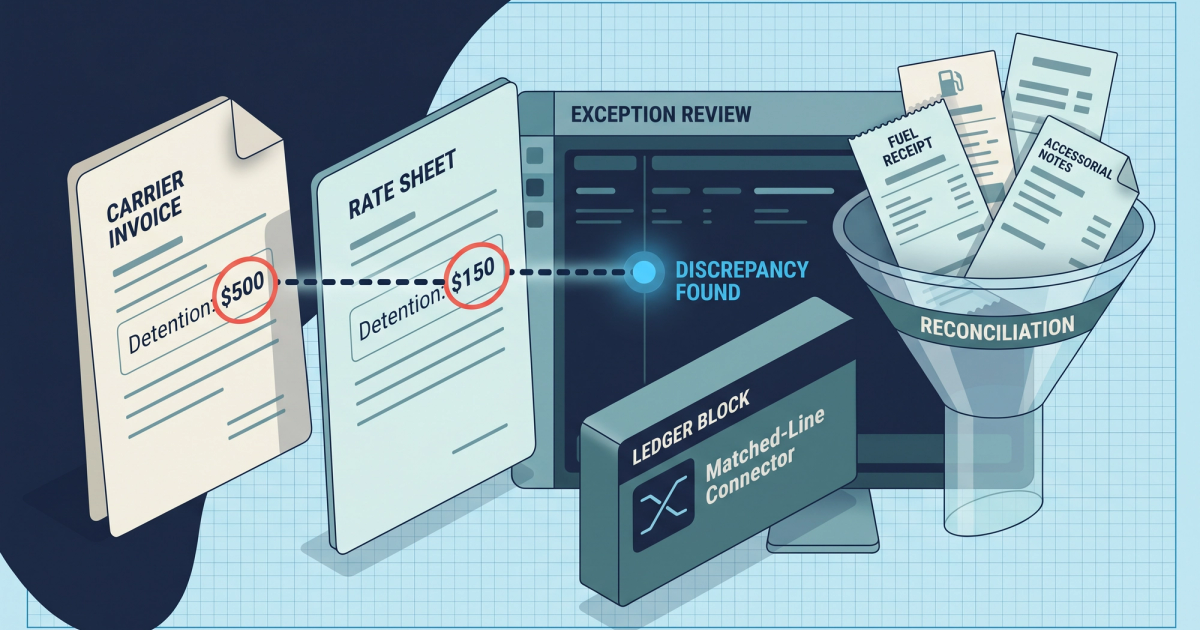
A freight broker processing 500 carrier invoices per month and spending 12 minutes on each one manually burns 100 hours of ops time before a single dispute gets filed. At a $25/hr loaded labor cost, that's $2,500/month in back-office overhead just to check line items against rate cons. And most of those checks still miss the overbills. According to freight invoice processing data from Lido, 3 to 7 percent of freight invoices contain errors. On a 500-load book, that's 15 to 35 invoices per month leaving money on the table. Invoice reconciliation software built for freight, not generic AP automation, is how you catch those errors before payment goes out. This post walks through what that software actually needs to do, how the reconciliation process works load by load, and where carrier invoices break down most often.
How Do You Actually Reconcile a Freight Invoice?
Freight invoice reconciliation means matching every line item on a carrier's invoice to the agreed rate confirmation, the BOL, the POD, and any supporting documents (lumper receipts, detention logs, accessorial approvals). You compare linehaul, fuel surcharge, detention, lumper fees, and any other accessorial charges against what was authorized. Discrepancies get flagged, disputed, or approved. Payment only goes out once everything matches.
Here's the short version for anyone searching "how do you reconcile invoices" in a freight context:
- Step 1: Pull the carrier invoice and match it to the corresponding rate confirmation (rate con) by load number or PRO number.
- Step 2: Compare linehaul rate, fuel surcharge percentage or flat amount, and any accessorial charges against the rate con terms.
- Step 3: Cross-reference detention and lumper charges against BOL timestamps, check-in/check-out logs, and attached receipts.
- Step 4: Flag any variance. Even $10. Small overbills at scale become large margin losses.
- Step 5: Approve matched invoices for payment or route discrepancies to your dispute workflow.
Why This Process Falls Apart at Scale
When your brokerage moves 100 to 500 loads a month, each invoice touches four to six documents. That's potentially 3,000 document comparisons monthly. Ops managers and billing coordinators doing this manually in spreadsheets or their TMS inevitably start skipping steps, especially on accessorial charges where the overbill is small per load but adds up across the book. According to MelloHQ's analysis of freight invoice reconciliation challenges, companies that deploy automated reconciliation tools see labor costs for this work drop by up to 70%. That's not a marginal improvement. It's the difference between a billing coordinator spending a full work week on reconciliation versus spending one day and catching more errors.
For a detailed walkthrough of the full reconciliation process and the most common places it breaks down, see our guide on the freight invoice reconciliation process.
What Generic Accounting Software Gets Wrong About Carrier Invoices
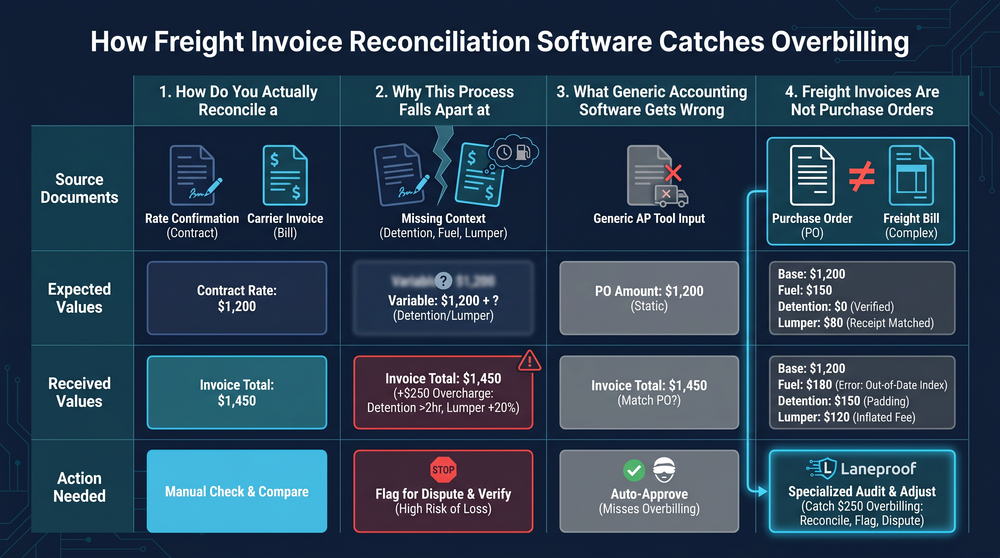
Most accounting software (QuickBooks, Sage, Xero) handles invoice reconciliation as a PO-to-invoice match. You have a purchase order, you get an invoice, and the system checks whether the totals align. If they do, the invoice gets approved. That logic works for buying office supplies. It does not work for freight.
Freight Invoices Are Not Purchase Orders
A carrier invoice for a single load might include a linehaul charge, a fuel surcharge calculated as a percentage of linehaul, a two-hour detention charge, a lumper fee, and a TONU charge from a previous dry run on the same lane. Each of those line items references a different source of truth: the rate con sets the linehaul and FSC cap, the BOL timestamps validate detention, the lumper receipt confirms the facility fee, and the carrier packet or load tender governs the TONU terms.
Generic accounting software sees one invoice total and one PO total. If the numbers match, it approves. If they don't, it flags the whole invoice without telling you which line item is wrong or what document to check. As Avantiico's overview of freight invoice auditing software explains, freight-specific auditing platforms are built to dissect invoices at the line-item level against multiple reference documents, something horizontal AP tools were never designed to do.
The TMS Integration Gap
Even brokerages using a TMS often find that their accounting software doesn't pull in the right fields. Your TMS has the rate con data, the load status, the check-call timestamps, and the carrier packet terms. Your accounting software has the invoice amount. Without a bridge between those systems, your billing coordinator is toggling between three or four screens to verify a single charge. TAI Software's guidance on freight broker accounting specifically calls out this integration gap as a primary reason brokerages lose margin on carrier payments. The fix isn't a better accounting tool. It's reconciliation software that sits between your TMS and your AP workflow and speaks freight.
The Three Accessorial Charges Carriers Overbill Most Often
Not all overbilling is intentional. Some of it comes from dispatchers estimating times, drivers rounding up, or carrier billing departments using default rates instead of contracted ones. But the result is the same: you pay more than you agreed to. These are the three accessorial categories where we see the most variance between the rate con and the carrier invoice. For a broader look at which line items carriers inflate most frequently, see the full breakdown of freight billing reconciliation patterns.
1. Detention Charges: Padded Hours, Real Dollars
Detention is the single most disputed accessorial in freight brokerage, and for good reason. The charge is time-based, which means it depends on accurate timestamps. When a carrier invoices detention at $75/hr for 4 hours ($300 total), but the BOL timestamp and the facility check-in log show only 2.5 hours of actual wait time, the real charge should be $187.50. That's a $112.50 overbill on one load.
Now scale it. If your brokerage moves 200 loads per month and 15% of those loads incur detention, that's 30 detention invoices monthly. If even half of them carry a similar padding pattern, you're looking at over $1,687 per month in detention overbills. Across a full year, that's more than $20,000 in margin lost to unverified timestamps.
At 200 loads/month with a 15% detention rate and consistent time padding, unverified detention charges can cost a brokerage over $3,300/month.
2. Lumper Fees: No Receipt, No Payment
Lumper fees are facility unloading charges, most common at grocery and retail distribution centers. The problem: carriers sometimes invoice lumper fees with no receipt attached, or they attach a receipt that doesn't match the invoiced amount.
Example: a carrier invoice lists a $450 lumper fee for a grocery DC delivery. Industry average lumper fees at grocery DCs run $175 to $275. A $450 charge with no receipt is an immediate audit flag. If the receipt shows $225 and the invoice says $450, that's a $225 discrepancy you need to dispute before payment. The fix is simple, but only if your reconciliation workflow requires receipt matching on every lumper line item.
3. Fuel Surcharge Miscalculations
Fuel surcharge (FSC) errors are easy to miss because they require math, not just document matching. The rate con might cap FSC at 24% of linehaul. The carrier's billing system might default to 28%. On a $2,200 linehaul, that's the difference between a $528 surcharge (correct) and a $616 surcharge (overbilled). That $88 per load gap, multiplied across your dry van book, adds up fast.
Catching this requires invoice reconciliation software that reads the FSC cap from the rate confirmation and recalculates the surcharge on every invoice, not just compares the total. Most generic tools don't do this.
Rate Con vs. Invoice: What a Match Should Look Like and Where It Usually Breaks Down
The rate confirmation is your contract. The carrier invoice is the carrier's version of what happened. Your job is to find every place those two documents disagree. Here's what a clean match looks like, field by field:
- Linehaul rate: Invoice amount matches rate con amount exactly. No variance.
- Fuel surcharge: Calculated using the FSC percentage or flat amount specified on the rate con, not the carrier's default schedule.
- Detention: Hours invoiced match BOL or facility timestamps. Rate per hour matches rate con terms (or the carrier packet default if not specified on the rate con).
- Lumper fee: Amount matches attached receipt. Receipt is from the delivery facility, not a third-party estimate.
- TONU/dry run: Amount matches the rate con or carrier packet flat rate. Reason for TONU is documented.
- Layover: Number of days invoiced matches driver check-call records or dispatcher notes. Daily rate matches rate con terms.
Where the Match Breaks Down
The breakdown almost never happens on linehaul. Carriers get the base rate right because it's the most visible number. The problems show up in the accessorial charges, where the source-of-truth documents are scattered across emails, driver apps, facility logs, and TMS notes.
A TONU charge billed at $250 when the rate con specifies $150 flat is a $100 discrepancy. That might seem small until you realize it appears on roughly 8% of loads for high-volume dry van brokers. On a 120-load operation, that's about 10 TONU invoices per month, adding up to approximately $960/month in overpayments.
Similarly, a layover charge of $350/day billed for two days when driver notes and check calls confirm a single overnight costs $350 per occurrence. If the load data is already matched to the invoice, disputing that takes under 60 seconds. If it's not matched, your billing coordinator has to dig through emails and TMS records, and the dispute often doesn't happen at all.
For a checklist your team can use to catch these overbills systematically, see our carrier invoice audit checklist.
What to Look for in Invoice Reconciliation Software If You're Moving 100-Plus Loads a Month
Once you're past 100 loads a month, manual reconciliation stops being a process and starts being a bottleneck. Here's what freight-specific invoice reconciliation software needs to do at that volume, and what separates it from generic AP tools.
Automated Rate Con to Invoice Matching
The software should ingest both the rate confirmation and the carrier invoice, then automatically compare linehaul, FSC, and every accessorial charge at the line-item level. According to Nuvocargo's analysis of freight invoice automation, automating this carrier invoice matching step alone can cut AP processing time by up to 78%. That's the difference between your billing coordinator spending 100 hours a month on reconciliation and spending 22 hours, while catching more discrepancies.
Document-Level Accessorial Verification
Matching a total is not enough. The software needs to pull in BOL timestamps for detention validation, lumper receipts for fee verification, and carrier packet terms for TONU and layover rates. If a detention charge doesn't have a supporting timestamp, it should be flagged before it reaches your AP queue, not after you've already paid it.
Fuel Surcharge Recalculation
This is where most generic tools fail entirely. Invoice reconciliation software for freight needs to read the FSC cap or percentage from the rate con and independently calculate what the surcharge should be, then compare that calculated amount to what the carrier invoiced. A 4-point FSC variance on a $2,200 linehaul is $88 per load. At 500 loads/month, even if only 20% have FSC errors, that's $8,800/month in potential overbilling.
Dispute Workflow with Documentation
Flagging a discrepancy is only half the job. The software should generate a dispute package: the original rate con, the invoice with the flagged line item, and the supporting document (timestamp, receipt, carrier packet clause) that proves the variance. Your ops team needs to send that dispute in minutes, not spend 30 minutes assembling evidence from four different systems.
According to MelloHQ's data on automated reconciliation outcomes, 72% of companies using automated reconciliation tools reduced invoice discrepancies by 20%, with transportation cost savings reaching up to 3.5%. For a brokerage spending $500,000/month on carrier payments, a 3.5% savings is $17,500 per month recovered.
TMS and Accounting Integration
The software has to sit between your TMS and your accounting system. Load data, rate con terms, and carrier packet details live in the TMS. Payment approvals and GL entries live in accounting. The reconciliation layer connects them. Microsoft's documentation on freight reconciliation in Dynamics 365 outlines both manual and automatic reconciliation workflows, showing how the data handoff between transportation management and financial systems needs to happen for accurate freight billing.
Laneproof's reconciliation engine checks each of these fields automatically, flagging variances between carrier invoices and rate cons before payment goes out. No toggling between screens. No manual spreadsheet comparisons.
Real Examples: What Freight Overbilling Looks Like on Actual Invoices
These scenarios are composites drawn from common carrier billing patterns. The math is straightforward. The point is to show what reconciliation software should catch automatically.
Example: Detention Padding on a Reefer Load
A carrier invoices 4 hours of detention at $75/hr for a reefer delivery at a grocery DC. Total invoiced: $300. The BOL timestamp shows the driver checked in at 6:15 AM and was released at 8:45 AM. Actual detention: 2.5 hours (after the standard 2-hour free time window specified on the rate con, the billable detention is 0.5 hours, not 2 hours billed above free time). But the carrier invoiced 4 hours total, ignoring the free time provision. The correct charge: $37.50 (0.5 billable hours × $75). The overbill: $262.50 on a single load.
At 200 loads/month with a 15% detention rate (30 loads), if even one-third carry this type of free-time violation, that's 10 loads × $262.50, which equals $2,625/month. Invoice reconciliation software that reads the free-time clause from the rate con and compares it to BOL timestamps catches this on every load, every time.
Example: Lumper Fee with No Supporting Receipt
A carrier invoice lists a $450 lumper fee for unloading at a retail DC. No receipt is attached. Industry average lumper fees at grocery and retail DCs run $175 to $275. A $450 charge with no documentation is a red flag. If your reconciliation workflow requires receipt matching on lumper line items, this gets flagged automatically. Your billing coordinator sends one email requesting the receipt. If the carrier can't produce one, the charge is disputed. If a receipt comes back showing $225, you pay $225, not $450. The $225 saved took less than two minutes of actual work, because the software flagged it.
Example: Fuel Surcharge Overcharge Across a Month's Book
A carrier's billing system applies a 28% fuel surcharge to every invoice. Your rate con for this lane caps FSC at 24%. On a $2,200 linehaul, the correct FSC is $528 (24% × $2,200). The invoiced FSC is $616 (28% × $2,200). The per-load overbill: $88. If you run 40 loads per month on this lane with the same carrier, that's $3,520/month in fuel surcharge overbilling. Over a year: $42,240. This is pure margin loss that only gets caught if your software recalculates the surcharge from the rate con terms instead of just accepting the carrier's number.
Frequently Asked Questions About Freight Invoice Reconciliation Software
How do you reconcile invoices in freight brokerage?
You match each carrier invoice to its rate confirmation at the line-item level: linehaul, fuel surcharge, detention, lumper fees, and any other accessorial charges. Then you cross-reference time-based charges (detention, layover) against BOL timestamps and check-call records, and verify fee-based charges (lumper, TONU) against receipts and carrier packet terms. Discrepancies are flagged and either disputed or corrected before payment. For a deeper walkthrough, see how to stop paying carrier overbills through invoice reconciliation.
What is the best reconciliation software for freight brokers?
The best option depends on your volume and pain points, but the non-negotiable features are: automated rate con to invoice matching at the line-item level, fuel surcharge recalculation, accessorial charge verification against supporting documents, and a dispute workflow that packages evidence automatically. According to Gartner's reviews of freight audit and payment providers, the top-rated platforms all share these capabilities. Generic accounting software does not offer them.
Can ChatGPT or AI tools do freight invoice reconciliation?
General-purpose AI tools like ChatGPT can explain what reconciliation is, but they can't connect to your TMS, pull rate con data, cross-reference BOL timestamps, or flag a fuel surcharge miscalculation on a live invoice. Freight reconciliation requires structured data matching across multiple document types in real time. That's a purpose-built software problem, not a chatbot use case.
Is there free software for freight invoice reconciliation?
Free accounting tools like Wave or limited QuickBooks plans handle basic invoicing but lack freight-specific features: no rate con matching, no accessorial audit logic, no detention timestamp comparison. If you're under 50 loads/month, a spreadsheet template may work. Past that volume, the labor cost of manual reconciliation (up to $2,500/month at 500 loads) typically exceeds the cost of purpose-built software.
How much does freight overbilling actually cost a mid-size brokerage?
It varies by volume and carrier mix, but the math is consistent. Per Lido's freight invoice processing analysis, 3 to 7% of freight invoices contain errors. On a brokerage moving 500 loads/month at an average carrier cost of $2,000 per load ($1,000,000/month in carrier spend), a 3.5% error rate represents $35,000/month in potential overbilling. Even catching half of that recovers $17,500 monthly.
Stop Reconciling Manually. Start Catching What You're Missing.
Manual freight invoice reconciliation is slow, inconsistent, and expensive. At 100-plus loads per month, it's also a guaranteed margin leak. The overbills are specific and predictable: padded detention hours, inflated lumper fees, fuel surcharge miscalculations, TONU overcharges, and duplicate layover days. You don't need a better spreadsheet. You need software that reads your rate cons, matches them to carrier invoices at the line-item level, recalculates surcharges, verifies receipts, and flags every variance before you pay.
That's what Laneproof does. See how automated invoice-to-rate-con matching works, or check Laneproof pricing to find the right plan for your load volume. Your back office has better things to do than manually checking 500 invoices a month.
Sources
- Freight Invoice Automation: Cut AP Processing by 78% — Nuvocargo
- The Best Freight Invoice Auditing Software Platforms (2025) — Avantiico
- Best Freight Invoice Processing Software in 2026 — Lido
- Best Freight Audit and Payment Providers Reviews 2026 — Gartner
- Solving Common Freight Invoice Reconciliation Challenges — MelloHQ
- Invoice Reconciliation for Freight Brokers: Stop Overbills — Laneproof
- Reconcile Freight in Transportation Management — Microsoft
- Best Accounting Management for Freight Brokers — TAI Software