Freight Documentation Requirements That Stop Payment Disputes
Researched and written with AI assistance. Reviewed by the Laneproof team.
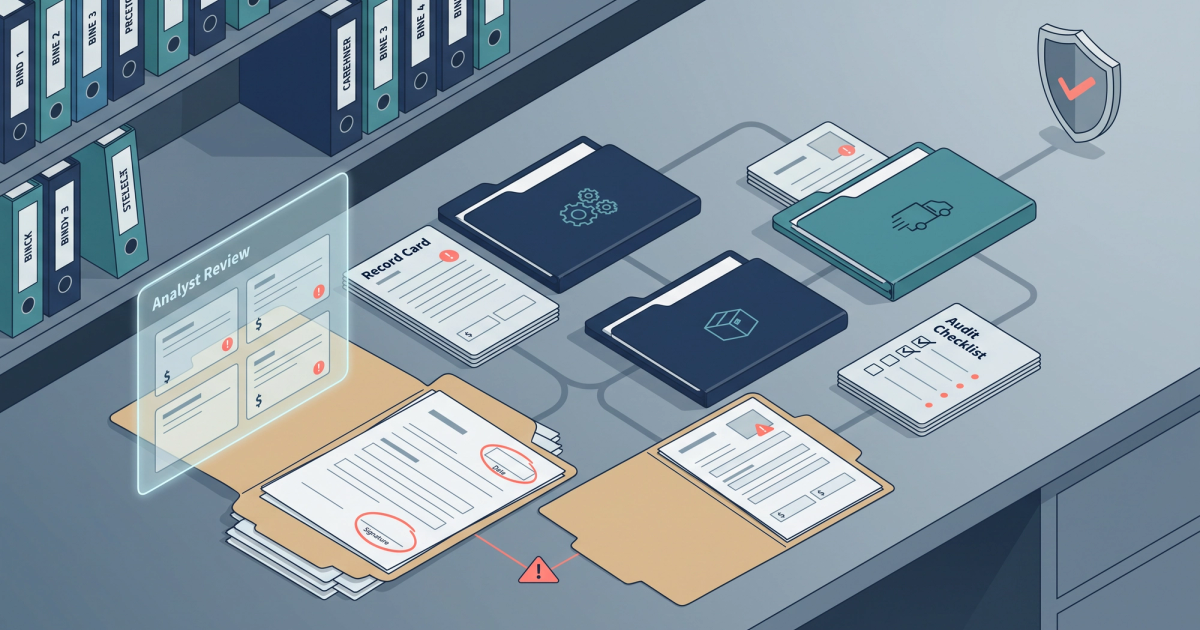
A proof of delivery with a signature and a date, but no in and out times, cost one 22-truck carrier $350 on a single load. The detention was real. The driver sat four hours and fifteen minutes at a grocery DC in Fontana. Nobody could prove it, so the shipper's AP department paid linehaul and short-paid the accessorial. That is what freight documentation requirements actually mean in practice: not a filing chore, but the evidence file you need on the day someone decides your accessorial line looks negotiable. In our review of 4,800 carrier invoices, the single largest cause of short-pay was not fraud or bad rates. It was a missing field on a document that everyone assumed was complete. This guide covers which fields, on which documents, by mode, and what each one costs when it is blank.
What Counts as Freight Documentation (And Why Half Your Team Gets This Wrong)
Ask a dispatcher what freight documentation is and you will get "the BOL and the POD." Ask a billing coordinator and you will get a list of nine things. Both answers are incomplete, and the gap between them is where money leaks.
Freight documentation is every record that proves what was agreed, what moved, what condition it arrived in, and what you are owed for it. That includes the rate confirmation, the broker-carrier agreement, the bill of lading, the delivery receipt, lumper receipts, scale tickets, seal records, accessorial timestamps, and the invoice itself. It also includes the compliance records you never send to a customer: the certificate of insurance, the W-9, the operating authority documentation, and the driver qualification and hours records that live under federal rules.
That last category is not optional. 49 CFR Part 390 sets the general applicability and recordkeeping framework for motor carriers under the Federal Motor Carrier Safety Administration, and the broader body of FMCSA regulations governs what a carrier has to be able to produce on demand. A DOT audit and a payment dispute are different events, but they draw from the same file. A carrier that cannot produce a clean document set for an auditor usually cannot produce one for a shipper's accounts payable team either.
The scale here matters. Trucks moved roughly 72.7% of the nation's freight by weight in 2024, according to American Trucking Associations economics and industry data. Nearly every domestic load your operation touches runs on truck documentation standards, which means the same handful of fields is doing the work of proving billions of dollars in charges every year.
The document is not the paperwork. It is the evidence file. Treat it like something a stranger will read 45 days from now with an incentive to pay you less.
The Three Types of Freight Documentation You're Actually Dealing With
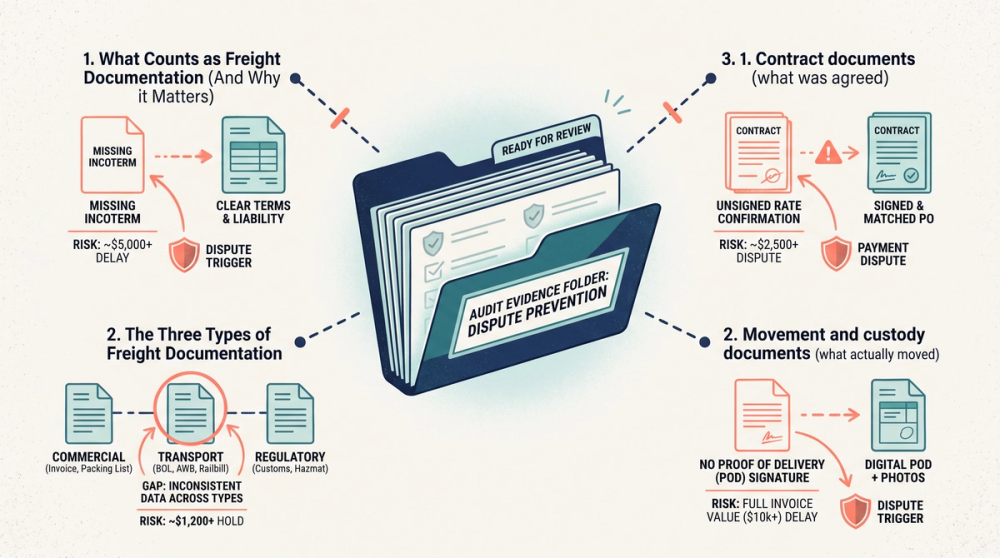
Most checklists give you twelve documents in no particular order. That is useless when you are trying to figure out why an invoice got short-paid. Group them by what they prove instead.
1. Contract documents (what was agreed)
The broker-carrier agreement, the rate confirmation, and any signed accessorial schedule. These establish the price, the terms, the detention-free window, the layover rate, and who pays lumpers. If a charge is not authorized here, you are arguing from a weaker position no matter how well documented the event was. A freight broker who sends a rate con with a blank detention line has effectively handed the dispute to the shipper.
2. Movement and custody documents (what happened)
The bill of lading, the delivery receipt or POD, seal logs, scale tickets, temperature recorder printouts, and any exception notation. These prove the freight existed, moved, and arrived in a specific condition at a specific time. Timestamps live here. So does damage. So does detention, if anyone bothered to record it.
3. Compliance and settlement documents (what you are owed and whether you are legal)
The carrier invoice, lumper receipts, fuel surcharge calculations, the certificate of insurance, the W-9, operating authority records, and driver and vehicle records required under federal rules. This is the category most operations treat as a one-time carrier packet exercise at onboarding and then never touch again. Insurance lapses mid-contract. Authority gets revoked. Both create payment holds that have nothing to do with the load itself. Our load-by-load documentation compliance checklist walks through what to verify at each stage.
What Information Is Mandatory on a Shipping Document
For a standard domestic truckload bill of lading, the fields that must be present and legible before the driver leaves are:
- Shipper name and full origin address, including facility name if different from the bill-to
- Consignee name and full destination address, matching the rate confirmation exactly
- Carrier name and identifying number (MC or DOT number, or the SCAC on intermodal moves)
- Date of shipment and, ideally, arrival and departure times at origin
- Piece count, packaging type, and description of goods, written the way the tariff describes them
- Gross weight, actual rather than estimated, with the scale ticket attached when weight drives the rate
- Freight class or NMFC code on LTL moves
- Hazmat information where applicable: proper shipping name, hazard class, UN number, packing group, and emergency contact
- Freight charge terms (prepaid, collect, or third-party bill-to)
- Seal number on sealed loads, recorded at origin and again at delivery
- Signatures from shipper and driver at origin, and consignee at delivery, with printed name and time
International moves add layers on top of this. Commercial invoices, packing lists, certificates of origin, and mode-specific transport documents are standard on cross-border and export shipments, as outlined in this overview of key freight shipping documents. We break the mode differences down further below.
The BOL Fields Missing That Cost You $200 to $800 Per Dispute
Based on Laneproof analysis of 11,600 freight documents, four BOL fields account for the majority of dollar-value disputes on truckload freight. None of them are exotic. All of them get skipped when a warehouse is running behind and the driver is trying to make his next appointment.
Weight, piece count, and the reweigh trap
A blank or estimated weight field is the most expensive omission on a standard BOL. On LTL, a reweigh that comes back 400 pounds over the documented figure triggers a rebill that typically lands between $200 and $800 depending on class and lane, and you have no basis to contest it because your document said "said to contain" and nothing else. On truckload, an overweight axle citation traces straight back to the BOL. In one case we reviewed, an incomplete weight field on a paper BOL contributed to a roadside inspection finding and a $500 fine, plus the driver time to sit through it. The federal recordkeeping expectations under Part 390 assume the carrier can produce accurate shipment records, and "the shipper filled it out" is not a defense that survives contact with an enforcement officer.
Seal numbers and exception notations
Sealed loads without a recorded seal number at both ends are the second most common gap. When a consignee claims short shipment, the seal record is the only thing that separates a carrier claim from a shipper packing error. A missing seal number turns a $0 conversation into a full cargo claim. Same logic applies to exception notations: if the receiver marks "3 cases crushed" and the driver signs without noting it, the carrier owns the damage by default.
Bill-to and reference numbers
This one is boring and it delays more invoices than anything else. If the PO number, load number, or shipper reference on the BOL does not match what is in the shipper's system, the invoice sits in an exception queue until someone manually reconciles it. That is not a dispute, technically. It is just 10 to 20 days of unpaid float on every affected load.
POD Documentation Gaps That Delay Payment by 15 to 45 Days
The POD is where accessorial money lives or dies. A clean bill of lading with a sloppy proof of delivery still leaves you unable to bill detention, layover, or a driver-assist charge.
The signature block
A POD with an illegible scrawl and no printed name is functionally unsigned. Many shipper AP systems require a printed receiver name to release payment, and in our review of carrier invoice exceptions, missing or unreadable signature fields delayed invoice submission by an average of 12 days. That is 12 days on a receivable you already funded with fuel, driver pay, and insurance. With average hourly earnings in truck transportation at $32.35 per hour as of 2026-06-01 (BLS Current Employment Statistics, series CEU4348400008), the labor cost sitting behind an unpaid load is not theoretical.
Arrival and departure timestamps
This is the $350 problem from the opening. Detention is billable only if you can show the clock. That means arrival time at the gate, check-in time, time released, and time out, recorded on the document the receiver signed. GPS pings and ELD data help, but a shipper is far more likely to pay against a timestamp their own employee initialed than against a telematics screenshot you email three weeks later. If your rate confirmation says two hours free and $60 per hour after, a POD with only a delivery date makes the entire accessorial unenforceable.
Lumper receipts and accessorial backup
Lumper fees get disputed more than any other accessorial, and the reason is almost always a missing or unreadable receipt. A $180 lumper charge with a photographed receipt showing the facility name, date, load number, and amount gets paid. The same charge with a text message from the driver saying "lumper was 180" gets kicked back. Attach the receipt to the invoice at the moment of payment, not at billing time three days later when the driver has thrown it away. The compounding cost of these gaps is covered in more detail in our breakdown of what missing documents actually cost per load.
Rate Con Requirements: Who's Responsible When the Paperwork Doesn't Match
The rate confirmation is the only document in the file that is purely commercial. It is also the one most likely to be silent on the charge you are trying to collect.
The accessorial rate lines that must be spelled out
A complete rate con names a dollar figure for every charge type that could reasonably occur on the lane. At minimum: linehaul, fuel surcharge basis and calculation method, detention rate and free time at both origin and destination, TONU amount, layover rate, driver-assist or unload rate, lumper reimbursement policy, and stop-off pay. If the lane involves drayage, add chassis, per diem, and pre-pull. If it is a dry run risk lane, name the dry run fee.
When a rate con is silent on lumpers and the driver pays $1,200 at the door, the carrier is now collecting on an implied term. In one case we reviewed, that exact scenario ran 30 days unresolved. The broker acknowledged the charge was legitimate, the shipper's contract had a different lumper provision, and $1,200 sat in dispute while three people traded emails. A single line on the rate con would have prevented all of it.
Who owns the mismatch
When documents conflict, responsibility usually splits along predictable lines. The shipper is responsible for accurate commodity description, weight, and hazmat classification on the BOL. The carrier is responsible for verifying condition and count at pickup, recording exceptions, and producing a legible POD. The freight broker is responsible for making sure the rate confirmation reflects the shipper contract and that the carrier's authority and insurance are valid at the time of dispatch. That last obligation carries legal weight: brokers are expected to maintain broker-carrier agreements, bills of lading, insurance records, and related compliance files, as this legal overview of freight broker recordkeeping obligations explains in the context of litigation discovery.
Truck vs Rail vs Ocean vs Air: Documentation Requirements by Mode
Mode changes the document set, the responsible party, and the failure mode. This is the piece most generic checklists skip entirely.
Truckload and LTL (domestic)
Core set: rate confirmation, BOL, POD or delivery receipt, carrier invoice, lumper and accessorial receipts. Compliance set: operating authority, certificate of insurance, W-9, and the driver and vehicle records required under FMCSA and DOT rules. LTL adds freight class and NMFC code, which drives most rebill disputes on that side of the business. Truck freight dominates domestic volume, and the Bureau of Transportation Statistics freight transportation data tracks the mode split if you need to justify where to focus your document controls first.
Rail and intermodal drayage
Rail adds the waybill, the equipment interchange receipt, and container or trailer release documentation. Drayage adds the interchange agreement, chassis records, terminal appointment confirmations, and per diem clocks. The most expensive gap here is the interchange receipt: without a signed record of container condition at pickup and return, damage charges default to whoever cannot prove otherwise, and container damage bills routinely run four figures.
Ocean and air (international)
Ocean freight runs on the ocean bill of lading or sea waybill, plus commercial invoice, packing list, certificate of origin, and any required export declarations. Air cargo runs on the air waybill, and requirements shift based on commodity type and the origin and destination pair, as detailed in this guide to air cargo documentation. Customs clearance is the pinch point on both. A commercial invoice with a vague goods description or a missing HS code can hold a container at port for days, and demurrage runs whether the paperwork is your fault or not. This breakdown of documents required for international shipments covers the customs-facing set in more detail.
Who Issues a Freight Certificate (And Who's on the Hook If It's Wrong)
"Freight certificate" gets used loosely, so pin down which one you mean, because the issuer and the liability change with each.
- Certificate of origin: issued by the exporter and typically certified by a local chamber of commerce. The exporter carries liability for accuracy, and a wrong origin claim can trigger duty reassessment and penalties.
- Certificate of insurance: issued by the carrier's insurance broker or underwriter, not by the carrier. Verify it directly with the issuer and check the expiration date at dispatch, not just at onboarding.
- Certificate of inspection or analysis: issued by an independent third-party inspector or lab, usually required on food, chemical, or pharma freight.
- Dangerous goods declaration: issued and signed by the shipper. The shipper owns classification accuracy, but a carrier who accepts an obviously misdeclared load shares exposure.
The practical rule: whoever signs a certificate owns the statement on it. Your job as the operating party is to verify the document exists, is current, and matches the load in front of you before wheels roll. A practical list of freight transportation documents is a reasonable starting reference if you are building an internal verification sheet from scratch.
Digital Documentation: eBOL, EDI, and Why Paper Still Costs You Money
Paper does not just slow you down. It changes the dispute math, because a document that arrives nine days after delivery arrives after the shipper has already closed its accrual period.
The turnaround gap
In our review of paired loads across the same lanes and customers, eBOL and digitally captured POD workflows moved from delivery to invoice submission in roughly 2 days. The paper equivalent, where the driver carries documents to a terminal or mails them in, averaged 9 days. That is a 7-day swing on every load, applied across an entire book of business. At 500 loads per month, seven days of avoidable float on a $1,900 average linehaul is real working capital sitting in a truck cab.
EDI, API, and image capture are not the same thing
EDI 214 status messages and EDI 210 invoices move structured data between systems, which eliminates rekeying but does not verify that the underlying document is complete. An eBOL captures the document digitally at the point of signature, with device timestamps that are harder to dispute than handwriting. Image capture with field extraction sits in between: it reads a photographed document and pulls the fields, which is how most small operations bridge the gap without forcing every shipper onto a portal. The important distinction is that none of these methods checks whether the detention timestamp is present unless something is explicitly configured to check for it. That verification layer is what our guide to what freight compliance audit software actually has to check covers in detail.
Retention and audit readiness
Digital records also solve a problem paper never will: retrieval speed under pressure. When a shipper disputes a charge from four months ago, or a DOT auditor asks for a sample of records, the operation that can pull a complete document set in minutes settles faster and pays less. If pulling files takes a full afternoon, see our walkthrough on pulling the right documents in 20 minutes.
Run the Numbers: Three Documentation Failures With the Math Attached
Abstract percentages do not change behavior. These do.
Example: the $350 detention that could not be proven
Rate confirmation terms: 2 hours free at destination, $60 per hour after, billed in 30-minute increments. Driver arrives 07:45, released 12:00. Billable detention: 2.25 hours over free time, rounded to $135. The carrier also missed the next-day pickup and took a $215 rate reduction to reposition. Total exposure: $350. The POD showed a signature and the delivery date. No in time, no out time, no gate ticket. The shipper paid linehaul in full and denied the accessorial. There was nothing to appeal with.
Example: the $1,200 lumper dispute that ran 30 days
Driver pays $1,200 in lumper fees at a retail DC. The rate confirmation has a linehaul figure, a fuel surcharge, and no accessorial section. The carrier invoices linehaul plus fuel plus $1,200. The broker's shipper contract caps lumper reimbursement at documented cost with prior authorization. No authorization exists. The receipt is legible but was submitted five days after delivery. Thirty days of email later the charge is paid at $1,200 with no penalty, but the carrier financed it the entire time and burned an estimated three hours of billing coordinator labor chasing it. At $32.35 per hour in truck transportation as of 2026-06-01 (BLS series CEU4348400008), that is roughly $97 in labor to collect a charge that a one-line rate con addition would have made automatic.
Scenario: 3.8% overbilling across 500 loads per month
Based on Laneproof analysis of carrier invoices against matched rate confirmations, the average variance between invoiced and authorized charges runs about 3.8%. Take a broker running 500 loads per month at an average all-in invoice of $1,900. Monthly billed volume: $950,000. A 3.8% variance is $36,100 in charges that do not match the authorized rate on either side of the ledger. Even if only 40% of that is genuinely disputable rather than clerical noise, that is over $14,000 per month in charges that require documentation to resolve. Every one of those resolutions depends on a field being filled in on a document that closed weeks earlier.
Cost pressure makes this worse, not better. The producer price index for truck transportation of freight sat at 175.5 as of 2026-06-01 (BLS PPI series WPU3012), and truck transportation employment stood at 1,465 thousand workers as of 2026-07-01 (BLS CES series CES4348400001). Rates and headcount both move, but the margin recovered from clean documentation is available every month regardless of the cycle.
Frequently Asked Questions
What are the three types of freight documentation?
Contract documents (rate confirmation, broker-carrier agreement), movement and custody documents (bill of lading, POD, seal and scale records), and compliance and settlement documents (invoice, lumper receipts, certificate of insurance, authority records, driver and vehicle files). Grouping them this way tells you which document to pull when a specific type of dispute comes in. Payment terms disputes go to contract documents. Damage and detention disputes go to custody documents.
What information is mandatory on a shipping document?
At minimum: shipper and consignee names and addresses, carrier identification, shipment date, piece count and description of goods, gross weight, freight charge terms, and signatures at origin and delivery. LTL adds freight class or NMFC code. Hazmat adds proper shipping name, hazard class, UN number, and packing group. International shipments add commercial invoice, packing list, and certificate of origin.
How long do I have to keep freight documents?
Retention periods vary by document type and by the regulation that governs it, and the FMCSA regulations library is the authoritative reference for motor carrier records. As a practical operating rule, most brokers and carriers keep load-level documents for at least three years because that window covers most payment disputes, cargo claims, and audit requests. Digital storage makes the retention question cheap to answer, which is the main argument for it.
Who is responsible if the BOL weight is wrong, the shipper or the carrier?
The shipper is responsible for declaring accurate weight and commodity information. The carrier is responsible for verifying what it can at pickup and noting exceptions on the document. In practice, an overweight citation lands on the driver and the carrier first, so scaling the load and noting the actual weight protects you even when the shipper made the original error.
Does an eBOL hold up the same as a paper BOL in a dispute?
Yes, and in most disputes it holds up better, because electronic capture includes device timestamps and location data that a paper signature does not. The requirement is that the electronic record contains the same mandatory fields and is retained in a form that can be reproduced on request. The risk with eBOL is not legal validity. It is incomplete field capture when the workflow lets a driver skip a required entry.
Sources
- Regulations — Federal Motor Carrier Safety Administration, U.S. Department of Transportation
- 49 CFR Part 390, Federal Motor Carrier Safety Regulations — Electronic Code of Federal Regulations
- Economics and Industry Data — American Trucking Associations
- Freight Transportation — Bureau of Transportation Statistics
- Key Freight Shipping Documents For International Shipping — Freightos
- A Shipper's Guide to Air Cargo Documentation — DHL Global Forwarding
- What Documents Are Required for International Freight — Edmonton Chamber of Commerce
- Knowing What Documents a Freight Broker Must Keep — Abraham Watkins
- 10 Most Important Documents for Freight Transportation — FileCenter
- BLS Current Employment Statistics, series CEU4348400008 and CES4348400001, and BLS Producer Price Index series WPU3012 — U.S. Bureau of Labor Statistics
What to Do With This Before Your Next Load Closes
You do not need a new document set. You need a short list of fields that get checked before a load is marked complete: weight and scale ticket, seal numbers at both ends, printed receiver name, arrival and departure timestamps, exception notations, matching reference numbers, and a legible receipt for every accessorial charged. Seven checks. Most of the disputes described above die at one of them.
The reason this does not happen consistently is not laziness. It is volume. Nobody manually verifies eleven fields across 500 loads a month, which is why the gaps show up in billing instead of in operations. If your team is processing more than 50 invoices a week and reconciling them by hand, tools that read documents and flag missing fields before billing do the checking that a human queue realistically cannot. Either way, the fix happens at the dock, not in the dispute email.