Automated Compliance Documentation Freight: What Missing Docs Actually Cost You
Researched and written with AI assistance. Reviewed by the Laneproof team.
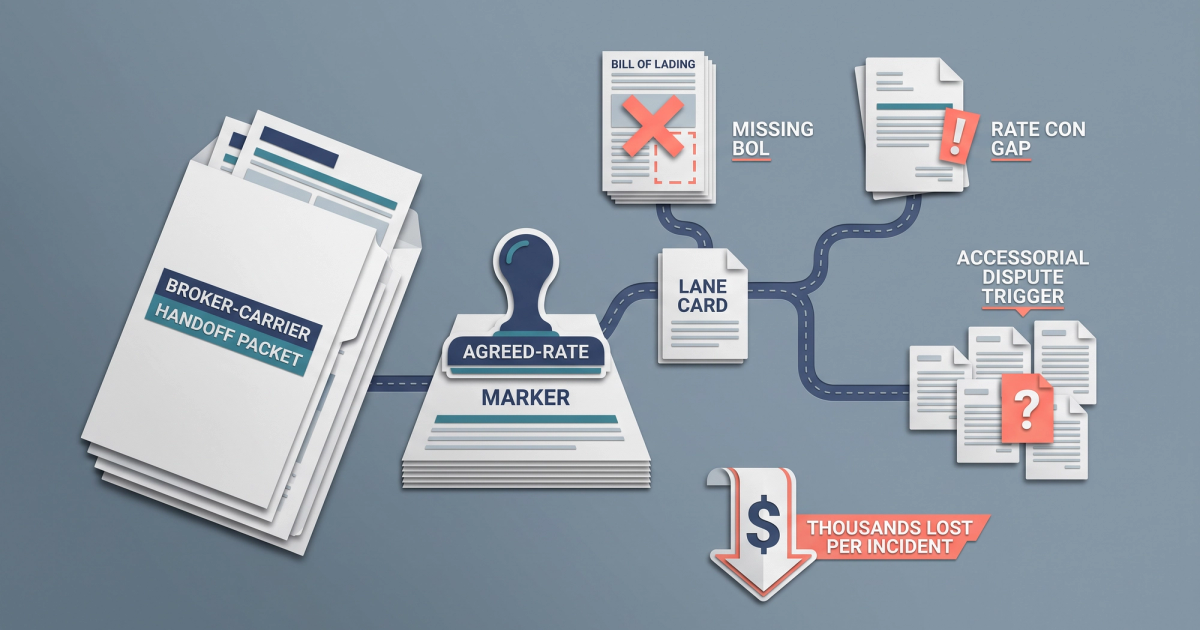
A fuel surcharge discrepancy of $0.08 per mile across 40 loads per week compounds to over $19,000 in annual overbilling if your team doesn't catch it at the invoice stage. That's one line item on one accessorial. Now multiply that exposure across detention charges billed without timestamps, lumper fees submitted without signed receipts, and TONU charges disputed without rate con records. For a mid-size freight broker running 500 loads per month, the gap between having automated compliance documentation freight workflows and not having them is measurable in five figures, monthly. This article shows you the specific dollar cost of each missing or mismatched document at audit time, walks through building an automated capture-and-match workflow for BOLs, rate cons, and accessorial backup, and identifies what to look for in freight document automation software that actually cuts hours off weekly invoice reconciliation.
What a Missing BOL or Rate Con Actually Costs You at Audit Time
Most ops managers know they need BOLs, rate cons, and PODs on file. What they don't always quantify is the dollar-per-incident cost when one of those documents is missing, unsigned, or mismatched at the moment a carrier dispute lands on their desk.
Here's where it gets expensive. Freight audit firms report that 78% of overbilling incidents involve at least one missing or unsigned accessorial authorization document. That means nearly four out of five times a carrier overbills you on an accessorial, the dispute outcome hinges not on whether the charge is legitimate, but on whether your team can produce the paperwork that proves it isn't.
The Real Numbers Behind Document Gaps
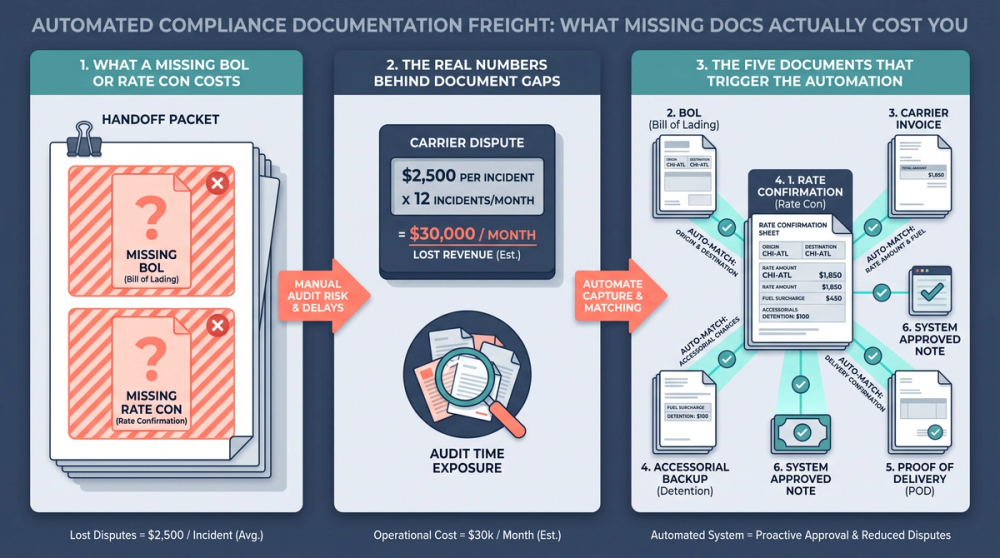
A single unresolved detention dispute without timestamped POD and gate records averages $450 to $650 in unrecoverable charges per load. TONU charges disputed without a rate con timestamp and refusal record have a recovery rate under 30% in carrier arbitration panels. A lumper fee billed without a signed receipt and matching accessorial authorization costs brokers an average of $185 per rejected dispute, with a 67% dispute loss rate when documentation is missing.
These aren't theoretical exposures. They're the charges your billing coordinator writes off every month because pulling the backup takes longer than the charge is worth. The problem compounds: according to document automation research from Artsyl Technologies, data capture and validation against compliance requirements remain the most error-prone manual steps in freight operations, and they're precisely the steps that determine whether you win or lose a dispute.
The FMCSA requires brokers to maintain transaction records, including rate confirmations and proof of delivery, for a minimum of three years. DOT audits can surface at any time during that window. If your document trail has gaps, you're not just losing individual disputes. You're building a compliance liability that grows with every load. For a deeper breakdown of what those regulatory requirements actually cost on each invoice, the numbers are sobering.
The Five Documents That Trigger the Most Carrier Disputes, and Why They Keep Going Missing
Not all freight documents carry equal dispute risk. Five document types account for the vast majority of carrier billing conflicts, and each one goes missing for a specific, preventable reason.
1. Rate Confirmation (Rate Con)
The rate con is the contractual agreement between broker and carrier for a specific load. When it's missing or doesn't match the invoice, every line item becomes disputable. Rate cons go missing most often because they're emailed as PDF attachments and never indexed to the load in the TMS. A dispatcher confirms a load verbally, the rate con arrives 20 minutes later, and nobody attaches it before the next load demand hits.
2. Bill of Lading (BOL)
The BOL is the primary proof of what was shipped, from where, and to whom. According to research on AI-driven document automation in logistics, bills of lading are among the most frequently mishandled compliance documents because they exist in multiple versions (shipper's copy, carrier's copy, consignee's copy) and are often submitted as low-quality scans. BOL documentation standards require legible signatures, accurate weight counts, and matching reference numbers. When any of those are off, you lose dispute leverage.
3. Proof of Delivery (POD)
PODs with missing timestamps are the single biggest reason detention disputes go unresolved. Without a time-stamped POD showing when the driver arrived and when they were released, you cannot challenge a detention charge that a carrier adds after the fact. Gate logs at receiver facilities are a backup, but brokers rarely collect them proactively.
4. Accessorial Authorization Documents
Lumper fees, detention charges, layover costs, and fuel surcharges all fall under accessorials. Each one should have a pre-authorization (ideally on the rate con) and a signed receipt or log at the point of service. The 67% dispute loss rate on lumper fees without signed receipts tells you how often these documents are missing: the majority of the time. For a full load-by-load list of what you need, see this compliance documentation checklist for freight brokers.
5. Carrier Packet and Insurance Documentation
Expired insurance certificates and incomplete carrier packets don't usually trigger billing disputes directly. But when a claim arises on a load hauled by a carrier whose insurance lapsed two weeks before the incident, you're exposed for the full claim value. FMCSA compliance requires verifying carrier authority and insurance status before tendering a load. Missing or outdated carrier packet documents turn a billing issue into a liability issue.
Manual vs. Automated Compliance Workflows: A Side-by-Side Cost Breakdown
The cost difference between manual and automated compliance workflows is not subtle. Let's put real numbers on it.
Labor Cost: Manual Invoice Reconciliation
Manual invoice reconciliation at 12 to 18 minutes per load adds up to 100 to 150 hours per month for an operation running 500 loads. As of 2026-05-01, average hourly earnings in truck transportation were $32.26/hr (BLS). Even at a billing coordinator rate of $25/hr (common for smaller brokerages), that's $2,500 to $3,750 in labor cost monthly just on invoice matching. At the BLS industry average, you're looking at $3,226 to $4,839 per month.
That labor goes to opening emails, downloading PDFs, matching line items to rate cons, checking for accessorial authorizations, and flagging discrepancies. Most of that work is pattern matching, exactly what automated systems do faster and more accurately.
Error Rates: Manual vs. Automated
According to comparative analysis of document processing methods, error rates on automated document processing fall below 1%, compared to typical manual processing error rates of 3% to 5%. On 500 loads per month, a 4% error rate means 20 loads with documentation mistakes. Each mistake is a potential dispute loss, an audit gap, or an overbilling that slips through.
A 1% error rate on the same volume means 5 loads. That's 15 fewer documentation problems per month, each one representing an average exposure of $185 to $650 depending on the document type.
Dispute Resolution Speed
One mid-size carrier with 220 loads per month reduced invoice dispute resolution time from 9 days to 1.4 days after implementing automated BOL-to-rate-con matching, recovering an additional $3,200 in previously written-off charges in the first 60 days. That recovery came from charges their team had been writing off because pulling the documentation took longer than the charge was worth.
The fastest way to lose a carrier dispute isn't being wrong. It's being right but unable to produce the document that proves it within the dispute window.
Here's the side-by-side summary for a 500-load-per-month broker:
- Manual labor cost: $2,500 to $3,750/month in reconciliation time alone
- Automated labor cost: Reduced by 60% to 80%, freeing 60 to 120 coordinator hours per month
- Manual error rate: 3% to 5%, creating 15 to 25 dispute-risk loads per month
- Automated error rate: Below 1%, reducing dispute-risk loads to 5 or fewer
- Manual dispute resolution: 7 to 14 days average
- Automated dispute resolution: 1 to 3 days average
Step-by-Step: How to Set Up Automated Document Capture and Matching Before a Dispute Starts
Automating compliance documentation doesn't require a six-figure software deployment or an IT team. Here's the operational workflow, step by step.
Step 1: Map Your Document Inflow Points
Before you automate anything, list every place documents currently arrive. For most brokerages, that's four to six channels: email attachments from carriers, TMS-generated rate cons, shipper portal downloads, fax-to-email (still common for BOLs from certain receivers), driver app uploads for PODs and lumper receipts, and EDI feeds from larger shippers or 3PLs.
Each channel needs a capture rule. The goal is zero documents sitting in an inbox without being indexed to a load number.
Step 2: Define Your Match Rules by Document Type
For each document type, define what "matched" means:
- Rate con: Load number matches TMS record. Linehaul rate matches. Accessorial pre-authorizations are listed.
- BOL: Shipper, consignee, commodity, and weight match the rate con and the TMS load record.
- POD: Delivery date and time match the BOL's consignee. Signature is present. Timestamps exist for arrival and departure.
- Accessorial receipts: Charge type matches a pre-authorized accessorial on the rate con. Signed receipt is present. Dollar amount falls within authorized range.
- Carrier invoice: Total matches linehaul plus authorized accessorials. No charges appear that aren't on the rate con.
These rules are the logic layer of your automation. Without them, you're just digitizing the same manual process.
Step 3: Automate Capture, Extraction, and Flagging
According to a case study on RPA in logistics compliance, one company automated the processing of 22,000 shipment documents monthly using robotic process automation, saving 2,200 work hours. You don't need to be at that scale to benefit. Even at 500 loads per month, automated capture and extraction eliminates the manual download, rename, and file cycle that eats coordinator time.
The workflow: documents arrive, OCR (optical character recognition) extracts key fields (load number, date, dollar amounts, signatures), the system matches extracted data against your TMS records using the rules from Step 2, and any mismatch gets flagged for human review.
Step 4: Build Exception Queues, Not Review Queues
The difference between bad automation and good automation: bad automation makes your team review everything digitally instead of on paper. Good automation only surfaces exceptions. Your billing coordinator should only see loads where something doesn't match: a rate variance, a missing signature, an unauthorized accessorial, or a document that didn't arrive at all.
For a 500-load operation with a sub-1% error rate on automated matching, that means your coordinator reviews 5 to 10 exception loads per day instead of touching all 25.
Step 5: Close the Loop Before Payment
The final step is making sure no carrier invoice gets paid until every required document is captured, matched, and cleared. This is where most manual processes fail: the payment deadline arrives, the documentation is incomplete, and the coordinator approves the invoice to avoid late-payment penalties or carrier relationship friction. Automated workflows hold the invoice in a pre-payment queue until the document set is complete, or escalate to an ops manager if a document remains missing past a defined threshold.
How to Integrate Freight Document Automation With Your Existing TMS Without a Six-Month IT Project
The most common objection to freight document automation software is integration complexity. "We already have a TMS. Adding another system means six months of IT work and a parallel data entry problem." That objection is valid for some legacy enterprise systems. For most SMB brokerages running modern cloud-based TMS platforms, integration is measured in days or weeks, not months.
What to Look For in Integration-Ready Automation Tools
When evaluating freight document automation software, four integration factors matter more than feature lists:
- API-first architecture: The tool should pull from and push to your TMS via API, not require CSV exports or manual uploads.
- Load-number indexing: Every document should be indexed to a TMS load number automatically, not filed by date or carrier name.
- Match-rule configurability: You should be able to define your own match tolerances (e.g., flag a fuel surcharge variance over $0.03/mile but not under).
- Exception routing: Flagged mismatches should route to the right person (billing coordinator for rate variances, ops manager for missing documents, dispatcher for TONU disputes).
According to Trax Technologies' analysis of automated compliance management, automated compliance systems can monitor regulatory requirements and validate freight transactions simultaneously across multiple jurisdictions. For brokers handling cross-border or multi-modal loads, this means your compliance documentation doesn't need a separate workflow for domestic vs. international shipments.
Realistic Implementation Timelines

For a brokerage running 300 to 1,000 loads per month on a cloud-based TMS, realistic implementation timelines for document automation look like this:
- Week 1: API connection to TMS, document inflow channel mapping, match rule configuration
- Week 2: Test run on 50 to 100 historical loads, exception threshold calibration
- Week 3: Live parallel run (automated system and manual process run side by side)
- Week 4: Full cutover, manual process retired for matched loads
That's four weeks, not six months. The key prerequisite is clean load data in your TMS. If your TMS records are missing load numbers, have inconsistent naming conventions, or don't capture accessorial pre-authorizations, you'll spend the first week on data cleanup. That's worth doing regardless of whether you automate.
If you want to understand how quickly your team can get audit-ready with the right document structure, the timeline is shorter than most ops managers expect.
Concrete Scenarios: What Automated Compliance Documentation Saves in Practice
Let's put three real operational scenarios on paper with step-by-step math.
Example: Accessorial Overbilling on 500 Loads Per Month
A freight broker handling 500 loads per month with a 4.2% carrier overbilling rate on accessorials faces 21 overbilled loads per month. At an average accessorial charge of $175 per incident, total monthly overbilling exposure is $3,675 on the charges alone. But the real cost is in disputes lost. Without documentation (signed receipts, rate con pre-authorizations, timestamped PODs), the dispute loss rate is 67%. That means 14 of those 21 disputes fail, costing $2,450 per month in unrecoverable overbilling. Over a year, that's $29,400 walking out the door. With automated document capture and matching, the dispute loss rate drops because every accessorial charge is checked against a pre-authorization and a signed receipt before the invoice is approved. Even reducing the loss rate from 67% to 15% saves $1,890 per month, or $22,680 annually.
Example: Fuel Surcharge Discrepancy Compounding Over Time
A fuel surcharge discrepancy of $0.08 per mile may look insignificant on a single load. On a 600-mile load, it's $48. Across 40 loads per week (a common volume for a mid-size broker), that's $1,920 per week. Over 50 working weeks, the annual total exceeds $19,000. Manual reconciliation misses these small per-mile variances because coordinators focus on large-dollar mismatches. Automated matching flags any fuel surcharge that doesn't match the rate con's agreed surcharge table, catching the $0.08 discrepancy on every load. As of 2026-05-01, the Producer Price Index for truck transportation of freight stood at 178.2 (BLS), meaning fuel surcharge calculations are built on an index that fluctuates regularly. If your surcharge validation isn't automated, you're relying on a coordinator to check the current index against every carrier invoice manually.
Example: Detention Disputes Without Timestamped Documentation
A detention charge of $75 per hour for a six-hour delay totals $450. Without a timestamped POD showing driver arrival and release times, and without gate records from the receiver, the broker has no evidence to dispute whether the delay was three hours or six. Carriers know this. The average unrecoverable detention charge without timestamped documentation runs $450 to $650 per load. For a broker averaging 8 detention events per month, that's $3,600 to $5,200 in monthly exposure. Automated workflows solve this by requiring timestamped POD upload before the load status can be marked as delivered. If the timestamp is missing, the system flags the load before the carrier invoice arrives, giving your team time to collect the documentation proactively rather than scrambling after a dispute is filed.
Laneproof's reconciliation engine checks each of these fields automatically, flagging rate con variances, missing accessorial authorizations, and timestamp gaps before payment goes out.
Frequently Asked Questions About Automated Compliance Documentation in Freight
How long does it take to see ROI from freight document automation software?
Most brokerages running 300 or more loads per month see measurable ROI within the first 30 to 60 days. The mid-size carrier example above recovered $3,200 in previously written-off charges within 60 days of implementing automated BOL-to-rate-con matching. The labor savings from reduced manual reconciliation (60 to 120 coordinator hours per month on 500 loads) appear immediately on the first full billing cycle.
Does automated compliance documentation replace my billing coordinator?
No. It replaces the repetitive matching and filing work that takes up 70% to 80% of their time. Your billing coordinator still handles exceptions, manages carrier relationships during disputes, and makes judgment calls on edge cases. Automation means they spend their time on the 5 to 10 loads per day that actually need human attention, not the 25 that match cleanly.
What happens if a carrier sends documents in formats my system can't read?
Modern OCR and intelligent document processing handle PDFs, scanned images, photos from driver apps, and even fax-to-email formats. According to research on intelligent document processing in customs and freight compliance, IDP goes beyond basic data capture to extract structured data from unstructured documents, including handwritten BOLs and low-resolution scans. The accuracy threshold matters: look for systems that flag low-confidence extractions for human review rather than guessing.
Do I need to change my TMS to use document automation?
No. API-based automation tools connect to your existing TMS and pull load data for matching. The automation layer sits on top of your TMS, not inside it. The integration requirements are an API connection (most cloud TMS platforms support this natively), consistent load-number formatting, and accessorial pre-authorization fields populated in your rate con workflow.
How does automated documentation help with FMCSA and DOT audits?
FMCSA requires freight brokers to maintain transaction records for at least three years. Automated systems index every document to its load number, creating a searchable, timestamped archive. When an auditor requests records for a specific load or date range, you pull them in minutes instead of digging through email folders and filing cabinets. For more on getting audit-ready with organized freight documentation, the preparation process is straightforward once your capture workflow is in place.
Conclusion: Stop Paying for Documents You Don't Have
Every missing BOL, unsigned lumper receipt, and unmatched rate con is a dollar amount your brokerage absorbs silently. The math is clear: a 500-load-per-month broker with manual compliance workflows is exposed to $8,400 to $12,600 monthly in lost accessorial disputes, $2,500 to $3,750 in reconciliation labor, and five-figure annual losses on fuel surcharge discrepancies alone. As of 2026-06-01, truck transportation employs 1,467 thousand workers (BLS), and the documentation demands on this workforce are only increasing with FMCSA enforcement activity. Automated compliance documentation in freight isn't about replacing people. It's about making sure your team's time goes to loads that need attention, not loads that should have matched cleanly and didn't because a PDF sat in someone's inbox.
If your team is spending 100-plus hours per month on manual invoice reconciliation and losing disputes for lack of documentation, see how automated document matching and exception flagging works in practice. The exposure is measurable. So is the fix.
Sources
- Document Automation in Logistics Compliance — Artsyl Technologies
- How RPA Simplifies Compliance in Logistics — CR Express Inc.
- Global Compliance Management Through Automated Systems — Trax Technologies
- AI for Logistics: Automating Shipping, Tracking, and Documentation — Ayoob.ai
- Streamline Logistics Operations with AI Document Management Automation — RevverDocs
- Automate Customs Compliance: A Complete 2026 Guide — CargoEZ
- Bureau of Labor Statistics, Current Employment Statistics (series CEU4348400008, WPU3012, CES4348400001)