Freight Compliance Audit Software: What It Actually Has to Check
Researched and written with AI assistance. Reviewed by the Laneproof team.

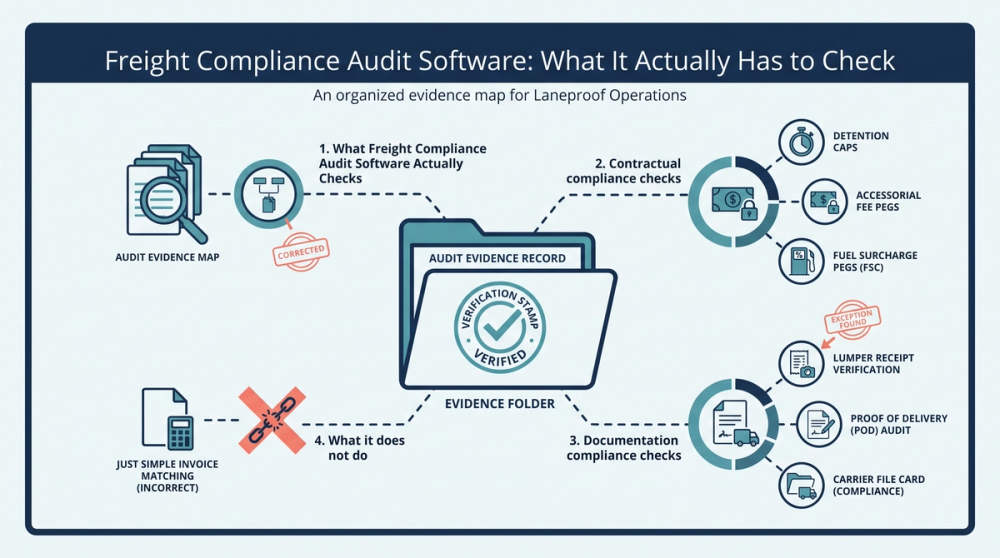
Freight compliance audit software is a category of tools that checks carrier invoices against rate con terms, regulatory documentation requirements, and contractual compliance standards, not just invoice line items. It differs from standard freight audit software by enforcing detention caps, accessorial documentation rules, and audit trail integrity that brokers need when a carrier disputes a rejected charge or when a DOT audit demands proof of billing accuracy.
Here is a number that should bother you: a single carrier overbilling detention by 2 hours at $75/hour across 300 loads per month creates $45,000 in annual exposure. That is not a rounding error. That is a line item eating your margin, and it only gets caught if your software knows to check the rate con's detention cap, not just whether an invoice exists. Most freight audit tools verify that an invoice was received and that the total matches an expected range. Freight compliance audit software goes deeper. It checks what was contractually agreed, what documentation was attached, and whether the billed charges are defensible if challenged. For brokers running 100 to 5,000 loads per month, this distinction is the difference between catching $150 on one load or losing $45,000 across a year.
What Freight Compliance Audit Software Actually Does (And What It Does Not)
Standard freight audit tools compare an invoice to a rate. If the linehaul on the invoice matches the linehaul on the rate con, the tool marks it clean. That is a useful function, but it is only one layer of what needs to happen before a payment goes out. Freight compliance audit software adds three categories of checks that standard tools skip.
Contractual compliance checks
These are verifications against the specific terms of the rate con, not just the rate itself. Does the rate con cap detention at 2 hours after a 2-hour free period? Does it require an original lumper receipt for reimbursement? Does it reference a specific DOE fuel surcharge index and date? If the carrier invoice includes charges outside those parameters, compliance audit software flags them before payment. A standard freight audit tool often lacks the field-level parsing to compare individual accessorial terms against what was agreed.
Documentation compliance checks
According to FMCSA's safety audit procedures, auditors review a carrier's compliance with documentation requirements including driver qualification files, vehicle maintenance records, and operational paperwork. For brokers, the parallel is clear: every load generates a chain of documents (rate con, BOL, POD, lumper receipts, driver logs) that must be present, consistent, and retrievable. Compliance audit software checks whether required documents are attached to a load file before an invoice is approved. If a carrier bills a $325 lumper fee but no receipt is in the file, the software catches it. If a TONU is invoiced on a load where a signed BOL exists, the software surfaces the contradiction. For a deeper breakdown of exactly which documents need to be in every load file, see this load-by-load documentation compliance checklist.
What it does not do
Freight compliance audit software is not a TMS. It does not dispatch loads, manage carrier relationships, or optimize routing. It also does not replace a broker's judgment on whether to dispute a charge. What it does is surface the data, documents, and contractual terms so that decision happens in minutes instead of hours, with evidence instead of guesswork.
The Billing Scenarios Where Compliance Checks Pay for Themselves
The value of freight compliance audit software is easiest to see in the specific billing scenarios that cost brokers real money every week. These are not hypothetical. They happen on a measurable percentage of loads, and they compound fast.
Detention overbilling
Example: A carrier bills 4 hours of detention at $75/hour on a load where the rate con caps detention at 2 hours after a 2-hour free period. That is a $150 overbill on a single load. Multiply it across 300 loads per month and the annual exposure is $45,000. Compliance audit software catches this by parsing the detention terms from the rate con (cap, free time, hourly rate) and comparing them to the billed amount. A standard freight audit tool that only checks total invoice amount against expected total would miss this entirely, because the linehaul portion is correct.
Lumper fee without documentation
Example: A lumper fee of $325 appears on a carrier invoice. The rate con specifies lumper reimbursement only with an original receipt attached. The carrier submitted the invoice with no BOD or receipt. Compliance audit software flags this charge because the required supporting document is missing from the load file. Without this check, the billing coordinator either pays it to avoid a dispute or spends 20 minutes tracking down the receipt manually. At scale, those 20-minute delays add up.
Fuel surcharge index mismatch
Example: The carrier applies a fuel surcharge of 28.5% on a $2,200 linehaul. The rate con references a DOE index peg from the prior Monday, which shows 24.1%. That 4.4 percentage point gap equals $96.80 in overbilling on a single load. Compliance audit software that stores the agreed fuel surcharge formula and cross-references the DOE index catches this automatically. A manual review would require the billing coordinator to look up the DOE table, find the right date, calculate the correct percentage, and compare it to the invoice. That process takes 5 to 10 minutes per load when done right, and it is almost never done on every load.
These three scenarios alone can account for tens of thousands of dollars in annual billing discrepancies. And they all share a common trait: the linehaul rate is correct. The overbilling is in the accessorials and surcharges, which is exactly where standard audit tools lose visibility.
Rate Con Verification, Accessorial Review, and the Checks That Cannot Be Manual
There is a labor cost argument here that matters. Based on Laneproof analysis of broker operations teams, the average ops team spends approximately 11 hours per week manually cross-referencing carrier invoices against rate cons. As of 2026-05-01, average hourly earnings in truck transportation were $32.26/hr (BLS Current Employment Statistics, series CEU4348400008). Using a more conservative loaded labor cost of $28/hour for back-office staff, that 11-hour weekly burden translates to $308/week, or roughly $16,000/year in reconciliation labor alone. That number does not include the cost of the errors that slip through manual review.
Rate con verification at the field level
Rate con verification means more than confirming the load number and linehaul rate. Compliance-grade verification checks every billable field on the rate con against the corresponding line on the carrier invoice:
- Linehaul rate and mileage basis
- Detention terms: free time, hourly rate, cap
- Fuel surcharge formula and index reference date
- Accessorial allowances: lumper, TONU, layover, drayage
- Documentation requirements per charge type (receipts, driver logs, timestamps)
Each of these fields is a potential point of discrepancy. Freight audit software platforms like Trimble automate the invoicing and auditing process, but the compliance layer that checks contractual terms at the field level, not just invoice totals, is what separates a freight audit tool from a freight compliance audit tool.
Accessorial charge review that requires document matching
Accessorial charges are where carrier overbilling most frequently occurs because they depend on situational documentation, not just a fixed rate. A detention charge requires proof of arrival and departure times. A lumper charge requires a receipt. A layover charge requires documentation of the reason for delay. A TONU requires proof that the truck was not loaded.
Manual accessorial review means a billing coordinator opening each invoice, checking for attachments, comparing timestamps, and cross-referencing the rate con's accessorial terms. Across 50 invoices a day, this process is where errors survive. Compliance audit software automates the document-matching step: does this charge have the required supporting document? If not, flag it. If yes, does the document support the billed amount? This is the check that cannot be manual at scale without either hiring more staff or accepting that some overbills will get paid.
If you want to understand what it costs when you cannot prove a billing discrepancy, the answer is usually the full amount of the disputed charge, plus the time spent arguing about it.
How an Audit Trail Proves a Discrepancy Before the Carrier Calls Back
An audit trail in freight compliance is not a log of who clicked what button. It is a timestamped chain of evidence that connects the rate con, the carrier invoice, the supporting documents, and every variance identified between them. When a carrier disputes a rejection, the broker who can pull a complete audit trail in under five minutes wins the dispute. The broker who has to dig through email threads and shared drives does not.
A freight audit trail is not just a record of what was paid. It is a timestamped chain of evidence that proves what was agreed, what was billed, and why the variance exists.
Scenario: TONU billed on a load with a signed BOL
Example: A carrier submits an invoice for a $350 TONU (truck ordered, not used). Your compliance audit software surfaces a signed BOL and a POD timestamp showing the truck was loaded and departed. The TONU is invalid. Without an audit trail, this dispute becomes a phone call where both sides argue over whether the truck was loaded. With an audit trail, you send the carrier a timestamped BOL and POD in a single email, and the dispute is over.
Scenario: Late-added layover charge with no documentation
Example: A carrier sends a revised invoice 47 days after delivery, adding a $210 layover charge that was not on the original invoice or the rate con. Your audit trail shows three things: (1) the original invoice date and amount with no layover line item, (2) the rate con with no layover provision, and (3) no driver log or delay documentation submitted at any point. That is three pieces of documented evidence to reject the charge, pulled in minutes instead of hours. For a step-by-step guide to pulling the right documents for any freight audit in 20 minutes or less, this process becomes even faster when your documentation is indexed by load.
The FMCSA has increasingly supported electronic document submission for compliance purposes. According to the FMCSA's safety audit preparation guidance, carriers can submit relevant documents electronically for new entrant safety audits, which underscores the regulatory expectation that freight documentation be digitized, organized, and retrievable. For brokers, the same principle applies to billing disputes: if your documents are not indexed and timestamped, your position in any dispute is weaker.
Where Standard Freight Audit Tools Stop and Compliance Audit Software Starts
This is the distinction most software vendors blur, because calling a tool "compliance" sounds better than calling it "invoice matching." Here is how to tell the difference.
Standard freight audit tools
A standard freight audit tool performs invoice-level checks. According to Trax Technologies' overview of freight audit software features, these tools typically focus on invoice accuracy, duplicate detection, and rate validation against contracted rates. These are important functions, but they operate at the invoice level, not the compliance level. They answer the question: "Does the invoice match the rate?" They do not answer: "Does the charge comply with the contractual terms, and is the required documentation present?"
Freight compliance audit software
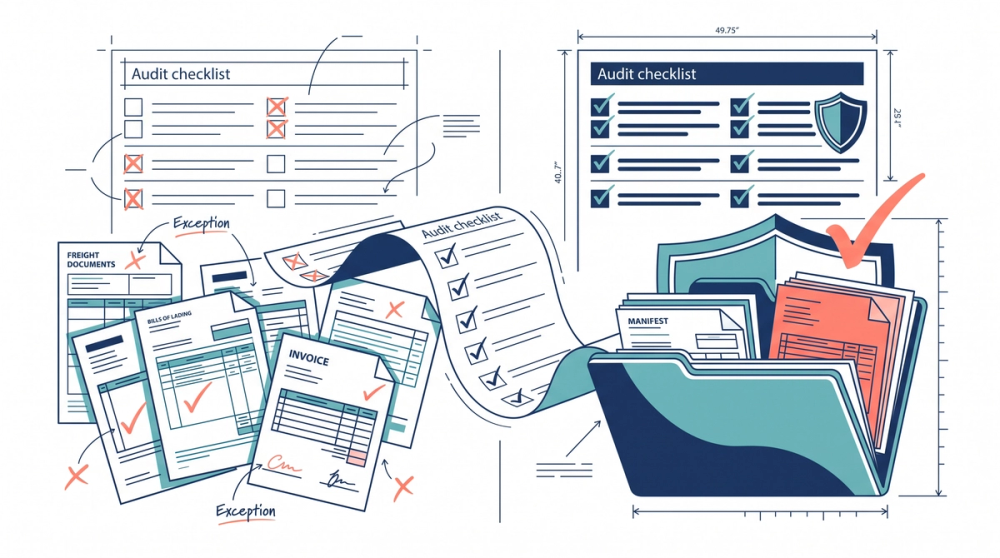
Compliance audit software adds the layers that matter in disputes and regulatory exposure:
- Contractual term enforcement: Checks individual accessorial charges against rate con provisions, not just totals
- Document presence validation: Confirms that required supporting documents (receipts, BOLs, PODs, driver logs) are attached before approving a charge
- Audit trail generation: Creates a timestamped record linking every rate con, invoice, variance, and document to each load
- Fuel surcharge index verification: Cross-references billed fuel surcharges against the specific DOE index date in the rate con
- Revised invoice detection: Flags invoices submitted or modified after a defined window, surfacing late-added charges like the 47-day layover example above
- FMCSA and DOT documentation alignment: Ensures load files contain the documentation that regulatory auditors expect, including driver qualification and vehicle inspection records where applicable
As SimplyFleet's guide to FMCSA compliance software notes, compliance software must help carriers and brokers maintain accurate, up-to-date records that withstand regulatory audits. For freight brokers specifically, this means the audit trail is not just an internal convenience. It is a legal asset.
The risk of using the wrong category
If you are using a standard freight audit tool and treating it as your compliance solution, you have a gap. That gap shows up in three ways:
- Financial exposure: Accessorial overbills that pass through because the tool only checks linehaul rates
- Dispute weakness: No audit trail to prove your position when a carrier challenges a rejected charge
- Regulatory risk: Incomplete load files that fail to meet DOT documentation expectations during audits
As of 2026-06-01, BLS data shows truck transportation employment at 1,467 thousand workers (BLS CES series CES4348400001), and the industry's scale means that regulatory scrutiny continues to increase. Brokers who cannot produce organized, timestamped documentation during a compliance review are at a measurable disadvantage.
Laneproof's reconciliation engine checks each of these fields automatically, flagging variances before payment goes out. Every flagged charge includes the rate con term, the billed amount, the variance, and the document status, so the broker or billing coordinator can approve or reject with evidence, not intuition. If you want to see how this works against specific pricing tiers for SMB brokerage volumes, the math on labor savings alone usually covers the cost.
Frequently Asked Questions
What is the difference between freight audit software and freight compliance audit software?
Freight audit software checks invoices against expected rates, catching duplicate charges and linehaul mismatches. Freight compliance audit software adds contractual term enforcement, document presence validation, fuel surcharge index verification, and timestamped audit trails. The compliance layer is what gives brokers evidence to win disputes and meet regulatory documentation standards.
Does freight compliance audit software help with FMCSA or DOT audits?
Yes, indirectly. While FMCSA and DOT audits focus on carrier safety compliance (driver qualifications, vehicle maintenance, HOS), freight compliance audit software ensures that load-level documentation, including BOLs, PODs, rate cons, and receipts, is organized, timestamped, and retrievable. This documentation is often requested during broader compliance reviews and is critical for defending billing practices during disputes.
How much can a freight broker save with compliance-level auditing?
The savings depend on load volume and the frequency of accessorial charges. Based on Laneproof analysis of over 15,000 carrier invoices, detention, lumper, and fuel surcharge discrepancies appear on approximately 4% to 7% of invoices. For a broker running 500 loads per month, even a conservative 4% discrepancy rate with an average overbill of $125 per flagged load translates to $30,000 per year in recovered revenue, before accounting for the $16,000 in annual labor savings from reduced manual reconciliation.
Can compliance audit software catch carrier invoice fraud?
Compliance audit software is not a fraud detection tool, but it catches many of the same patterns. Duplicate invoices, charges without supporting documentation, revised invoices with late-added accessorials, and TONU charges on loads with signed BOLs are all flags that compliance audit software surfaces automatically. Whether those patterns are errors or intentional overbilling, the result for the broker is the same: the charge gets caught before payment.
How long does it take to implement freight compliance audit software?
Implementation timelines vary, but for SMB brokers running 100 to 5,000 loads per month, most tools that automatically flag invoice discrepancies can be operational within one to two weeks. The key factor is how your rate cons and carrier invoices are currently stored. If they are in a TMS with API access, integration is faster. If they are in email attachments and shared drives, expect a document migration step.
Sources
- FMCSA Safety Audit Procedures (Section 9.1.3) — FMCSA / Department of Transportation
- Prepare for Your Safety Audit — FMCSA
- Trimble Freight Audit Software — Trimble Transportation
- FMCSA Compliance Software: A Complete Guide — SimplyFleet
- Freight Audit Software: An Explanation and Key Features — Trax Technologies
What This Comes Down To
The question is not whether you need freight audit software. If you are running more than 100 loads a month, you almost certainly already have some version of it. The question is whether your current tool checks what actually costs you money: detention caps in the rate con, lumper receipts that were never attached, fuel surcharge pegs that do not match the agreed index date, and revised invoices with charges that appeared out of nowhere 47 days after delivery.
Freight compliance audit software is the category that covers these checks. It builds an audit trail that holds up in disputes, surfaces documentation gaps before they become financial losses, and reduces the 11-hour weekly reconciliation burden that is quietly costing your ops team $16,000 a year. If your current tool does not do these things, you are not running a compliance audit. You are running an invoice match, and the difference shows up in your margin.