Freight Document Automation Software: Where the Money Leaks
Researched and written with AI assistance. Reviewed by the Laneproof team.
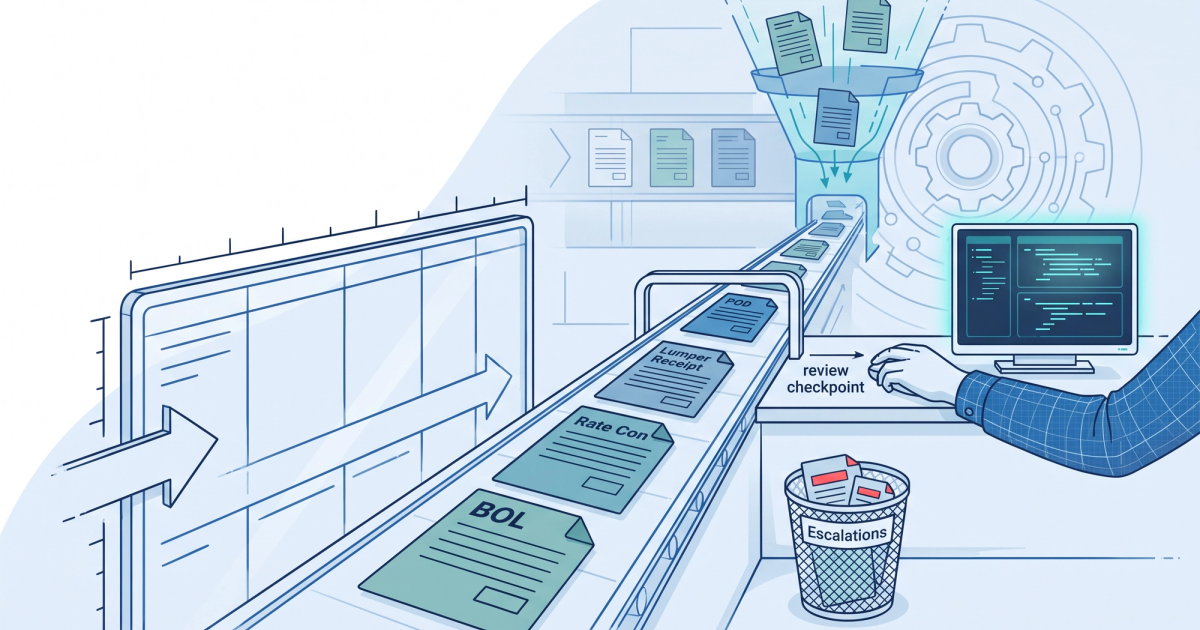
A billing coordinator spending 3 hours per day on manual invoice reconciliation at $22/hr costs the operation roughly $1,430 per month in labor alone. That number does not include the errors that slip through: missed detention caps, fuel surcharge mismatches, accessorial overbills. Those add thousands more. Freight document automation software exists to close these gaps, but most ops managers have no way to tell which tool actually does what it claims versus which one just adds another dashboard. This article maps each document type (BOL, rate con, POD, lumper receipt) to its specific dollar cost when handled manually, explains what automation should do for each one, and gives you a framework for evaluating whether a tool actually fixes your problems or just relocates them.
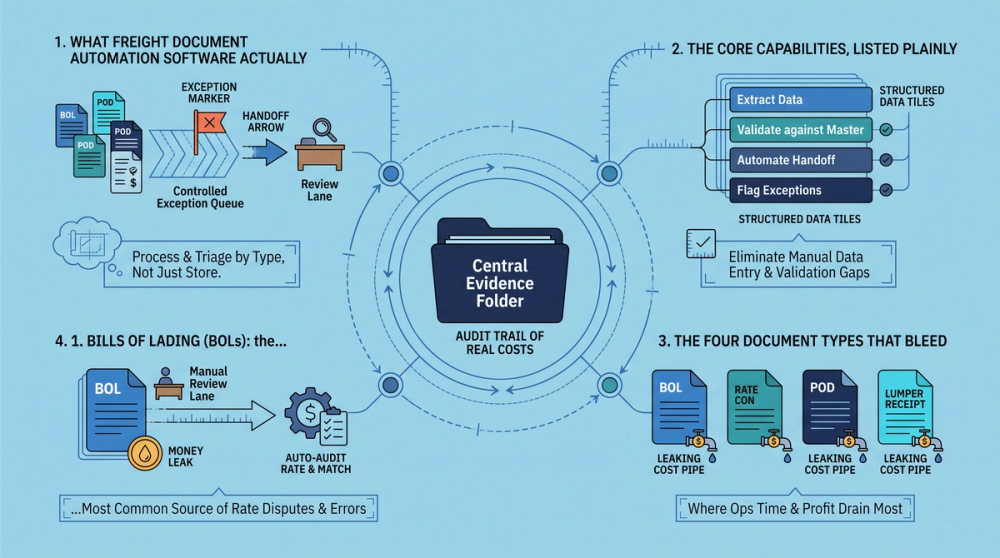
What Freight Document Automation Software Actually Does (Two-Sentence Version)
Freight document automation software uses OCR (optical character recognition) and rules-based matching to read, extract, and cross-check data from freight documents like BOLs, rate confirmations, carrier invoices, PODs, and lumper receipts. It then matches that extracted data against your TMS records and flags discrepancies before you pay the wrong amount.
That is the entire value proposition in two sentences. Everything else is implementation detail. But those implementation details matter enormously, because a tool that reads a BOL but cannot match the extracted linehaul to the rate con's agreed amount is not actually solving your reconciliation problem. It is just digitizing the front end of a broken process.
The core capabilities, listed plainly
- Document capture: Ingest carrier invoices, BOLs, PODs, and receipts from email, fax, driver uploads, and carrier portals.
- OCR and data extraction: Read key fields (load number, linehaul, accessorials, fuel surcharge, detention, lumper amount, shipper/consignee, dates) from scanned or photographed documents.
- Automated invoice matching: Cross-reference extracted invoice data against rate con terms stored in the TMS.
- Discrepancy flagging: Surface mismatches on linehaul, accessorials, detention caps, FSC percentages, and TONU charges before payment approval.
- Audit trail creation: Log every document version, extraction result, and match decision for dispute resolution and compliance.
According to ARDEM's analysis of AI-powered document processing in freight, AI-driven systems can reduce freight invoice and BOL processing times by up to 40%. That is the ceiling. The question for your operation is how close a given tool gets to that ceiling for the specific document types that cost you the most.
The Four Document Types That Bleed Time and Money Every Week
Not all freight documents carry equal risk. A missing BOL causes different problems than a misread lumper receipt. Evaluating freight document automation software starts with understanding which documents create the most financial exposure in your operation. For most brokerages running 100 to 5,000 loads per month, these are the four that matter most.
1. Bills of Lading (BOLs): the data entry bottleneck
The BOL is the single most retyped document in freight operations. Every load generates one, and every BOL contains fields (shipper, consignee, commodity, weight, piece count, PRO number) that need to land in the TMS accurately. When they do not, downstream problems multiply. A wrong piece count triggers a dispute. A mistyped shipper address delays the POD match. A transposed load number means the invoice gets filed against the wrong shipment, and nobody notices until the carrier calls asking why they have not been paid.
For a broker handling 200 loads per month, catching just 2% of invoices with BOL number mismatches saves an estimated 8 to 10 hours of back-and-forth dispute resolution per month. That is a full day of a coordinator's time recovered, every month, from fixing just one field on one document type. For a deeper look at where BOL errors create the most damage, see where BOL errors cost freight brokers the most.
2. Rate confirmations: the billing baseline nobody checks fast enough
The rate con is the contract. It sets the linehaul, caps detention, specifies FSC terms, and defines what accessorials are included. When a carrier invoice arrives, every line item should be checked against the rate con. In practice, that almost never happens at scale. A billing coordinator might spot-check the linehaul but skip the detention cap, miss that the FSC percentage does not match the agreed formula, or overlook an accessorial that was not on the original rate con at all.
Rate con versus invoice mismatches on fuel surcharges are among the top three most common billing discrepancies. FSC errors average $18 to $35 per load depending on lane and carrier. On a 500-load month, even a 5% error rate on FSC alone can mean $450 to $875 in overbilling.
3. Proof of Delivery (PODs): the filing chaos
PODs confirm the load was delivered. They should be matched to the correct load in the TMS, associated with the corresponding invoice, and stored for audit access. What actually happens: PODs arrive via email, carrier portal download, or driver photo upload. They get saved to a shared drive, maybe renamed, maybe not. They get filed against the wrong load. They go missing entirely during high-volume weeks.
POD matching errors, where a POD is filed against the wrong load in the TMS, can cause double-billing to go undetected for weeks. This is especially common in high-volume months where manual audits get deprioritized. According to Transport Pro's documentation on AI document automation, AI systems can automatically index, label, and match documents such as PODs and invoices to loads, eliminating these manual filing steps for freight brokers.
4. Lumper receipts: the blurry photo problem
Lumper fees are reimbursable. That means the broker pays the carrier, who paid the lumper, based on a receipt the driver photographed with a phone at the dock. These receipts are frequently blurry, creased, partially cut off, or taken at an angle that makes the amount unreadable. The result: invoice disputes that drag.
Lumper receipts submitted as blurry cell phone photos cause an estimated 15% to 20% of invoice disputes to drag past 30 days. That delays carrier payment and increases the risk of relationship damage and load coverage problems. A carrier who does not get paid on time is less likely to accept your next tender. This is not a hypothetical. It is a pattern that repeats weekly in brokerages that handle more than a few hundred loads per month.
What Good Automation Should Do for Each Document, and How to Check If It Does
Vendor demos look great. Everything matches. Every field extracts cleanly. Then you go live and discover the tool cannot read a BOL from a certain carrier because their format is non-standard, or the OCR chokes on handwritten weight fields, or the matching logic does not know how to handle a rate con with tiered detention rates. Here is what to actually look for, document by document.
BOL automation: what to verify
Good freight OCR should extract shipper name, consignee name, commodity description, weight, piece count, and PRO/load number from a BOL with at least 90% field-level accuracy on the first pass. Ask the vendor: what is your extraction accuracy on handwritten BOL fields? What happens when a BOL has a non-standard layout? How does your system handle multi-page BOLs where the load number is on page one but the weight is on page three?
The test is simple. Send the vendor 20 real BOLs from your operation, including the worst ones (the handwritten, the blurry, the multi-page). Ask them to run extraction and show you field-level results. If they will not do this during the sales process, that tells you something.
Rate con matching: what to verify
The automation should extract linehaul, FSC terms, detention caps, and listed accessorials from the rate con, then compare each of those against the corresponding carrier invoice line items. The key question: does the tool flag a $75 detention cap on the rate con when the carrier invoices $150 for detention? If the answer is not an unqualified yes with a demonstrated example, move on.
A single missed detention charge cap, where the rate con limits detention to $75 but the carrier invoices $150, seems small. Until it repeats across 80 loads in a month and adds up to $6,000 in overbilling.
POD matching: what to verify
The system should auto-match PODs to loads using extracted load numbers, PRO numbers, or delivery dates. Ask: what is your match rate on first attempt? What happens when the POD does not contain a load number? How does the system surface unmatched PODs for manual review?
Lumper receipt handling: what to verify
This is where most tools fall short. Lumper receipts are the hardest document type to process because they are the lowest quality inputs. Ask the vendor: what is your extraction accuracy on phone-photographed lumper receipts? Can the system flag a lumper amount that does not match the amount on the carrier invoice? According to RevverDocs' analysis of AI document management in logistics, AI-driven document automation improves accuracy across freight documentation types, but receipt-quality inputs remain the most challenging category for OCR systems.
The Real Cost of Manual Reconciliation: Here Is What the Numbers Look Like
Talk of automation is abstract until you attach dollars. Here are concrete scenarios based on common brokerage operations. Each uses conservative estimates. Your actual numbers may be higher.
Scenario: The billing coordinator's hidden cost
Example: A billing coordinator spends 3 hours per day on manual invoice reconciliation. At $22/hr fully loaded, that is $66/day or roughly $1,430 per month in labor dedicated to matching invoices to rate cons, checking accessorials, and chasing missing PODs. This does not include the errors that make it through. According to CargoFive's data on freight workflow automation, freight forwarders using automation solutions report up to 61% time savings in their operations. Even a 40% reduction in reconciliation time would save over $570/month in labor on this single task.
Scenario: Accessorial overbilling at scale
Example: Carriers overbill on accessorials in roughly 1 in 4 invoices according to industry billing audits. At an average of $47 per incident, a broker moving 500 loads per month faces approximately 125 overbilled invoices. That is $5,875 per month in accessorial overbilling. Without an automated matching layer that compares each invoice line item to the rate con, these charges get paid and absorbed as margin loss.
Laneproof's reconciliation engine checks each of these fields automatically, flagging variances before payment goes out. The goal is not to eliminate every discrepancy (some are legitimate). It is to make sure you see them before you pay them.
Scenario: The 12-person brokerage that recovered 8 hours per week
Example: An ops manager at a 12-person brokerage identifies that their team spends 11 hours per week on document entry and matching. The breakdown: 4 hours on BOL data entry into the TMS, 3 hours on invoice-to-rate-con matching, 2 hours on POD filing and matching, and 2 hours on dispute resolution for documents that were filed incorrectly. Automating BOL data capture and invoice matching alone cuts the total to under 3 hours per week, freeing roughly 8 hours per week for load coverage, carrier relationship management, or just not working until 7 PM.
Scenario: Fuel surcharge errors compounding across lanes
Example: FSC errors average $18 to $35 per load depending on lane and carrier. A broker running 400 loads/month with a 6% FSC mismatch rate is looking at 24 loads with incorrect fuel surcharges. At $25 average per error, that is $600/month in overbilling on fuel surcharges alone. Combined with detention and accessorial overbilling, the total exposure for a mid-volume broker can easily exceed $8,000 per month.
The real cost of manual reconciliation is not just labor. It is the sum of labor plus the errors that labor misses plus the disputes those errors create plus the carrier relationships those disputes damage.
Build vs. Buy: Why Most Freight Brokers Should Not Be Coding This Themselves
Some ops managers look at the problem and think: we can build this. We will set up an email parser, connect an OCR API, write some matching rules, and pipe it into our TMS. It is just document reading and comparison, right?
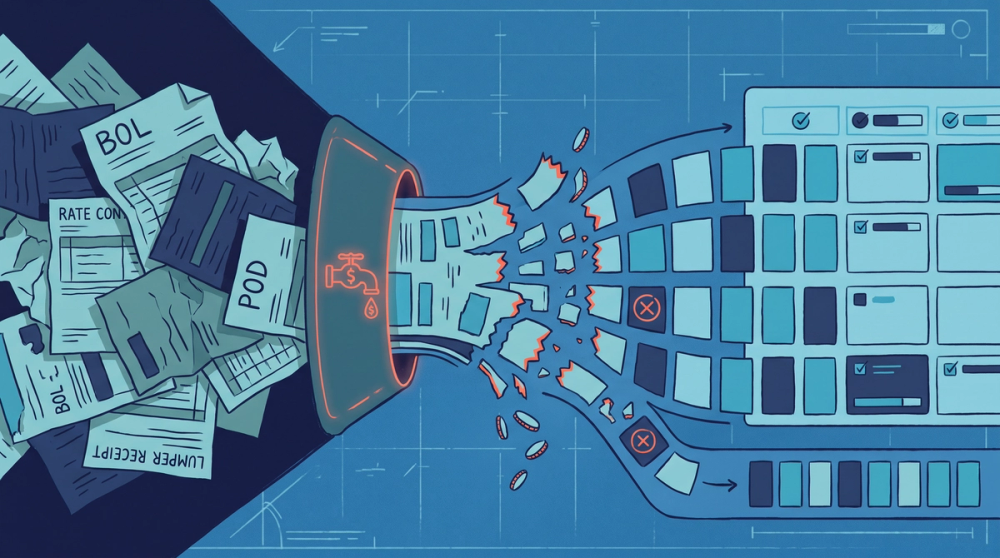
In theory, yes. In practice, the build path collapses under three realities that freight-specific automation has to handle.
Reality 1: Document variability is the hard part
A BOL from Werner looks nothing like a BOL from a three-truck carrier in rural Georgia. Rate cons come as PDFs, Word docs, screenshots, and occasionally handwritten faxes. PODs arrive as multi-page scans, single photos, and carrier portal downloads in proprietary formats. According to Cozentus' analysis of logistics document types, there are at least 10 distinct document types in logistics that require different extraction templates, each with its own layout variations. Building extraction logic that handles this variability is not a weekend project. It is a full-time engineering investment.
Reality 2: Matching rules are not static
Detention cap structures change by carrier. FSC formulas change by quarter. Accessorial definitions change by shipper. A matching engine that works in January might miss new billing patterns by March. Maintaining and updating these rules requires someone who understands both the code and the freight billing context. Most brokerages with 5 to 50 employees do not have that person on staff, and hiring one costs more than any SaaS subscription.
Reality 3: Audit trails require infrastructure
When a carrier disputes a deduction, you need to show the original invoice, the rate con it was matched against, the extracted data, the discrepancy that was flagged, and the decision that was made. A homegrown system that extracts data but does not log every step of the matching process will leave you exposed in disputes. Freight document automation software built for this purpose stores every document version, every extraction result, and every match decision in a searchable, timestamped log. That is not a feature you add later. It is the foundation.
For operations that want to start with the extraction piece and see results before committing to a full workflow, tools that automatically extract data from freight documents can serve as a practical first step.
Frequently Asked Questions About Freight Document Automation
How long does it take to implement freight document automation software?
For most mid-market brokerages (100 to 2,000 loads/month), implementation takes 2 to 4 weeks. The first week typically covers TMS integration and document ingestion setup. Weeks two and three focus on training the extraction models on your specific document formats. By week four, you are running live matching with human review on flagged discrepancies. Full autonomous matching (where only exceptions need review) usually takes 6 to 8 weeks as the system learns your carrier base.
What is the difference between OCR and intelligent document processing?
OCR reads text from images and PDFs. Intelligent document processing (IDP) goes further: it identifies what type of document it is looking at, locates specific fields based on context (not just position on the page), extracts structured data, and validates that data against business rules. For freight, the difference matters. Basic OCR might read "$150" from an invoice. IDP identifies that $150 as a detention charge, compares it to the $75 cap on the rate con, and flags the $75 overage.
Can automation handle carriers that send invoices in different formats?
Yes, but the quality of handling varies by tool. The best freight document automation software uses machine learning models trained on thousands of carrier invoice formats, so it adapts to new layouts without manual template creation. Ask vendors how they handle a carrier format they have never seen before. The right answer involves automated layout detection and field inference, not "we will build a custom template for you in 5 business days."
Does freight document automation replace my billing coordinator?
No. It changes what your billing coordinator spends time on. Instead of 3 hours per day on data entry and basic matching, they spend 30 to 45 minutes reviewing flagged exceptions, handling edge cases the system cannot resolve, and managing carrier communication on legitimate disputes. The coordinator's judgment still matters. The automation removes the repetitive work that buries that judgment under hours of manual comparison.
What ROI should I expect in the first 90 days?
For a brokerage running 300 to 500 loads per month, a conservative estimate based on the scenarios above: $1,400/month in recovered labor time, $2,000 to $5,000/month in caught overbilling, and 6 to 10 hours/week freed for revenue-generating work. The combined value typically exceeds the cost of the software within the first month. The key metric to track is not just time saved but dollars caught: how many invoice discrepancies did the system flag that would have been paid without review?
Sources
- AI-Powered Document Processing Transforming Freight Invoice Management — ARDEM
- TMS Document Automation for Freight Brokers — Transport Pro
- Streamline Logistics Operations with AI Document Management Automation — RevverDocs
- How Workflow Automation Reduces Freight Forwarding Costs — CargoFive
- 10 Logistics Docs to Automate with Document Processing — Cozentus
Stop Paying for Errors You Could Catch Automatically
Manual reconciliation is not just slow. It is expensive in ways that do not show up on a single invoice but compound across hundreds of loads per month. The four document types covered here (BOLs, rate cons, PODs, and lumper receipts) each create distinct financial exposure when handled by hand. The right freight document automation software does not just speed up data entry. It catches the $18 FSC mismatch, the $75 detention overage, and the $47 accessorial overbill before they become your margin loss.
If you want to see what this looks like on your actual invoices, Laneproof's document extraction tool processes your freight documents and flags the discrepancies that manual review misses. No six-month implementation. No dashboard you will never open. Just matched documents and flagged variances on the invoices you are already paying.