Document Processing for Freight Brokers: Where BOL Errors Cost You
Researched and written with AI assistance. Reviewed by the Laneproof team.
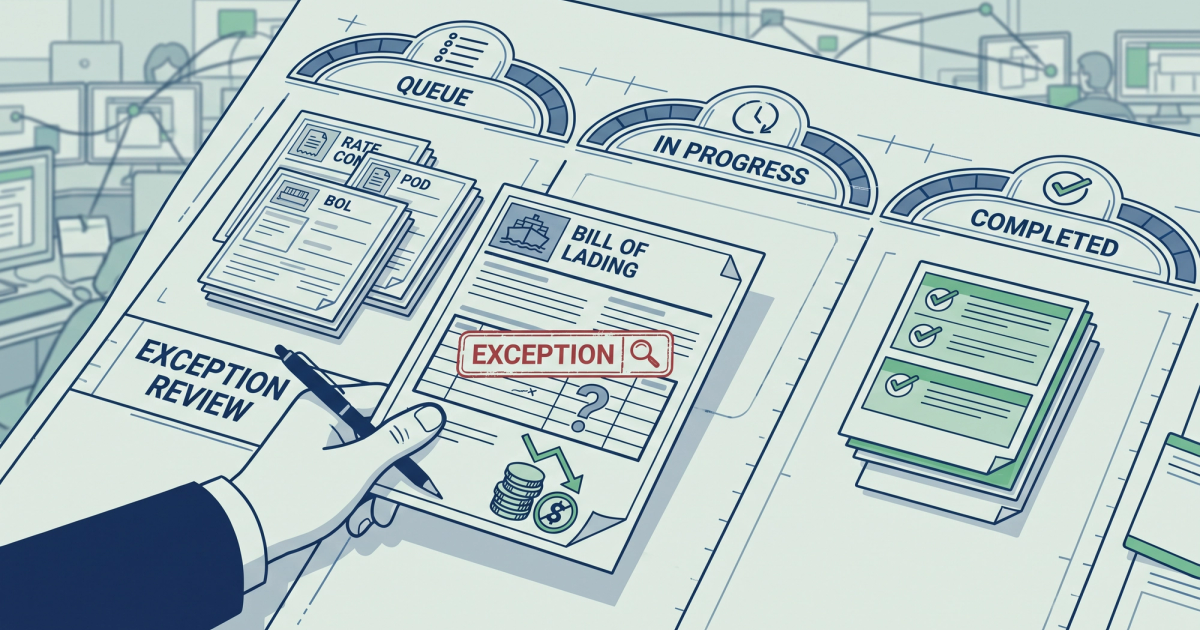
A broker running 300 loads a month at an average freight invoice of $1,800 stands to lose roughly $2,052 every month in carrier overbilling, assuming even a conservative error rate. That's $24,624 a year walking out the door because someone didn't catch a detention overcharge on a BOL or a lumper fee that didn't match the rate con. Document processing in freight isn't an IT project. It's the thing standing between your margin and a carrier's billing mistake. According to a Global Trade Magazine survey, 57% of logistics executives reported shipment delays in the past year directly tied to document errors. The delays are bad enough. The billing errors that ride alongside them are worse.
What Is Document Processing in Freight? (It's Not What the Software Blogs Say)
Most articles about document processing are written for IT teams evaluating enterprise software. They talk about "unstructured data extraction" and "intelligent classification." That's fine if you're running a bank. If you're running a freight brokerage with 15 employees and 800 loads a month, document processing means something different.
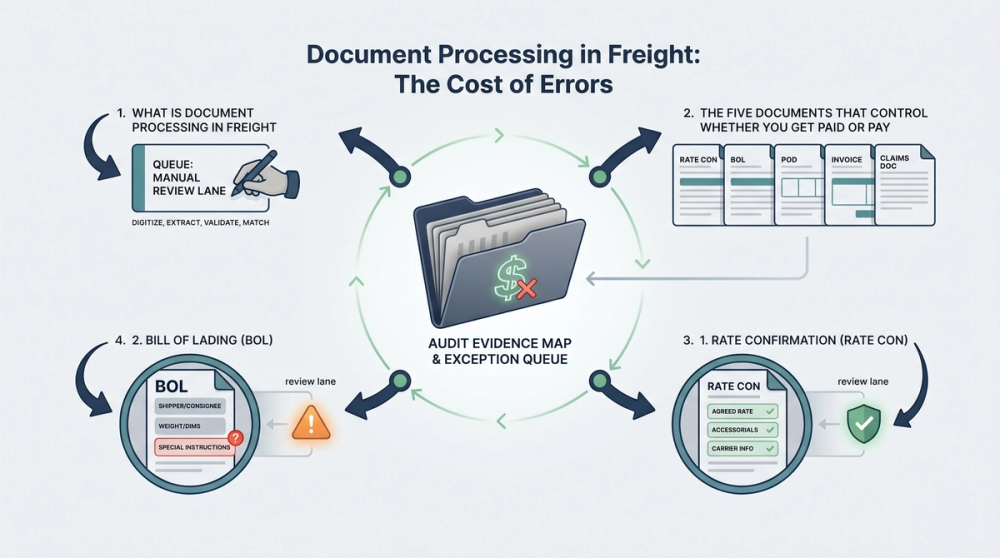
In freight, document processing is the work of receiving, reviewing, matching, and acting on the paperwork attached to every load. It starts when a rate con is signed and doesn't end until the carrier invoice is paid and the shipper invoice is collected. Every document in between (the BOL, the POD, the lumper receipt, the carrier packet) either confirms or contradicts what you agreed to haul, at what price, and under what conditions.
Here are the core steps of document processing in a freight workflow:
- Document receipt: Carrier packets, BOLs, PODs, and invoices arrive via email, TMS upload, fax, or driver photo.
- Data extraction: Key fields (load number, pickup/delivery dates, weight, charges, accessorial line items) are pulled from each document, either manually or through OCR technology.
- Cross-referencing: Extracted data is compared against the rate con and the original load tender to confirm that what was invoiced matches what was agreed.
- Exception flagging: Discrepancies (wrong rates, unauthorized accessorials, missing signatures, mismatched weights) are identified and routed for review.
- Resolution and payment: Clean invoices get approved. Flagged invoices get disputed, corrected, or escalated before any money moves.
That's it. No magic. But every one of those steps is a place where money leaks out if the process is slow, inconsistent, or nonexistent. According to ReformHQ's freight industry analysis, the freight industry faces a $4 billion annual cost burden from paper-based document handling. That number includes your back office.
The Five Documents That Control Whether You Get Paid Right
Not every document in a carrier packet matters equally. Some are compliance checkboxes. Others are the ones that determine whether you overpay a carrier or underbill a shipper. Here are the five that control your money.
1. Rate Confirmation (Rate Con)
The rate con is your contract. It specifies linehaul rate, authorized accessorials, detention terms, lumper fee caps, and cancellation windows. Every carrier invoice should be compared against this document first. If a charge isn't on the rate con, you have grounds to dispute it. If your team isn't checking every invoice line against the rate con, you're paying whatever carriers decide to bill.
2. Bill of Lading (BOL)
The BOL records what was picked up, when, and in what condition. Pickup timestamps on the BOL are your primary defense against inflated detention claims. Weight and commodity descriptions on the BOL determine whether the freight class matches what was quoted. A BOL with missing fields or illegible handwriting is a carrier dispute waiting to happen. This is where BOL processing errors cost brokers the most) because the BOL touches pricing, claims, and compliance all at once.
3. Proof of Delivery (POD)
The POD confirms the load was delivered, when, and whether there were exceptions (shortages, damage, refused items). Without a timestamped POD, you can't verify delivery windows, which means you can't dispute layover charges. A missing POD also stalls shipper invoicing because most shippers won't pay until delivery is confirmed.
4. Carrier Invoice
The freight invoice is where every upstream document error turns into a dollar amount. Carriers submit invoices with line items for linehaul, fuel surcharges, detention, lumper fees, TONU charges, and other accessorials. Each line item needs to be matched against the rate con and supporting documents. A carrier invoice that doesn't match the rate con is either a mistake or an overbill. Either way, your billing coordinator needs to catch it.
5. Lumper Receipt
Lumper receipts are the most commonly missing document in carrier packets. When a carrier invoices for lumper services without a signed receipt, you have no way to verify the actual amount paid at the facility. The rate con might authorize up to $175, but without a receipt, a $250 invoice goes unchallenged.
Where the Dollar Losses Actually Happen: Common Errors by Document Type
Knowing which documents matter isn't enough. You need to know what goes wrong on each one, and what it costs per load. Here are the most common errors, broken down by document type, with real dollar examples.
BOL Errors: Detention Overbilling
Scenario: A carrier invoices for 4 hours of detention at $75/hour ($300 total). But the timestamped BOL shows the driver was at the facility for 2 hours, which falls within the standard free time window. That's a $150 overcharge on a single load. Without the BOL timestamp readily accessible during invoice review, your billing coordinator either pays it or spends 45 minutes pulling documents to build a dispute case. Multiply that across 10 similar loads in a month and you're looking at $1,500 in potential overcharges.
Rate Con Errors: Fuel Surcharge Mismatch
Scenario: A carrier applies a fuel surcharge percentage that isn't referenced anywhere in the rate con. On a $2,200 linehaul, a 2% discrepancy adds $44 per load. That seems small until you realize it's happening across 50 similar loads in a month. That's $2,200 in uncaptured overcharges over 30 days, simply because no one checked the fuel surcharge line against the rate con terms.
POD Errors: Unjustified Layover Charges
Scenario: A carrier invoices for a layover because the POD shows no confirmed delivery time. The carrier claims the driver arrived the evening before and had to wait until the next morning for an appointment. Without a timestamped POD, the broker has no documentation to deny a $300 layover charge. A clean POD with a delivery timestamp would have resolved this in seconds.
Lumper Receipt Errors: Unauthorized Amounts
Scenario: The rate con authorizes up to $175 for lumper services. The carrier invoices $250. There's no signed lumper receipt in the carrier packet. The broker pays $75 more than agreed with no paper trail to push back. This is one of the most preventable losses in freight billing, and it happens because the lumper receipt is the document most often missing from carrier packets.
TONU Disputes: No Proof of Timeline
Scenario: A carrier claims a truck was dispatched and the load was subsequently cancelled, then invoices a $250 TONU. The rate con shows the cancellation happened within the agreed penalty-free window. But without timestamped load activity records (dispatch confirmation, cancellation notice), the broker has no fast proof. The dispute drags on, or the broker just pays. Having those documents organized and accessible for disputes is the difference between a 5-minute resolution and a week-long back-and-forth.
What a Document Processing Workflow Looks Like on a Real Load
Theory is one thing. Here's what document processing looks like on an actual load, from dispatch to payment.
Step 1: Load Tender and Rate Con Execution
The load is booked. A rate con is generated from your TMS and signed by the carrier. At this point, the rate con should include: linehaul rate, fuel surcharge terms, authorized accessorials and their caps (detention rates, lumper fee limits), cancellation/TONU policy with time windows, and pickup/delivery appointment times. This document is your baseline. Every downstream document gets compared against it.
Step 2: Pickup and BOL Capture
The driver picks up the load and the BOL is generated at the shipper's facility. Your ops team or the carrier sends a copy (photo, scan, or TMS upload). At pickup, you need to verify: the BOL has a legible pickup timestamp, weight and commodity match the load tender, the shipper's signature is present, and there are no exception notes that could trigger a claim.
Step 3: Delivery and POD Capture
The driver delivers and the POD is signed at the receiver. Your team needs to confirm: the POD has a delivery timestamp, the receiver signed without exceptions, and the delivery date matches the appointment window on the rate con. A POD without a timestamp is a document gap that carriers can (and do) use to justify layover or detention charges.
Step 4: Carrier Invoice Submission
The carrier submits a freight invoice, usually within 24 to 72 hours of delivery. This is where your billing coordinator's manual document review begins. The invoice needs to be checked line by line against the rate con: does the linehaul match? Is the fuel surcharge calculated correctly? Are there accessorial charges, and are they authorized? Is there a lumper fee, and is there a receipt to support it? According to Truckstop's guide on freight broker back-office operations, this reconciliation step is one of the most time-intensive parts of the broker back office.
Step 5: Exception Handling and Dispute
Any line item that doesn't match the rate con or isn't supported by a document (receipt, BOL timestamp, POD signature) gets flagged. The billing coordinator either requests a corrected invoice from the carrier or initiates a formal dispute. This is where having every document organized, indexed, and searchable saves hours.
Step 6: Payment and Shipper Re-bill
Once the carrier invoice is clean, payment is approved. The shipper invoice is generated based on the contracted rate plus any approved accessorials. If documents are missing or disputes are unresolved, payment stalls on both sides.
Manual vs. Automated Document Review: What the Time and Error Costs Actually Add Up To
Let's put real numbers on the cost of manual document review.
The Manual Reconciliation Math
Example: A billing coordinator at a mid-size brokerage processes roughly 150 loads per week. Each load requires cross-referencing the rate con, BOL, POD, and carrier invoice. That coordinator spends approximately 11 hours per week on reconciliation alone. At $22/hour, that's $242/week, or roughly $12,584/year in labor cost dedicated solely to matching documents.
That number doesn't include the cost of errors that slip through. If your coordinator is reviewing 30 invoices a day, fatigue and time pressure mean some discrepancies won't get caught. A 3.8% error rate across 300 loads at $1,800 average invoice value means roughly $2,052 per month in potential overcharges. Over a year, that's $24,624 in overbilling exposure on top of the $12,584 in labor. Total annual cost of manual document processing for a 300-load-per-month operation: approximately $37,208.
What Automation Changes (and What It Doesn't)
Automated document processing uses OCR (optical character recognition) to extract data from scanned BOLs, PODs, and carrier invoices, then matches extracted fields against rate con data stored in your TMS. According to Grand View Research, the global intelligent document processing market was valued at $2.30 billion in 2024 and is projected to reach $12.35 billion by 2030, growing at a CAGR of approximately 32%. That growth is being driven by exactly the use case freight brokers face: high volumes of semi-structured documents that need fast, accurate matching.
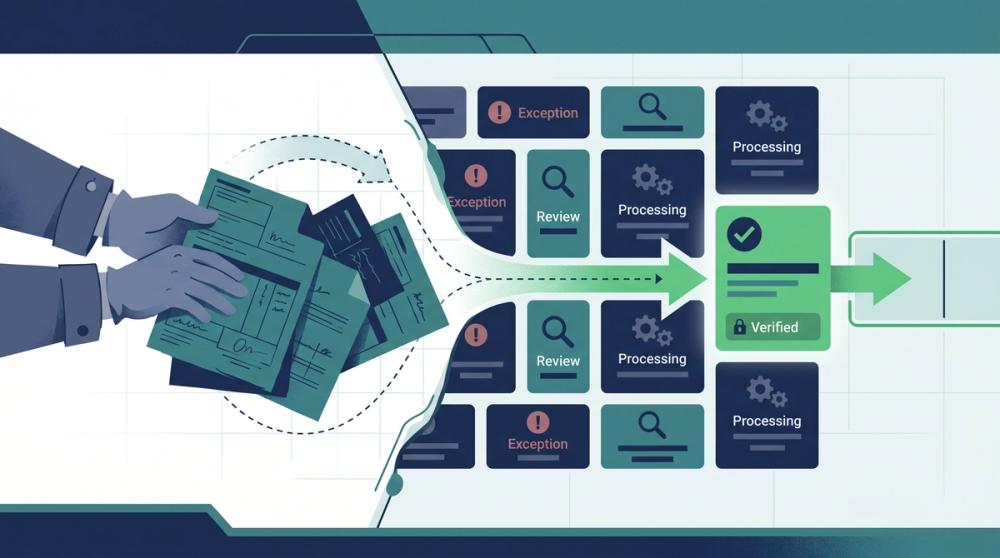
What automation does well: extracting standard fields (load numbers, dates, dollar amounts, addresses) from documents that follow common formats. Matching extracted carrier invoice data against rate con terms. Flagging discrepancies automatically so a human reviewer only looks at exceptions.
What automation doesn't do well (yet): reading heavily damaged or handwritten BOLs with perfect accuracy. Understanding context-dependent accessorial disputes that require operational judgment. Replacing the billing coordinator entirely.
The real value isn't replacing people. It's reducing the 11 hours a week your billing coordinator spends on routine matching so they can focus on the exceptions that actually require judgment.
The goal of automating document processing isn't zero humans. It's making sure humans only spend time on the invoices that are actually wrong, not the 96% that are clean.
How to Build a Document Check Process Without Buying New Software First
You don't need to buy new software to start fixing your freight document workflow. Most of the losses described in this article happen because there's no consistent process, not because the right tool is missing. Here's how to build a document check process with what you already have.
Create a Per-Load Document Checklist
Before any carrier invoice is approved for payment, require that these documents are present and reviewed:
- Signed rate con with all accessorial terms and caps clearly listed
- BOL with legible pickup timestamp, weight, and commodity description
- POD with delivery timestamp and receiver signature (no exceptions noted)
- Lumper receipt (if applicable) signed and showing the actual dollar amount paid
- Carrier invoice with line items that match the rate con, supported by the above documents
If any document is missing, the invoice doesn't get approved. Period. This single rule, enforced consistently, will catch the majority of overbilling scenarios described above.
Standardize Your Document Naming Convention
One of the biggest time sinks in manual document review is finding the right file. If your team stores BOLs, PODs, and rate cons in email threads, shared drives, and TMS attachments with no consistent naming, every reconciliation task starts with a scavenger hunt. Use a simple format: [LoadNumber]_[DocType]_[Date]. Example: 48291_BOL_20250619. This takes 10 minutes to implement and saves hours per week in search time.
Set a 72-Hour Document Submission Deadline for Carriers
According to DAT's carrier onboarding guide, establishing clear documentation requirements during onboarding is a best practice that prevents disputes downstream. Add a clause in your carrier packet requiring all supporting documents (BOL, POD, lumper receipt) within 72 hours of delivery. Carriers who submit invoices without supporting documents get a standard response: "Invoice held pending receipt of [missing document]." This shifts the burden of proof where it belongs.
Run a Weekly Exception Review
Set aside 30 minutes each week to review every invoice that was flagged during the week. Look for patterns: Is the same carrier consistently overbilling detention? Are lumper fees always higher than the rate con cap on loads to a specific facility? Are fuel surcharges consistently misapplied on a particular lane? These patterns tell you where to focus your document review effort and which carrier relationships need a conversation. Compliance with FMCSA requirements for maintaining copies of records also means your documentation practices need to be consistent and auditable.
Know When It's Time to Automate
The process above works well for brokerages handling up to about 200 loads per month with a dedicated billing coordinator. Beyond that, the manual approach starts to break down. Signs you've outgrown manual document review: your billing coordinator is spending more than 10 hours per week on reconciliation, disputes are taking longer than 48 hours to resolve because documents can't be found quickly, you're consistently paying invoices without full supporting documentation because the volume is too high to check everything, and your error catch rate is declining as load volume increases.
When you hit that point, the math on freight document data extraction tools starts to make sense. The key is choosing a solution built for freight documents specifically (BOLs, rate cons, PODs) rather than a general-purpose OCR tool that wasn't designed for the variability of carrier invoices.
Frequently Asked Questions About Freight Document Processing
What do you mean by document processing in freight?
Document processing in freight is the work of receiving, reading, extracting data from, and cross-referencing the paperwork attached to every load. This includes rate cons, BOLs, PODs, carrier invoices, and lumper receipts. The goal is to verify that what a carrier invoices matches what was agreed to on the rate con, supported by timestamps and signatures on the BOL and POD.
What does a document processor do in a freight back office?
A document processor (usually your billing coordinator) receives carrier invoices and supporting documents, extracts key data points (load number, charges, dates, weights), matches those data points against the rate con, and flags any discrepancies for dispute or correction. In an automated workflow, OCR software handles the extraction and matching steps, and the human reviewer focuses only on flagged exceptions.
Is document processing hard for freight brokers?
The concepts aren't complex. The volume is what makes it hard. A single load might have 4 to 6 documents that need to be matched. At 300 loads per month, that's 1,200 to 1,800 documents. The challenge isn't understanding what to check. It's having the time to check everything consistently, and having documents organized well enough to find what you need in seconds instead of minutes.
What are the steps in document processing for freight?
The core steps are: (1) receive documents from carriers via email, TMS, or fax; (2) extract key fields like load number, charges, dates, and signatures; (3) match extracted data against the rate con and load tender; (4) flag mismatches or missing documents; (5) resolve exceptions through dispute or corrected invoice requests; and (6) approve payment once all documents are clean and matched.
How much does manual document review cost a freight brokerage?
For a brokerage processing 300 loads per month, manual reconciliation labor alone can run approximately $12,584 per year (based on 11 hours per week at $22/hour). Add the cost of uncaught overbilling at even a modest error rate and total annual exposure can reach $37,000 or more. The exact number depends on your load volume, average invoice size, and how thorough your current review process is.
Sources
- 72% of Logistics Leaders Plan to Invest in Document Automation in the Next 12–18 Months — Global Trade Magazine
- The $4B Paper Problem: AI Document Ingestion for Freight — ReformHQ
- Intelligent Document Processing Market Size Report, 2030 — Grand View Research
- Streamline Your Freight Broker Back-Office Operations — Truckstop
- Best Practices for Carrier Onboarding: What Every Broker Should Know — DAT
- 4.1.11 Copies of Records or Documents (390.31) — FMCSA CSA Safety Planner
Stop Paying for Errors You Can Catch
Every freight invoice that doesn't match a rate con is money leaving your brokerage. The fix starts with a consistent process: a per-load document checklist, a naming convention that makes files findable, a 72-hour submission deadline for carriers, and a weekly exception review. These steps cost nothing to implement and can recover thousands per month in overbilling.
If your team processes more than 50 carrier invoices a week and reconciliation is eating 10+ hours of labor, automated extraction tools like Laneproof can catch the discrepancies covered in this guide. They won't replace your billing coordinator. They'll give them the 8 hours a week back to focus on the exceptions that actually need a human.
Full guide: Document Automation for Freight Ops: Stop Entering BOL Data by Hand
Related: Data Extraction in Freight: Stop Retyping BOLs and Losing Money
Related: Freight OCR: What It Reads Accurately and Where It Breaks Down