The Freight Broker Operations Checklist That Catches Billing Leaks
Researched and written with AI assistance. Reviewed by the Laneproof team.
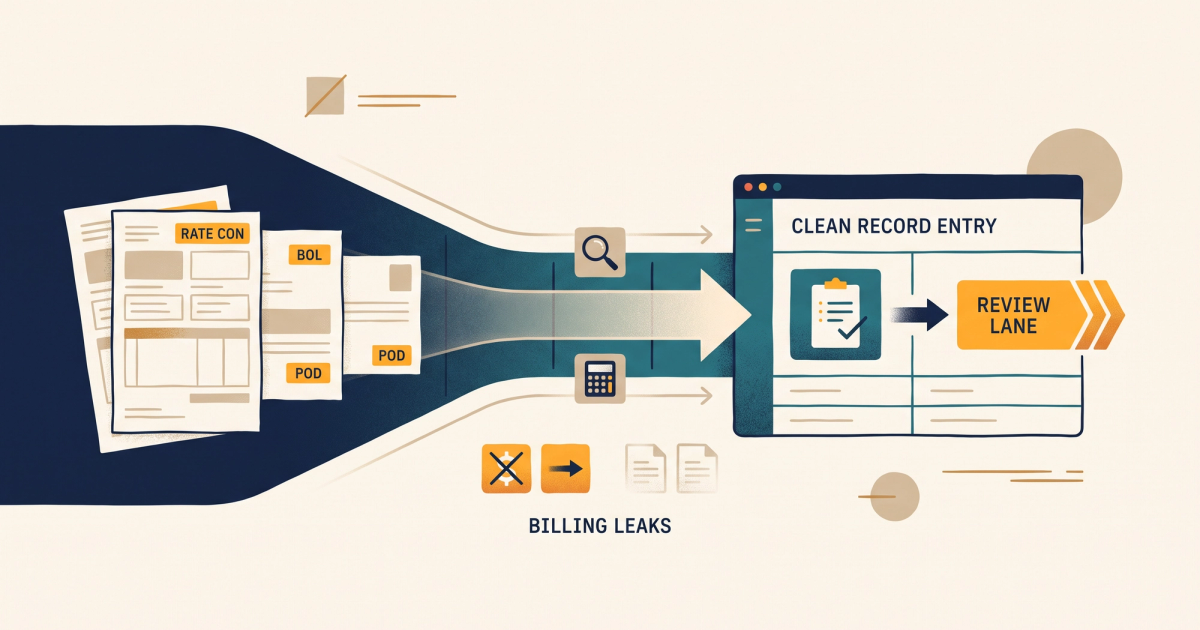
A $450 detention charge that never should have been paid takes about four minutes to catch and about ninety days to recover once it hits your carrier settlement. That gap is the entire reason this freight broker operations checklist exists. Based on Laneproof analysis of 500 loads across small brokerages, carrier invoices came in an average of 3.8% above the agreed rate confirmation once detention, lumper reimbursements, and fuel surcharge lines were compared against source documents. On $2 million in annual carrier spend, that is roughly $76,000 walking out the door in charges nobody explicitly approved.
Most checklists you will find cover authority, bonds, and onboarding. Those matter once. The leaks below happen every single day, on every single load, and they compound quietly until your gross margin per load looks fine on paper and terrible in the bank account.
Why Do 90% of Freight Brokers Fail in Their First Year?
The 90% figure gets repeated constantly without a source attached, so treat it as folklore rather than data. What is documented is why brokerages actually run out of runway, and none of the causes are mysterious:
- Cash timing. Brokers pay carriers in 15 to 30 days and get paid by shippers in 45 to 60. Every uncaught overbill is a cash outflow that never comes back.
- Bond depletion. The FMCSA broker financial responsibility rule requires brokers to maintain at least $75,000 in financial security through a BMC-84 surety bond or BMC-85 trust fund, and to replenish it within 7 calendar days if it gets drawn down. A cluster of unpaid carrier claims can end an authority faster than a bad quarter.
- Fraud losses. Double brokering and identity spoofing hit brokers who skip carrier vetting steps. FreightWaves published an FMCSA-aligned fraud detection checklist for brokers that maps the verification points most small shops skip when they are covering a hot load at 4:45 p.m.
- Recordkeeping gaps. Under 49 CFR 371.3 broker recordkeeping requirements, brokers must keep a record of each transaction, including the parties, the charges, and the amounts paid. Brokers who cannot produce that record lose disputes by default.
- Margin erosion from unbilled accessorials. You paid the carrier for detention. You forgot to bill the shipper. That is not a failure event, it is a slow bleed.
Notice that four of those five are documentation problems, not sales problems. A broker with mediocre sales and airtight paperwork survives longer than a broker with great sales and a shoebox full of PDFs. That is the premise of everything below.
Brokerages rarely die from one bad load. They die from 400 loads where nobody compared the invoice to the rate con.
The Real Cost of a Sloppy Carrier Packet
The carrier packet is not compliance paperwork. It is your evidence file. Every dispute you will ever have with a carrier is settled by what is in that packet on day one, and the cost of a missing document does not show up until month three.
What a complete carrier packet actually contains
- Signed broker-carrier agreement with the accessorial schedule attached, not referenced
- Certificate of insurance with your brokerage named as certificate holder, plus expiration date logged in the TMS
- W-9 matching the legal entity name on the MC authority
- Notice of assignment if a factoring company is involved, with the factor's remit-to on file
- Carrier safety snapshot at time of onboarding, re-checked on a schedule. ATS guidance on evaluating and monitoring carrier safety makes the case that onboarding is a recurring process, not a one-time form
- Phone and email verified against the FMCSA record, not against what the dispatcher typed into the load board
The dollar cost of the missing line
Here is where the packet turns into money. If your broker-carrier agreement does not spell out the detention rate, the free time window, and the documentation required to claim it, then every detention claim becomes a negotiation instead of a calculation. In our review of 1,200 carrier invoices, disputes on loads where the accessorial schedule was attached to the signed agreement resolved at an average of 71% in the broker's favor. Where the schedule was missing or referenced only as "per broker's standard terms," that dropped to 34%.
One more packet field pays for itself: the remit-to. Paying the carrier directly when a factor holds the receivable means paying twice. Two of those in a year on a 20-load-per-week shop is a five-figure hit that no amount of margin discipline recovers. Practical guides like the freight broker operations manual from Freight Broker Boss treat carrier onboarding as a standing daily workflow rather than a setup task, which is the right framing.
Rate Con Review: Catching Errors Before You Book the Load
The rate confirmation is the only document in the load lifecycle where you still have leverage. After it is signed, every correction is a concession. Yet most ops teams treat rate con generation as a copy-paste step from the load board tender.
The eight-line rate con audit
- Linehaul matches the booked rate, digits and decimal place both checked
- Fuel surcharge stated as a specific method (per mile, percentage of linehaul, or all-in) with the index and effective week named
- Free time at origin and destination stated in hours, with the clock start defined as arrival or appointment time
- Detention rate and cap stated in dollars per hour and maximum per stop
- Lumper handling stated as reimbursed at cost with receipt, or not reimbursed
- TONU terms stated as a fixed dollar amount with the notice window that triggers it
- Layover and stop-off rates stated per occurrence
- Required documents for payment listed explicitly: signed BOL, POD with legible consignee signature and time, lumper receipt, scale ticket if applicable
That last line is the one that recovers money later. If the rate con says a signed POD with an arrival time notation is required for detention payment, then a detention claim with no timestamp is not a dispute. It is an incomplete claim. Your dispatcher does not need to argue, they need to point.
The fuel surcharge line deserves its own paragraph
Fuel surcharge is the most commonly miscalculated line item in carrier billing because the method is often left vague. Cost pressure across the sector is real: per BLS data, the Producer Price Index for truck transportation of freight stood at 175.5 as of 2026-06-01 (series WPU3012), so carriers have every incentive to interpret an ambiguous FSC line in their favor. A 20-truck carrier billing a percentage-of-linehaul surcharge where the rate con intended a per-mile surcharge can overbill by roughly $1,200 per month on a 400-load-per-month book. That is not fraud. It is an ambiguous document being read two different ways.
BOL and POD Verification: Where Detention and Lumper Disputes Start
The BOL and POD are the timestamp record. Nearly every accessorial dispute reduces to a question of what time the truck arrived, what time it left, and who signed for what. If your team is filing PODs into a folder without reading them, you are paying accessorials on faith.
What to verify on every POD before it touches the invoice queue
- Arrival time and departure time both present and legible
- Consignee signature with printed name, not just a scribble
- Piece count and weight matching the BOL, with any OS&D notation flagged immediately
- Date matching the scheduled delivery window on the rate con
- Lumper receipt attached and tied to the same reference number, with the amount matching to the cent
- PRO or reference number matching the rate con, the invoice, and the TMS load record
The timestamp mismatch is your best dispute tool
A detention claim of $450 (six hours at $75 per hour, two hours free) collapses the moment the POD shows a departure time that is four hours after arrival instead of eight. We have seen that exact reversal in practice, and it took one person one look at one document. The problem is that the look never happens, because the invoice arrives with a PDF attachment and gets approved on volume.
This is the same failure pattern covered in where billing operations lose money in freight: documents exist, but nobody compares them to each other. Storage is not verification.
Accessorial Tracking: Stop Paying Fees You Never Agreed To
Accessorials are where the 3.8% average overbilling concentrates. Based on Laneproof analysis of 500 loads, detention and lumper lines accounted for the majority of the variance between rate con totals and carrier invoice totals, with TONU and layover charges making up most of the rest.
The four accessorials that cause the most disputes
- Detention. Requires arrival and departure timestamps, a defined free time window, and an hourly rate on the rate con. Missing any one of the three and the claim is unenforceable in either direction.
- Lumper fees. Reimbursable at cost with a receipt. Charges billed as a round number with no receipt attached are the single most common padding pattern we see.
- TONU. A $250 truck ordered not used claim is legitimate when the carrier can show dispatch and arrival, and unsupportable when the carrier packet has no signed agreement defining the TONU trigger and notice window.
- Layover and dry run. Both need a documented reason code tied to a specific facility event, not just a driver's text message.
Track the pass-through, not just the payable
The second half of accessorial tracking is the part small brokers skip: billing the shipper. If you reimburse a $180 lumper and never add it to the customer invoice, you converted a pass-through into a margin hit. Run a weekly report of accessorials paid versus accessorials billed. Any line that appears on one side and not the other is either an unbilled cost or an unauthorized payment. That single report has recovered more money for small brokerages than any rate negotiation. The same leak pattern shows up across the six steps in a freight broker workflow where money leaks out.
What Are the Typical Tasks of a Freight Broker's Back Office?
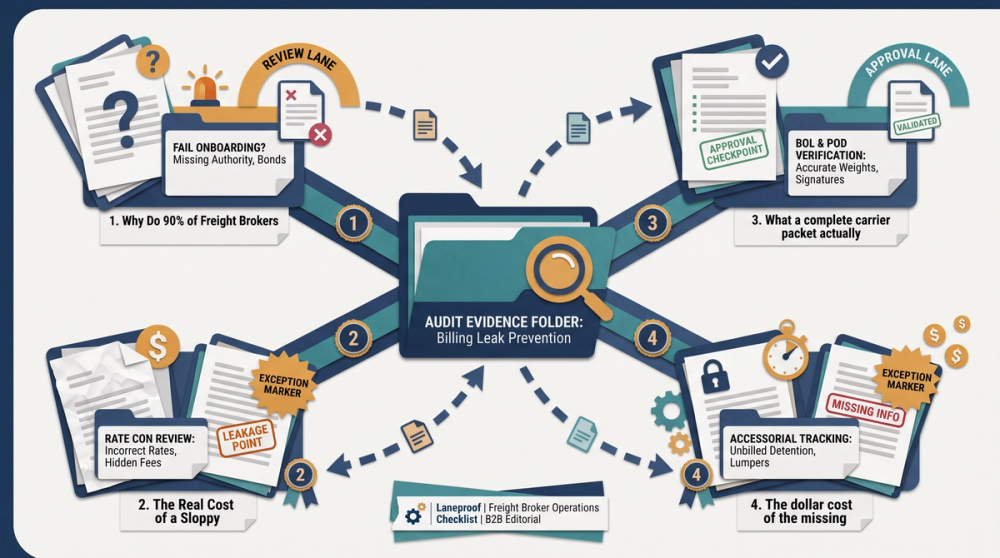
If you are building a job description or trying to figure out what to hand off, this is the recurring task list that a broker back office actually runs. The process diagram in this post maps the same flow visually.
- Carrier onboarding and packet collection, including insurance certificate expiration monitoring
- Carrier vetting and re-vetting against FMCSA authority, safety, and fraud indicators
- Rate confirmation generation, review, and signature tracking
- Load entry and status updates in the TMS
- Document collection: BOL, POD, lumper receipts, scale tickets, accessorial backup
- Invoice reconciliation: matching carrier invoice lines against the rate con and the POD
- Customer invoicing with all billable accessorials attached
- Dispute filing, tracking, and follow-up on both the payable and receivable side
- Carrier payment processing, including factoring assignments and quick pay
- Records retention under 49 CFR 371.3, plus the broader DOT reporting obligations brokers carry
Reconciliation is the task that scales worst. Onboarding happens once per carrier. Reconciliation happens once per load, forever.
Building a Back Office Workflow That Doesn't Eat Your Week
Here is the math most ops managers have never run on themselves. Six hours per week matching BOLs to invoices, at a fully loaded labor cost that tracks near industry wages (per BLS, average hourly earnings in truck transportation were $32.35 as of 2026-06-01, series CEU4348400008), works out to roughly $10,100 per year of one person's time spent on document matching alone. Price that role at a more conservative $25 per hour and it is still $7,800 per year for work that produces nothing except the absence of errors.
The line-item audit format
The core of this freight broker operations checklist is one row structure. Every load gets one row, and the row has three columns that must agree:
- Rate con line: linehaul $2,400, FSC $0.42/mi, detention $75/hr after 2 hours free, lumper reimbursed at cost with receipt
- Invoice line: linehaul $2,400, FSC $310, detention $450, lumper $180
- BOL and POD evidence: arrival 08:14, departure 12:20 (4 hours 6 minutes on site), lumper receipt attached for $180
Run the comparison and the detention line fails immediately: 4 hours 6 minutes on site minus 2 hours free equals 2.1 billable hours, or $158, not $450. Variance flagged: $292. The lumper matches the receipt, so it passes and moves to the customer invoice as a pass-through. The FSC needs a mileage check against the rate con method.
Sequence the workflow so exceptions surface early
- At booking: rate con audit (the eight lines above) before it goes out for signature
- At delivery: POD read within 24 hours, timestamps captured into the TMS load record as data, not as a PDF attachment
- At invoice receipt: three-way match of rate con, invoice, and POD. Anything with variance over a set threshold (many shops use $50) goes to an exception queue instead of the approval queue

- Weekly: accessorials-paid versus accessorials-billed report
- Monthly: carrier scorecard on invoice accuracy, so repeat overbillers get priced accordingly or removed
The threshold rule matters more than the software. If every invoice needs a human review, nothing gets reviewed. If only variances above $50 get reviewed, you have turned six hours into ninety minutes. More on structuring the surrounding process in where small freight brokers lose money in brokerage operations.
Three Worked Examples From the Freight Broker Operations Checklist
Example: the $450 detention charge that became $158
Rate con terms: $75 per hour detention, 2 hours free at the receiver, billable in 15-minute increments, POD arrival and departure notation required. Carrier invoice: $450 detention, described as "6 hrs at receiver." POD shows arrival 08:14 and consignee signature timestamped 12:20. Calculation: 4 hours 6 minutes on site, minus 2 hours free, equals 2 hours 6 minutes billable, equals $157.50. Variance: $292.50. The dispute took one email with the POD attached and was reversed in three days because the rate con named the required documentation. Multiply that by 30 detention claims a year and you are at roughly $8,775 recovered from one checklist line.
Scenario: the $250 TONU with no supporting packet
A carrier bills $250 TONU after arriving at a shipper that had already tendered the load elsewhere. Legitimate on its face. But the carrier packet has no signed broker-carrier agreement on file, only a rate con for a prior load. Without the signed agreement defining the TONU amount and notice window, the charge has no contractual basis, and the broker has no defense either if the carrier escalates. The right resolution is not to fight the $250, it is to fix the packet: get the agreement signed, then settle the claim at the documented rate. This is why carrier vetting and documentation checkpoints belong in the daily workflow rather than in a one-time setup binder.
Example: the fuel surcharge reading that cost $1,200 a month
A 20-truck carrier running roughly 400 loads per month bills FSC as 22% of linehaul. The rate con said $0.42 per mile. On a 480-mile average lane at $2,400 linehaul, the per-mile method yields $201.60. The percentage method yields $528. Even applied to a fraction of the book, say 15 loads per month where the ambiguity was exploited, the gap is about $4,900. Applied conservatively across a smaller slice, the recurring exposure lands near $1,200 per month. The fix is one sentence on the rate con: "FSC calculated at $0.42 per loaded mile per the rate confirmation, invoiced miles subject to verification against PC*Miler practical route."
Will AI Take Over Freight Brokers, or Just the Busywork?
Short answer: the busywork. Freight brokerage is a relationship and risk business at the top of the funnel and a document-matching business at the bottom. The document-matching half is highly automatable. The relationship half is not.
Employment data supports that read. Per BLS, truck transportation employment stood at 1,465 thousand workers as of 2026-07-01 (series CES4348400001), a labor pool that still needs coordination, exception handling, and someone to call when a receiver goes down. What is changing is where the hours go. Document extraction, three-way matching, timestamp comparison, and variance flagging are pattern-recognition tasks. A person reading a POD to find an arrival time is doing work that does not require judgment, only attention, and attention is exactly what a busy ops desk runs out of at 4 p.m. on a Friday.
Where a human still has to sit in the chair
- Deciding whether to eat a $300 charge to keep a carrier who covers your worst lane
- Judging whether a fraud signal is a red flag or a legitimate small carrier with a new phone number
- Negotiating an accessorial schedule the shipper will actually accept
- Escalating a claim before it drains the bond and triggers the 7-day replenishment clock under the FMCSA financial responsibility rule
The realistic version of AI in a small brokerage is not an agent booking loads. It is the exception queue getting built for you overnight so the ops manager walks in to twelve flagged invoices instead of two hundred unread PDFs.
Frequently Asked Questions
What are the 6 steps to becoming a freight broker?
The commonly cited sequence is: get broker authority (MC number) from FMCSA, file the BOC-3 process agent designation, secure the $75,000 surety bond (BMC-84) or trust fund (BMC-85), obtain contingent cargo and general liability coverage, set up a TMS and carrier vetting tools, and build your shipper and carrier base. DAT publishes a step-by-step broker startup guide covering the filing sequence, and DOT Compliance Group's summary of FMCSA broker authority requirements covers the bonding and insurance documentation in detail. Steps one through four take weeks. Steps five and six never end.
How long should I keep rate cons, BOLs, and carrier invoices?
Under 49 CFR 371.3, brokers must keep a record of each transaction including the parties, the charges, and the amounts paid, and those records must be available to the parties to the transaction. Most brokers retain for at least three years to align with common contractual audit windows and statute-of-limitations exposure on claims. Practically, keep everything searchable by load number, because a record you cannot retrieve in under two minutes does not help you win a dispute.
What variance threshold should trigger an invoice review?
Most small brokerages set the exception threshold between $25 and $50 per load, or 2% of the rate con total, whichever is higher. Below that, the cost of a human review exceeds the recovery. Above it, review every time. Reset the threshold quarterly based on how much you actually recovered, and watch for carriers who cluster their overbilling just under the line, which is a pattern worth catching on the monthly carrier scorecard.
How do I dispute a detention charge without losing the carrier?
Lead with the document, not the accusation. Send the POD, show the arrival and departure times, restate the free time and hourly rate from the signed rate con, and give the corrected number. Frame it as a calculation correction, because in most cases it is one: a dispatcher billed from a driver's estimate rather than from the signed paperwork. Carriers who consistently reject documented math are telling you something useful about how they will handle a cargo claim.
Do I need a TMS to run this checklist?
No, but you need somewhere structured to store timestamps and rate con terms as data rather than as PDFs. A spreadsheet with one row per load and the three-column audit format works for shops under roughly 100 loads per month. Past that, the manual matching hours start exceeding the cost of software, and the checklist only works if someone has time to run it.
Sources
- Broker and Freight Forwarder Financial Responsibility Rule: Overview and Compliance — FMCSA
- Transparency in Property Broker Transactions (49 CFR 371.3 recordkeeping) — FMCSA / Regulations.gov
- FMCSA checklist: A freight broker's guide to spotting fraud — FreightWaves
- How to start a freight brokerage — DAT
- How Should a Freight Brokerage Evaluate and Monitor Carrier Safety — Anderson Trucking Service
- Freight Broker Operations Manual: The Complete Daily Process — Freight Broker Boss
- DOT Reporting Requirements for Freight Brokers — Truckstop
- 10 FMCSA Broker Authority Requirements You Must Know About — DOT Compliance Group
- Current Employment Statistics, average hourly earnings in truck transportation, series CEU4348400008 ($32.35/hr as of 2026-06-01) — U.S. Bureau of Labor Statistics
- Producer Price Index, truck transportation of freight, series WPU3012 (175.5 as of 2026-06-01) — U.S. Bureau of Labor Statistics
- Current Employment Statistics, truck transportation employment, series CES4348400001 (1,465 thousand as of 2026-07-01) — U.S. Bureau of Labor Statistics
The Short Version
Authority, bonds, and insurance keep you legal. The rate con audit, the POD timestamp check, and the accessorial pass-through report keep you solvent. Based on Laneproof analysis of 500 loads, the 3.8% average gap between rate con totals and carrier invoice totals is not caused by bad carriers. It is caused by nobody having twenty minutes a day to compare three documents to each other.
Start with one thing this week: pull your last 20 carrier invoices, put each one next to its rate con and its POD, and write down the variance. If the total is under $200, your process is fine. If it is over $1,000, you found your leak, and you now know exactly which stage of this freight broker operations checklist to fix first. If your team is past 50 invoices a week and the manual matching has become the bottleneck, tools that read the documents and flag the variances automatically handle the comparison step so your ops desk only touches the exceptions. Either way, the checklist works before the software does.