Freight Billing Mistakes That Are Costing You Real Money
Researched and written with AI assistance. Reviewed by the Laneproof team.
Freight billing mistakes are charges on a carrier invoice that don't match what was agreed to on the rate confirmation. They include detention overcounts, unauthorized accessorial fees, fuel surcharge miscalculations, weight reclassifications, and duplicate line items. According to ICC Logistics' analysis of industry data, between 5% and 15% of all freight invoices contain errors. For a brokerage moving 300 loads per month at a $500 average linehaul, even a 3.8% overbill rate means roughly $5,700 per month walking out the door before anyone files a single dispute.
This guide doesn't just list those mistakes. It ties each one to a specific dollar impact, shows you the exact documents you need to win a dispute, and gives your billing coordinator a repeatable process to stop each error from recurring.
What Freight Billing Mistakes Actually Are (And Why They Keep Happening)
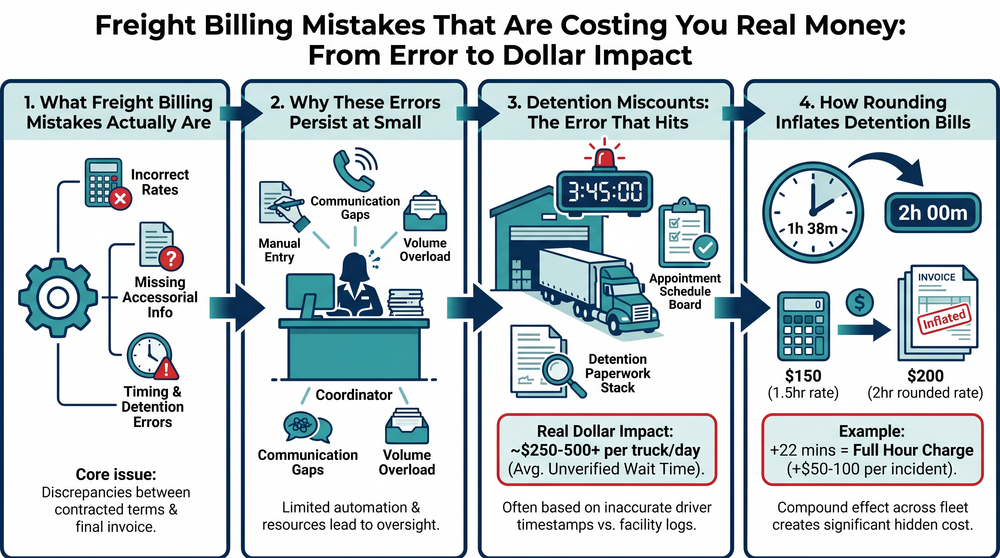
A freight billing mistake is any charge on a carrier's invoice that deviates from the terms documented on the rate confirmation (rate con). That deviation can be a detention overcount, a fuel surcharge calculated on the wrong base amount, an accessorial that was never authorized, or a weight reclassification the carrier applied after delivery without documentation.
The federal framework governing these charges is laid out in 49 CFR Part 377, Payment of Transportation Charges, which establishes baseline rules for billing accuracy and payment timelines. Section 377.205 specifically addresses clerical and ministerial errors in freight billing, as documented in the FMCSA's CFR guidance on billing error correction. In other words, there's a legal expectation that invoices match the contracted terms. When they don't, you have grounds to dispute.
Why These Errors Persist at Small and Mid-Size Brokerages
The short answer: manual processes and time pressure. A billing coordinator running manual reconciliation spends an average of 6 to 9 hours per week cross-referencing rate cons, BOLs, and PODs against carrier invoices. As of 2026-02-01, average hourly earnings in truck transportation was $31.94/hr (BLS). Even at a more modest $22/hour billing coordinator rate, that manual audit function alone costs $6,864 to $10,296 in labor annually. When you're buried in 200 invoices and working against payment deadlines, some discrepancies simply don't get caught.
According to Cass Information Systems' analysis of freight audit dangers, one of the biggest risks is lack of visibility into what you're actually paying versus what you agreed to pay. Without a structured comparison between the rate con and the invoice, line by line, errors become invisible until they've already compounded across hundreds of loads.
The result is a compounding problem. Each unchallenged overbill trains the carrier's billing system (and sometimes the carrier's back office) to keep billing that way. If you never push back on a $75 detention overcount, that overcount becomes the baseline. If you're seeing patterns like these across your invoices, start with this breakdown of common freight billing errors and what they cost to benchmark your own exposure.
Detention Miscounts: The Error That Hits Your Invoice Every Third Load
Detention charges are supposed to compensate carriers for wait time beyond a contracted free time window, typically 2 hours. The problem isn't the concept. The problem is how the time gets counted and rounded.
How Rounding Inflates Detention Bills
Here's a scenario brokers see constantly:
Example: A carrier invoices detention at 2 hours. The BOL timestamp shows the driver arrived at 09:15 and was released at 10:37. That's 1 hour and 22 minutes of total facility time. With a standard 2-hour free time window, actual billable detention is zero. But the carrier rounds up to the nearest hour, bills for 2 hours of detention, and adds $75 per hour to the invoice.
At $50 to $75 per occurrence, this looks small. But run the math on volume. If you move 40 loads per month where this rounding pattern occurs, that's $2,000 to $3,000 in unverified detention charges annually. Multiply that across your full book of business and you're looking at a five-figure leak.
What to Check and How to Dispute
Every detention dispute comes down to three documents:
- BOL with facility timestamps: This is your primary evidence. It shows arrival, check-in, and departure times.
- Rate con detention terms: Pull the exact clause specifying free time, per-hour rate, and any rounding rules.
- Carrier's invoice line item: Compare the billed hours against the timestamp math.
If the timestamps don't support the billed hours, send the carrier a dispute email that includes: the load number, the rate con clause with the detention terms, screenshots of the BOL timestamps, your calculated detention (with math shown), and a request for a corrected invoice. You'll find a deeper breakdown of this process in our guide on how to catch carrier overbilling on detention charges.
Accessorial Overcharges: How Carriers Add Fees You Never Agreed To
Accessorial charges are the single most disputed line item category in freight billing. According to IntelliTrans' analysis of freight billing errors, 27% of all accessorial fees levied on shipments are incorrect. That's not a rounding error. That's more than one in four accessorial charges being wrong.
The Lumper Fee Without a Receipt
Example: A lumper fee of $185 appears on a carrier invoice. You check the carrier packet: no lumper receipt attached, no POD notation mentioning a lumper, no third-party receipt. Nothing.
This is one of the most common accessorial overcharges brokers encounter. The fix is straightforward: before paying any lumper fee, require the carrier to provide a third-party lumper receipt with the facility name, date, amount, and a signature or stamp. If they can't produce it, the charge gets rejected.
Duplicate Accessorial Line Items
Example: A liftgate charge appears twice on the same invoice, tied to the same BOL number. Each line is $95. That's $95 recoverable in full if you catch it within the standard invoice review window, typically 30 days from receipt.
Duplicates happen more often than you'd expect, particularly when carriers use manual entry into their own billing systems. The prevention step is simple but requires discipline: before approving any freight invoice, sort accessorial line items by BOL and check for identical charge codes. One liftgate per stop, one detention per facility visit, one TONU per cancelled load.
The TONU That Exceeds the Rate Con Cap
Example: A carrier invoices a TONU (Truck Ordered Not Used) charge at $250 for a dry run. You pull the rate con. It caps TONU at $150. The carrier's invoice is $100 over the agreed amount.
Your dispute email should include the exact clause language from the rate con. Copy and paste it. Something like: "Per the rate confirmation dated [date], Section 4: 'TONU/Dry Run charges shall not exceed $150.00.' The attached invoice bills $250.00 for load #[number]. Please issue a corrected invoice reflecting the contracted TONU cap of $150.00."
Direct. Documented. No emotional language needed.
Fuel Surcharge Rounding and Rate Con Discrepancies That Quietly Drain Margin
Fuel surcharge (FSC) errors are insidious because they look correct at a glance. The percentage might be right. The problem is what it's applied to.
Gross Linehaul vs. Base Linehaul Misapplication
Example: A load has a $1,200 invoice. The base linehaul is $900 and accessorials total $300. The rate con specifies a 6% fuel surcharge applied to base linehaul only. Correct FSC: $900 × 6% = $54. But the carrier calculates FSC on the gross invoice amount: $1,200 × 6% = $72. That's an $18 overcharge on a single load.
On loads with higher accessorial totals, the gap widens to $24 or more per load. Across 100 loads per month, that's $1,800 to $2,400 annually from a single calculation method error that most billing coordinators won't catch because the FSC percentage itself is correct.
How to Prevent FSC Discrepancies
Your rate confirmation should explicitly state: "Fuel surcharge applies to base linehaul only, excluding all accessorial charges." If your rate con language is ambiguous, fix it now for all future contracts. For existing invoices, pull the rate con's FSC clause, recalculate manually using the base linehaul, and flag any variance above $1.
According to AFS Logistics' breakdown of LTL invoice errors, 10.3% of LTL billing errors come from discount discrepancies, a category that includes FSC miscalculations. The same data shows 12.3% of errors stem from freight misclassifications. Both error types share a root cause: the invoice doesn't match the contracted rate structure, and nobody is checking line by line.
Bill of Lading Discrepancies and What They Cost You at Audit Time
The bill of lading (BOL) is the foundational document in every freight transaction. When the BOL doesn't match the invoice, you have a discrepancy that can cost hundreds per load and is difficult to resolve after the fact.
LTL Reclassification: The $312 Surprise
Example: You ship an LTL load classified as NMFC class 70, based on shipper-declared weight and dimensions documented on the signed BOL. After delivery, the carrier reclassifies the freight to class 85 and adds $312 to the invoice.
This is one of the most common and most winnable disputes in freight billing, but only if your documentation is airtight. The signed BOL with shipper-declared weight and dimensions is the document that wins this dispute. If the shipper measured correctly and the BOL reflects that, the carrier needs to provide an inspection certificate or re-weigh ticket showing the original classification was wrong. Without that, the reclassification doesn't hold.
Typical BOL Discrepancies That Lead to Billing Errors
- Weight discrepancies: Carrier scales show a different weight than the BOL, triggering reweigh charges of $50 to $200.
- Piece count mismatches: BOL says 12 pallets, carrier counts 14, and bills for the extra handling.
- Missing or illegible signatures: Without a clear signature at delivery, POD disputes become he-said-she-said situations.
- Consignee address discrepancies: A mismatch between BOL address and actual delivery point can trigger redelivery charges.
Per Supply Chain Brain's analysis of invoice accuracy benchmarks, invoice rejection rates should not exceed 4% of all invoices received, with 2% considered industry best practice. If your rejection rate is significantly higher, BOL discrepancies are likely a major contributor, and the fix starts at the loading dock, not in the billing office.
How to Dispute a Carrier Invoice Without Burning the Relationship
Disputing a carrier invoice doesn't have to be adversarial. In fact, carriers with professional back offices expect disputes. What they don't expect (and what damages relationships) is vague complaints without documentation.
A Five-Step Dispute Workflow
Here's the process your billing coordinator should follow for every flagged invoice:
Step 1: Identify the variance. Compare every line item on the carrier's freight invoice against the rate confirmation. Flag any charge that doesn't appear on the rate con or that exceeds the contracted amount. This includes linehaul, detention, fuel surcharge, and every accessorial.
Step 2: Gather supporting documents. For each flagged line item, pull the rate con clause, the BOL (with timestamps if detention is involved), the POD, and any receipts (lumper, scale tickets). This is your evidence package.
Step 3: Calculate the exact variance. Don't just say "detention is wrong." Show: "Rate con allows 2 hours free time. BOL shows arrival at 09:15 and departure at 10:37. Total facility time: 1h 22m. Billable detention: $0. Invoiced detention: $150. Variance: $150.00."
Step 4: Send a structured dispute email. Include: load number, carrier name, invoice number, each disputed line item with the rate con clause, your calculation, and the supporting document references. Request a corrected invoice with a specific response deadline (7 to 10 business days is standard).
Step 5: Log the outcome. Whether the carrier accepts, partially adjusts, or rejects your dispute, record the result. This data is how you identify repeat offenders, build a case for renegotiation, and measure your audit program's recovery rate.
What This Looks Like in Practice
Scenario: Your billing coordinator flags a carrier invoice for load #4782. The invoice shows a $1,847 total. The rate con shows a $1,650 linehaul with a $75 fuel surcharge, totaling $1,725. The carrier's invoice includes an additional $72 in "handling" and a $50 "appointment scheduling fee," neither of which appear on the rate con.
The dispute email reads: "Regarding invoice #INV-9034 for load #4782: the rate confirmation dated 03/12/2026 specifies a linehaul of $1,650.00 and FSC of $75.00, totaling $1,725.00. Your invoice includes a handling charge of $72.00 and an appointment scheduling fee of $50.00. Neither charge appears on the rate confirmation or was authorized prior to pickup. Please issue a corrected invoice for $1,725.00 by March 28, 2026."
That's $122 recovered on one load. Do that consistently across your book and the numbers compound fast. Based on Laneproof's analysis of brokerage invoice data, a broker running 300 loads per month at a 3.8% overbill rate on a $500 average linehaul loses approximately $5,700 per month, or $68,400 annually, before a dispute process is in place.
Protecting Carrier Relationships During Disputes
Three rules keep disputes professional:
- Stick to documents, not accusations. Never say "you're overbilling us." Say "the invoice doesn't match the rate confirmation. Here's the documentation."
- Dispute quickly. The longer you wait, the more it looks like you're trying to renegotiate after the fact. Flag errors within 48 hours of invoice receipt when possible.
- Acknowledge correct invoices. When a carrier's billing is consistently clean, tell them. Positive feedback builds trust and makes occasional disputes easier to resolve.
Quantifying Your Monthly Exposure: Real Math for Real Brokerages
Most brokers know billing errors happen. Few know exactly how much they're losing. Here's how to calculate your specific exposure.
The Monthly Loss Formula
Use this calculation: (Monthly loads) × (Average linehaul) × (Overbill rate) = Monthly loss from billing errors.
Example 1: Mid-size brokerage. 300 loads/month × $500 average linehaul × 3.8% overbill rate = $5,700/month or $68,400/year. The 3.8% figure comes from Laneproof's review of brokerage invoice discrepancies. Your rate may be higher or lower depending on carrier mix and how many accessorials your loads carry.
Example 2: Smaller operation. 100 loads/month × $800 average linehaul × 2.5% overbill rate = $2,000/month or $24,000/year.
Now add the labor cost. Your billing coordinator spends 6 to 9 hours per week on manual reconciliation. At $22/hour, that's $6,864 to $10,296 annually just for the audit function. That's the cost of finding errors, not the errors themselves.
Recovery Rate Benchmarks
Not every dispute results in a full recovery. Based on industry patterns, here are realistic recovery expectations:
- Unauthorized accessorials with no supporting documentation: 85% to 95% recovery rate. These are the easiest to win because the carrier simply can't produce evidence the charge was authorized.
- Detention overcounts with BOL timestamp evidence: 70% to 85% recovery rate. Some carriers will argue about clock-start definitions, but timestamps usually settle it.
- Fuel surcharge miscalculations: 60% to 80% recovery rate. These require clear rate con language. Ambiguous FSC clauses give carriers room to push back.
- LTL reclassifications: 50% to 70% recovery rate. Success depends entirely on whether your BOL has accurate shipper-declared weight and dimensions.
Between 5% and 15% of all freight invoices contain errors. At scale, even the low end of that range represents a six-figure annual problem for a mid-size brokerage.
Frequently Asked Questions About Freight Invoice Errors
What are some common billing errors in freight?
The most common freight billing mistakes include detention overcounts (carriers rounding up wait time beyond what timestamps support), unauthorized accessorial charges (lumper fees without receipts, liftgate charges billed twice), fuel surcharge miscalculations (FSC applied to gross invoice instead of base linehaul), LTL weight reclassifications post-delivery, and TONU charges that exceed rate con caps. According to IntelliTrans' freight billing data, 27% of all accessorial fees are incorrect.
What are the typical discrepancies with bills of lading?
BOL discrepancies that lead to billing disputes include weight variances between shipper-declared weight and carrier scale weight, piece count mismatches (12 pallets on the BOL versus 14 counted at delivery), missing or illegible signatures that weaken POD claims, and address discrepancies that trigger redelivery charges. The most expensive BOL discrepancy is a post-delivery freight reclassification by the carrier, which can add hundreds of dollars per shipment if the shipper's original classification isn't supported by documented weight and dimensions on the signed BOL.
How do you handle discrepancies in billing?
Handle billing discrepancies with a structured five-step workflow: identify the variance by comparing each invoice line item to the rate confirmation, gather supporting documents (rate con, BOL, POD, receipts), calculate the exact dollar variance with math shown, send a dispute email to the carrier with all documentation and a response deadline, and log the outcome for pattern tracking. Disputes submitted within 48 hours of invoice receipt and supported by specific documentation have the highest resolution rates.
What are the most common mistakes in carrier pricing?
Carrier pricing mistakes typically fall into three categories: contractual errors (billing a rate not on the rate confirmation, applying the wrong lane rate), calculation errors (fuel surcharge applied to the wrong base amount, mileage discrepancies), and unauthorized additions (accessorials not pre-approved, detention billed without meeting the free-time threshold). According to AFS Logistics, 12.3% of LTL invoice errors come from freight misclassifications and 10.3% from discount discrepancies.
How much do freight billing errors cost per month?
The cost depends on your load volume and average linehaul. A brokerage moving 300 loads per month with a $500 average linehaul and a 3.8% error rate loses approximately $5,700 per month, or $68,400 per year. Smaller operations with 100 loads per month at $800 average linehaul and a 2.5% error rate still lose $2,000 per month. These figures don't include the $6,864 to $10,296 annual labor cost of manual invoice reconciliation. Per Debales.ai citing Gartner research, companies lose 1% to 5% of total transportation spend to freight payment errors.
Stop Losing Money on Errors You Can Catch
Every freight billing mistake in this guide is catchable. Detention overcounts, unauthorized accessorials, fuel surcharge miscalculations, BOL reclassifications, and TONU overcharges all leave a paper trail. The question is whether your team has the time and process to follow it.
Start with the basics: compare every carrier invoice to the rate confirmation, line by line. Pull BOL timestamps for detention. Require receipts for lumper fees. Check what base amount the FSC is applied to. Log every dispute and track your recovery rate. These steps alone will recover thousands per month at most brokerages.
If your team processes more than 50 invoices a week and the manual reconciliation is eating 6 to 9 hours of billing time, tools that automatically flag invoice vs. rate con discrepancies can catch the errors covered in this guide in seconds instead of hours. The math on whether that's worth it for your operation is straightforward: calculate your monthly exposure using the formula above, compare it to the cost of automation, and the answer is usually obvious.
Sources
- 49 CFR Part 377: Payment of Transportation Charges — Electronic Code of Federal Regulations
- DOT § 377.205: Clerical and Ministerial Billing Errors — Federal Motor Carrier Safety Administration via GovInfo
- Freight Invoice Audits and Why They Matter — FreightWaves
- 5 Top Dangers in Freight Invoice Audit and Payment — Cass Information Systems
- Why Freight Invoice Errors Keep Costing You — ICC Logistics
- Driving Millions of Dollars in Rail Freight Billing Errors Back into Shippers' Pockets — IntelliTrans
- Industry Statistics on LTL Invoice Errors — AFS Logistics
- How to Ensure That Freight Bills Are Correct and Paid Quickly — Supply Chain Brain
- Freight Billing Mistakes Cost Money: 7 Errors Draining Margins — Laneproof
- Why Freight Billing Errors Still Drain 3PL Profits — Debales.ai (citing Gartner)
Full guide: Carrier Invoice Mistakes That Are Costing You Real Money