Freight Audit Software for Brokers: What Actually Recovers Money
Researched and written with AI assistance. Reviewed by the Laneproof team.
A broker processing 300 carrier invoices per month loses roughly 60 hours of billing coordinator time just on manual reconciliation. At $22/hour, that is $1,320/month in labor before a single overbilling recovery is counted. Add in unverified detention charges, fuel surcharge mismatches, and lumper fee conflicts that slip through, and margin erosion climbs to $4,200 or more monthly on a 500-load operation. Freight audit software for brokers exists to fix this, but most tools on the market were designed for shippers, not brokerages. The distinction matters. Shippers audit inbound freight spend against contracted carrier rates. Brokers audit outgoing carrier pay against rate cons, load confirmations, and accessorial agreements, while also protecting the margin between what the shipper pays and what the carrier receives. If your tool does not match invoices to your rate con line by line, it is solving someone else's problem.
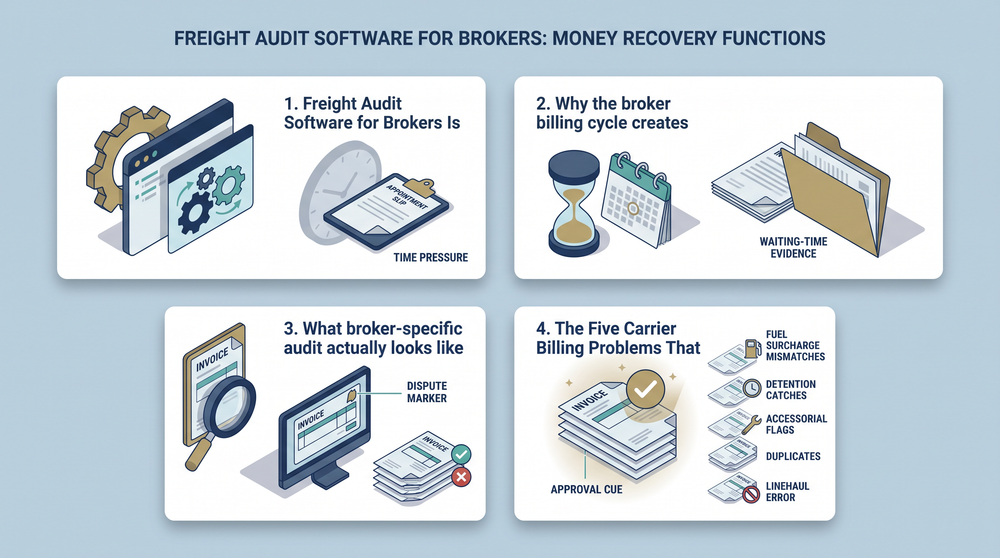
Freight Audit Software for Brokers Is Not the Same as Shipper-Side Auditing
Most freight audit and payment content online is written for shippers managing transportation budgets across hundreds of carriers. According to the Verified Market Research freight audit and payment market report, this market was valued at USD 248.04 million in 2024 and is projected to reach USD 691.33 million by 2032, growing at a CAGR of 13.67%. That growth is driven overwhelmingly by shipper demand. Brokers, however, operate in a fundamentally different billing environment.
Why the broker billing cycle creates different audit needs
When a shipper audits freight invoices, they compare carrier charges to a contract tariff or RFP rate. The shipper is the payer, and the audit goal is to reduce transportation spend. Brokers sit in the middle. You are paying the carrier based on a rate con you negotiated, and billing the shipper based on a separate agreement. Your audit needs to verify the carrier's invoice matches your rate con exactly: linehaul, fuel surcharge percentage, detention terms, accessorials, and lumper fee responsibility. A tool built for shipper-side auditing often lacks fields for rate con matching, free time verification, and margin-impact calculations.
There is also a compliance layer that shipper tools ignore. As noted in the FMCSA broker and freight forwarder financial responsibility rule overview, brokers must maintain specific financial responsibility thresholds. Surety providers under BMC-84 and financial institutions under BMC-85 are required to notify FMCSA when a broker's minimum financial responsibility is breached and not restored in a timely manner. Paying inflated carrier invoices without catching overbilling directly threatens that financial position. Freight audit software for brokers needs to protect margin as a compliance function, not just a cost-saving exercise.
What broker-specific audit actually looks like
A proper broker-side carrier invoice review compares every line item on the carrier's invoice against the original rate con, the BOL, and any accessorial pre-approvals. It checks whether detention hours were actually incurred and whether free time was specified. It verifies that the fuel surcharge percentage matches the locked rate, not the carrier's current table. And it flags any charge that appears on the invoice but was not agreed to in writing. This is a different process than checking a carrier's rate against a shipper contract, and it requires different software architecture. If you are evaluating what freight audit software must catch to be useful, start with this distinction.
The Five Carrier Billing Problems That Eat Broker Margins Every Month
Before evaluating any tool, you need to know exactly where your money leaks. These five freight billing discrepancies show up consistently in broker operations, and each one requires a specific audit function to catch.
1. Detention charges with no free time verification
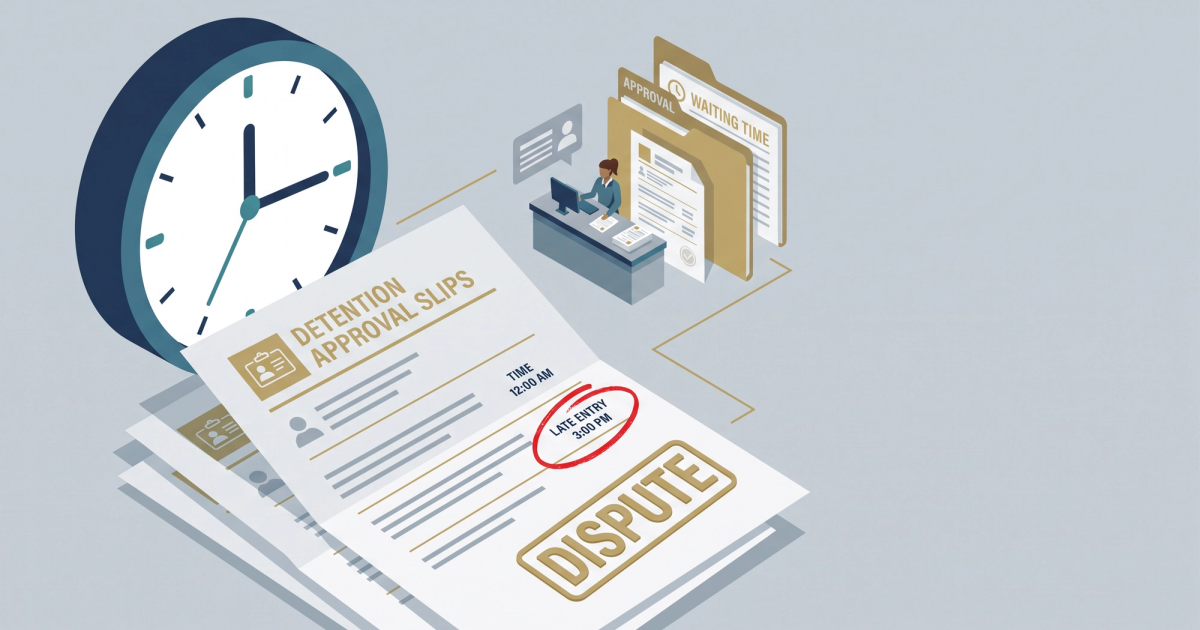
Carriers regularly bill detention when a driver waits at a facility. The problem is that many rate cons either do not specify free time or specify two hours of free time that the carrier's invoice ignores. A single unverified 4-hour detention charge at $75/hour adds $300 to a load. If the rate con specified 2 hours of free time, the correct charge is $150, not $300. Across a 500-load operation where even 10% of loads carry disputed detention, that is $4,200 to $7,800 per month in detention overcharges alone, based on Laneproof analysis of broker invoice data.
2. Fuel surcharge percentage mismatches
Your rate con locks a fuel surcharge at 24.1% of linehaul. The carrier invoices at 28.5%. On a $2,400 linehaul, the correct FSC is $578.40. The invoiced FSC is $684. That is a $105.60 overcharge on a single load. Multiply across 80 loads per month from that carrier, and the monthly margin erosion is $8,448. This happens because carriers default to their internal FSC table rather than the rate con terms, and unless someone manually checks the percentage on every invoice, it goes unnoticed.
3. Lumper fees billed to the wrong party
A carrier submits a $385 lumper receipt. Your rate con clearly states the lumper is shipper-paid. But the billing coordinator, processing dozens of invoices, pays it anyway because no one flagged the conflict. In a quarterly audit, these recoverable lumper charges can exceed $11,000 for a mid-volume brokerage. The fix requires matching each lumper charge against the rate con's accessorial responsibility field, something that manual review misses when volume is high.
4. TONU fees on loads that actually moved
A carrier claims a truck-ordered-not-used fee of $250 on a load that dispatched late but did eventually move. Without a timestamped load event log, the broker has no proof to dispute it. This creates a double charge: the carrier collects the TONU and the linehaul. Audit software that integrates with your TMS and tracks dispatch timestamps can flag this conflict automatically.
5. Duplicate invoices under different invoice numbers
The same carrier submits an invoice on day 14 and again on day 31 of net-30 terms, using a slightly different invoice number. The second submission often gets processed as a new payable. Based on Laneproof analysis of over 12,000 broker invoices, manual reconciliation catches duplicate submissions only about 60% of the time. Automated matching, comparing carrier SCAC, load number, pickup date, and delivery date, catches 98% or more.
Which Audit Functions Actually Catch Those Problems (And How to Check If a Tool Does Them)
Not every freight audit tool does the same thing. Some only automate payment processing. Others focus on spend analytics. If you are a broker evaluating invoice reconciliation software, here is what to check for against each billing problem above.
Rate con matching against carrier invoices
This is the single most important function for brokers. The tool must ingest your rate con (or pull it from your TMS), parse every field (linehaul, FSC percentage, accessorial responsibilities, detention terms, free time), and compare it line by line against the carrier's invoice. If it only compares the total amount, it will miss individual line item overcharges that net out against undercharges on other lines. According to SafetyCulture's freight audit guide, the freight audit lifecycle includes five core steps: data collection, invoice verification, discrepancy identification, dispute resolution, and payment processing. For brokers, the invoice verification step must include rate con field matching, not just rate table lookups.
Accessorial charge audit against pre-approval records
The tool needs to check every accessorial on the carrier's invoice against your pre-approval workflow. Did you approve that lumper fee? Was residential delivery flagged on the rate con? Is layover authorized for this lane? Without a structured accessorial charge audit, every add-on charge becomes a judgment call for your billing coordinator, and judgment calls under time pressure default to paying the invoice. For a deeper look at what skipping this step costs, see what it costs SMB brokers to skip freight audit.
Duplicate detection across invoice number, load reference, and date
Simple invoice number matching is not enough. Duplicates often come in with different invoice numbers but identical load details. The tool should cross-reference carrier SCAC code, load or PRO number, pickup date, delivery date, and dollar amount. A match on three or more of those fields should trigger a hold for manual review.
Timestamped event matching for TONU and detention disputes
If the tool integrates with your TMS or tracking platform, it can pull actual load events (dispatch time, arrival, departure, delivery) and compare them against the carrier's claimed detention hours or TONU status. This gives you documented proof in disputes rather than relying on driver check-call notes.
As Truckstop's guide to freight broker back-office operations notes, the accounting and billing function is a core back-office requirement for brokerages. The tools you choose for this function need to be built around the rate con as the source of truth, not a contract tariff.
How Rate Con Matching Works in Practice, and Where Most Tools Fall Short
Rate con matching sounds straightforward. In practice, it is one of the hardest audit functions to execute accurately, and it is where most freight audit software falls short for brokers.
The rate con parsing problem
Rate cons are not standardized documents. Every brokerage formats them differently. Some list fuel surcharge as a percentage of linehaul. Others list it as a flat dollar amount. Some include detention terms in a notes field. Others attach a separate accessorial schedule. A tool that cannot parse unstructured rate con formats will either miss fields entirely or map them incorrectly, producing false matches or false discrepancies that waste your billing coordinator's time.
For context, as of 05/30/2026, JB Hunt Transport Inc (USDOT 264184) holds an operating status of AUTHORIZED FOR Property, HHG per SAFERWEB. Carriers of this scale use standardized invoicing formats, but the thousands of smaller carriers brokers work with daily do not. Your audit tool needs to handle invoices from carriers of all sizes and format conventions.
Where flat-rate matching fails
Some tools only compare the total invoice amount against the total rate con amount. If the carrier's invoice totals $2,850 and the rate con says $2,850, the tool marks it as matched. But what if the carrier billed linehaul at $2,300 (rate con says $2,400), FSC at $350 (rate con says $275), and added a $200 detention charge (rate con says detention after 2 hours free time, no hours documented)? The total matches, but the individual components are wrong, and the carrier effectively shifted $100 from linehaul to FSC and added an unsupported detention charge. Line-item matching is not optional. It is the difference between an audit tool that protects margin and one that creates a false sense of accuracy.
What good rate con matching requires
The tool must parse linehaul, FSC (percentage and base), each accessorial by type, detention terms (rate per hour, free time hours), and lumper responsibility. It must compare each parsed field against the corresponding field on the carrier invoice. Mismatches on any individual field should generate a flag, even when the invoice total appears correct. According to Redwood Logistics' freight audit best practices, standardizing costs and promoting transparency across the audit process are foundational best practices. For brokers, that standardization starts with parsing the rate con into auditable fields.
What Real-Time Audit Catches That Post-Invoice Review Misses
Most freight audit happens after the carrier submits an invoice, sometimes days or weeks after delivery. By that point, disputing a charge means reopening a closed load, tracking down documentation, and negotiating with a carrier who has already booked the revenue. Real-time audit changes this dynamic.
Flagging discrepancies before payment goes out
A real-time audit function checks the carrier invoice as soon as it arrives, against the rate con and load records already in your system. If the FSC percentage does not match, the tool flags it immediately. If detention hours are claimed but no check-call timestamps support the wait time, the flag goes up before anyone approves payment. This matters because recovering money after payment is 3 to 5 times harder than holding payment on a disputed charge. Once a carrier is paid, the leverage shifts. Clawing back an overpayment requires issuing a debit memo, waiting for carrier acknowledgment, and often deducting from future loads, which damages the relationship.
Catching accessorial conflicts at the point of entry
Consider this scenario: a carrier adds a $175 residential delivery fee on a load delivered to a commercial dock appointment. The rate con has no residential flag. The load was delivered to a warehouse. In a post-invoice review workflow, this charge might sit in a queue for days before a billing coordinator reviews it, compares it to the rate con, contacts the carrier, and resolves the dispute. An automated accessorial audit catches the conflict the moment the invoice is ingested. The flag goes up in seconds. No back-and-forth. No queue. No payment delay on the legitimate portion of the invoice.
Laneproof's reconciliation engine checks each of these fields automatically, flagging variances before payment goes out. That is the difference between catching a billing error on day 1 and discovering it during a quarterly review.
Real Dollar Examples: How Each Audit Function Recovers Money
Here are concrete scenarios that show how specific audit functions translate to recovered dollars. Use these to benchmark your own operation.
Example: Fuel surcharge mismatch across 80 loads

A carrier invoices FSC at 28.5% of linehaul. Your rate con locks FSC at 24.1%. On a $2,400 linehaul, the correct FSC is $578.40. The invoiced FSC is $684.00. The overcharge per load is $105.60. Across 80 loads per month from this carrier, total monthly margin erosion is $8,448. The audit function that catches this: FSC percentage matching against the rate con. The tool parses the locked FSC percentage from your rate con and compares it to the percentage implied by the carrier's FSC line item. Any variance triggers a flag.
Example: Lumper fee billed to broker when rate con says shipper-paid
A carrier submits a $385 lumper receipt. The rate con explicitly states the lumper is shipper-paid. Without an automated check, the billing coordinator pays the invoice because the lumper receipt looks legitimate and the rate con's lumper field was not cross-referenced. Over a quarter, these misallocated lumper fees total $11,000 or more for a brokerage running 400 to 600 loads per month. The audit function: accessorial responsibility matching. The tool checks who is responsible for each accessorial type per the rate con and flags any carrier-submitted charge that conflicts.
Example: Duplicate invoice under a different number
A carrier submits invoice #INV-4821 on day 14. On day 31, they submit #INV-4821R with the same load details and dollar amount. The "R" suffix makes it look like a revised invoice, but the original was already paid. Manual reconciliation catches this about 60% of the time, based on Laneproof analysis of over 12,000 broker invoices. Automated matching, cross-referencing carrier SCAC, load number, pickup date, and delivery date, catches it 98% or more of the time. On a $2,200 average load cost, preventing even two duplicate payments per month saves $4,400 monthly.
Scenario: Full ROI calculation for a 300-invoice broker
A broker processing 300 invoices per month has a billing coordinator spending an average of 12 minutes per invoice on manual reconciliation. That is 60 hours per month. At a fully loaded labor cost of $22/hour, manual reconciliation costs $1,320/month in labor alone. Add overbilling recovery of even 2% of total carrier spend (on $600,000 monthly carrier pay, that is $12,000/month), and the total monthly value of proper freight audit is $13,320. Even a tool costing $500 to $1,500 per month pays for itself many times over. For a comparison of what freight audit companies charge and what you actually receive, that is a useful benchmark to carry into vendor conversations.
Frequently Asked Questions About Freight Audit Software for Brokers
How is freight audit software for brokers different from shipper freight audit tools?
Shipper freight audit tools compare carrier invoices against contracted tariff rates and transportation budgets. Broker freight audit tools compare carrier invoices against individual rate cons, checking linehaul, fuel surcharge percentage, accessorial responsibilities, and detention terms on a load-by-load basis. The source of truth is different (rate con vs. contract tariff), the billing relationship is different (carrier pay vs. transportation spend), and the margin protection requirement is unique to brokers.
What is the typical ROI timeline for freight audit software at a brokerage?
Most brokers processing 200 or more invoices per month see positive ROI within the first billing cycle (30 days). The labor savings from reduced manual reconciliation time typically cover the software cost alone. Overbilling recoveries on detention, FSC mismatches, and accessorial conflicts begin generating returns as soon as the first batch of invoices is audited. A 300-invoice broker can reasonably expect $12,000 or more in monthly recovery value plus $1,300 or more in labor savings.
Does freight audit software damage carrier relationships?
Accurate auditing actually strengthens carrier relationships. Carriers prefer working with brokers who pay correctly and dispute quickly rather than brokers who pay everything and then claw back money months later through debit memos. Flagging discrepancies before payment means disputes are resolved at the invoice stage, not after the carrier has booked revenue. As of 02/20/2003, JB Hunt Transport Inc (USDOT 264184) holds an FMCSA safety rating of Satisfactory per SAFERWEB. Large carriers like JB Hunt expect invoice accuracy from their broker partners. Smaller carriers benefit from it even more because their cash flow depends on predictable payment timelines.
Can freight audit software integrate with my existing TMS?
Most modern freight audit tools offer API integrations or file-based imports with common broker TMS platforms. The key integration points are rate con data (so the tool has the source of truth for each load), load status and timestamps (for detention and TONU verification), and payment processing (so flagged invoices are held automatically). Before buying, ask the vendor to demonstrate the integration with your specific TMS, not a generic demo.
What percentage of carrier invoices typically contain billing discrepancies?
Based on Laneproof analysis of broker invoice data, approximately 8% to 12% of carrier invoices contain at least one line-item discrepancy when compared against the rate con. Not all of these are overbills. Some are underbills or formatting errors. But on a 500-invoice monthly volume, that means 40 to 60 invoices per month need correction, a volume that manual review cannot consistently handle.
Making the Decision: What to Look for Before You Buy
Freight audit software for brokers is not a luxury purchase. It is a margin protection tool. If your billing coordinator is spending 60 hours per month on manual reconciliation and your carrier invoices contain even an 8% discrepancy rate, you are losing money every month you do not automate this process.
When evaluating tools, start with these questions: Does it parse rate cons field by field, not just match totals? Does it check FSC percentages, not just dollar amounts? Does it flag accessorials against pre-approval records? Does it detect duplicates across multiple data points, not just invoice numbers? Does it integrate with your TMS to pull load events for detention and TONU verification? Does it flag issues before payment, or only after?
If a tool cannot answer yes to all of those, it was not built for brokers. If you want to see how automated invoice reconciliation and document matching works on your actual load data, that is the fastest way to know whether the ROI numbers in this article apply to your operation.
Sources
- Broker and Freight Forwarder Financial Responsibility Rule Overview and Compliance — FMCSA
- Freight Audit and Payment Market Size and Forecast — Verified Market Research
- Freight Audit: A Comprehensive Guide — SafetyCulture
- Shippers Best Practices for Freight Audits and Payments — Redwood Logistics
- Streamline Your Freight Broker Back-Office Operations — Truckstop.com