Detention Charges in Shipping: How Carriers Miscalculate and What It Costs You
Researched and written with AI assistance. Reviewed by the Laneproof team.
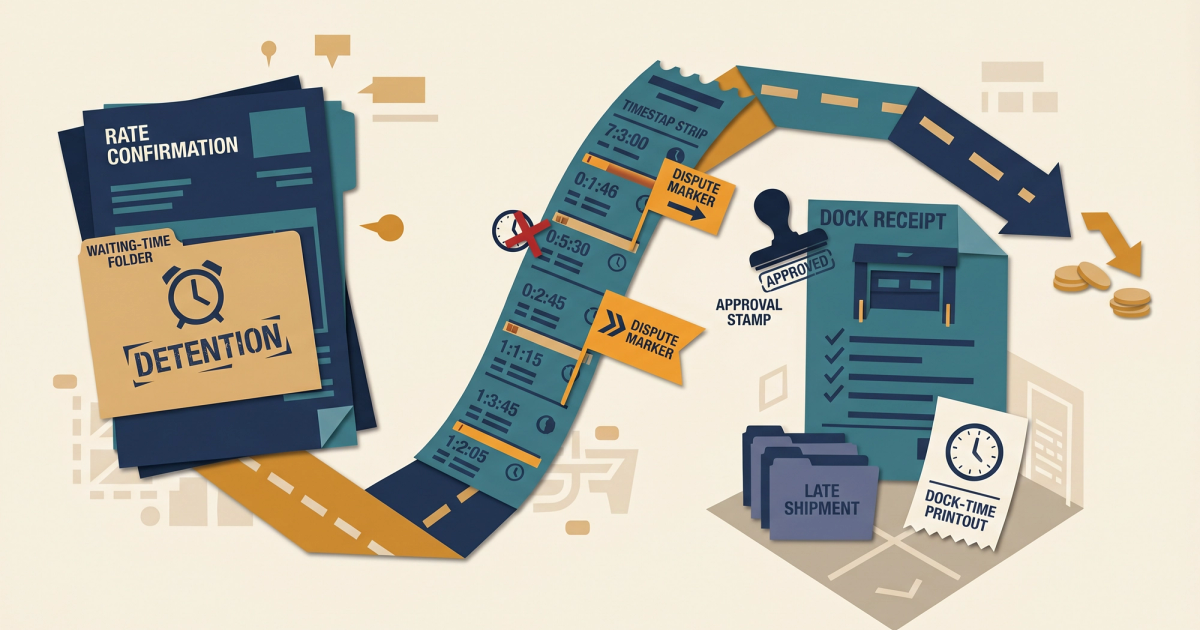
The average trucking detention fee runs approximately $85 per hour, according to Truckstop's carrier billing data. Multiply that by even a small miscalculation on every invoice, say 45 minutes of padded time, and a broker running 200 loads a month is leaking over $12,000 a year on detention charges in shipping they never actually owed. The problem isn't that detention fees exist. Drivers deserve to get paid when they're sitting at a dock. The problem is that carriers routinely miscalculate these charges, and most brokers pay the invoice without checking the math against the BOL or the rate con. This guide doesn't rehash definitions you already know. It shows you exactly where the numbers go wrong, what your rate con detention clause needs to say, and how to run a dispute that gets money back.
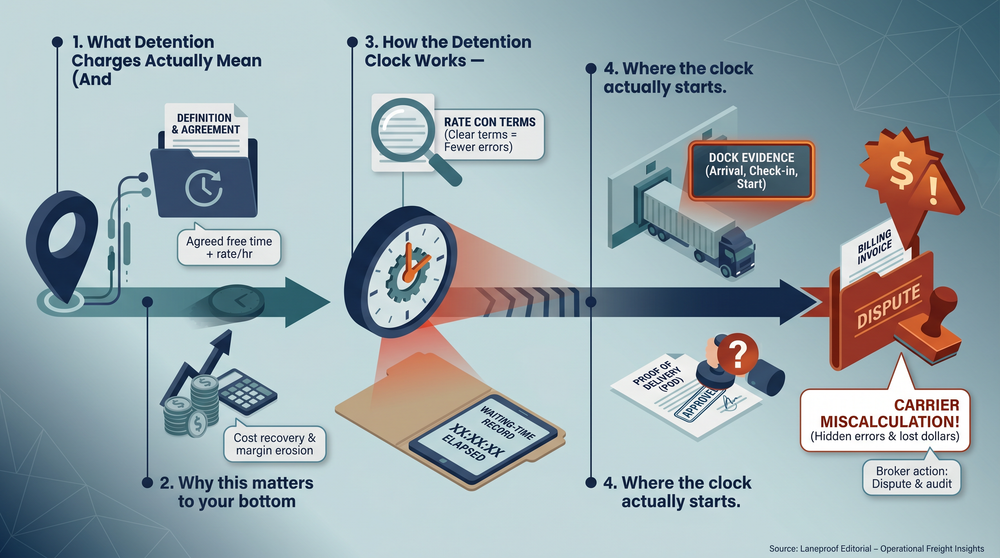
What Detention Charges Actually Mean (And the One-Line Difference From Demurrage)
Detention charges are fees assessed when a truck driver is delayed at a shipper or receiver facility beyond a specified free time window, compensating the carrier for lost productivity during the wait. Demurrage, by contrast, applies to containers held at a port or rail terminal beyond their allotted free time.
That single distinction matters more than most brokers realize, because carriers sometimes apply the wrong term (and the wrong rate schedule) to the wrong situation. According to Descartes' logistics documentation, detention refers specifically to the time a loaded or empty truck is held at a facility, while demurrage covers storage charges on containers at terminals. When a carrier invoice says "demurrage" for a dry van sitting at a warehouse dock, that's a red flag worth investigating.
Why this matters to your bottom line
The FMCSA found that CMV drivers experienced detention time on approximately 1 in every 10 stops, with an average detention duration of 1.4 hours per occurrence. At an industry average rate of $85 per hour, that's roughly $119 per detention event. Across a mid-size brokerage handling 500 loads a month, that translates to 50 potential detention invoices totaling nearly $6,000 monthly. Even a 15% error rate on those invoices means $900 a month walking out the door. And that's before you factor in the loads where carriers bill detention that shouldn't have been billed at all.
On the ocean and intermodal side, the numbers get even bigger. According to FreightAmigo's industry analysis, ocean carriers collected over $2 billion in detention and demurrage charges from U.S. shippers and truckers in 2021 alone. Journal of Commerce data cited by OpenTrack shows that the average detention and demurrage charge for containers of all types reached $1,219 by March 2021. These aren't abstract numbers. They represent real margin erosion for brokers who don't verify every line item.
How the Detention Clock Works — And Where Carriers Fudge the Numbers
The detention clock is supposed to be straightforward. The driver arrives at the facility, checks in, and a defined free time period begins. Once that free time expires, every additional minute counts as billable detention. The clock stops when the driver is released (loaded or unloaded and cleared to leave). In practice, carriers manipulate nearly every element of this sequence.
Where the clock actually starts
The most common point of dispute is when the detention clock begins. Your rate con should specify: does free time start at the scheduled appointment time, the driver's actual arrival time, or the check-in time at the gate? These are three different moments, and the gap between them can be 30 to 90 minutes. Industry commenters to the FMCSA proposed a standard two free hours of wait time, after which a $100 per hour detention charge should apply, per FMCSA detention time research. But that proposal hasn't become a binding rule, which means every brokerage needs to define the start trigger in their own rate confirmations.
For a deeper breakdown of who controls the clock and who ends up paying, see our guide on detention time in trucking and who controls the clock.
Three ways carriers inflate the clock
- Starting the clock at scheduled appointment time instead of actual arrival. If a driver arrives 45 minutes early for a 10:00 AM appointment and the carrier starts the detention clock at 10:00, those 45 minutes of self-imposed early arrival get billed as if the facility caused the delay.
- Rounding up to full hours. A driver who waits 2 hours and 20 minutes beyond free time gets invoiced for 3 full hours. Unless your rate con specifies 15-minute increments, the carrier will round in their favor every time.
- Combining origin and destination detention when the rate con separates them. Some carriers submit a single cumulative detention total across both stops, inflating the billable window by counting free time only once instead of twice.
These aren't hypothetical tricks. They show up on carrier invoices every week, and they're the reason carrier overbilling on detention charges is one of the most common margin leaks in brokerage operations.
What Your Rate Con Detention Clause Should Say Word for Word
A vague rate con detention clause is an invitation to get overbilled. If your rate confirmation says something like "detention applies per carrier's standard policy," you've handed the carrier a blank check. Here's what a defensible detention clause needs to include, line by line.
The five non-negotiable elements
- Free time definition. Specify the exact number of free hours at each stop. Example: "2 hours free time at origin. 2 hours free time at destination. Free time at each stop is independent and non-cumulative."
- Clock start trigger. Define when detention begins. Example: "Detention clock begins at actual facility check-in time as recorded on the BOL or facility gate log, not at scheduled appointment time."
- Hourly rate and increment. State the per-hour rate and billing increment. Example: "Detention rate: $75.00 per hour, billed in 15-minute increments. No rounding to full hours."
- Maximum cap. Set a ceiling on total detention per stop or per load. Example: "Maximum detention charge not to exceed $300 per stop or $500 per load."
- Documentation requirement. Require proof before any detention charge is payable. Example: "Carrier must submit signed BOL or facility timestamp showing arrival and departure times. Detention charges submitted without supporting documentation will be denied."
A sample clause you can copy
"Carrier is allowed 2 hours of free time at origin and 2 hours of free time at destination. Free time begins at actual facility check-in as documented on the BOL or gate log. After free time expires, detention accrues at $75.00 per hour, billed in 15-minute increments. Maximum detention per load: $500. Detention charges must be accompanied by timestamped arrival and departure documentation. Claims submitted without documentation will be rejected."
This language isn't legal advice, but it gives you a concrete starting point. The key is specificity. Every ambiguity in your rate con is a dollar amount the carrier will define for you, in their favor. For more on how proving the clock started affects your billing outcome, read our guide on detention billing and how to prove the clock started.
The Most Common Detention Billing Errors That Cost Brokers Real Money
Detention billing errors aren't always intentional fraud. Sometimes they're dispatch mistakes or TMS auto-calculations that nobody checked. But the result is the same: you pay more than you owe. Here are the errors that show up most frequently.
Error #1: Billing from appointment time, not arrival time
Scenario: A carrier bills detention starting from the 10:00 AM scheduled appointment time rather than the driver's actual arrival time of 10:45 AM. On a $90/hour rate, that 45-minute early arrival inflates the invoice by $67.50 per load. Across 40 loads in a month, that's $2,700 in overbilling from a single error pattern. Your rate con needs to specify "actual arrival" as the clock trigger, and you need to check the BOL check-in stamp against the carrier's submitted times.
Error #2: Ignoring free time entirely
Scenario: A carrier invoices 4 hours of detention at $75/hour on a load where the rate con allows 2 free hours. The broker pays $300 without checking the clock-in time on the BOL, losing $150 they didn't owe. This is the simplest error to catch and the one that slips through most often because billing coordinators are processing dozens of invoices and don't cross-reference the free time clause on the rate con.
Error #3: Billing origin and destination separately when free time is combined
Scenario: A rate con states free time as "2 hours at origin and destination combined." The carrier bills each stop separately, effectively giving themselves 0 free hours at the second stop. This doubles the billable detention window and adds $180 to a single invoice. The fix is either to write your rate con with separate free time per stop (as recommended above) or to flag any carrier invoice that bills both stops independently against a combined-time clause.
Error #4: No supporting documentation
Scenario: A carrier submits a detention charge with no supporting timestamp documentation. The FMC's 2024 final rule on demurrage and detention billing requirements established that billing parties must provide clear, specific information to support charges, including dates and times. While this rule directly targets ocean carriers, it sets a regulatory precedent. If a trucking carrier can't provide arrival and departure records, you have solid grounds to reject the charge entirely.
As of 2026-04-01, average hourly earnings in truck transportation stood at $32.41/hr (BLS). Carriers build detention fees to cover more than just driver pay, accounting for equipment downtime, fuel, and opportunity cost. But that also means the gap between what the driver actually costs and what the carrier bills for detention is significant, sometimes $50 or more per hour. Understanding this gap helps you evaluate whether a carrier's detention rate is reasonable or inflated.
How to Calculate Detention Charges Yourself Before the Invoice Arrives
Every broker should be able to calculate the correct detention charge on any load within 60 seconds. Here's the formula and a step-by-step walkthrough.
The formula
Billable detention = (Total time at facility minus free time) × hourly rate. Total time at facility is measured from actual check-in to release. Free time is defined in your rate con. The hourly rate and billing increment are also in the rate con.
Example: Full calculation walkthrough
Example: A load picks up at a warehouse. The driver checks in at 08:00. Free time per the rate con is 2 hours. The driver clears the facility at 11:45. Here's the math:
- Total time at facility: 08:00 to 11:45 = 3 hours 45 minutes (3.75 hours)
- Minus free time: 3.75 hours − 2.0 hours = 1.75 hours billable
- Detention rate: $65/hour
- Correct invoice: 1.75 × $65 = $113.75
The carrier submitted an invoice for $195, billing 3 full hours (rounding up from 3.75 total and ignoring free time properly). The difference: $81.25 on a single load. Run that across a month of loads and you're looking at real money.
Example: Retail distribution center with pre-negotiated free time
Scenario: A carrier arrives at a retail distribution center and waits 3.5 hours total. The standard free time is 2 hours, which would make billable detention 1.5 hours at $75/hour, equaling $112.50. But this broker pre-negotiated 3 hours of free time on the rate con for this specific lane because the DC is known for slow unloads. With the extended free time, billable detention drops to 0.5 hours, and the charge is $37.50. That single clause saved $75 on one load. On a regular lane running weekly, that's $3,900 per year from one rate con edit.
As of 2026-04-01, the Producer Price Index for truck transportation of freight stood at 174.6 (BLS), reflecting continued cost pressures across the industry. This index context helps explain why carriers are pushing harder on accessorial charges, including detention, to recover margin. All the more reason for brokers to verify every calculation.
How to Dispute a Detention Charge and Actually Win
Disputing a detention charge isn't about being adversarial. It's about having better documentation than the carrier. Here's the process that works.
Step 1: Pull your documentation before you reply
Before you push back on any carrier invoice, gather three documents: the rate confirmation (for free time, rate, and clock trigger language), the BOL or POD with facility timestamps, and the carrier's submitted detention documentation (if any). If the carrier didn't submit timestamps, that alone is your dispute. The FMC's final rule on detention and demurrage billing practices makes clear that billing parties must include specific charge details and a clear timeline. Apply the same standard to your trucking detention disputes.
Step 2: Run your own calculation
Using the formula above, calculate what you believe the correct charge is based on actual timestamps. Compare it to the carrier's invoice line by line. Note every discrepancy: wrong start time, missing free time deduction, rounding errors, wrong rate. Document each one.
Step 3: Send a concise, fact-based dispute
Your dispute email should include four things: the load number, the carrier's invoiced amount, your calculated amount with supporting math, and copies of the BOL/POD timestamps. Keep it short. Don't argue. Let the numbers do the work. A single paragraph with attached documents is more effective than a multi-page explanation.
Step 4: Track dispute outcomes monthly
Example: A broker disputes 11 detention charges in one month averaging $140 each. After pulling POD timestamps against carrier-submitted clock times, the broker recovers $1,540. That's not a one-time win. It's a repeatable process. Track every dispute, its outcome, and the carrier involved. Patterns emerge: some carriers consistently overbill, and those patterns inform your carrier scoring and future rate con negotiations. For more on catching these patterns systematically, see our guide on how carriers overbill on detention and how to fight back.
The broker who disputes 11 detention charges per month and recovers $1,540 isn't doing anything complicated. They're checking timestamps against rate con terms and sending one email per load. The math is simple. The discipline is what pays.
A note on regulatory backing
Regulatory momentum is on the side of documentation-based billing. According to FreightWaves reporting, truckers have pushed the FMCSA to make brokers pay for detention time, which means the pressure is increasing on all parties to document wait times accurately. This cuts both ways: carriers need to prove their detention claims, and brokers need to show they're paying legitimate charges promptly. Clean documentation protects you on both fronts.
Frequently Asked Questions About Detention Charges in Shipping
What is the meaning of detention charges?
Detention charges are fees a carrier bills when their truck and driver are held at a shipper or receiver facility beyond the agreed-upon free time. They compensate the carrier for lost driving time and equipment availability. Per Truckstop data, the average trucking detention fee is approximately $85 per hour, though rates vary by carrier, lane, and rate con terms.
What is the difference between detention and demurrage in shipping?
Detention applies to trucks and trailers held at shipper or receiver facilities beyond free time. Demurrage applies to containers held at ports, rail yards, or terminals beyond their allotted free time. According to Descartes, the core distinction is the location: detention happens at a customer facility, while demurrage happens at a terminal or port. Demurrage rates for ocean containers can range from $75 to $200 per day per container, per DSV's rate guidance.
How do you calculate detention charges?
Subtract the free time from the total time at the facility, then multiply the remaining hours by the detention rate in your rate con. Example: if a driver checks in at 08:00, clears at 11:00, and free time is 2 hours, billable detention is 1 hour. At $75/hour, the charge is $75. Always use actual check-in and departure timestamps from the BOL or facility log, not the carrier's self-reported times.
Who is responsible for detention charges?
Responsibility depends on who caused the delay and what the rate con states. If the shipper or receiver held the driver beyond free time, the broker typically owes the carrier detention per the rate con terms, and the broker can back-charge the shipper if their contract allows it. If the carrier arrived outside the appointment window or can't document the wait, the broker has grounds to deny the charge. The FMCSA's detention time study found that drivers experience detention on about 1 in 10 stops, making this a recurring operational question, not a one-off event.
Can you negotiate free time on detention?
Yes, and you should. Free time is not a fixed industry standard. It's a negotiable term on your rate con. Most rate confirmations default to 2 hours of free time, but brokers who know a specific facility runs slow (retail DCs, cold storage facilities, multi-stop consolidation warehouses) should negotiate 3 or even 4 hours of free time for those lanes. As shown in the retail DC example above, extending free time by one hour on a weekly lane can save $3,900 per year.
Stop Paying Detention Charges You Don't Owe
Detention charges in shipping aren't going away. Drivers sit at docks, and they deserve to get paid for it. But the gap between what you actually owe and what shows up on the carrier invoice is real, measurable, and fixable. The brokers who protect their margins aren't the ones who refuse to pay detention. They're the ones who write tight rate con clauses, check every timestamp against every invoice, and dispute with documentation instead of arguments.
Start with your rate con language. Add the five elements outlined above. Build a habit of running your own detention calculation before you approve any invoice. Track your disputes and their outcomes monthly. The math is simple. The discipline is what separates brokers who leak margin from brokers who don't.
If your team processes more than 50 carrier invoices a week, manually checking every detention line item against rate con terms and BOL timestamps gets old fast. Tools that automatically flag invoice discrepancies can catch the billing errors covered in this guide before they hit your accounts payable.
Sources
- Impact of Driver Detention Time on Safety and Operations — FMCSA
- What Are Detention and Demurrage in Logistics? — Descartes
- Truckers push FMCSA to make brokers pay for detention time — FreightWaves
- Demurrage and Detention Billing Requirements — Federal Register
- FMC Publishes Final Rule on Detention and Demurrage Billing Practices — FMC
- Understanding Trucking Detention Pay for Carriers and Freight Brokers — Truckstop.com
- Demurrage Vs. Detention Vs. Per Diem Rates — OpenTrack
- Demystifying Detention and Demurrage Charges — FreightAmigo
- What is the difference between Demurrage and Detention? — DSV
- What Are Detention Charges and How eBOLs Stop Them — Vector