Carrier Reconciliation Services: What They Catch, What They Miss
Researched and written with AI assistance. Reviewed by the Laneproof team.
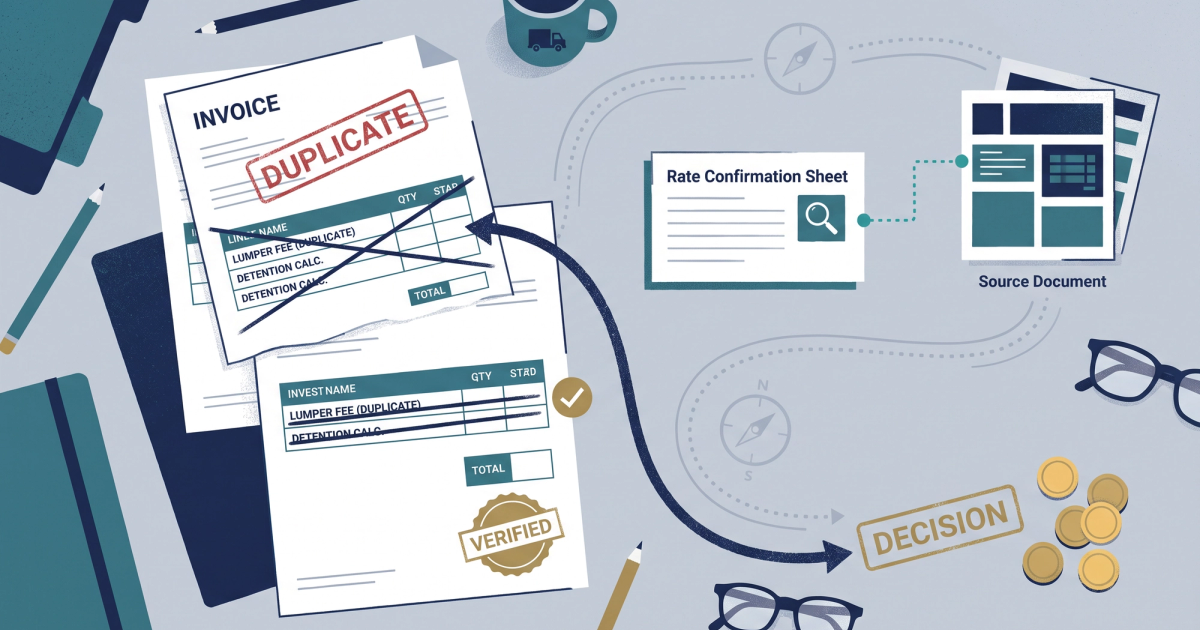
A $180 lumper fee billed twice against the same BOL costs you $180. Miss it four times a month and you have paid $720 for nothing. Miss it across a year and you have handed a carrier $8,640 that was never in the rate con. That is the arithmetic that sells carrier reconciliation services, and it is real. What is less clear is whether the service you are paying to catch that error costs more than the error itself. Most freight audit firms work on contingency: they keep 3 to 5 percent of every dollar they recover, and they take two to three weeks to close a single accessorial dispute. This article breaks down what a carrier invoice audit checks field by field, where human review teams consistently miss money, and how to run the cost math for your own load volume before you sign anything.
Your Margin Is Leaking Through the Invoice, Not the Rate
You negotiate the linehaul hard. You know your lanes. Then the invoice arrives with a detention line you did not authorize, a fuel surcharge computed off a stale index, and a lumper receipt that was already reimbursed on a separate check. None of that showed up when you booked the load. All of it shows up in your margin.
The volume is what makes this expensive. Per the American Trucking Associations industry data, trucks moved roughly 72.7 percent of the nation's freight by weight in 2024, totaling 11.27 billion tons. Every one of those loads generates a rate confirmation, a bill of lading, a proof of delivery, and a freight invoice. On a 500-load month, that is 2,000 documents your billing coordinator is supposed to cross-check before payment goes out. Nobody checks 2,000 documents by hand.
The error rate is not catastrophic on any single load, which is exactly why it survives. MelloHQ's analysis of freight invoice reconciliation challenges puts the share of carrier invoices rated incorrectly at roughly 1 to 2 percent. That sounds small until you apply it to spend rather than count, because the invoices that get rated wrong are disproportionately the ones with accessorials attached, and accessorials carry the biggest per-line dollar swing.
On the recovery side, Cloudsquid's breakdown of freight bill reconciliation reports that companies recover 2 to 4 percent of freight spend through audit and dispute programs. FreightOptics puts the range wider, at 2 to 8 percent of shipping costs recovered through reconciliation. Take the conservative end. On $2 million of annual carrier spend, 2 percent is $40,000 sitting in invoices you already paid.
The money is not lost in the negotiation. It is lost between the rate confirmation and the check.
What Carrier Reconciliation Services Actually Check Line-by-Line
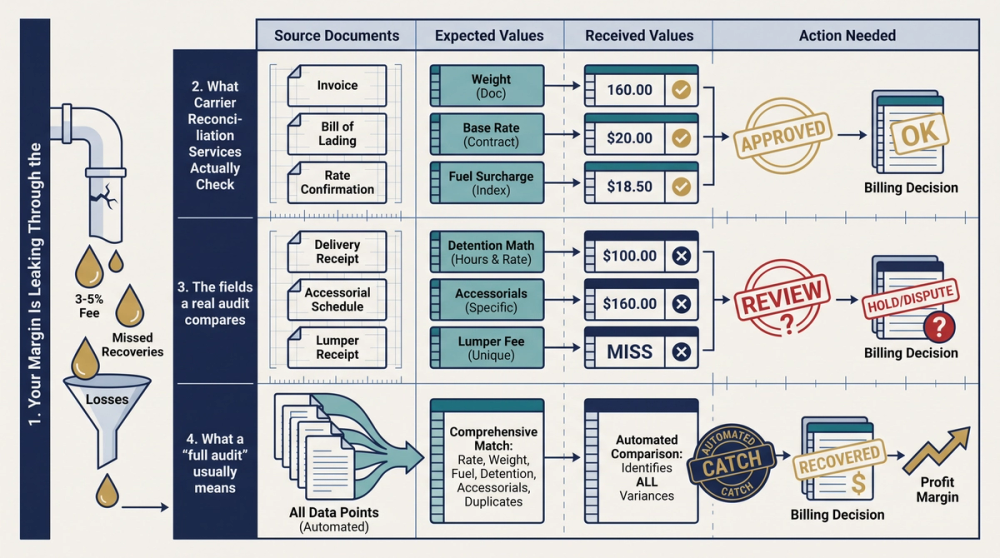
Every reputable carrier invoice audit runs the same core comparison: the freight invoice against the rate confirmation, with the BOL and POD as supporting evidence. The difference between services is how many fields they compare and how deep they go into the supporting documents.
The fields a real audit compares
- Linehaul rate. Invoice amount versus the agreed rate on the rate con. Flat rate, per-mile, or minimum charge, checked against the actual mileage basis used.
- Fuel surcharge. The FSC rate applied, the index date it was pulled from, and the mileage it was multiplied against. This is the single most common quiet overcharge.
- Detention. Free time allowed, arrival and departure timestamps from the BOL or POD, hourly rate, and any cap in the rate con or carrier packet.
- Lumper fees. Receipt attached, amount matching the receipt, and whether that same receipt was already reimbursed on a prior invoice or an advance.
- Layover, TONU, and dry run. Whether the triggering event is documented in dispatch notes, and whether the flat amount matches the agreed schedule.
- Accessorials. Driver assist, pallet exchange, reefer fuel, chassis and per diem on drayage, tarping, extra stops. Each needs an authorization trail.
- Duplicate detection. Same load number, same BOL number, same PRO, invoiced twice under a different invoice number or through a different billing entity.
What a "full audit" usually means in practice
Ask the service how many of those fields they check on every invoice versus on a sample. Many freight audit and payment companies run a full match on linehaul and fuel, then spot-check accessorials, because accessorials require reading a PDF that no EDI feed contains. That is the gap. Automated reconciliation platforms hit high accuracy on structured data: FreightOptics describes 3PL reconciliation automation reaching 90 to 95 percent match accuracy on EDI X12 invoices. But the EDI 210 rarely carries the timestamped BOL that proves detention was 2.5 hours and not 4. If nobody opens the document, the dispute never gets built. We covered which specific line items carriers inflate most often in our breakdown of freight billing reconciliation line items.
The 3 to 5 Percent Cut: What Audit Teams Cost You on Recovered Dollars
Contingency pricing is the default model for traditional freight audit companies, and it sounds risk-free. No recovery, no fee. The catch is that the fee scales with the exact thing you want to grow.
Run the contingency math on your own spend
Say you run $2 million in annual carrier spend and your audit program recovers 2.5 percent, which sits inside the 2 to 4 percent band Cloudsquid reports. That is $50,000 recovered. At a 4 percent contingency fee, you pay $2,000. Fine. Now scale it. At $10 million in spend and the same recovery rate, you recover $250,000 and pay $10,000. The work per invoice did not change. The fee tripled and then some.
Contingency also creates an incentive problem that nobody in a sales meeting will name for you: a contingency-fee auditor makes money on disputes filed and won, not on disputes prevented. There is no revenue in telling you that your rate con template is missing a detention cap, which is the fix that stops the overbilling from happening in the first place.
The hidden line items in an audit contract
- Minimum monthly fee that applies whether or not anything is recovered, common in the $500 to $1,500 range for SMB accounts.
- Implementation and integration fees to connect your TMS, sometimes billed as a one-time setup.
- Per-invoice processing fees stacked on top of the contingency percentage.
- Float on recovered funds, where the audit firm holds recovery for a payment cycle before remitting.
Read the contract for who owns the dispute record. If you leave the vendor, you want your documented variance history, because that history is what gets a carrier to concede quickly the second time. Gartner's reviews of freight audit and payment providers are a reasonable starting point for scoping the vendor landscape, but pricing structure is rarely disclosed publicly. You have to ask directly.
Where Manual Audits Miss Detention, Lumper, and Accessorial Errors
Human reviewers are good at obvious mismatches and bad at arithmetic done across three documents. Here is where the misses cluster.
Detention: the free-time and rounding problem
Detention disputes fail because nobody compares the invoiced hours against the BOL timestamps. A carrier bills 4 hours at $60 per hour after 2 hours free. The BOL shows a 09:14 arrival and an 13:47 departure, which is 4 hours 33 minutes on site, minus 2 hours free, so 2.55 billable hours. Rounded to the nearest quarter hour, that is 2.75 hours, or $165. The invoice says $240. The $75 gap is real, but catching it requires a reviewer to open the POD PDF, read two timestamps, subtract free time, and apply the rounding rule in the carrier packet. On 500 loads a month, that does not happen.
Lumpers: the double-reimbursement trap
Lumper fees get paid twice more often than any other accessorial because they frequently move through two channels. The driver gets a Comchek or advance at the dock, and then the fee appears again as a line item on the final freight invoice with the receipt attached. Both look legitimate in isolation. Only a check against the same BOL number across the advance ledger and the invoice catches it.
Fuel surcharge: the index nobody re-checks
FSC errors are small per mile and enormous in aggregate. If a carrier applies a surcharge computed off a prior week's index and the difference is $0.12 per mile on a 1,200-mile run, that is $144 on one load. Nobody disputes $144. Across 60 loads on that lane in a quarter, it is $8,640. A human reviewer scanning an invoice sees a fuel line that looks normal. A field-level match sees a rate that does not equal the contracted formula.
TONU, layover, and dry run: the authorization gap
These are flat-fee accessorials, which means the amount is usually right and the entitlement is usually the question. Was the truck actually dispatched and canceled? Did the shipper refuse the load, or did the driver miss the appointment window? The proof lives in timestamped dispatch logs and check calls, not on the invoice. A manual audit team does not have access to your dispatch system, so they either accept the charge or send you an email asking about it, which is where the three-week dispute cycle starts.
Rate Con vs. Invoice: The Mismatch That Costs You Most
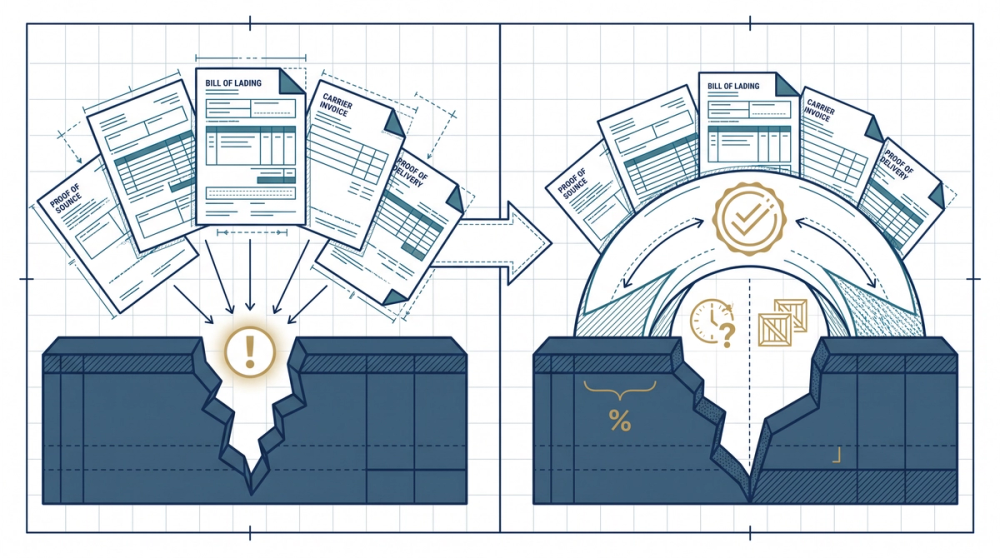
If you only compare one pair of documents, compare the rate confirmation to the freight invoice. That single match catches most of the dollars. The diagram in this section lays out the flow: rate con establishes the agreement, BOL and POD establish what physically happened, and the invoice claims payment. Reconciliation is the process of proving those three tell the same story.
The four mismatch types worth building a rule for
- Rate variance. Invoice linehaul does not equal rate con linehaul. Usually a rebooking or a rate amendment that never made it into the TMS.
- Unauthorized accessorial. A charge appears on the invoice with no matching line on the rate con and no approval in email or dispatch notes.
- Quantity or basis error. Correct rate applied to the wrong mileage, wrong weight, wrong number of stops, or wrong hours.
- Duplicate submission. Same load billed under a second invoice number, or billed by both the carrier and its factoring company.
The reason this mismatch is the most expensive one is that it compounds silently. A carrier that gets paid on an unauthorized $150 driver-assist charge in March will include it again in April. Nothing about your payment behavior told them not to. If you want the plain-language version of how this process works end to end, we wrote it up in what invoice reconciliation actually means in freight.
Keep the records, because you are already required to
Document retention is not just good billing hygiene. Carriers operate under the Federal Motor Carrier Safety Regulations in 49 CFR Part 390, and the FMCSA motor carrier registration and compliance requirements set the operating framework your carrier partners are working inside. Your carrier packet, signed rate cons, and signed PODs are the same file set you will need if a dispute escalates or if a carrier's authority status becomes an issue mid-claim. Build the archive once and it serves both purposes.
How Automated Matching Catches What a Human Reviewer Skips
Automation does not audit better than a good human. It audits every invoice instead of a sample, and it does the same arithmetic identically at 2 a.m. on invoice 480 as it did on invoice 1.
The three steps that actually matter
First, extraction. The system reads the rate con, invoice, BOL, and POD and pulls structured fields: load number, BOL number, linehaul, FSC rate, detention hours, arrival and departure timestamps, lumper amount, accessorial codes. Most of these documents are PDFs and scans, not EDI, which is why extraction quality is the whole ballgame.
Second, matching. Every extracted invoice field gets compared to its counterpart on the rate con, with tolerance rules you set. A $2 variance on a fuel line is noise. A $2 variance on linehaul might mean a rate was amended. You decide the thresholds.
Third, variance output. The system produces a flagged exception with the supporting document reference attached, so your billing coordinator opens a queue of 14 disputes instead of a folder of 500 invoices. That is the difference between a two-hour week and a two-day week.
Where automation still needs a person
Automated matching will not decide whether a TONU was justified when the shipper canceled 90 minutes before the appointment and your dispatcher never logged the call. It will not renegotiate a lane. It flags the variance and hands you the evidence. The judgment call and the carrier relationship stay yours, which is usually the right split. If you want the feature-level comparison, we covered it in invoice reconciliation software that actually catches freight overbilling.
Freight Audit Companies vs. Automated Tools: A Real Cost Comparison
Here is the comparison in the terms that matter: total cost, speed to close a dispute, and coverage percentage.
Total annual cost at three volume tiers
- 150 loads per month, ~$450K annual spend. Contingency audit at 4 percent on 2.5 percent recovery ($11,250 recovered) costs $450 in fees, plus a typical $500 monthly minimum, so roughly $6,450 per year. Flat-fee software at $500 per month costs $6,000. Roughly a wash on cost, but the software runs on every invoice instead of a sample.
- 500 loads per month, ~$1.8M annual spend. Contingency at 4 percent on $45,000 recovered costs $1,800 plus minimums, call it $7,800. Flat-fee software at $500 per month is $6,000, and coverage is 100 percent of invoices rather than a sampled subset.
- 2,000 loads per month, ~$7.2M annual spend. Contingency at 4 percent on $180,000 recovered costs $7,200 in fees alone, before minimums or per-invoice charges. Flat-fee tooling at $500 to $1,500 per month lands between $6,000 and $18,000 and does not scale with your recovery.
These are illustrative structures using the 2 to 4 percent recovery band reported by Cloudsquid and the flat-fee and contingency models common in the market, not vendor-published pricing. Build the same table with your own spend and your own quoted rates. The pattern holds: contingency is cheapest at low volume and gets expensive fast as recovery grows, because you are paying a percentage of your own money back.
Speed is the underrated variable
A contingency audit team works in batches, often monthly, and files disputes after you have already paid. Recovery then means a credit memo or a refund, which is a collections problem. Automated matching flags the variance before payment goes out, which turns a refund request into a short-pay with documentation attached. Short-pay with proof closes in days. A refund request against a carrier that has already been paid closes in weeks, if it closes.
Do You Need a Carrier Invoice Audit Process or a Reconciliation Tool?
Answer four questions honestly before you buy anything.
- How many invoices per month do you actually review line-by-line? If the honest answer is under 30 percent, you have a coverage problem, not a headcount problem. Software fixes coverage. More reviewers fix throughput.
- Where do your documents live? If rate cons are in email, PODs are in a shared drive, and invoices come in three formats, extraction is your bottleneck before matching is. Fix document capture first.
- Do you pay before or after review? Paying first turns every error into a collection. Any process change that moves review ahead of payment is worth more than the tool you use to do it.
- What is your recovery rate today? If you cannot state it, you do not have an invoice reconciliation process. You have a habit of catching the big ones.
The broader financial pressure is not going away. IBISWorld's long-distance freight trucking industry analysis documents thin operating margins across the sector, which is exactly why carriers bill aggressively on accessorials and why your side of the ledger needs the same discipline.
Examples: Running the Numbers on Three Disputes
Three scenarios with the arithmetic shown, because the abstract percentages only matter when you attach them to a load.
Example: the $180 lumper billed twice
Load 44812, dry van, Chicago to Memphis. Driver pays a $180 lumper at the receiver and gets a Comchek advance the same day. Eleven days later, the carrier's freight invoice arrives with a $180 lumper line and the same receipt attached. Step one: match the BOL number on the invoice against the advance ledger. Step two: compare receipt numbers, both read the same. Step three: short-pay the invoice by $180 with the advance record attached. Total time with an automated duplicate check: under five minutes. Total time if nobody checks: $180 gone, and the same pattern repeats on the next four loads through that receiver, for $900.
Scenario: detention billed at 4 hours when the POD shows 2.5
Reefer load, Fresno to Denver. Rate con allows 2 hours free at the shipper, detention at $60 per hour thereafter, capped at $300. Invoice bills 4 hours at $60, which is $240. The signed BOL shows arrival 06:12 and departure 10:41, or 4 hours 29 minutes on site. Subtract 2 hours free and you get 2 hours 29 minutes, rounded to 2.5 billable hours, or $150. Variance: $90. Now apply it across a lane where detention hits on 30 percent of loads. At 500 loads per month and a 30 percent detention rate, that is 150 detention events. If even one in five carries a $90 rounding or free-time error, that is $2,700 per month, or $32,400 a year, on one accessorial type.
Example: fuel surcharge computed off a stale index
Flatbed, 1,200 miles. Contracted FSC formula produces $0.41 per mile for the delivery week. The carrier bills $0.53 per mile using a prior index. Difference: $0.12 per mile, or $144 on one load. Nobody disputes $144 on a $3,100 invoice. Run 60 loads on that lane per quarter and the error is $8,640 per quarter, or $34,560 annually. A field-level FSC check against the contracted formula catches this on invoice number one, before it becomes a pattern.
Scenario: TONU closed in 48 hours instead of 3 weeks
Carrier bills a $250 TONU. Your dispatch log shows the driver was released at 07:40 after the shipper pushed the appointment, and the carrier accepted a replacement load out of the same market at 09:15. With timestamped dispatch records pulled and attached to the dispute in one pass, the carrier concedes in 48 hours. Routed through a monthly audit batch instead, the same dispute goes out three weeks later against an invoice you already paid, and now it is a credit request competing with the carrier's own AR priorities. Same $250, radically different close rate.
The common thread across all four is that the evidence already existed. It was sitting in a BOL, a POD, an advance ledger, or a dispatch log. Nobody had time to pull it. Tools that match every invoice line against the rate confirmation and flag variances before payment exist to remove the time cost of pulling that evidence, not to replace your judgment about which disputes are worth filing.
Frequently Asked Questions
What is a typical contingency fee for carrier reconciliation services?
Most freight audit and payment companies charge between 3 and 5 percent of recovered dollars, frequently with a monthly minimum on top. Ask specifically whether the percentage applies to gross recovery or net of any credits you would have caught anyway, and whether implementation, per-invoice, and integration fees are separate. Gartner's freight audit and payment provider reviews are useful for scoping vendors, though pricing is almost never published and has to be quoted.
How much can a carrier invoice audit realistically recover?
Cloudsquid reports companies recover 2 to 4 percent of freight spend through audit and dispute programs, and FreightOptics puts the range at 2 to 8 percent of shipping costs. Where you land depends heavily on your accessorial mix. Brokers with a lot of drayage, reefer, and multi-stop freight see more variance because there are more billable events per load to get wrong.
Can automated reconciliation handle PDF invoices, or does it need EDI?
EDI-based matching reaches high accuracy on structured data, with FreightOptics citing 90 to 95 percent match accuracy on EDI X12 invoices in 3PL reconciliation. The problem is that small carriers rarely send EDI, and the documents that prove accessorial disputes (signed BOLs, PODs, lumper receipts) are almost always scans. Any tool you evaluate needs to pull fields off PDFs and images, not just parse EDI feeds.
Should I short-pay a disputed carrier invoice or pay and request a credit?
Short-pay with documentation attached, when your carrier agreement allows it, closes disputes faster because the carrier has to respond to collect. Paying in full and requesting a credit puts you in line behind everything else in the carrier's AR queue. Either way, attach the specific document and the specific field: "POD timestamps show 2h29m on site against 2 hours free" gets resolved. "Detention looks high" does not.
Do FMCSA rules cover detention billing disputes?
Not directly as a rate-setting matter. FMCSA governs motor carrier registration, safety, and operating authority under the Federal Motor Carrier Safety Regulations in 49 CFR Part 390, while detention rates and free time are contractual terms between you and the carrier. That is why your rate confirmation and carrier packet language matter so much: they are the enforceable document in a detention dispute, not a federal rule.
Sources
- Economics and Industry Data — American Trucking Associations
- Motor Carriers — Federal Motor Carrier Safety Administration, U.S. Department of Transportation
- 49 CFR Part 390, Federal Motor Carrier Safety Regulations — Electronic Code of Federal Regulations
- Freight Bill Reconciliation: How to Catch Carrier Errors — Cloudsquid
- 3PL Freight Reconciliation: Find and Fix Errors Before They Cost — FreightOptics
- Solving Common Freight Invoice Reconciliation Challenges — MelloHQ
- Best Freight Audit and Payment Providers Reviews — Gartner
- Long-Distance Freight Trucking in the US Industry Analysis — IBISWorld
The Short Version
Carrier reconciliation services earn their fee on the disputes you would never have found. They lose it on the percentage they keep as your recovery grows, and on the two to three weeks it takes to close an accessorial dispute after payment has already gone out. The fields that matter are the same either way: linehaul, fuel surcharge, detention hours against BOL timestamps, lumper receipts against advance ledgers, and duplicate BOL numbers. Check all of them on every invoice, before you pay, and the recovery percentage stops being a vendor's selling point and starts being your baseline.
If the bottleneck on your side is that nobody has time to open 2,000 PDFs a month, that is a document problem before it is an audit problem. Pulling load numbers, timestamps, and accessorial amounts directly off rate cons, BOLs, and PODs automatically is what makes line-by-line matching possible at your volume instead of theoretical. Start by measuring your current recovery rate for one month. If you cannot calculate it, you already have your answer.