The Invoice Reconciliation Template Built for Freight Brokers
Researched and written with AI assistance. Reviewed by the Laneproof team.

A broker moving 100 loads per month at an average of $2,400 per load who doesn't catch a 3.8% overbill on detention alone is losing roughly $9,100 every month. That's $109,200 per year walking out the door on a single accessorial category. The fix isn't complicated, but it does require a process. Specifically, it requires an invoice reconciliation template built for freight, not one borrowed from an accounts payable team that has never seen a rate con or a lumper receipt. Every top search result for "invoice reconciliation template" gives you a generic Excel grid designed for matching supplier statements to purchase orders. That's not your world. Your world is BOL timestamps, detention windows, fuel surcharges added post-delivery, and carrier invoices that don't match what the rate confirmation agreed to. This guide gives you the exact template columns, the step-by-step reconciliation process, and the specific line items where carriers overbill most often.
What Is Invoice Reconciliation in Freight (and Why Your Current Process Is Costing You Money)
Invoice reconciliation in freight is the process of comparing a carrier's invoice against the original rate confirmation, the Bill of Lading (BOL), and the Proof of Delivery (POD) to confirm that every charge is accurate, documented, and agreed upon. If there's a variance between what was quoted and what was billed, you flag it, dispute it, and recover the difference before paying.
That definition sounds simple. In practice, it breaks down fast. According to a Metaport analysis of freight billing errors, up to 20% of freight invoices contain some form of billing error. These aren't just rounding mistakes. They include inflated detention charges, undocumented accessorials, duplicate fuel surcharges, and lumper fees billed without receipts.
The problem isn't that brokers don't know about these errors. The problem is that the reconciliation process itself takes so long that errors slip through. A billing coordinator spending 6 hours per week on manual reconciliation across 300 loads per month, at a $35/hour ops cost, burns $10,920 per year in labor just for invoice review. That's before you count the overbills that weren't caught because someone was rushing through the last 40 invoices on a Friday afternoon.
If your current process is a spreadsheet with three columns (carrier name, expected amount, actual amount), you're missing the line items where the real money disappears. Detention, lumper fees, layover, TONU, and fuel surcharges each need their own tracking fields. Without them, you're reconciling at the summary level and missing the line-item detail where carriers pad invoices. For a deeper look at where those hours go and how to cut them, read through this breakdown of the freight invoice reconciliation process.
The Freight Invoice Reconciliation Template: Every Line Item You Need to Check
A freight invoice checklist that actually works needs more than just "amount billed" and "amount expected." According to Apex Capital's guide to building a freight bill, a proper freight bill reconciliation package requires at minimum three documents: an invoice page, a rate confirmation sheet, and a Bill of Lading. Your template needs to track the data from all three, side by side, on every single load.
Core Template Columns
Here are the columns your invoice reconciliation template needs. Each one exists because it catches a specific type of billing discrepancy in freight operations:
- Load ID — Your internal reference number. Every document (rate con, BOL, POD, carrier invoice) should tie back to this.
- Carrier Name — Track patterns by carrier. Some carriers overbill systematically; you need the data to prove it.
- Rate Con Amount — The agreed linehaul rate from the rate confirmation. This is your baseline.
- Carrier Invoice Amount — The total the carrier actually billed. Compare against the rate con amount to calculate variance.
- Variance ($) — The difference between rate con and invoice. Positive variance means the carrier billed more than agreed.
- Accessorial Type — Detention, lumper, layover, TONU, fuel surcharge, drayage, or other. Each needs its own entry because each has different documentation requirements.
- Accessorial Amount Billed — The dollar amount the carrier charged for the accessorial.
- Accessorial Amount Approved — What your records, timestamps, and agreements actually support.
- Supporting Doc Attached (Y/N) — Is the lumper receipt, detention log, or timestamp documentation actually present? If this field says "N," the charge gets disputed.
- BOL In/Out Timestamps — Pulled directly from the BOL or facility log. Used to verify detention eligibility.
- POD Delivery Timestamp — Confirms whether delivery was on time. Kills false layover and late-delivery accessorial claims.
- Dispute Status — Open, Submitted, Resolved, or Written Off. Track every dispute to close the loop.
- Resolution Date — When the dispute was settled. Aging disputes cost you money in delayed payments and strained carrier relationships.
- Amount Recovered — The actual dollars clawed back. This is your ROI metric for the entire reconciliation process.
Why These Columns Matter More Than a Generic Template
The U.S. Department of Transportation even provides an invoice summary Excel template for infrastructure projects, but it's designed for construction billing, not freight. Most reconciliation templates you'll find online follow that same pattern: they assume you're matching a purchase order to a supplier statement. In freight, the "purchase order" is a rate confirmation, the "receipt" is a BOL/POD combo, and the "supplier statement" is a carrier invoice that may include line items nobody agreed to. Your template has to reflect that reality.
Where Carriers Overbill Most Often: The Dollar Amounts That Add Up Fast
Not all billing discrepancies in freight are equal. Some are $15 fuel surcharge rounding. Others are $200 detention charges on a 47-minute wait. If you want to focus your carrier invoice audit where it actually recovers money, here's where to look first.
Detention Charges
Detention is the most commonly overbilled accessorial in freight. The standard industry practice is a 2-hour free time window at pickup or delivery, after which detention accrues at $50 to $100 per hour. The problem: carriers round up aggressively, and many brokers don't cross-reference BOL timestamps to verify the actual wait time. For a detailed look at which line items get inflated most often, see this guide to freight billing reconciliation and the line items carriers inflate.
Scenario: Detention charged at 2 hours when the BOL shows a 47-minute wait. The carrier invoices $150 for 2 hours of detention at $75/hour. You pull the BOL: driver checked in at 10:13 AM, loaded and released at 11:00 AM. Total facility time: 47 minutes. That's well within the standard 2-hour free time. The entire $150 charge is invalid. On 100 loads per month, if even 10% carry this type of inflated detention, that's $1,500/month in false charges.
Lumper Fees Without Receipts
Lumper fees are legitimate costs at many grocery and retail distribution centers. But they require documentation: a receipt from the lumper service, attached to the POD, with the amount matching what the carrier bills.
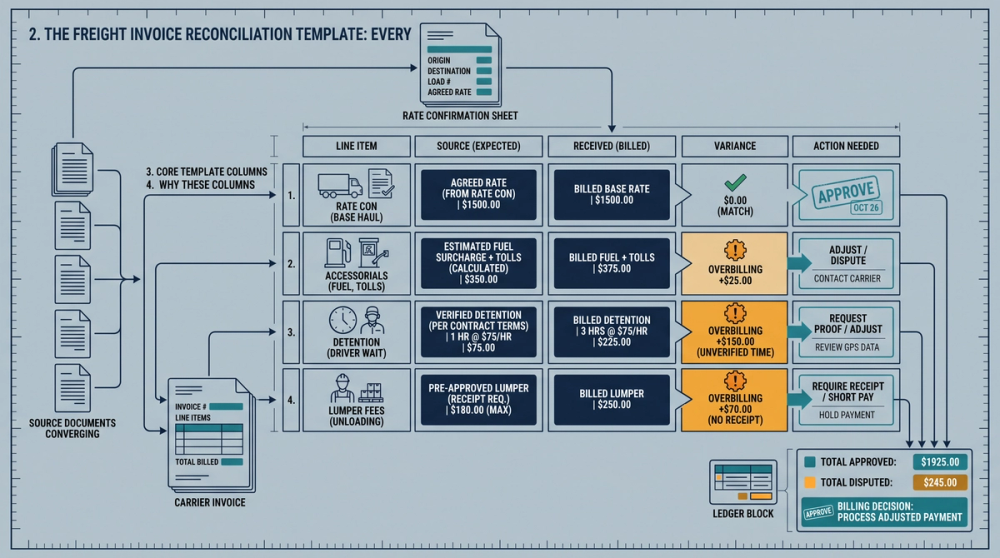
Scenario: A lumper fee billed at $185 with no receipt attached to the POD. The carrier invoice shows a $185 lumper charge on a load delivered to a grocery DC. You check the POD packet: no lumper receipt. The dispute is straightforward. Here's the exact language you send back:
"Carrier invoice includes a lumper fee of $185 on Load #4821. No lumper receipt was included with the POD packet. Per our rate confirmation, all accessorial charges require supporting documentation. Please provide the original lumper receipt or this charge will be deducted from payment."
No receipt, no payment. This is one of the simplest disputes to win, but only if your template has a "Supporting Doc Attached" column that forces someone to check.
Post-Delivery Fuel Surcharges
Fuel surcharges should be agreed upon in the rate confirmation before the load moves. Some carriers add or inflate the fuel surcharge on the invoice after delivery, treating it as a line item the broker won't scrutinize.
Scenario: Rate con shows $1,750 linehaul. Carrier invoices $1,950 with an undocumented fuel surcharge. The rate confirmation is clear: $1,750 all-in. The carrier invoice arrives at $1,950, with a $200 "fuel surcharge" line item that wasn't on the original rate con. Using the template, you compare the Rate Con Amount ($1,750) to the Carrier Invoice Amount ($1,950), see the $200 variance, check the Accessorial Type column (fuel surcharge), and verify there's no supporting documentation or rate con amendment. Dispute filed, $200 recovered.
TONU on Rescheduled Pickups
A Truck Order Not Used (TONU) charge is valid when a carrier is dispatched to a pickup and the load is fully cancelled. It is not valid when the shipper reschedules the pickup to a later time or date and the carrier accepts the rescheduled appointment.
Scenario: TONU billed on a load where the carrier accepted a rescheduled pickup rather than a full cancellation. The carrier invoices a $350 TONU. Your records show the original pickup was rescheduled from Monday to Wednesday, and the carrier confirmed the new appointment via email and completed the load. A TONU applies to cancellations, not schedule changes that the carrier agreed to and fulfilled. The load was delivered. The TONU is invalid. Track this in the Accessorial Type column as "TONU" and document the rescheduled confirmation in the Supporting Doc field.
False Layover Charges
Layover charges are billed when a driver has to wait overnight (or longer) between pickup and delivery due to shipper or receiver scheduling. But some carriers bill layover on loads that delivered on time.
Scenario: Accessorial charges for layover billed on a load that delivered on time per the POD. The carrier adds a $250 layover charge. You pull the POD: delivery timestamp shows the load arrived within the original delivery window. No delay occurred. The POD timestamp kills this dispute instantly, but only if you catch it. If your template doesn't have a POD Delivery Timestamp column, this $250 sails right through to payment.
How to Reconcile a Freight Invoice Step by Step
Here's the process for reconciling a single freight invoice using the template above. This is the workflow your billing coordinator or ops team should follow on every load.
Step 1: Pull the Three Core Documents
For every load, gather the rate confirmation, the carrier invoice, and the BOL/POD packet. Per 49 CFR Part 373, every motor carrier must issue a receipt or bill of lading for property tendered for transportation in interstate or foreign commerce. If the carrier hasn't provided a complete BOL, that's a documentation gap worth flagging before you even look at the invoice.
Step 2: Enter the Baseline Data
In your template, enter the Load ID, Carrier Name, and the Rate Con Amount. This is your agreed-upon cost for the load. It should include the linehaul rate and any pre-approved accessorials documented on the rate confirmation.
Step 3: Enter the Carrier Invoice Total and Calculate Variance
Enter the Carrier Invoice Amount. The template should automatically calculate the Variance column (Carrier Invoice Amount minus Rate Con Amount). If the variance is zero, the load matches. If positive, the carrier billed more than agreed. If negative, double check for credits or short-bills.
Step 4: Break Down Every Accessorial Line Item
This is where most brokers skip steps and lose money. For every accessorial on the carrier invoice (detention, lumper, fuel surcharge, layover, TONU, or anything else), enter a separate row or column entry. Record the Accessorial Type, the Amount Billed, and whether a Supporting Doc is Attached. This is your accessorial charge tracking system.
Step 5: Cross-Reference Timestamps
Pull the BOL in/out times and the POD delivery timestamp. Enter them in the template. Compare detention claims against actual facility time. Compare layover claims against delivery windows. This single step catches the majority of detention fee overbilling.
Step 6: Flag, Dispute, and Track
Any load with a positive variance or an unsupported accessorial gets a Dispute Status of "Open." Send the dispute to the carrier with specific documentation (rate con, BOL timestamps, missing receipt callout). Update the status to "Submitted." When resolved, log the Resolution Date and the Amount Recovered. For a ready-to-use checklist that complements this process, see the carrier invoice audit checklist.
What 3-Way Matching Looks Like in a Freight Operation
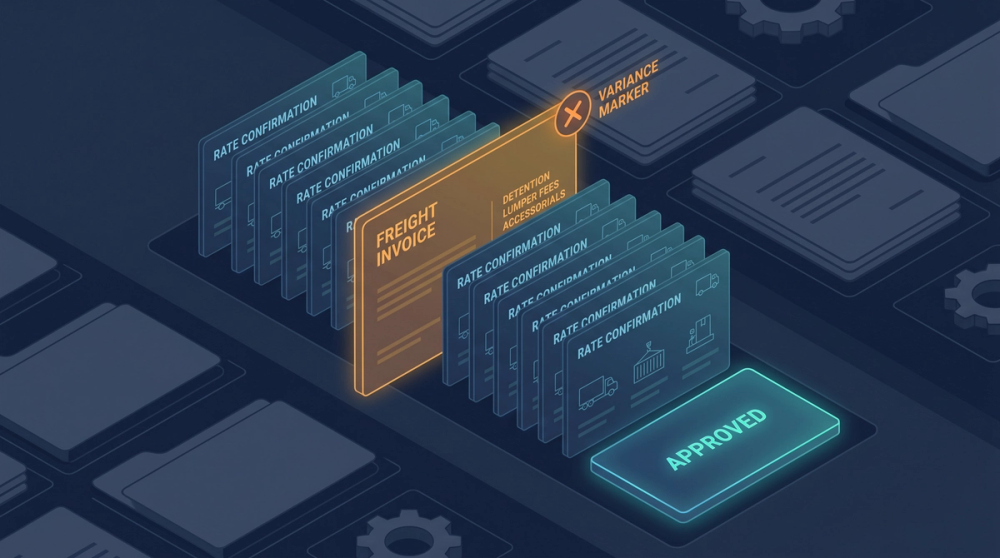
Three-way matching is a standard accounting control, but in freight it works differently than in traditional procurement. According to Microsoft's documentation on freight reconciliation in transportation management, the reconciliation process can be done manually or automatically, but it always requires matching the freight invoice against expected costs derived from shipment data.
The Three Documents in Freight 3-Way Matching
In a typical accounts payable operation, 3-way matching means purchase order, goods receipt, and vendor invoice. In freight, those translate to:
- Rate Confirmation (the "purchase order"): The agreed price and terms between broker and carrier before the load moves.
- BOL/POD (the "goods receipt"): Proof that the shipment was picked up and delivered, including timestamps, condition notes, and any facility-level documentation like lumper receipts or detention logs.
- Carrier Invoice (the "vendor invoice"): The carrier's bill for the completed load, including linehaul and any accessorial charges.
The match works like this: the carrier invoice amount should equal the rate confirmation amount, and the BOL/POD should confirm that the services billed (detention time, lumper use, delivery timing) actually occurred as claimed. If any of the three documents contradict each other, you have a billing discrepancy.
Why Document Errors Cause Most Mismatches
According to a Klippa analysis of logistics document handling, 57% of logistics executives report shipment delays due to document errors, especially incorrect or missing invoice data. In a freight brokerage, these document errors don't just cause delays. They cause payment errors. A missing BOL means you can't verify detention. A POD without a timestamp means you can't disprove a layover claim. A rate con that wasn't uploaded to your TMS means your billing coordinator has to hunt for the agreed rate before they can even start the comparison.
Your invoice reconciliation template is only as strong as the documents feeding into it. If your carrier packet intake process doesn't require all three documents before payment processing begins, you're reconciling blind on every load that's missing a piece.
Manual vs. Automated 3-Way Matching
Manual 3-way matching means a human opens the rate con, opens the carrier invoice, opens the BOL/POD, and compares them line by line. At 300 loads per month, that's roughly 6 hours per week of pure comparison work. According to Avantiico's analysis of freight invoice automation, automating this process eliminates the cost overruns that come from manual overcharging detection, late delivery disputes, and damaged goods claims that go uncaught.
The template in this guide is designed for teams doing manual reconciliation today. It gives you structure, consistency, and a paper trail. But if you're processing hundreds of loads per month, the math on automation is hard to ignore: 6 hours per week at $35/hour is $10,920 per year in labor, and that doesn't account for the overbills that still slip through human review.
Frequently Asked Questions About Freight Invoice Reconciliation
What is a reconciliation invoice?
A reconciliation invoice is the carrier's bill for a completed freight load, reviewed against the original rate confirmation and delivery documents (BOL and POD) to confirm that every charge is accurate. In freight, this means verifying the linehaul rate matches the rate con, confirming that accessorial charges like detention and lumper fees are supported by documentation, and flagging any variance for dispute before payment is issued.
How are invoices reconciled in freight?
Freight invoices are reconciled by comparing the carrier invoice to the rate confirmation (for agreed pricing) and the BOL/POD (for service verification). The process involves: (1) pulling all three documents for the load, (2) comparing the total billed against the total agreed, (3) checking each accessorial line item for documentation, (4) verifying timestamps against detention and layover claims, and (5) filing disputes on any charges that aren't supported. A structured template with columns for variance, accessorial type, and supporting documentation makes this repeatable across every load.
What is 3-way reconciliation in freight?
Three-way reconciliation in freight means matching three documents: the rate confirmation (what was agreed), the BOL/POD (what actually happened), and the carrier invoice (what was billed). All three must align for a load to be paid without dispute. If the carrier invoice exceeds the rate con, or if an accessorial charge isn't supported by the BOL/POD, that's a mismatch that requires investigation before payment.
Can AI or automation handle freight invoice reconciliation?
Yes, and adoption is accelerating. Tools that extract data from rate cons, BOLs, and carrier invoices can automatically compare line items, flag variances, and surface unsupported accessorials. For teams processing more than a few dozen loads per week, automation eliminates the hours spent on manual line-by-line comparison and catches discrepancies that human review misses under time pressure.
How often should freight brokers reconcile invoices?
Every load, every time. Reconciliation should happen before payment is issued, not as a batch process at the end of the month. Monthly reconciliation means you're paying first and disputing later, which makes recovery harder and gives carriers less incentive to fix billing practices. The template in this guide is designed for per-load use so that no invoice gets paid without a documented comparison.
Sources
- 49 CFR Part 373: Receipts and Bills — Electronic Code of Federal Regulations
- Invoice Summary Excel Template — U.S. Department of Transportation, Build America
- How to Automate Freight Invoice Reconciliation in Dynamics 365 Finance — Avantiico
- Reconcile Freight in Transportation Management — Microsoft Learn
- Reconcile Loads, Orders & Freight Invoices Automatically — Klippa
- Manual Freight Reconciliation: Hidden Costs & How to Automate — Metaport
- How to Build a Freight Bill Like A Pro — Apex Capital
Stop Paying for Charges You Never Agreed To
The template and process in this guide exist for one reason: to make sure you never pay a carrier invoice without comparing it, line by line, against the rate confirmation and delivery documents. Detention padding, undocumented lumper fees, phantom fuel surcharges, and false layover claims add up to thousands of dollars per month for a broker moving even modest volume. The fix isn't more people. It's a better process that forces every charge through documentation checks before payment.
Start with the template columns outlined above. Build the habit of per-load reconciliation. Track your Amount Recovered column monthly to prove the ROI to yourself. And if your team processes more than 50 invoices a week, tools that automatically match carrier invoices against rate cons can catch the discrepancies this guide teaches you to find, without the 6 hours of manual comparison every week.
Full guide: Invoice Reconciliation for Freight Brokers: Stop Paying Carrier Overbills