Rate Confirmation Trucking: The Fields That Cost You Money
Researched and written with AI assistance. Reviewed by the Laneproof team.
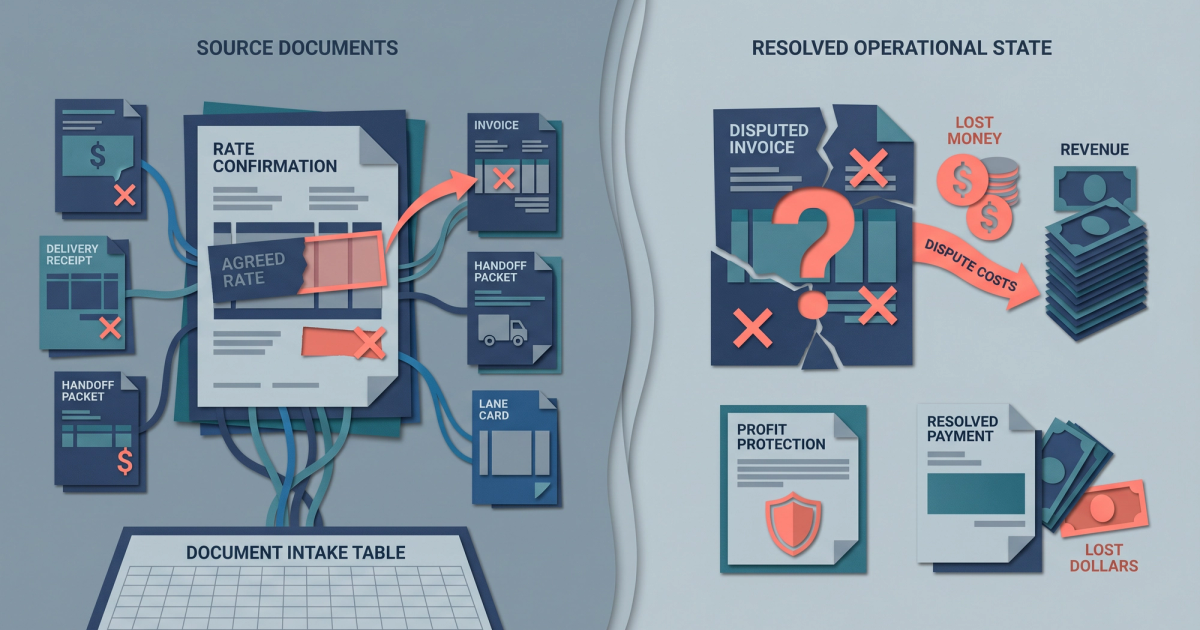
A rate confirmation in trucking is a legally binding agreement between a freight broker and a carrier that specifies the rate, pickup and delivery details, and terms governing a specific load. It should be the document that settles every billing question before one arises. In practice, most rate cons leave enough ambiguity that carriers can invoice hundreds of dollars above the agreed rate, and brokers have no contractual ground to push back. According to DAT's official documentation, a rate confirmation is a "legally binding agreement of pay between the freight broker and carrier." But "legally binding" only protects you if the fields on that document are specific enough to hold up in a dispute. A rate con that says "detention applies after delay" instead of specifying free time, hourly rate, and a cap gives the carrier the pen to write their own invoice. This guide breaks down the specific fields where that happens, how much each one costs, and what to write instead.
What Is a Rate Confirmation in Trucking and Why Most of Them Have Holes
Every load you broker should start with a rate confirmation. The rate con locks in the linehaul rate, pickup and delivery locations, load details, and any accessorial terms between you and the carrier. It is the single document your billing team uses to reconcile the carrier invoice against what was agreed. When that document is tight, disputes are fast: you point to the field, show the number, and the conversation is over. When it is loose, you spend hours pulling BOLs, calling dispatchers, and eating charges you never agreed to.
Why Most Rate Cons Fall Short
The problem is not that brokers do not know what a rate con is. The problem is that most rate cons are built from templates that were last updated years ago, or they are generated by a TMS that auto-fills some fields and leaves others blank. According to Tai TMS documentation, a traditional PDF rate confirmation takes a freight broker a minimum of 15 minutes to fill out manually. When you are moving 30, 50, or 100 loads a day, that time pressure means corners get cut. Accessorial fields get marked "TBD" or "per agreement." Detention clauses use vague language. Fuel surcharge references skip the index. Every one of those shortcuts creates an opening for a carrier to invoice above the rate you intended to pay.
The result: brokers reconciling 200 loads per month with vague accessorial fields spend an estimated 6 to 9 hours per week on manual invoice review. That is time your ops team burns not because the work is complex, but because the rate con did not do its job at booking. If you want a deeper look at the most common template mistakes, read what brokers consistently get wrong on rate confirmations.
The Regulatory Backdrop You Should Know
Rate con requirements are also shifting on the regulatory side. FMCSA Docket No. FMCSA-2023-0257 proposes clarifying broker transparency obligations so that all parties to a brokered freight transaction have a clearer right to review the broker's record of the transaction. The January 2025 proposed rulemaking signals that regulators are looking more closely at what brokers disclose on rate confirmations. Even if the final rule does not change your day-to-day operations, the direction is clear: vague rate cons carry more risk than they used to.
The Fields That Create the Most Expensive Carrier Invoice Disputes
Not every field on a rate confirmation carries equal risk. Some are informational (driver name, MC number). Others are financial. The fields below are the ones where missing or vague language directly leads to overbilling. If your rate con template does not address each of these with specific numbers and defined terms, you are exposed.
Linehaul Rate and What "All-In" Actually Means
The linehaul rate is the largest number on the rate con and usually the least disputed, because it is the number both parties negotiate directly. The problem shows up when the rate con describes the linehaul as "all-in" without defining what "all-in" excludes. As FreightWaves notes in their rate con breakdown, carriers and brokers need to be clear about what charges fall inside and outside the linehaul figure.
Scenario: Your rate con shows a linehaul of $1,850 all-in. The carrier picks up the load, but the consignee refuses it on the first attempt. The carrier reattempts delivery the next day and invoices a $250 TONU on the first attempt, arguing that "all-in" covers only successful delivery. Your rate con does not specify what all-in excludes, so you have no contractual basis to reject the charge. That is $250 gone on a single load.
The fix: Replace "all-in" with an explicit list. "Rate of $1,850 includes linehaul, fuel surcharge, and one delivery attempt. TONU, layover, detention, and accessorial charges are governed by sections below. Charges not listed are not covered under this rate confirmation." That sentence takes 30 seconds to add and saves you money every time a carrier tries to bill outside the agreement.
Fuel Surcharge Without an Index Reference
Listing a fuel surcharge as a percentage without citing the specific index and effective date is one of the most common rate con mistakes. Different fuel surcharge tables can produce different numbers on the same load.
Scenario: Your rate con states "fuel surcharge of 22%." The carrier invoices using a fuel surcharge table that calculates 24.5% based on a different DOE regional average. On a $1,800 linehaul, that 2.5% difference is $45. Across a week of loads with the same carrier, it adds up. On a $7,200 linehaul lane, a single load overbill hits $180.
The fix: Specify the index, the effective date range, and the calculation method. "Fuel surcharge per DOE National Average as published on [date], applied to linehaul at [X]%. FSC schedule attached as Exhibit A." For more on how carriers use these fields to bill above the agreed rate, see rate con fields carriers use to overbill you.
Missing Accessorial Caps
The accessorial section is where most billing disputes live. When a rate con does not define specific dollar caps for charges like liftgate, inside delivery, or pallet exchange, carriers fill the gap with their own rate sheet.
Scenario: A carrier uses a liftgate at delivery. The rate con does not mention liftgate service at all. The carrier invoices $210 for the liftgate, citing their standard accessorial schedule. You never verbally agreed to the charge, but because the rate con did not explicitly exclude it, you cannot prove it was not covered. The invoice gets paid.
The fix: List every accessorial you are willing to pay, with a dollar cap for each. Then add a catch-all: "Accessorial charges not listed in this rate confirmation will not be paid unless approved in writing by [broker name] prior to the charge being incurred." That one line is worth thousands of dollars over a year.
Detention, Lumper, and Accessorial Language That Carriers Use Against You
Detention and lumper fees are the two accessorial categories that generate the most disputes for SMB freight brokers. They are also the two categories where rate con language matters most, because the dollar amounts are high enough to fight over but low enough that many brokers just pay them to avoid the hassle. That habit adds up fast.
Detention Clauses That Give Carriers a Blank Check
A detention clause that says "detention applies after delay" without defining free time, hourly rate, or a maximum cap is not a clause. It is an invitation.
Scenario: Your rate con includes the line "detention applies after delay at origin or destination." The carrier sits at a shipper for 2.5 hours and invoices $450 for detention, claiming 1 hour of free time and $225/hour after. Your rate con never defined free time as 2 hours (which is the standard you intended). The carrier argues 1 hour is industry standard for their fleet. You have no written number to point to. You pay the $450.
The fix: Write detention clauses with three numbers: free time in hours, hourly rate after free time, and a per-occurrence cap. "Detention: 2 hours free time at origin and destination. After free time, $75/hour, capped at $300 per occurrence. Detention must be documented on the BOL or POD with facility sign-off and timestamps." That documentation requirement matters. Without it, you are relying on the carrier's word for how long they waited.
Lumper Fee Language That Costs You on Every Grocery Load
Lumper fees are common on grocery and retail loads, and they are notoriously hard to verify after the fact. A rate con that says "lumper fee may apply" is functionally useless for invoice reconciliation.
Scenario: Your rate con states "lumper fee may apply." The carrier invoices $375 for a lumper at a grocery distribution center. You ask for a receipt. The carrier provides one, but it is from a third-party lumper service with no facility notation on the BOL. You have no way to cross-reference the charge against the delivery paperwork. You have no cap to challenge the amount. You pay $375.
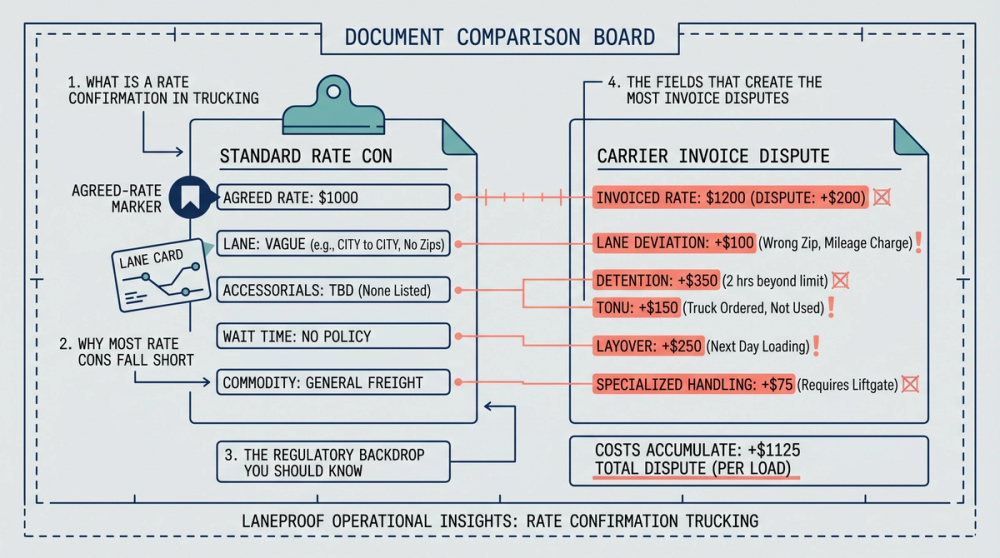
The fix: Replace "may apply" with a cap and a documentation requirement. "Lumper fees reimbursed up to $250 per occurrence with original lumper receipt required. Receipt must include facility name, date, and driver signature. Lumper fees exceeding $250 require pre-approval from [broker name] before incurring the charge." This gives you a number to enforce and a paper trail to verify.
For a broader look at how carrier agreement gaps create overbilling exposure across every load, see rate agreement gaps carriers use to overbill you.
How to Read a Rate Con Like You Are Already in a Dispute
Most brokers read their rate cons at booking, when everything looks fine. The right time to read a rate con is when you are building it, and you should read it as if the carrier is already disputing an invoice. Every field should answer the question: if the carrier invoices $200 more than I expect, does this field give me a specific number or term to point to?
The Five-Point Rate Con Audit
Before you send any rate confirmation, run through these five checks:
- Linehaul specificity: Does the rate state exactly what is included and what is not? If it says "all-in," is there an exclusion list?
- Fuel surcharge source: Is a specific DOE index and effective date cited? Can the carrier calculate the same number you expect using only what is on this document?
- Detention numbers: Are free time hours, hourly rate, and per-occurrence cap specified for both origin and destination? Is BOL or POD documentation required?
- Accessorial caps and catch-all: Is every anticipated accessorial listed with a dollar cap? Is there a catch-all clause that requires written pre-approval for unlisted charges?
- BOL match requirements: Does the rate con state that carrier invoices must match the BOL for weight, stop count, and delivery confirmation before payment is issued?
If any of those five points is missing or vague, you have a field that will cost you money. CarrierAssure's analysis of rate con language risks confirms that vague rate con wording creates transparency problems that directly lead to billing disputes between brokers and carriers.
Cross-Referencing the Rate Con Against the BOL
Your rate confirmation and your bill of lading (BOL) should tell the same story. If the rate con says the load is 40,000 lbs and the BOL shows 44,000 lbs, you have a discrepancy that a carrier can use to justify a weight-based accessorial. If the rate con specifies one stop and the BOL shows two delivery addresses, the carrier has a case for a stop-off charge.
Match these fields between the rate con and BOL before the load moves: weight, piece count, pickup and delivery addresses, number of stops, and any special handling notes. Catching a mismatch before dispatch takes two minutes. Catching it after the carrier invoices takes an hour of back-and-forth and usually ends in a split-the-difference compromise that favors the carrier.
What to Do When a Carrier Bills Outside the Rate Con
Even with a tight rate con, carriers will sometimes invoice charges that are not on the agreement. How you handle it determines whether you eat the cost or enforce the terms you set.
Step 1: Pull the Rate Con and Identify the Exact Field
Do not start a dispute by calling the carrier and saying "this invoice is wrong." Start by pulling the rate confirmation and identifying the specific field the carrier's invoice contradicts. If the carrier invoiced $210 for a liftgate and your rate con has a catch-all clause requiring pre-approval for unlisted accessorials, that clause is your answer. If the carrier invoiced detention at $225/hour and your rate con specifies $75/hour with a $300 cap, you point to those numbers.
Step 2: Check the Supporting Documents
Before you respond to the carrier, cross-reference the invoice against the BOL and POD. Does the BOL support the carrier's claim? If they invoiced detention, is there a timestamp on the POD showing arrival and departure times? If they invoiced a lumper, is there a receipt with the facility name? Supporting documents either confirm or undermine the carrier's invoice. Either way, you need to know before you engage.
Step 3: Respond in Writing With the Rate Con Attached
Always respond to invoice disputes in writing, with the rate confirmation attached. Your response should cite the specific field, the specific dollar amount on the rate con, and the specific dollar amount on the invoice. Keep it short:
"Per rate confirmation [number], dated [date], detention is specified at $75/hour after 2 hours free time, capped at $300 per occurrence. Your invoice shows $450 for detention with no free time applied. Please resubmit at $300 per the agreed terms, with POD timestamps attached."
That response takes 60 seconds to write when your rate con has the right numbers in it. It takes 30 minutes of phone calls and email threads when it does not.
Step 4: Document the Outcome for Future Loads
Track which carriers consistently invoice outside the rate con and which fields they target. If a carrier bills detention above your cap on three consecutive loads, that is a pattern. Use it to inform future booking decisions or to tighten your rate con language for that specific carrier. This tracking does not need to be complex. A spreadsheet with carrier name, load number, disputed field, and outcome is enough to spot repeat offenders.
Real Costs of Vague Rate Con Language: Three Examples

The examples above are scattered across individual fields. Here is what the aggregate cost looks like when multiple fields are loose on the same rate con.
Example 1: The Grocery Load With Three Weak Fields
A broker books a reefer load to a grocery DC at $2,400 linehaul. The rate con has three problems: detention says "applies after delay" with no free time defined, lumper fee says "may apply" with no cap, and there is no catch-all clause for unlisted accessorials. The carrier sits 3 hours at the DC, uses a lumper service, and invoices:
- Detention: $450 (claiming 1 hour free, $225/hour for 2 hours)
- Lumper: $375 (no pre-approval, receipt from third-party service)
- Pallet exchange: $85 (not mentioned on rate con)
Total overbilling exposure: $910 on a $2,400 load. That is 37.9% above the linehaul. With proper rate con language (2 hours free at $75/hour capped at $300 for detention, lumper capped at $250 with pre-approval, catch-all excluding unlisted charges), the broker's exposure drops to $550 maximum, and only if the documentation requirements are met. That is a $360 difference on one load.
Example 2: The "All-In" Rate That Was Not All-In
A broker books a flatbed load at $1,850 "all-in." The consignee refuses the load on the first attempt due to a dock scheduling error. The carrier reattempts delivery the next day. The carrier invoices a $250 TONU for the refused first attempt and a $200 layover for the overnight wait. The rate con says "$1,850 all-in" with no exclusion list and no layover or TONU terms.
Total disputed amount: $450. The broker cannot prove that "all-in" was meant to cover these scenarios because the rate con does not define it. The carrier's position is reasonable: TONU and layover are standard accessorials, and the rate con did not address them. The dispute ends in a compromise: the broker pays $350. That is $350 that never should have been negotiable.
Example 3: The Monthly Cost of Manual Reconciliation
A brokerage moving 200 loads per month has rate cons with vague accessorial fields on roughly 40% of their loads. That is 80 loads per month where the billing coordinator has to manually compare the carrier invoice against the rate con, pull the BOL, check for supporting receipts, and either pay or dispute. Each of those reconciliations takes 15 to 25 minutes. At 80 loads, that is 20 to 33 hours per month, or roughly 6 to 9 hours per week, spent on work that tighter rate con language would reduce by half. At an average billing coordinator salary, that is real labor cost on top of the overbilling itself.
Frequently Asked Questions About Rate Confirmations in Trucking
What is a rate confirmation in trucking?
A rate confirmation is a legally binding document between a freight broker and a carrier that specifies the agreed rate, load details, pickup and delivery information, and any accessorial terms for a specific shipment. According to DAT, it serves as the "legally binding agreement of pay" governing the transaction. It is the primary document used to reconcile carrier invoices and resolve billing disputes.
Who receives the rate confirmation?
The freight broker creates and sends the rate confirmation to the carrier. Both parties sign it before the load moves. The broker retains a copy for invoice reconciliation, and the carrier uses it to confirm the agreed compensation. Under the FMCSA's proposed transparency rulemaking, all parties to a brokered transaction may have expanded rights to review the broker's transaction records, which includes the rate con.
What does a rate confirmation look like?
A rate confirmation typically includes the broker's and carrier's company names and MC numbers, the load number, pickup and delivery addresses and dates, commodity description, weight, linehaul rate, fuel surcharge terms, accessorial terms, detention and lumper clauses, payment terms, and signature lines. Most are one to two pages. FreightWaves provides a detailed walkthrough of the key sections and what to look for on each one.
What is the difference between a rate confirmation and a BOL?
A rate confirmation is a financial agreement between the broker and carrier that governs payment terms. A bill of lading (BOL) is a shipping document between the shipper and carrier that governs the freight itself, including weight, commodity, and delivery instructions. Both documents should match on key details like weight, pickup location, and delivery location. When they do not match, disputes follow.
Can a carrier charge for something not on the rate confirmation?
A carrier can invoice for anything, but whether a broker is obligated to pay depends on the rate con language. If the rate con includes a catch-all clause requiring written pre-approval for unlisted charges, the broker has strong ground to reject unapproved invoices. If the rate con is silent on a specific charge, the carrier's argument becomes much stronger, especially if the service was actually performed. The lesson: list everything you will pay, cap every amount, and add the catch-all.
Building Rate Cons That End Disputes Before They Start
Every dollar you lose to a vague rate confirmation is a dollar that was preventable at booking. The fixes are not complicated: define free time and hourly caps on detention, set dollar limits on lumper fees, cite your fuel surcharge index, list every accessorial you will pay with a cap, and add a catch-all clause for everything else. Those changes take minutes to implement on your template and save hours of reconciliation every week.
The harder part is catching discrepancies after the load moves, especially when you are processing hundreds of invoices a month against rate cons that may or may not have the right language. If your team processes more than 50 invoices a week, automated document extraction tools can pull rate con fields, match them against carrier invoices, and flag the mismatches before your billing team spends an hour chasing each one. The rate con is the first line of defense. Making sure it is enforced on every load is the second.
Sources
- FMCSA Docket No. FMCSA-2023-0257: Transparency in Property Broker Transactions — Federal Motor Carrier Safety Administration
- Rate Confirmation (also known as Ratecon) — DAT
- How to Read Your Rate Con Like a Pro — FreightWaves
- Automate Operations with Rate Confirmation Software — Tai TMS
- Here's Why You Should Watch Your Rate Con Language — CarrierAssure