Rate Confirmation PDF: Every Field That Prevents a Billing Dispute
Researched and written with AI assistance. Reviewed by the Laneproof team.
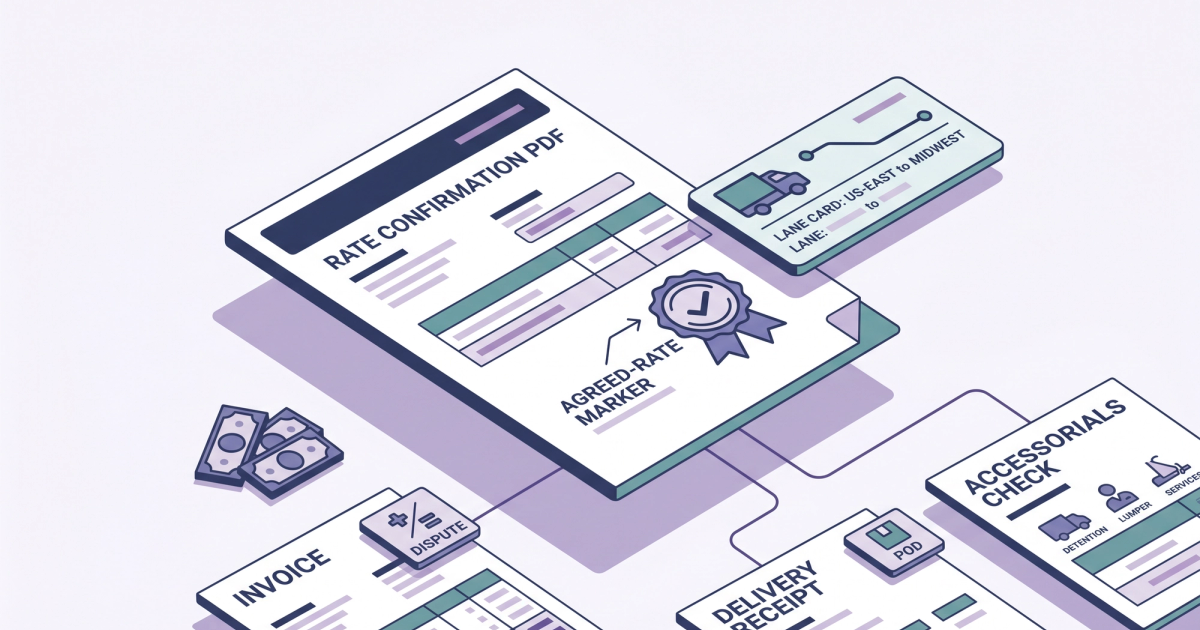
A broker processing 300 loads per month with a 3.8% overbilling rate and an average $150 overcharge per incident is leaving roughly $1,710 per month on the table. That's over $20,000 a year, not from market conditions or bad lanes, but from rate confirmation PDFs that didn't say what they needed to say. The rate confirmation PDF is the single document that defines what you agreed to pay a carrier. When a field is vague, missing, or poorly worded, you lose the ability to dispute an invoice. You pay the overcharge because you can't prove otherwise. This guide breaks down every field that matters on a rate confirmation PDF, explains the language that holds up during billing disputes, and shows you how to connect your rate con to the BOL, POD, and invoice so nothing slips through.
A Rate Con Is Only as Good as What You Put in It
Most brokers treat rate confirmations as a formality. You book the load, fill in the basics (origin, destination, pickup date, rate), email the PDF to the carrier, and move on. The problem shows up two weeks later when the carrier invoice arrives with charges that don't match what you thought you agreed to.
A rate confirmation is a legally binding agreement between the freight brokerage and the carrier. It's not a courtesy document or an informal acknowledgment. It defines the terms of the load, and in a billing dispute, it's the first thing both sides point to. If a field is missing or ambiguous, the carrier's interpretation usually wins, because you can't prove yours.
According to TQL's regulatory submission to FMCSA, rate confirmations must confirm any verbally agreed upon rates and comply with all applicable FMCSA regulations. This isn't optional language. It means your rate con needs to capture everything discussed on the phone or over email, not just the linehaul number.
The Real Cost of Incomplete Rate Cons
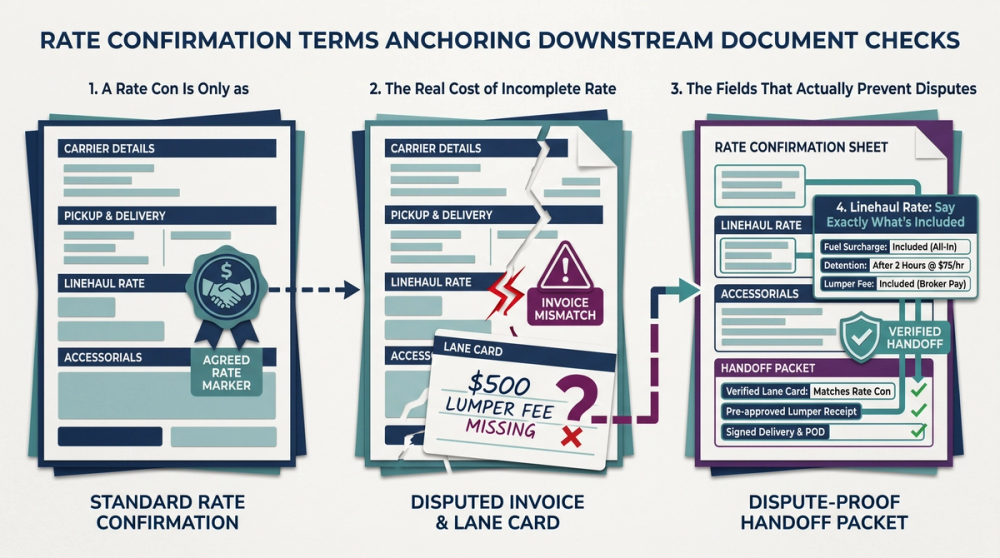
Carrier billing errors and overbilling occur on an estimated 1 in 5 invoices in truckload freight, with average overcharge amounts ranging from $75 to $400 per load. When your rate con doesn't specify detention caps, accessorial rules, or fuel surcharge inclusion, every one of those overcharges becomes harder to fight. You end up paying not because the carrier is right, but because your documentation is weak.
If you've been burned by this before, you're not alone. We covered the most common mistakes brokers make in Rate Confirmation: What Brokers Get Wrong and What It Costs, and the pattern is almost always the same: the rate con had enough information to book the load, but not enough to settle the invoice.
The Fields That Actually Prevent Disputes (Go Beyond the Basics)
Every rate confirmation PDF includes the obvious fields: shipper name, consignee, pickup and delivery dates, and the agreed rate. Those are table stakes. The fields that prevent disputes are the ones most brokers skip or leave vague.
According to Truckstop.com's guide to freight broker documents, a rate confirmation is one of the 10 essential broker forms, and it functions as a legally binding document. But "legally binding" only protects you if the document actually spells out the terms. Here are the rate con fields that matter most when a billing dispute hits your desk.
Linehaul Rate: Say Exactly What's Included
The linehaul rate is where the most expensive ambiguities live. If your rate con says "$1,850 all-in" but doesn't define what "all-in" means, a carrier can reasonably argue that fuel surcharge is separate. That's not a hypothetical. It happens constantly.
Your linehaul field should explicitly state whether the rate includes or excludes fuel surcharge, toll charges, and any other standard fees. Use language like: "Linehaul rate of $1,850.00 inclusive of fuel surcharge, tolls, and all standard carrier operating costs. No additional charges will be honored unless pre-approved in writing by broker."
That one sentence eliminates an entire category of invoice surprises.
Equipment Type and Requirements
If the load requires a reefer set to 34°F and the carrier sends a unit that can't hold temp, you need the rate con to reflect the requirement. Equipment type (dry van, reefer, flatbed, step deck) and any specific requirements (temp range, load locks, tarps) should be stated clearly. This field protects you from both service failures and from carriers billing for equipment upgrades they claim were necessary.
Weight and Commodity
According to KCH Transportation's best practices guide, brokers should include weight, dimensions, and commodity details on every rate confirmation. This isn't just for carrier planning. When a carrier claims the load was heavier than expected and invoices an overweight surcharge, the weight listed on your rate con is your first line of defense.
Pickup and Delivery Windows (Not Just Dates)
Listing "Pickup: 03/15" is not the same as listing "Pickup: 03/15, 0600-1000." The window matters because detention calculations start from the appointment time. If your rate con doesn't specify a window, the carrier defines when detention begins, and you lose control of the clock.
Broker and Carrier Contact Information
This sounds basic, but incomplete contact info creates real problems when disputes arise. Include the carrier's MC number, DOT number, dispatcher name, driver name (when available), and the broker contact responsible for the load. These details tie the rate con to a specific carrier entity, which matters if you're dealing with a carrier operating under multiple authorities.
Accessorial and Detention Language That Holds Up When You Need It
Accessorial charges are where brokers lose the most money per load, not because the charges are always wrong, but because the rate con doesn't address them at all. When a carrier invoices a detention charge, lumper fee, TONU, layover, or dry run cost, your only defense is the language in the carrier agreement document you both signed.
Detention Clause: Free Time, Caps, and Proof
A detention clause needs three things to be enforceable: a defined free-time window, a capped rate after free time expires, and a documentation requirement. Without all three, you're exposed.
Example language: "Detention free time: 2 hours at origin, 2 hours at destination. Detention rate after free time: $50.00 per hour, capped at $250.00 per occurrence. Carrier must provide timestamped check-in/check-out documentation to support any detention claim."
This is not boilerplate. It's the difference between paying a $450 detention invoice without recourse and paying $0 because the carrier couldn't produce proof. For a deeper look at how carriers use vague rate con fields to overbill, read Rate Con Fields Carriers Use to Overbill You (With Real Numbers).
Lumper Fee Language
Lumper fees are common on grocery and retail deliveries, and they're one of the most frequently disputed charges in brokerage billing. Your rate con should state whether lumper fees are the broker's responsibility, the carrier's responsibility, or reimbursable with a receipt.
Example language: "Lumper fees, if applicable, will be reimbursed by broker upon receipt of an itemized lumper receipt. Maximum reimbursable amount: $250.00. Lumper charges exceeding this amount require prior written broker approval."
Without this language, a $275 lumper fee on a grocery delivery becomes an unplanned cost that you can't push back on. The carrier didn't make it up. They paid the lumper. But the rate con said nothing about who absorbs the cost, so you do.
TONU and Cancellation Terms
Truck Order Not Used (TONU) charges are legitimate when a carrier dispatches a truck and the load cancels. But without a cancellation window defined in your rate con, the carrier can bill a TONU even if you canceled with reasonable notice.
Example language: "In the event of load cancellation, a TONU fee of $200.00 applies only if cancellation occurs less than 4 hours before the scheduled pickup time. Cancellations made 4 or more hours before pickup incur no charge."
This kind of precision saves money. If a carrier bills a $350 TONU and you canceled with 6 hours' notice, the rate con language is your proof.
Dry Run Charges
A dry run happens when a carrier arrives at the pickup or delivery location and the freight isn't available or the appointment falls through. Carriers will invoice dry run charges, and they're often justified. But the key question is: did the carrier have authorization to charge for it?
Example language: "Dry run fees will be considered only with prior written authorization from broker. Unauthorized dry run charges will not be honored."
This clause puts the burden on the carrier to get approval before the cost is incurred, which is where it belongs.
Layover Charges
Layover language follows the same logic as detention. Define the conditions under which a layover is payable, set a cap, and require documentation. If the rate con is silent on layovers, a carrier invoicing $300 for an overnight hold has a strong position, even if you didn't agree to it verbally.
How Your Rate Con Should Connect to the BOL, POD, and Invoice
A rate confirmation PDF doesn't exist in isolation. It's one document in a chain that includes the bill of lading (BOL), the proof of delivery (POD), and the carrier invoice. When these documents don't match, billing disputes follow.
Rate Con to BOL: Matching the Load Details
The BOL is created at the shipper's dock and records what was actually loaded. Your rate con should match the BOL on weight, piece count, commodity, and origin/destination. When they don't match, you have a problem. A rate con showing 38,000 lbs and a BOL showing 42,000 lbs means someone is wrong, and if the carrier invoices an overweight surcharge, you need to know which document is accurate before you pay or dispute.
Build a habit of comparing rate con details to the BOL as soon as the BOL is available. This takes less than two minutes per load and catches mismatches before they become invoice disputes.
Rate Con to POD: Confirming Delivery Terms
The POD confirms that the load was delivered. It should show the delivery date, time, and any exceptions (shortages, damage, refusals). If a carrier invoices detention at the consignee, the POD timestamp should align with the detention claim. If the POD shows a 45-minute unload and the carrier invoices for 3 hours of detention, you have the evidence to dispute.
Rate Con to Invoice: The Final Check
The carrier invoice should reflect the exact terms of the rate con. Linehaul should match. Accessorials should match. Fuel surcharge should be included or excluded per the rate con language. Every dollar on the invoice should trace back to a field on the rate confirmation PDF.
When brokers process hundreds of invoices per week manually, this check gets skipped or done superficially. That's where the 1-in-5 overbilling rate hits hardest. The data was there to catch the discrepancy, but nobody had time to match it. For more on how rate agreement gaps create overbilling opportunities, see Rate Agreement Gaps Carriers Use to Overbill You on Every Load.
Digital vs. Paper Rate Confirmation PDFs: What Changes and What Doesn't
The shift from paper to digital rate confirmations has been happening for years, but it's not as simple as "PDF good, fax bad." What matters is what's in the document, not how it's delivered. That said, the format does affect your workflow and your ability to use the rate con in disputes.
What Stays the Same
The fields, the language, and the legal weight of a rate confirmation don't change based on format. A digital PDF has the same enforceability as a printed and signed copy, as long as you have a record of the carrier's acceptance. Email confirmation, electronic signature, or load board acceptance all count as acknowledgment in most broker-carrier relationships.
As noted in Sensible's analysis of rate confirmation data extraction, the core data fields on a rate confirmation PDF remain consistent across formats: shipper/consignee information, load details, agreed rate, and terms. Whether you generate the document from your TMS, a template, or a load board, the critical content is the same.
What Changes with Digital
Digital rate confirmation PDFs offer three advantages that paper doesn't:
- Searchability. A digital PDF can be searched, indexed, and retrieved in seconds during a dispute. A paper rate con in a filing cabinet takes significantly longer to locate.
- Data extraction. Digital PDFs can be parsed to pull rate con fields directly into your TMS or accounting system, reducing manual data entry errors. According to Turing IT Labs, manual rate confirmation processing is a significant time drain for freight brokers, and automation reduces payment errors and accelerates carrier payouts.
- Audit trail. Digital delivery (email, load board, e-signature platform) creates a timestamped record of when the rate con was sent and accepted. This is critical evidence if a carrier claims they never agreed to your terms.
The Risk of Poorly Formatted Digital Rate Cons
One downside of digital rate confirmation PDFs is inconsistent formatting. If your TMS generates a PDF where the accessorial language is cut off, the detention clause runs into the footer, or the font is unreadable, you have a document that's technically complete but practically useless in a dispute. Always review your generated PDFs before sending them. Open the file, confirm that every field is visible, and make sure the language is legible.
Real Examples: How Rate Con Language Wins and Loses Disputes
The difference between paying an overcharge and disputing it successfully almost always comes down to what the rate confirmation PDF says. Here are five scenarios that show how specific language (or the lack of it) determines the outcome.
Example 1: $450 Detention Invoice, No Cap Defined
Scenario: A carrier invoices $450 in detention on a reefer load. The rate con listed the delivery appointment as "03/18" with no time window and no detention clause. The carrier's invoice included a breakdown: 6 hours at $75/hour. The broker had no documentation to dispute the timeframe or the rate.
Outcome: Broker pays $450. With a detention clause capping charges at $250 and requiring timestamped proof, the broker could have reduced or eliminated this charge entirely.
Example 2: $275 Lumper Fee with No Language on Responsibility
Scenario: A grocery delivery requires a lumper service. The carrier pays the lumper $275 and invoices the broker. The rate con had no mention of lumper fees. The carrier argues it's standard for the broker to reimburse lumpers on grocery loads.
Outcome: Broker pays $275. A single sentence in the rate con defining a lumper cap of $200 with prior approval required above that amount would have either reduced the charge or shifted the excess to the carrier.
Example 3: Broker Saves $180 by Citing TONU Language
Scenario: A carrier dispatches a truck for a morning pickup. The broker cancels the load at 4 PM the day before, giving 14 hours' notice. The carrier invoices a $350 TONU. The broker's rate con states: "TONU of $200.00 applies only if cancellation occurs less than 4 hours before scheduled pickup. Cancellations with 4+ hours' notice incur no charge."
Outcome: Broker disputes and pays $0. The carrier had no basis to charge under the agreed terms. The broker saved $350 (or $180 compared to paying the reduced TONU amount of $170 the carrier offered as a compromise). The rate con language was unambiguous.
Example 4: 'All-In' Linehaul Creates a $220 Surprise
Scenario: Rate con lists the linehaul rate as "$1,850 all-in." Carrier invoices $1,850 plus $220 for fuel surcharge. Carrier argues "all-in" referred to the linehaul only and that fuel surcharge is always separate per their carrier packet terms.
Outcome: Broker pays $2,070. The phrase "all-in" was not defined. Had the rate con stated "$1,850.00 inclusive of fuel surcharge and all other standard fees," the broker would have had clear documentation to reject the fuel surcharge line item.
Example 5: Dry Run Charge Disputed Successfully
Scenario: Carrier arrives at the shipper and the freight isn't ready. Carrier invoices a $350 dry run fee. The rate con includes: "Dry run fees require prior written authorization from broker. Unauthorized dry run charges will not be honored."
Outcome: Broker disputes and pays $0. The carrier never contacted the broker for authorization before leaving the facility. The rate con clause was clear, and the carrier had no written approval.
Frequently Asked Questions About Rate Confirmation PDFs
Is a rate confirmation PDF legally binding?
Yes. A rate confirmation is a legally binding agreement between the freight brokerage and the carrier. Once the carrier acknowledges or signs the rate con (including via email reply or electronic acceptance), both parties are bound by its terms. This is why the language on the document matters so much. Vague terms get interpreted against whoever wrote them.
What's the difference between a rate confirmation and a load confirmation?
A rate confirmation focuses on the financial terms: linehaul rate, accessorial rules, detention caps, and payment terms. A load confirmation (sometimes called a dispatch sheet) focuses on operational details: pickup/delivery times, driver info, and load requirements. In practice, most brokers combine both into a single document. The risk is when the financial terms get buried under operational details and critical clauses are overlooked by the carrier.
Should I send the rate con before or after the carrier accepts the load?
Before. The rate confirmation should be sent and acknowledged before the carrier dispatches a truck. Sending it after dispatch creates a situation where the carrier can claim they agreed to different terms verbally. As referenced in TQL's FMCSA submission, rate confirmations must confirm verbally agreed rates, meaning the document formalizes what was discussed but should be in the carrier's hands before the load moves.
How long should I keep rate confirmation PDFs on file?
Most brokers keep rate confirmations for a minimum of three years, which aligns with common statute-of-limitations periods for freight contract disputes and FMCSA record-keeping guidance. If you're working with factoring companies or handling audits, you may need them longer. Digital storage makes this easy. Paper filing makes it expensive and slow.
Can a carrier override rate con terms with their own carrier packet?
This depends on the broker-carrier agreement hierarchy. In most cases, the rate confirmation is load-specific and supersedes general carrier packet terms for that particular shipment. However, if your rate con doesn't explicitly state that it takes precedence over the carrier's standard terms, there's room for dispute. Add a line: "In the event of a conflict between this rate confirmation and any carrier-issued terms, this rate confirmation governs."
Sources
- Rate Confirmation: Definition, Components & Best Practices — Fulfill.com
- TQL Regulatory Submission to FMCSA (Redacted) — FMCSA Docket FMCSA-2023-0257
- Freight Broker Documents: 10 Important Forms — Truckstop.com
- Best Practices Every Freight Broker Should Know — KCH Transportation
- Extracting Data from Rate Confirmations — Sensible Blog
- Freight Rate Confirmations: Why They Drain Time and How to Automate — Turing IT Labs
- FMCSA Regulations and Interpretations – 49 CFR Parts 300 — Federal Motor Carrier Safety Administration
Build Rate Cons That Pay for Themselves
Every field on your rate confirmation PDF is either protecting your margin or leaving it exposed. Detention caps, accessorial language, fuel surcharge inclusion, TONU windows, dry run authorization: these aren't legal formalities. They're the operational controls that determine whether you pay a disputed invoice or reject it with evidence.
Start with the fields covered in this guide. Review your current rate con template against the examples above. If your template is missing detention language, lumper clauses, or clear linehaul definitions, fix it before the next load goes out. The cost of leaving it unchanged is measurable: for a 300-load-per-month operation, even a 3.8% overbilling rate at $150 per incident means $1,710 per month walking out the door.
If your team processes more than 50 invoices a week and matching rate con fields to carrier invoices is eating hours of staff time, automated document extraction tools can pull rate con data, flag mismatches against invoices, and give you the evidence you need to dispute in seconds instead of hours.
Related: Rate Confirmation Template Word: Every Field That Protects You
Related: Rate Confirmation Trucking: The Fields That Cost You Money
Related: Rate Confirmation Trucking Template: Fields Most Brokers Miss