Invoice Reconciliation in SAP: Where It Breaks for Freight Teams
Researched and written with AI assistance. Reviewed by the Laneproof team.
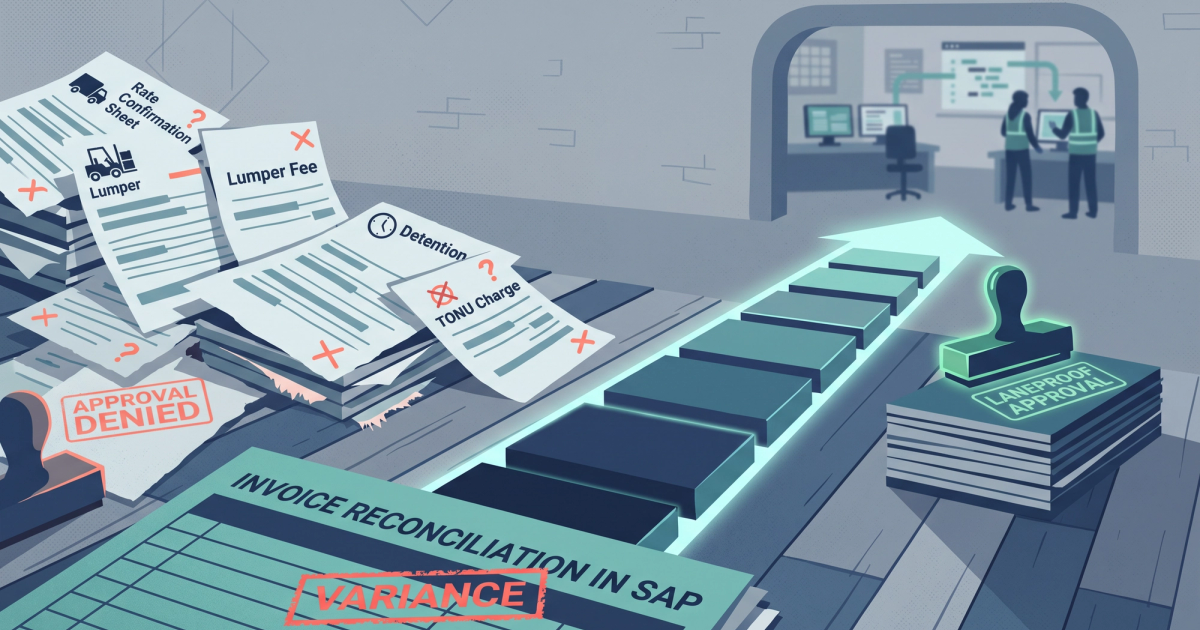
Invoice reconciliation in SAP is the process of matching a vendor's invoice against the corresponding purchase order (PO) and goods receipt to verify that quantities, prices, and totals align before payment is released. For freight teams, that means matching a carrier's freight invoice against a rate confirmation, delivery confirmation, and any approved accessorial charges. In theory, SAP catches discrepancies. In practice, it misses the charges that cost freight brokers the most money.
If your billing coordinator is spending 10+ hours a week pulling carrier invoices out of SAP and manually comparing them to rate cons and BOLs, the system isn't doing its job. Not because SAP is broken. Because SAP's reconciliation logic was designed for procurement, not freight. And the gap between those two worlds is where your margin disappears.
What Invoice Reconciliation in SAP Actually Means for Freight Teams
At its core, SAP defines invoice reconciliation as the systematic verification that an invoice's details match the corresponding purchase order, contract, or goods receipt, with discrepancies identified and managed before payment. According to SAP's official reconciliation documentation, the system is designed to catch mismatches between what was ordered, what was received, and what was billed.
For a manufacturing company buying steel or a retailer ordering inventory, that process works well. A PO says 500 units at $10 each. The warehouse confirms 500 units arrived. The vendor invoices $5,000. SAP matches all three, and payment flows.
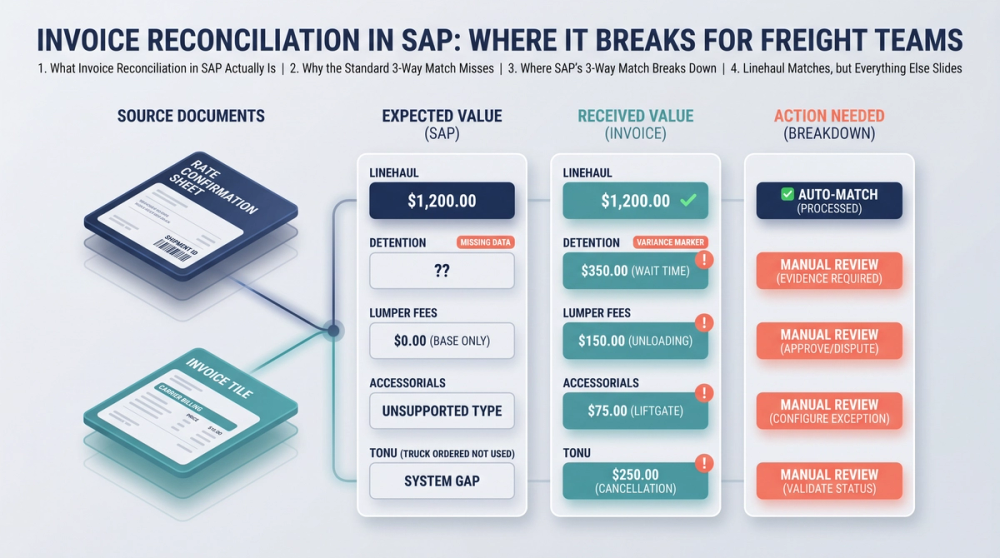
Freight doesn't work like that. Your "purchase order" is a rate confirmation. Your "goods receipt" is a proof of delivery (POD) or signed BOL. And the invoice from your carrier often includes line items that weren't on the rate con at all: detention charges, lumper fees, fuel surcharge adjustments, TONU charges, layover fees, and other accessorials that get tacked on after the load moves.
Why the Standard 3-Way Match Misses Freight Charges
SAP's standard reconciliation runs what's called a 3-way match: invoice to PO to goods receipt. If all three documents agree within a set tolerance threshold, payment is approved automatically. The problem is that for freight, the "PO" (your rate con) typically only covers linehaul, and the "goods receipt" (your POD) confirms delivery but says nothing about what happened during transit. Detention time, lumper use, driver wait time at the shipper: none of this shows up in the standard 3-way match data set.
That means SAP is comparing a carrier invoice against an incomplete picture. Charges that should trigger an exception simply don't, because SAP has no reference document to compare them to. For a deeper look at how this affects day-to-day billing operations, see our breakdown of the freight invoice reconciliation process and where teams lose hours.
Where SAP's 3-Way Match Breaks Down on Carrier Invoices
SAP has added intelligence to its matching process. The platform's intelligent 3-way match uses machine learning to reconcile procurement goods receipts and invoices, reducing manual intervention on standard procurement transactions. But freight invoices aren't standard procurement transactions. Here's where the match logic falls apart.
Linehaul Matches, but Everything Else Slides Through
SAP does a reasonable job matching the linehaul rate. If your rate con says $2,100 for a load from Dallas to Atlanta and the carrier invoices $2,100 for linehaul, the system confirms the match. Where it breaks is on the additional line items that appear on the same invoice.
A carrier adds $450 in detention. SAP checks the PO (rate con) for a matching line item. There isn't one, because detention wasn't pre-authorized on the rate confirmation. But the invoice total of $2,550 may still fall within the PO tolerance percentage that your SAP admin set (often 5% to 10% to account for fuel surcharge fluctuations). So the system approves payment. No exception is thrown. No flag for your billing team.
Tolerance Thresholds That Hide Real Overbilling
SAP's tolerance-based approach is designed to prevent payment holds on minor price variations. In procurement, that makes sense. A $0.03 per-unit price difference on a 10,000-unit order shouldn't freeze your AP queue. But in freight, a 5% tolerance on a $3,000 load means $150 in unmatched charges pass automatically. Scale that across 500 loads a month, and you could be auto-approving up to $75,000 in unreviewed charges per month. Not all of those are overbills, but you have no way to know which ones are.
This is the fundamental mismatch: SAP's tolerance logic is percentage-based and total-focused, while freight billing discrepancies are line-item-specific. A $275 lumper fee that was never authorized doesn't care about your tolerance percentage. It just needs someone to look at it. And SAP won't.
The Accessorial Problem: Detention, Lumpers, and TONU Don't Fit SAP's PO Logic
Accessorials are where freight billing gets complicated and where the most money leaks out. Detention charges, lumper fees, TONU (truck ordered not used), layover fees, dry run charges: these are all event-driven costs that get determined after the rate con is signed. SAP's PO-based logic has no framework to handle them.
No Event Data, No Exception
SAP processes invoices based on document matching. It compares what's on the invoice to what's on the PO and what's on the receipt. But freight accessorials are tied to events, not documents. Detention happens because a driver waited at a facility. A lumper fee happens because a third-party crew unloaded the trailer. A TONU happens because a load was cancelled after the truck was dispatched.
Your TMS may have records of these events (timestamps, dispatch logs, facility check-in data), but SAP typically doesn't have access to that data in its reconciliation workflow. As noted in an SAP Community discussion on freight payment reconciliation, freight teams have long struggled with reconciling carrier payments against actual delivery events and preventing duplicate payments within SAP.
Five Accessorial Failures SAP Won't Catch
Here are specific scenarios that SAP's standard reconciliation will approve without flagging:
- Detention with free time violation. A carrier invoices $450 in detention on a load where the rate con specifies a 2-hour free window. The driver was at the facility for 2 hours and 45 minutes. The detention charge should be based on 45 minutes, not the full amount. SAP sees no detention line on the PO, so it doesn't check the math. It either passes on tolerance or gets manually routed with no context for the reviewer.
- Unauthorized lumper fee. A lumper fee of $275 appears on a carrier invoice with no supporting receipt and no BOL notation. SAP processes it because the invoice total clears the PO tolerance threshold, even though the charge was never authorized by the broker.
- TONU on a cancelled load. A TONU charge of $200 is billed on a load that dispatchers have a timestamped cancellation record for showing the load was cancelled before the truck departed. SAP has no freight event data to cross-reference, so the charge passes the 3-way match without a flag.
- Duplicate dry run charges. A dry run charge appears on 6 separate invoices in a single month from the same carrier. Individually, each clears SAP tolerance. Collectively, they represent $1,200 in charges that were never documented in the TMS. SAP's match runs per-invoice, not per-carrier-pattern.
- Fuel surcharge discrepancy. The carrier's fuel surcharge rate is 2% higher than the rate con's fuel surcharge schedule. On a $2,800 linehaul, that's $56. Within tolerance. Repeated across 40 loads that month, it's $2,240. SAP never aggregates these.
For a full list of the line items carriers inflate most often, see our guide to freight billing reconciliation and the charges that slip through.
How to Build a Reconciliation Workflow When Your TMS and SAP Don't Sync
Most freight teams running SAP are also running a separate TMS (or spreadsheets, or a combination of both). The rate con lives in the TMS. The invoice gets entered into SAP. The POD is a scanned PDF sitting in an email or a shared drive. These systems rarely talk to each other in real time, and that's where the manual work piles up.
Step 1: Extract What SAP Actually Matched
Before you can build a catch process for what SAP misses, you need to know what it caught. Run a report of all carrier invoices that passed SAP's 3-way match in the last 30 days. Filter for invoices where the total exceeded the PO amount. These are the payments that cleared on tolerance, not on exact match. This is your starting pool for manual review.
Step 2: Pull Rate Cons from the TMS for Every Tolerance-Passed Invoice
For each invoice that passed on tolerance, pull the corresponding rate confirmation from your TMS. You're looking for accessorial line items on the invoice that don't appear on the rate con. Detention, lumper fees, layover, TONU, and dry run charges are the most common. Flag every unmatched line item.
Step 3: Cross-Reference Event Data
For every flagged accessorial, check your operational records. Did the dispatcher log a detention event? Is there a lumper receipt? Was a TONU authorized? Check timestamps in the TMS, driver check-in/check-out records, and any email or messaging thread related to the load. This is the step that takes the most time and is the one SAP can't automate, because the data lives outside SAP's document ecosystem.
Step 4: Batch Disputes Weekly, Not Per-Invoice
If you're disputing carrier invoices one at a time, you're burning hours. Instead, batch your flagged discrepancies by carrier. Send a single dispute communication per carrier per week with all flagged line items listed. Include the load number, the rate con amount, the invoiced amount, and the specific line item in question. Carriers respond faster to organized dispute batches than to scattered individual emails.
For a step-by-step audit checklist that covers this workflow, our carrier invoice audit checklist walks through each verification step.
Step 5: Track Dispute Outcomes and Carrier Patterns
Keep a running log of every dispute: what was flagged, what was resolved in your favor, what was legitimate, and which carriers appear most frequently. Over three to six months, you'll see patterns. Some carriers consistently overbill detention. Others pad lumper fees. This data becomes your early-warning system and your basis for renegotiating carrier agreements or adjusting rate con terms.
What a Carrier Invoice Dispute Actually Costs You Per Month
The cost of missed billing discrepancies isn't just the overbilled amount. It's the labor spent finding them (or not finding them), the margin erosion on each affected load, and the opportunity cost of your billing team doing manual reconciliation instead of higher-value work.
Scenario: The Billing Coordinator's 11-Hour Week
A billing coordinator at a brokerage moving 15 loads per day spends roughly 11 hours per week manually cross-referencing carrier invoices against rate cons and BOLs. At $25 per hour, that's $275 per week, or approximately $14,300 per year in labor dedicated solely to manual invoice review. That's one person, at one brokerage. If your team has two people splitting this work, double it.
And that labor cost assumes they catch everything. They won't. A person reviewing 75 invoices per week, each with multiple line items, will miss discrepancies. Fatigue, time pressure, and inconsistent documentation guarantee it.
Scenario: Accessorial Overbilling at Scale
Based on Laneproof analysis of carrier invoice data, accessorials are overbilled on approximately 3.8% of invoices. For a broker moving 500 loads per month with an average accessorial exposure of $180 per load, that math looks like this:
- 500 loads × $180 average accessorial exposure = $90,000 in monthly accessorial charges
- 3.8% overbilling rate × $90,000 = $3,420 in overbilling per month
- $3,420 × 12 months = $41,040 in annual overbilling
SAP's standard 3-way match process will not catch this. The charges pass individually within tolerance. They don't trigger exceptions because there's no PO line item for SAP to match them against. And your billing coordinator may catch some of them, but not all, and not consistently.
Scenario: The Repeat Offender Carrier
One carrier submits dry run charges on 6 invoices in a single month. Each charge is between $175 and $225. Individually, they're within SAP's tolerance. Collectively, they total $1,200 in charges with no supporting documentation in the TMS. SAP doesn't aggregate charges by carrier or by charge type across invoices. It processes each invoice in isolation. Without a manual review step or a freight-specific audit layer, those 6 charges get paid without question.
SAP's tolerance logic is percentage-based and total-focused. Freight billing discrepancies are line-item-specific. That mismatch is where your margin leaks.
According to a guide on vendor invoice reconciliation automation in SAP, automating the reconciliation process drives faster month-end close cycles and fewer processing errors. That's true for standard procurement. But for freight, automation only works if the system has the right data to automate against, and SAP's standard configuration doesn't include the freight event data that accessorial validation requires.
When It Makes Sense to Add a Freight-Specific Audit Layer
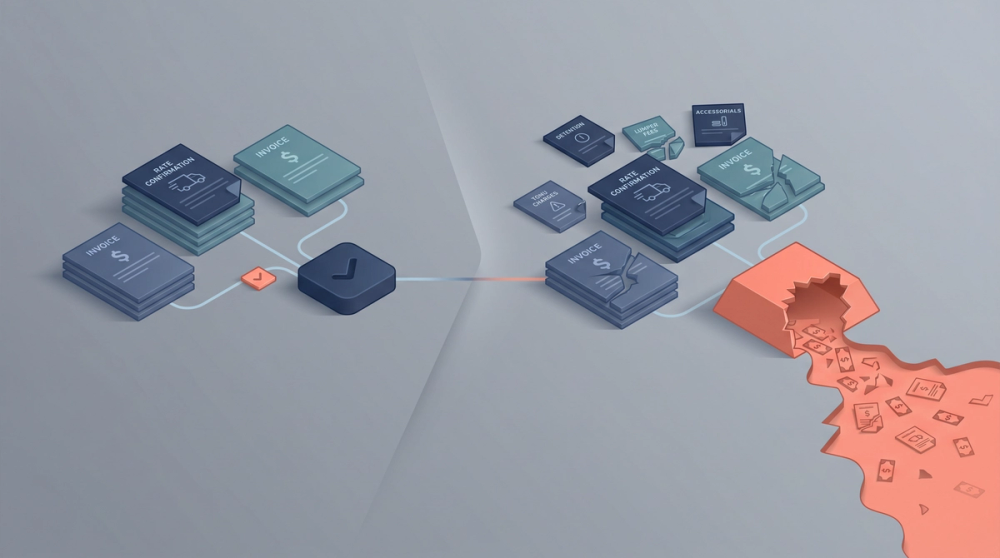
SAP isn't going away. If your company runs SAP for finance and AP, you're not replacing it with a freight-specific tool. The question is whether SAP alone is sufficient for freight invoice reconciliation, or whether you need an additional layer that sits between your TMS and SAP to catch what the 3-way match misses.
Signs You Need a Layer Outside SAP
- Your billing team spends more than 5 hours per week on manual invoice review against rate cons
- You've had carrier disputes resolved in your favor more than 3 times in the past quarter (meaning discrepancies are getting through)
- You move more than 200 loads per month and have no automated accessorial validation
- Your TMS and SAP don't share data in real time, requiring manual data entry or CSV exports
- You've paid a TONU, detention, or lumper charge that was later found to be unauthorized
What a Freight Audit Layer Actually Does
A freight-specific audit tool compares the carrier's invoice not just against a PO, but against the rate confirmation, the BOL, the POD, dispatch timestamps, and facility check-in records. It matches at the line-item level, not just the invoice-total level. It flags accessorials that don't have supporting documentation. And it tracks carrier billing patterns over time, catching repeat offenders that SAP's per-invoice logic will never surface.
SAP Freight Audit exists as a module designed to automate freight bill auditing within the SAP ecosystem. But many SMB brokerages and carriers find that this enterprise module is either unavailable in their SAP tier, requires significant configuration, or still lacks the granular freight event data needed for accessorial-level validation. For freight brokers in particular, whose rate cons and carrier packets live outside SAP's procurement module, the gap remains.
For a broader look at how freight brokers can stop paying carrier overbills, our overview of invoice reconciliation for freight brokers covers the full process from rate con to payment.
Frequently Asked Questions
What is invoice reconciliation in SAP?
Invoice reconciliation in SAP is the process of matching a vendor invoice against the corresponding purchase order and goods receipt to verify that quantities, prices, and totals align before payment is approved. According to SAP's documentation, the system identifies discrepancies and routes them for review. For freight teams, this translates to matching carrier invoices against rate confirmations and delivery confirmations, though SAP's standard process often lacks the freight event data needed to validate accessorials like detention, lumper fees, and TONU charges.
What is invoice reconciliation with an example?
Invoice reconciliation is the act of comparing what a vendor billed against what was agreed upon and what was actually delivered. Example: A carrier's rate con specifies $2,100 linehaul for a load from Dallas to Atlanta. The carrier invoices $2,550, adding $450 in detention. Reconciliation means checking whether that detention was authorized, whether the driver's facility time exceeded the free time window on the rate con, and whether supporting documentation (timestamps, facility logs) exists. If the detention is unsupported, the $450 is flagged for dispute before payment.
What are the four types of reconciliation?
The four commonly referenced types are: (1) bank reconciliation, matching bank statements to internal records; (2) vendor or AP reconciliation, matching vendor invoices to POs and receipts; (3) customer or AR reconciliation, matching customer payments to issued invoices; and (4) intercompany reconciliation, matching transactions between related business entities. In freight, carrier invoice reconciliation falls under vendor/AP reconciliation, but requires freight-specific data (rate cons, BOLs, PODs, dispatch logs) that standard AP reconciliation workflows don't typically include.
What are the different types of reconciliation in SAP?
SAP supports several reconciliation types, including invoice reconciliation (matching invoices to POs and goods receipts), internal reconciliation (matching debits and credits within business partner accounts, as described in SAP Business One's internal reconciliation overview), bank reconciliation, and intercompany reconciliation. For freight operations, invoice reconciliation is the most relevant, but it requires configuration beyond SAP's defaults to handle carrier-specific documents like rate confirmations and accessorial charge validation.
Can SAP automate freight invoice auditing?
SAP offers a Freight Audit module designed to automate freight bill auditing. However, its effectiveness depends on how much freight event data is available within SAP's ecosystem. If your rate cons, dispatch logs, and facility timestamps live in a separate TMS, SAP's freight audit module may not have the data it needs to validate accessorials. Many freight teams find they need an additional audit layer that pulls data from both SAP and the TMS to get complete invoice reconciliation coverage.
Stop Paying for What SAP Can't See
Invoice reconciliation in SAP works for what it was built for: matching invoices to purchase orders on standard procurement transactions. It was not built for freight. It doesn't read rate cons. It doesn't check detention free time windows. It doesn't validate lumper receipts or cross-reference TONU charges against dispatch logs. And it doesn't aggregate carrier billing patterns to catch repeat overbilling.
If your team is spending hours every week on manual invoice review to catch what SAP misses, you don't have a process problem. You have a tooling gap. The fix isn't better SAP configuration. It's adding a freight-specific reconciliation layer that speaks the same language as your rate cons, BOLs, and carrier invoices.
If your team processes more than 50 carrier invoices a week, tools that automatically match invoices against rate confirmations can catch the detention, lumper, and accessorial discrepancies that SAP's 3-way match will never flag.
Sources
- Overview of Invoice Reconciliation — SAP Help Documentation
- Intelligent 3-Way Match and Reconciliation with Machine Learning — SAP
- Invoice Reconciliation in SAP: Process Guide & Best Practices — Klearstack
- An Overview of Internal Reconciliation in SAP Business One — SAP Press
- Need Help on Freight Payments and Reconciliation — SAP Community
- SAP Freight Audit — CT Global Freight Audit