Freight Invoice Reconciliation Process: Stop Losing Hours
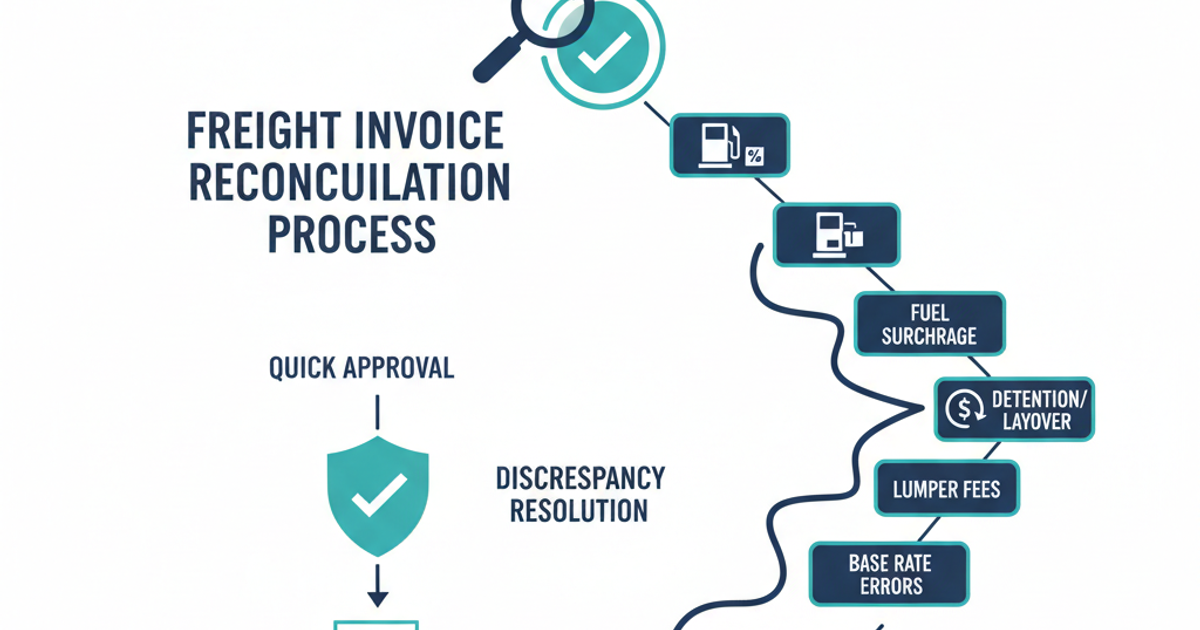
A mid-size brokerage in Dallas processing 800 loads per month recently discovered they'd overpaid carriers by $38,400 over a single quarter. Not because anyone was trying to cheat them—most of the errors were simple: detention charges that didn't match the agreed-upon rate con, fuel surcharges calculated on the wrong linehaul amount, and lumper fees tacked on without a receipt. The culprit wasn't fraud. It was a broken freight invoice reconciliation process that relied on one billing coordinator eyeballing PDFs against a spreadsheet. If you're running manual invoice review on more than a few hundred loads a month, the math is working against you. Every unverified line item is a small leak. Enough small leaks, and you're hemorrhaging margin without seeing it on any single load.
Why Your Freight Invoice Reconciliation Process Is Bleeding Money
Here's the reality: carrier invoices don't match rate cons roughly 8–12% of the time. That number comes from internal audits at mid-market brokerages, and it's consistent enough to call it a rule, not an exception. On a $1,800 average load, a 3.8% average overbill means you're paying $68.40 more than you should per affected load. Multiply that by the 8–12% error rate across 500 loads, and you're looking at $2,700–$4,100 per month walking out the door.
The problem isn't that your team doesn't care. The problem is that manual invoice review doesn't scale. When your billing coordinator is pulling up a rate con PDF, switching to the carrier invoice, checking line by line, then logging into the TMS to verify delivery notes—that's 20–30 minutes per load done carefully. Most people don't have 30 minutes per load. So they spot-check. They skim. They approve invoices that look "close enough." And freight billing errors slip through.
The other issue is documentation. Even when your team catches a discrepancy, proving it to the carrier takes time. You need the original rate con, the BOL, the POD, maybe a lumper receipt. If those documents are scattered across email threads, TMS uploads, and shared drives, your billing coordinator is spending more time hunting for proof than actually doing the carrier invoice audit.
The 15-Minute Freight Invoice Reconciliation Process, Step by Step
You don't need to overhaul your entire operation. You need a repeatable, documented process that any member of your team can follow on every single load. Below is the exact sequence that gets invoice matching freight work done in under 15 minutes per load. It's not magic—it's discipline and structure.
Step 1: Pull the Rate Con and Carrier Invoice Side by Side
Before you look at a single number, get both documents open at the same time. This sounds obvious, but most billing errors survive because people check invoices from memory or against TMS fields that may have been entered incorrectly in the first place. The rate con is your source of truth. Not the TMS entry. Not what dispatch remembers agreeing to. The signed rate confirmation.
If your rate cons are buried in email chains or scattered across carrier packets, you've already found your first bottleneck. Every rate con should be accessible by load number in under 30 seconds. If it takes longer than that, you need a better document management system before you worry about reconciliation speed.
Step 2: Match the Linehaul Rate First
Start with the biggest number. The linehaul rate should match exactly between the rate con and the carrier invoice. No rounding, no adjustments. If the rate con says $2,150 and the invoice says $2,200, that's a $50 discrepancy you flag immediately. Don't move on to accessorials until the base rate matches. About 3% of invoices we see have linehaul discrepancies—usually from carriers submitting invoices based on an earlier quote rather than the final confirmed rate.
Step 3: Check Every Accessorial Against the Rate Con
This is where the real money hides. Go through every line item on the carrier invoice that isn't the linehaul rate. Fuel surcharges, detention, layover, lumper fees, TONU charges, stop-off fees—each one needs a corresponding authorization on the rate con or a separate written approval. If an accessorial appears on the invoice but not on the rate con, it doesn't get paid until it's verified. We'll break down the five most common problem areas in the next section.
Step 4: Verify Delivery Documentation
Check the POD and BOL against the invoice. Confirm the delivery date matches (this affects detention calculations), confirm the weight if you're paying per-pound surcharges, and confirm the delivery location if there are stop-off charges. A surprising number of freight billing errors come from invoices that reference the wrong delivery date, which inflates detention time.
Step 5: Log the Result and Dispute or Approve
Every load gets one of three statuses: approved, disputed, or pending documentation. Don't leave invoices in limbo. If there's a discrepancy, send the dispute with the specific line item, the rate con amount, and the invoiced amount—all in the same message. Carriers resolve disputes faster when you give them the exact numbers upfront instead of a vague "this doesn't look right."
That's the full freight payment reconciliation loop. Five steps. When your documents are organized and accessible, each load takes 10–15 minutes. The bottleneck is almost never the comparison itself—it's finding the documents.
The Five Line Items Where Freight Billing Errors Actually Hide
You could audit every line on every invoice with equal attention, but that's not how you get efficient. These five categories account for roughly 85% of the billing discrepancies we see across mid-size brokerages. Focus your carrier invoice audit energy here first.
1. Detention Charges
Detention is the single most disputed accessorial in freight. The typical rate con specifies free time (usually 2 hours) and then a per-hour charge after that. Here's where it goes wrong: carriers calculate detention from arrival time, but the arrival time on the invoice doesn't always match what the facility or the driver's ELD recorded. A carrier might bill 4 hours of detention when the actual overage was 2.5 hours. At $75/hour, that's a $112.50 difference on one load. Across a month, detention overbilling alone can cost a 500-load brokerage $1,500–$3,000.
Always cross-reference the detention start time against the check-in/check-out times on the BOL or facility receipt. If the carrier can't provide documentation of their arrival and departure times, the charge doesn't hold up.
2. Fuel Surcharges
Fuel surcharges should be calculated based on a clearly defined formula—typically a percentage of the linehaul rate tied to the DOE national diesel average for a specific week. The two most common errors: carriers applying the surcharge percentage to the total invoice (including other accessorials) instead of just the linehaul, or using a different week's fuel index than what was specified. On a $2,000 linehaul with a 22% fuel surcharge, applying it to a $2,300 total invoice instead inflates the surcharge by $66. It's not a huge number per load, but it adds up to hundreds per month.
3. Lumper Fees
Lumper fees are supposed to be pass-through costs with a receipt. The rate con should specify whether lumper is included, capped, or billed at cost. The problem: carriers sometimes submit lumper charges without receipts, or submit receipts that don't match the invoiced amount. We've seen cases where a carrier invoiced a $350 lumper fee with a receipt showing $275. That $75 difference is pure margin loss if you don't catch it. Always require the original lumper receipt and match it to the penny.
4. Duplicate Invoices
This one isn't about a single line item—it's about the entire invoice showing up twice. Duplicate invoices happen more often than most brokerages realize, especially with carriers who use different billing systems for different terminals or who resubmit after a dispute. A study by the Aberdeen Group found that duplicate payments account for 0.5–2% of total freight spend for companies without automated matching. On $500,000 in monthly carrier payments, that's $2,500–$10,000 in double payments. Your process needs a duplicate-detection step, even if it's as simple as checking the load number and carrier name against recent payments before approving.
5. Accessorials Not on the Rate Con
This is the catch-all category, and it's more common than it should be. A carrier adds a $150 "inside delivery" charge that was never discussed. Or a $200 layover fee shows up when the rate con only authorizes detention. Or there's a "reclassification fee" that doesn't correspond to anything in the original agreement. The rule is simple: if it's not on the rate con and wasn't approved in writing afterward, it doesn't get paid. But enforcing that rule requires you to actually read every line item on every invoice—which is exactly what falls apart when your team is processing invoices in bulk.
Why "Rate Con vs Invoice" Isn't Always a Clean Comparison
In a perfect world, every rate con would be a clean, structured document with clearly labeled fields, and every carrier invoice would use the same format and terminology. You don't operate in a perfect world. Rate cons come in dozens of formats. Some list fuel surcharges as a separate line; others bake them into the linehaul. Some specify detention terms in a notes field at the bottom; others reference a separate carrier packet.
Carrier invoices are even worse. Some carriers send professional, itemized invoices. Others send a one-line PDF that says "Transportation services: $2,450" with no breakdown whatsoever. When you're doing rate con vs invoice matching, you're often comparing two documents that don't speak the same language. Your billing coordinator has to mentally translate between them, and that's where interpretation errors creep in.
This is one reason freight document extraction tools have become critical for brokerages processing more than a few hundred loads monthly. Instead of manually reading and interpreting each document, extraction tools pull the key fields—linehaul rate, accessorial charges, reference numbers, dates—into a structured format you can compare directly. Laneproof's document extraction tool at /tools/document-extract handles this for rate cons, invoices, BOLs, and PODs, turning unstructured PDFs into matchable data fields.
How Manual Invoice Review Falls Apart at Scale
Let's do the math on manual freight payment reconciliation. Say your billing coordinator can reconcile one load every 20 minutes when being thorough. That's 3 loads per hour, 24 loads in a full 8-hour day (assuming no interruptions, which never happens). If you're processing 600 loads per month, that's 25 full working days of reconciliation. You'd need more than one full-time employee doing nothing but invoice matching.
Most brokerages don't have that headcount dedicated to billing. So what actually happens? Your billing coordinator reconciles maybe 30–40% of invoices carefully and spot-checks the rest. The loads that get spot-checked are the ones where errors survive. And because no one tracks which loads were fully audited versus spot-checked, there's no way to know how much is slipping through.
The compounding problem is disputes. When your team does catch an error, the dispute process itself takes time—composing the email, attaching documentation, following up when the carrier doesn't respond. Without a structured dispute workflow, caught errors sometimes go unresolved because it's faster to just pay the invoice and move on. That's the most expensive shortcut in freight billing.
This is exactly the bottleneck that automated invoice reconciliation addresses. Tools like the reconciliation feature at /tools/reconcile match rate con fields to carrier invoice fields automatically, flagging discrepancies by line item so your team only spends time on loads that actually have problems. Instead of reviewing 600 invoices, your coordinator reviews the 50–70 that the system flagged—a workload that fits in a few hours per week instead of a few weeks per month.
Building a Carrier Invoice Audit That Actually Sticks
The reason most audit processes fail isn't the process itself—it's that no one follows it consistently. Week one, everyone checks every line item. Week three, the team is behind on payments and starts skipping steps. By month two, you're back to approving invoices on gut feel. Here's how to build a carrier invoice audit process that survives contact with reality.
Make It the Same Every Time
Document your reconciliation steps. Print them. Tape them to the monitor if you have to. The process should be identical whether you're reconciling a $900 local dray or a $4,500 reefer load. When your team has to decide "how carefully should I check this one," that's a decision point where errors enter. Remove the decision. Every load, every line item, same process.
Set a Dollar Threshold for Escalation, Not for Auditing
Some brokerages set a rule like "only audit invoices over $2,000." This is backwards. A $50 overbill on a $1,200 load is a higher percentage margin hit than a $50 overbill on a $3,000 load. Audit everything. But set a dollar threshold for escalation—discrepancies under $25 might get logged but not disputed, while anything over $25 gets a formal dispute sent to the carrier. This keeps your team from spending 30 minutes arguing over a $12 rounding difference while still catching the real money.
Track Patterns by Carrier
After three months of consistent auditing, you'll have data. Use it. If a specific carrier overbills on detention 40% of the time, that's not a series of accidents—it's a billing practice. You can address it directly in your next rate negotiation, add tighter language to your carrier packet, or simply factor it into your carrier selection. Pattern data turns a reactive billing process into a proactive margin-protection strategy.
What a Clean Reconciliation Workflow Looks Like
Here's the end state you're building toward. This isn't theoretical—it's how brokerages that have fixed their freight invoice reconciliation process actually operate day to day.
A carrier invoice arrives. Within seconds, the key fields are extracted: carrier name, load number, linehaul rate, each accessorial line item, total amount. Those fields are automatically compared against the rate con on file for that load. If everything matches within your defined tolerances, the invoice is approved and queued for payment. If there's a discrepancy on any line item, the invoice is flagged with the specific field that doesn't match, the expected value from the rate con, and the invoiced value. Your billing coordinator reviews only flagged invoices, verifies the discrepancy, and sends a dispute with all supporting documents attached.
The whole cycle—from invoice receipt to approval or dispute—takes minutes per load instead of a half hour. Your team focuses their expertise on the loads that actually need human judgment instead of burning hours on loads where everything is fine.
If you want to see what that looks like in practice, Laneproof's reconciliation tool at /tools/reconcile runs this exact workflow. You can also check /pricing to see whether the numbers make sense for your load volume—because the ROI on fixing your reconciliation process should be obvious in the first month, not something you have to take on faith.
Your Freight Invoice Reconciliation Checklist
Use this as a starting point for your own process. Adapt the dollar thresholds and escalation rules to your operation, but don't skip steps.
- Pull the signed rate con and carrier invoice for the load side by side before reviewing any numbers.
- Verify the linehaul rate matches exactly between the rate con and the invoice—no rounding, no adjustments.
- Check every fuel surcharge calculation: confirm it's applied only to the linehaul rate and uses the correct week's DOE index.
- Cross-reference detention charges against facility check-in/check-out times on the BOL or facility receipt.
- Require original lumper receipts for every lumper fee and match the receipt amount to the invoiced amount.
- Search for duplicate invoices by checking the load number and carrier against invoices paid in the last 90 days.
- Reject any accessorial that does not appear on the rate con or in a separate written approval.
- Log every discrepancy with the specific line item, rate con value, and invoiced value—even if you choose not to dispute it.
- Send disputes within 48 hours of invoice receipt, with the rate con, BOL, and POD attached.
- Track overbilling patterns by carrier monthly and flag repeat offenders for rate con language tightening or carrier review.
- Set a clear dollar threshold for disputes (e.g., $25+) so your team isn't spending time on immaterial differences.
- Review your reconciliation metrics monthly: total discrepancies found, total dollars recovered, average time per load, and percentage of invoices flagged.
The freight invoice reconciliation process doesn't have to eat your week. It has to be consistent, documented, and—ideally—automated where the work is repetitive. Save the human judgment for the loads that actually need it, and let a structured process handle the rest.
Full guide: Invoice Reconciliation for Freight Brokers: Stop Paying Carrier Overbills
Related: Freight Invoice Reconciliation Software: What It Catches Before You Pay
Related: Invoice Reconciliation in SAP: Where It Breaks for Freight Teams