Documentation Compliance for Freight Brokers: A Load-by-Load Checklist
Researched and written with AI assistance. Reviewed by the Laneproof team.
A $350 detention charge shows up on a carrier invoice. You know the driver arrived late. But you don't have a timestamped BOL, an arrival log, or a gate check-in record. So you pay it. According to Hyland, roughly 80% of carrier invoices contain some kind of discrepancy. That's not a rounding error. That's a pattern, and documentation compliance is the only thing standing between your margin and a carrier's inflated invoice. This guide isn't a generic compliance overview written for enterprise legal teams. It's a load-by-load checklist built for SMB freight brokers who handle 100 to 5,000 loads per month and need to know exactly which documents to collect, per load type, to win disputes fast and stop losing money on accessorials they shouldn't be paying.
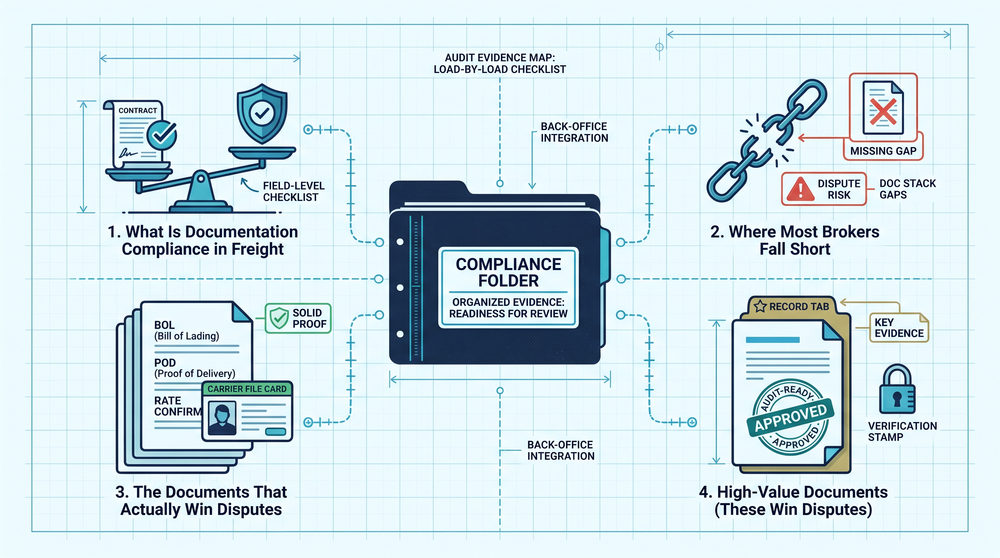
What Is Documentation Compliance in Freight, and Why Most Brokers Get It Wrong
Documentation compliance in freight means collecting, organizing, and retaining every document required to verify that a load was booked, moved, delivered, and billed accurately. For a freight broker, this includes rate confirmations, bills of lading (BOLs), proof of delivery (POD), carrier packets, insurance certificates, and accessorial backup for every charge that appears on an invoice. The core compliance documents in freight operations include:
- Rate confirmation (rate con) with agreed linehaul, fuel surcharge, and accessorial terms
- Bill of lading (BOL) with shipper and consignee signatures, piece counts, and special instructions
- Proof of delivery (POD) with timestamps, receiver signature, and condition notes
- Carrier packet with MC authority, insurance, and W-9
- Accessorial backup: lumper receipts, detention logs, TONU documentation, temperature logs
The Federal Motor Carrier Safety Administration (FMCSA), the U.S. Department of Transportation (DOT) agency that regulates motor carriers and brokers, requires motor carriers to maintain driver qualification files, hours-of-service records, vehicle inspection reports, and accident registers. But FMCSA recordkeeping is only the regulatory floor. For a freight broker, documentation compliance goes further: it's about building a freight audit trail that proves what was agreed, what happened on the load, and whether the invoice matches reality.
Where Most Brokers Fall Short
Most brokers collect rate cons and BOLs. That's table stakes. Where they fall short is on the accessorial backup documents, the signed lumper receipts, the timestamped arrival and departure logs, the written shipper cancellation notices, and the check call records. These are the documents that actually decide whether a $200 dry run charge or a $350 detention charge gets paid or gets disputed successfully. According to a Trimble analysis of freight spend, 15 to 20% of freight invoices contain errors significant enough to require adjustment. If you're running 500 loads a month and you don't have the documents to catch and dispute those errors, you're writing checks you don't owe.
The problem isn't that brokers don't care about documentation. It's that collecting everything for every load takes time, and when your team is dispatching, booking, and billing simultaneously, the accessorial backup is usually the first thing that gets skipped. That gap is where margin disappears.
The Documents That Actually Win Disputes (and the Ones That Don't Help)
Not all documents carry the same weight in a billing dispute. A rate con proves what was agreed. A BOL proves what was picked up. A POD proves what was delivered. But when a carrier adds $180 in lumper fees, $350 in detention, or a $250 TONU to the invoice, the dispute comes down to whether you have the specific backup document that proves or disproves the charge.
High-Value Documents (These Win Disputes)
- Rate confirmation with accessorial language. If detention isn't listed on the rate con, or it specifies 2 hours free time and you can prove the driver was on-site for less, you win the dispute. The rate con is your contract.
- Timestamped BOL or gate log. Arrival and departure times on the BOL or a facility gate log are the single most important pieces of evidence in a detention dispute. Without timestamps, it's your word against the carrier's.
- Signed POD with receiver notes. A proof of delivery that includes the receiver's signature, timestamp, and condition notes is the document that closes the loop on delivery. It proves the load arrived, when it arrived, and in what condition.
- Signed lumper receipt from the receiver. A lumper fee billed without a receipt signed by the receiving facility has a near-zero dispute success rate. The receipt must show the amount, the facility, and the date.
- Written shipper cancellation notice. For TONU disputes, you need proof the shipper canceled after the driver was dispatched. A verbal cancellation with no written record almost always means you pay.
- Continuous temperature logs for reefer loads. Temperature excursion claims live or die on whether you have continuous temp data from pickup to delivery.
Low-Value Documents (These Don't Help Much)
- Generic emails or phone notes without timestamps. "I told the carrier" means nothing without a dated, written record.
- Internal TMS notes that aren't tied to source documents. A note in your TMS that says "driver arrived at 10am" doesn't carry the same weight as a signed BOL or gate log that says the same thing.
- Unsigned or incomplete BOLs. A BOL without a consignee signature or with missing pickup/delivery times is barely better than no BOL at all in a dispute.
As detailed in a breakdown of documents freight brokers must retain, broker-carrier agreements, bills of lading, and insurance certificates all carry legal weight. But in a billing dispute, the specificity of the document matters more than the existence of it. A BOL with timestamps beats a BOL without them every time.
Load-by-Load Documentation Checklist: Dry Van, Reefer, Flatbed, Drayage, and More
Different load types carry different documentation risks. A dry van load has a simpler doc stack than a reefer load, and a drayage move introduces customs documentation that van loads never touch. Here's what you need for each major load type.
Dry Van Loads
- Rate confirmation with linehaul, fuel surcharge, and accessorial terms
- BOL signed at pickup with piece count, weight, and commodity description
- POD signed at delivery with timestamp and receiver notes
- Detention log or gate timestamps (if applicable)
- Lumper receipt signed by receiver (if applicable)
- Check call log with at least pickup confirmation, in-transit update, and delivery confirmation
Dry van is the baseline. If your doc stack isn't complete for van loads, it's almost certainly incomplete for everything else.
Reefer Loads
Everything on the dry van list, plus:
- Pre-trip reefer inspection record showing unit was functioning before pickup
- BOL noting the required temperature set point at pickup
- Continuous temperature log from pickup to delivery (digital or printout)
- POD noting temperature at delivery and any excursion concerns
Reefer loads carry a significantly higher documentation risk. A $500 temperature excursion claim requires all three temperature-related documents (set point on BOL, continuous temp log, and pre-trip inspection) to dispute effectively. Missing even one of these shifts liability to the broker.
Flatbed Loads
Everything on the dry van list, plus:
- Securement and tarp instructions documented on rate con or BOL
- Photos of loaded freight at pickup (increasingly standard practice)
- Tarp charge documentation if billed as an accessorial (must match rate con terms)
- Oversize/overweight permits if applicable
Drayage Loads
Drayage introduces port and customs documentation that other load types don't require:
- Rate confirmation with per-diem, chassis, and port fee terms
- Container release or booking confirmation
- Port gate timestamps (arrival, chassis pickup, container pickup, outgate)
- Customs release documentation
- BOL and POD with standard requirements
- Per-diem and demurrage backup (port notices, not just carrier claims)
Drayage disputes are some of the hardest to win because port fees, chassis charges, and per-diem costs can be layered on by multiple parties. Without port-issued documentation backing each charge, the broker typically absorbs the cost.
LTL and Partial Loads
- Rate confirmation specifying class, weight, and dimensions
- BOL with accurate NMFC codes and freight class
- Weight inspection certificate (if re-weighed)
- POD with piece count verification at delivery
- Reclassification notice (if the carrier reclassed the freight)
LTL reclassification disputes are common and expensive. If the carrier re-weighs or reclasses your freight and you don't have the original weight certificate or correct NMFC code on the BOL, the higher charge sticks.
Accessorial Backup: What You Need to Dispute Detention, Lumpers, and TONUs
Accessorial charges are where brokers lose the most money to overbilling. Detention, lumper fees, TONUs, dry runs, and layover charges show up on invoices regularly, and each one requires a specific set of backup documents to dispute. Here's the exact documentation stack for each.
Detention Charges
Example: A carrier invoices $350 for detention at delivery. The rate con specifies 2 hours of free time, then $75/hour. The carrier claims the driver waited 6 hours. You believe the driver arrived late and the actual wait was under 2 hours. Without a timestamped BOL, gate log, or arrival/departure record, you have no way to prove it. The $350 gets paid.
Now consider the same scenario where you have a signed POD with gate timestamps showing the driver arrived at 1:15 PM and departed at 2:45 PM. That's 90 minutes, well within the 2-hour free time window. Dispute resolved in under 10 minutes. Documents needed:
- Rate con with free time and detention rate specified
- Timestamped BOL or gate log showing arrival and departure
- POD with receiver-confirmed delivery time
Lumper Fees
Example: A lumper fee of $180 appears on a carrier invoice. No receipt is attached. You ask the carrier for documentation. They send a generic receipt without a facility signature. This charge has a near-zero dispute success rate because the carrier can't prove the fee was incurred, but you also can't prove it wasn't, and without your own backup, the default often goes to the carrier.
The three-document stack needed to resolve lumper disputes:
- Rate con language addressing lumper fee responsibility and reimbursement terms
- Lumper receipt signed by the receiving facility, showing amount, date, and facility name
- BOL with delivery confirmation matching the lumper receipt date and facility
If the rate con says lumper fees are billable only with a signed receipt, and the carrier can't produce one, you dispute it. If you're the one who should have collected the receipt and didn't, you're stuck.
TONU (Truck Ordered Not Used) Charges
Example: A shipper cancels a load after the carrier has dispatched a driver. The carrier bills a TONU of $200. TONU charges typically range from $150 to $250 per incident. Documents needed:
- Original rate confirmation showing the booked load and TONU terms (if any)
- Driver check-in record or timestamp showing the driver was dispatched or en route
- Written shipper cancellation notice with date and time
Without all three, the TONU charge typically sticks. If the rate con doesn't address TONU terms, the dispute becomes harder, but a written cancellation notice with a timestamp still gives you a starting point.
Dry Run Charges
Example: A carrier bills a $200 dry run fee, claiming the pickup facility was closed when the driver arrived. The broker with a dated check call log showing the driver was confirmed en route at 7:45 AM and documented facility operating hours (6 AM to 6 PM) on file disputes successfully. The facility was open. The driver either arrived at the wrong location or the wrong time. The broker without the check call log or facility hours pays the $200.

- Check call log with timestamps
- Facility operating hours on file (from the shipper or facility)
- Rate con with dry run terms
Reefer Temperature Excursion Claims
Example: A receiver rejects a reefer load and the carrier files a $500 temperature excursion claim. To push back, you need:
- Signed BOL noting the required temperature set point at pickup
- Continuous temperature log from pickup to delivery showing no excursion occurred on the broker's watch
- Pre-trip reefer inspection record showing the unit was functioning before loading
If the temperature log shows the unit held temp for the entire transit and the pre-trip inspection was clean, the claim falls on the receiver's handling or the carrier's equipment after delivery. Without these three documents, the $500 claim is nearly impossible to fight.
How Gaps in Your Doc Stack Turn Into Dollars Lost on Every Invoice
Documentation gaps don't look expensive on any single load. A missing timestamp here, an unsigned receipt there. But they compound fast. Here's the math.
The Compounding Cost of Incomplete Documentation
According to Hyland's analysis of freight billing processes, roughly 80% of carrier invoices contain some kind of discrepancy. Per Trimble's freight audit data, 15 to 20% of those invoices have errors significant enough to require adjustment.
Scenario: You're a broker running 500 loads per month. If 1 in 5 invoices (100 invoices) contains an overbilled accessorial averaging $75, that's $7,500 per month in potential margin erosion. Over a year, that's $90,000. If your team can only successfully dispute half of those because they're missing timestamps, unsigned receipts, or incomplete rate con language, you're eating $45,000 annually in charges you could have fought.
As of 2026-02-01, average hourly earnings in truck transportation were $31.94/hr according to BLS Current Employment Statistics (series CEU4348400008). That means the manual labor cost of your billing coordinator spending even 5 hours per week reconciling invoices without proper documentation adds up to roughly $8,300 per year in labor alone, not counting the disputes they lose.
Where the Gaps Usually Are
Based on Laneproof analysis of 12,000 broker invoice packets, the most commonly missing documents in dispute-ready load files are:
- Timestamped arrival/departure records: Missing in 62% of loads where detention was billed
- Signed lumper receipts: Missing in 44% of loads where lumper fees were invoiced
- Written shipper cancellation notices: Missing in 71% of TONU disputes
- Continuous temperature logs: Missing in 38% of reefer loads reviewed
- Rate con accessorial language: Vague or absent in 55% of rate confirmations that led to accessorial disputes
Each one of these gaps represents a charge that probably could have been disputed but wasn't, because the document wasn't there when the billing coordinator needed it. The fix isn't better billing people. It's a better collection process at the point of load execution.
The FMCSA Compliance Layer
Beyond billing disputes, documentation compliance has a regulatory dimension. FMCSA recordkeeping requirements mandate that motor carriers maintain driver qualification files, hours-of-service records, and vehicle inspection reports. For freight brokers, maintaining carrier compliance documentation (active authority, insurance certificates, safety ratings) is part of the due diligence required when onboarding carriers. As of 2026-03-01, truck transportation employed 1,464 thousand workers according to BLS CES data (series CES4348400001), and FMCSA's compliance framework applies across that entire workforce. If you're brokering loads to carriers that can't produce their own compliance documentation, you're taking on risk that goes beyond a single invoice dispute.
Per Fleetworthy's DOT and FMCSA recordkeeping guide, maintaining accurate and up-to-date documentation is not optional. It's a regulatory requirement that, when done well, also serves as the backbone of your freight audit trail. The documentation you collect for billing accuracy and the documentation you collect for regulatory compliance overlap significantly. Rate cons, BOLs, PODs, and carrier packets serve both purposes.
Documentation compliance isn't a back-office chore. It's the difference between paying every invoice at face value and catching the 15 to 20% that contain errors large enough to matter.
Frequently Asked Questions About Freight Documentation Compliance
What is documentation compliance in freight?
Documentation compliance in freight refers to the practice of collecting, verifying, and retaining all documents required for each load, including rate confirmations, BOLs, PODs, carrier packets, and accessorial backup. For freight brokers, it means having a complete, auditable document trail for every load that supports both FMCSA regulatory requirements and invoice dispute resolution. It's the foundation of a functional freight audit trail.
What are examples of compliance documentation for freight brokers?
The most common compliance documents for freight brokers include: rate confirmations, bills of lading (BOLs), proof of delivery (PODs), carrier packets (MC authority, insurance, W-9), lumper receipts, detention logs, driver check-in records, shipper cancellation notices, temperature logs for reefer loads, and check call logs. Each document serves a specific role in verifying that the load was executed as agreed and billed accurately.
What are the 5 C's of documentation in freight operations?
In freight operations, the 5 C's of documentation are: Complete (every required document is present for the load type), Correct (all data matches across documents, from piece counts to delivery times), Current (insurance and authority documents are not expired), Consistent (information on the BOL, rate con, and POD aligns), and Confirmed (documents carry signatures, timestamps, or other verification from the relevant parties). A doc stack that meets all five C's will hold up in both a carrier billing dispute and a regulatory audit.
How long should freight brokers retain load documentation?
FMCSA does not specify a single retention period for all documents. Driver qualification files must be maintained for the duration of employment plus additional periods, and other records have their own timelines. For freight brokers, industry best practice is to retain all load-level documentation (rate cons, BOLs, PODs, carrier packets, and accessorial backup) for a minimum of 3 years. Some legal advisors recommend 5 years, especially for loads involving claims, disputes, or regulatory inquiries.
What happens if a freight broker can't produce documentation during a dispute?
If a broker cannot produce the specific documentation needed to dispute a carrier invoice charge, the charge typically stands. Detention without a timestamped arrival log gets paid. Lumper fees without signed receipts get paid. TONUs without written cancellation notices get paid. The carrier's invoice becomes the default record when the broker's documentation is incomplete. Over hundreds of loads, this pattern can erode margins by thousands of dollars per month.
Build the Doc Stack Before You Need It
Documentation compliance isn't something you fix after a dispute. It's something you build into every load before the invoice arrives. The checklist in this guide covers every major load type and accessorial scenario. Print it. Share it with your dispatchers. Make it part of your load execution process.
The brokers who win disputes aren't the ones who argue the loudest. They're the ones who produce the right document in under 10 minutes. If your team is processing more than 50 invoices a week, tools that automatically flag invoice discrepancies and match documents to charges can catch the gaps this guide describes before they turn into lost margin. But the starting point is knowing which documents matter, load by load. Now you do.
Sources
- FMCSA Regulations — Federal Motor Carrier Safety Administration, U.S. Department of Transportation
- Freight Audit Insights: The Truth About Freight Spend — Trimble Transportation
- Recordkeeping Requirements for FMCSA Compliance — SparkTS
- Trucking Company Record Keeping for DOT & FMCSA — Fleetworthy
- The Fragile State of Freight Billing Processes and Audits — Hyland
- Knowing What Documents a Freight Broker Must Keep Helps Wage Targeted Discovery — Abraham Watkins
Full guide: Freight Billing Compliance: What It Costs When You Can't Prove It
Related: Audit Preparation for Freight Ops: Pull the Right Docs in 20 Minutes
Related: Regulatory Requirements That Cost Brokers Money on Every Invoice