Detention Charges in Logistics: How Carriers Overbill and How to Fight Back
Researched and written with AI assistance. Reviewed by the Laneproof team.
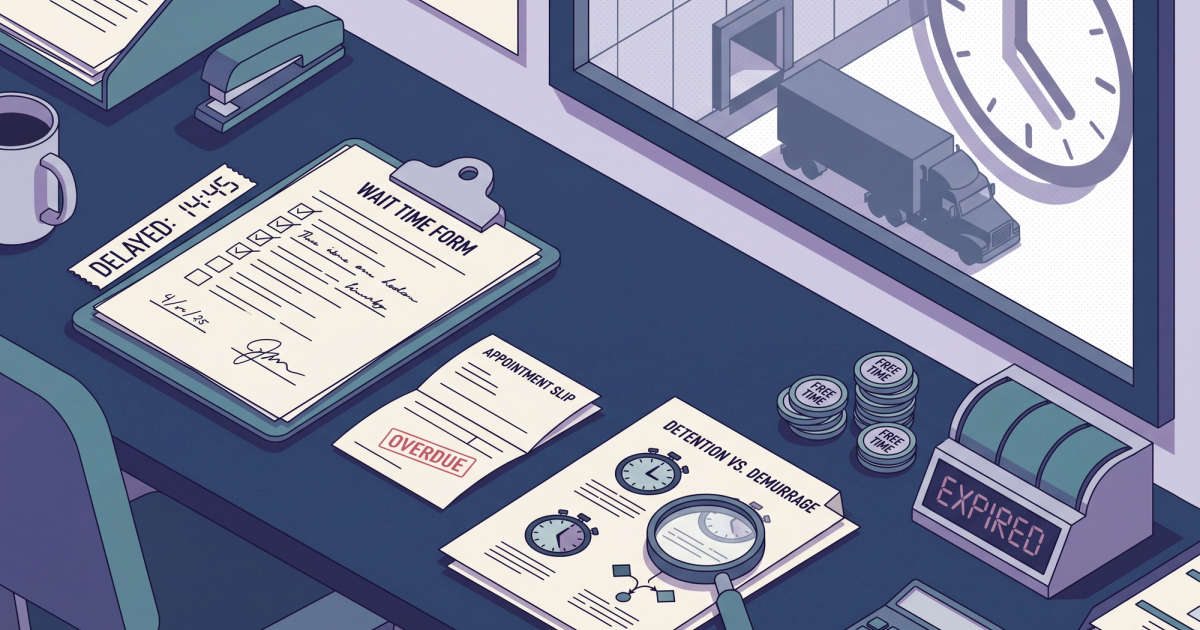
Detention charges in logistics are one of the fastest ways to lose margin without moving a single extra load. A broker running 40 loads per month who pays an average of $180 in unchecked detention per load bleeds $7,200 every month, or $86,400 per year, without filing a single dispute. According to a 2014 FMCSA study on driver detention time, commercial vehicle drivers experienced detention on approximately 1 in every 10 stops, with an average duration of 1.4 hours per occurrence. That frequency means detention invoices land on your desk regularly. The question is whether you're paying what you actually owe or absorbing inflated charges because you don't have time to check every line item.
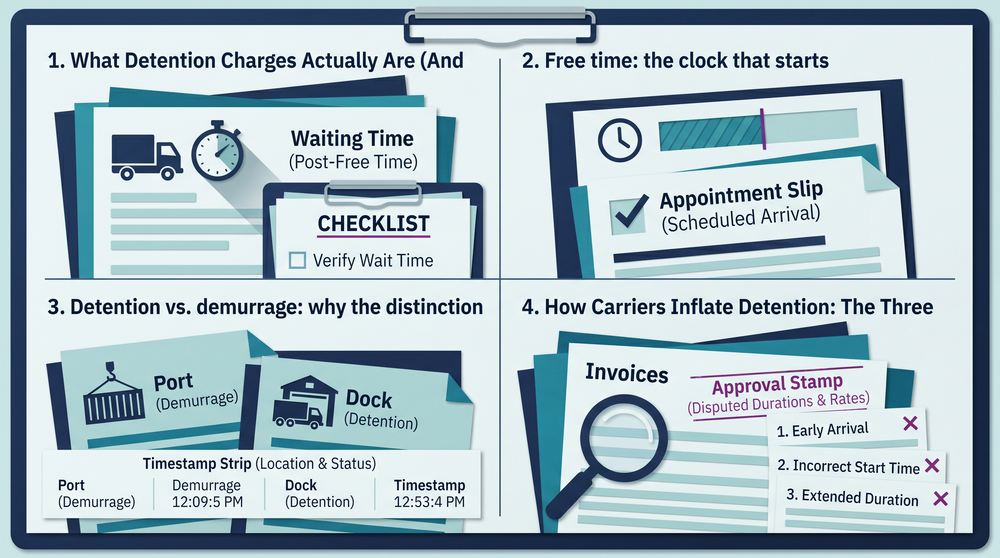
What Detention Charges Actually Are (And What Triggers Them)
A detention charge is a fee a carrier bills when a truck is held at a shipper or receiver facility beyond the agreed free time window. The charge compensates the carrier for the driver's lost productivity, the equipment sitting idle, and the downstream scheduling disruption. According to Truckstop's detention pay breakdown, the average trucking detention fee is approximately $85 per hour, intended to cover driver pay and carrier operating costs during the wait. As of 2026-04-01, average hourly earnings in truck transportation stood at $32.41/hr (BLS Current Employment Statistics, series CEU4348400008), so when a carrier quotes $75 to $100 per hour for detention, the margin above driver wage covers fuel idle costs, insurance, and lost opportunity on the next load.
Free time: the clock that starts every dispute
Free time is the window (typically 1 to 2 hours at most truckload facilities) during which a driver can be loaded or unloaded without triggering a detention charge. Once the clock runs past free time, charges begin accruing. The problem for brokers is that "when the clock starts" is rarely defined the same way on every rate con. Some carriers start the clock at the appointment time. Others start it at driver arrival. And a few start it when the driver checks in at the guard shack, which can be 15 to 30 minutes before the truck reaches a dock door. Every one of those definitions changes the math on your invoice. If your rate con detention clause doesn't specify a start trigger, you're negotiating after the fact, and the carrier holds the leverage.
Detention vs. demurrage: why the distinction matters for your invoice
Detention and demurrage are related but not interchangeable. As Descartes defines it, detention refers to charges for holding a carrier's equipment (a trailer or container) beyond the allowed free time for loading or unloading, while demurrage applies to storage charges at a terminal or port for cargo that sits beyond its allotted time. In truckload brokering, you'll deal with detention far more often. In drayage and intermodal, both charges can appear on the same invoice. A peer-reviewed study published in PMC on demurrage and detention as operational challenges found that these charges have become a systemic cost driver in intermodal transport, with cascading effects on scheduling and profitability. For brokers handling drayage loads, understanding which charge applies to which delay event is the difference between paying one fee and paying two for the same problem.
How Carriers Inflate Detention: The Three Billing Tactics You'll See Most
Not every inflated detention charge is intentional fraud. Some result from sloppy timekeeping. Others come from billing templates that default to the carrier's most favorable interpretation. But the effect on your margin is the same. Here are the three patterns that show up most often when you start auditing carrier detention invoices.
Tactic 1: Starting the clock before the driver actually arrives
This is the most common detention billing error brokers encounter. The carrier submits an invoice showing detention starting at the appointment time (say, 08:00), but the driver didn't actually arrive until 08:45. On a rate of $75/hr, that 45-minute gap adds roughly $56 to the invoice. It sounds small on one load. On 100 loads per month, it's $5,600 in charges that never should have existed. The fix is straightforward: match the carrier's claimed start time against the BOL arrival timestamp or the facility check-in record. If the driver was late, detention free time doesn't start until the truck is physically on site and ready to be loaded or unloaded.
Scenario: A carrier invoices a 4-hour detention window, but the BOL timestamp shows the driver arrived 45 minutes late. Actual billable time is 3 hours and 15 minutes, not 4 hours. At $75/hr, the carrier overbilled by $56.25 on a single load.
Tactic 2: Bundling unauthorized accessorials into the detention line item
This one is harder to spot if you're reviewing invoices quickly. A carrier submits what looks like a $245 detention charge, but buried in the total is a $150 lumper fee that was never authorized on the rate con. The legitimate detention portion was $95. By combining the charges into a single line, the carrier avoids the scrutiny that a separate lumper fee line item would trigger. This tactic also shows up with TONU charges, fuel surcharges, and layover fees. Any time an accessorial charge appears rolled into a detention total rather than broken out separately, it should raise a flag. Your rate con should specify which accessorials are pre-approved, and anything not listed requires separate authorization before the carrier can bill it.
Scenario: Carrier submits a $245 detention invoice. After reviewing the rate con, the broker finds no lumper fee authorization. The legitimate detention charge is $95. The remaining $150 is an unauthorized lumper fee that the carrier bundled into the detention line to avoid pushback.
Tactic 3: Double-billing for the same delay event
This happens most frequently in drayage and intermodal operations, but it shows up in OTR as well. A carrier invoices both a detention charge and a layover charge for the same delivery window. The logic: the delay at the facility triggered detention, and the fact that the driver couldn't make the next pickup caused a layover. But if both charges stem from a single delay event at a single facility, the broker is paying twice for the same problem. Understanding how detention time interacts with layover and scheduling decisions is critical to catching these duplicates.
Scenario: A drayage carrier invoices a $350 layover charge on top of a $160 detention charge for the same delivery window. Both charges were triggered by the same delay at the receiver. The broker disputes the layover as a duplicate, saving $350 on that single load.
Which Line Items to Check First on Any Carrier Detention Invoice
You don't need to spend 30 minutes on every detention invoice. You need a checklist that catches the most expensive errors in under 5 minutes. Here's the priority order.
1. Compare the claimed detention start time against the BOL arrival record
Pull the BOL for the load. Find the arrival timestamp (or the facility check-in log if available). Compare it to the start time the carrier listed on their invoice. If there's a gap, the carrier is billing for time before the driver was on site. This single check catches the most common inflation tactic and takes less than a minute per invoice.
2. Verify the departure time against the POD signature timestamp
The POD (proof of delivery) usually includes a signature timestamp showing when the receiver accepted the freight. If the carrier claims detention ended at 13:00 but the POD was signed at 10:47, that's a 2-hour and 13-minute discrepancy. At $75/hr, the carrier overbilled by approximately $166. This check is the second highest-value audit step.
Scenario: A detention invoice shows a start time of 08:00 and an end time of 13:00, claiming 5 hours of detention. But the POD signature timestamp is 10:47, confirming a total dwell time of 2 hours and 47 minutes. At $75/hr, the carrier overbilled by $166.25.
3. Match the rate per hour against the rate con
The rate con should specify the detention rate. If it says $75/hr and the invoice charges $90/hr, the carrier is billing above the agreed rate. This discrepancy is easy to miss when you're processing invoices in bulk, but it compounds fast. On a 3-hour detention event, a $15/hr rate inflation adds $45. On 100 loads per month, that's $4,500 in excess charges.
4. Check for bundled accessorial charges
If the detention total looks higher than the hours multiplied by the rate, break it apart. Look for lumper fees, fuel surcharges, or other accessorial charges embedded in the detention line. Each should be a separate, authorized line item. If it's not on the rate con, it's not pre-approved.
5. Look for duplicate charges on the same delay event
Cross-reference detention charges against any layover, dry run, or TONU charges on the same invoice or on separate invoices for the same load. If two charges reference the same facility and the same date window, one is likely a duplicate. For more detail on spotting these overlaps, see our guide on how carriers overbill on detention and how to catch it.
The Documentation You Need to Win a Detention Dispute
Filing a detention dispute without documentation is a waste of your time and the carrier's. You need a file that proves the discrepancy clearly enough that the carrier's billing team can verify it without a phone call. Here's what that file should contain.
The four documents that form your dispute file
- Rate confirmation (rate con): This is the contract. It shows the agreed detention rate, free time window, and start trigger definition. If the carrier billed outside these terms, the rate con is your primary evidence.
- Bill of lading (BOL): The BOL shows arrival time, pickup or delivery details, and any notes from the facility. The arrival timestamp on the BOL is usually the most reliable record of when the driver actually showed up.
- Proof of delivery (POD): The POD signature timestamp establishes when the load was accepted and the truck was free to leave. This is your end-of-detention marker.
- Facility check-in/check-out logs: Not always available, but when they are, they provide a third-party record that neither the broker nor the carrier controls. Some warehouses and distribution centers will provide these on request.
Building the dispute email
Keep it factual and short. State the load number, the invoiced detention amount, the amount you believe is correct, and the specific discrepancy. Attach the rate con, BOL, and POD. Here's a template structure:
- Subject line: Detention Dispute, Load #[number], Invoice #[number]
- Line 1: "We've identified a discrepancy on the detention charge for Load #[number]."
- Line 2: "Invoiced amount: $[X]. Verified amount based on BOL arrival and POD departure: $[Y]. Difference: $[Z]."
- Line 3: "Attached: rate confirmation showing agreed rate and free time, BOL with arrival timestamp, POD with departure timestamp."
- Line 4: "Please review and issue a corrected invoice within [X] business days."
That's it. No emotion, no accusations. Just numbers and documents. Carriers resolve these disputes faster when the math is laid out clearly.
What recovery looks like in practice
Scenario: A broker implements a timestamp-matching review process, comparing BOL arrival times and POD departure times against every carrier detention invoice. In the first month, the broker identifies discrepancies on 6 invoices and files disputes on all 6. Total recovered: $1,100. The entire review process takes about 15 minutes per invoice. For a team processing 100+ loads per month, this single workflow change can recover thousands of dollars in the first quarter alone.
How to Read the Detention Clause on a Rate Con Before You Sign
Most detention disputes start long before the truck arrives at the facility. They start when the broker signs a rate con without reading the detention clause carefully. Here's what to look for.
Free time definition
The rate con should state the free time window explicitly: 1 hour, 2 hours, or whatever the agreement is. If the rate con says "standard free time" without defining it, you're accepting the carrier's interpretation. For brokers, 2 hours of free time at both pickup and delivery is the most common standard. If the carrier's rate con lists anything less, negotiate before you book. According to FreightWaves reporting on broker detention liability, the FMCSA has faced ongoing pressure from carriers to formalize detention payment obligations for brokers, making it even more important to have clear terms in writing.
Clock start trigger
This is the single most important line in a detention clause. Does the clock start at the appointment time, at driver arrival, at check-in, or at dock assignment? Each definition changes the math. If the rate con doesn't specify, add language that says: "Detention free time begins upon confirmed driver arrival at the facility." This prevents the carrier from billing based on appointment time when the driver showed up late.
Scenario: Free time is listed on the rate con as 2 hours, but the carrier invoices detention starting at the appointment time rather than the confirmed arrival time. The driver arrived 30 minutes after the appointment. On a $90/hr detention rate, that 30-minute gap adds $45 per load. On 100 loads per month, that's $4,500 in charges that wouldn't exist if the rate con specified "arrival time" as the start trigger.
Rate cap and maximum charge
Some rate cons include a maximum detention charge per stop (for example, "detention not to exceed $300 per stop"). This protects the broker against runaway charges on loads with extreme delays. If the rate con doesn't include a cap, consider adding one. A cap of 4 to 6 hours at the agreed hourly rate is reasonable and limits your worst-case exposure.
Authorized accessorials
The rate con should list every accessorial that's pre-approved: detention, lumper fees, layover, TONU, fuel surcharges. If it's not on the list, it's not authorized. This prevents carriers from bundling unapproved charges into detention line items. A clean rate con is your first line of defense against every billing tactic described in this guide.
The Cost of Doing Nothing: Real Numbers on Unchecked Detention
The DOT Office of Inspector General's 2018 report on commercial driver detention adapted FMCSA economic models to estimate detention's cumulative negative effects on both driver net income and motor carrier revenues. The report established that detention isn't just an operational inconvenience. It's a systemic cost burden that flows through the entire supply chain. For brokers, that cost burden lands directly on your P&L when you pay inflated invoices without auditing them.
Consider the math at scale. As of 2026-05-01, truck transportation employment stood at 1,465 thousand workers (BLS CES series CES4348400001). The sheer volume of drivers interacting with shipper and receiver facilities every day means detention events are not rare exceptions. They are a daily occurrence across the industry. The FMCSA's finding that 1 in 10 stops involves detention means a broker dispatching 200 loads per month can expect roughly 20 detention events. If even half of those invoices contain a billing error worth $50 to $150, the monthly exposure ranges from $500 to $1,500 in avoidable charges.
A broker processing 40 loads per month at an average of $180 in unchecked detention per load loses $86,400 per year. That's margin you earned on the linehaul, handed back on the invoice.
The data from the Federal Register notice on FMCSA's ongoing detention data collection confirms that the agency is actively studying detention's operational and safety impacts, signaling continued regulatory attention. For brokers, this means detention practices are likely to face more scrutiny, and having clean documentation and dispute workflows in place now puts you ahead of whatever compliance requirements may follow.
Frequently Asked Questions About Detention Charges in Logistics
What is detention in logistics?
Detention is a charge a carrier bills when their truck and driver are held at a shipper or receiver facility beyond the agreed free time for loading or unloading. Rates typically range from $50 to $100 per hour, depending on the carrier and the terms on the rate con. According to Truckstop, the industry average is approximately $85 per hour.
What is the difference between demurrage and detention in logistics?
Demurrage is a charge for cargo sitting at a port or terminal beyond its allotted free time. Detention is a charge for holding a carrier's equipment (trailer, container, or chassis) beyond the allowed free time at a facility. In truckload brokering, detention is the charge you'll see most often. In drayage and intermodal, you may encounter both on the same shipment, sometimes on the same invoice. Descartes provides a clear breakdown of both terms.
Who is responsible for detention charges?
Responsibility depends on who caused the delay. If the shipper or receiver held the truck beyond free time, the detention charge typically flows from the carrier to the broker and then to the shipper. If the driver arrived late and that reduced the available free time, the carrier may bear part of the responsibility. The rate con and the BOL timestamps are the documents that determine liability. Per FreightWaves, carriers have pushed FMCSA to formalize broker payment obligations for detention, but as of now, contractual terms on the rate con remain the primary governing framework.
What is 14 days free detention and demurrage?
This term typically appears in ocean and intermodal freight. It means the consignee has 14 calendar days from the container's arrival at port or terminal to return the empty container or chassis to the carrier without incurring detention or demurrage fees. After the 14-day window, charges begin accruing daily. For truckload brokers who also handle drayage, this free time window should be confirmed in writing before booking, as some carriers offer shorter windows (7 or 10 days) and charge higher daily rates once the window expires.
How do I dispute a carrier detention charge?
Start by pulling the rate con, BOL, and POD for the load. Compare the carrier's claimed detention start and end times against the timestamps on those documents. Calculate the correct billable time based on the rate con's free time and clock start definitions. If there's a discrepancy, send the carrier a written dispute with the load number, the invoiced amount, the verified amount, and copies of all supporting documents. Most carriers will review and issue a corrected invoice within 5 to 10 business days if the documentation is clear.
Stop Paying for Time You Don't Owe
Detention charges in logistics aren't going away. Carriers have a legitimate right to bill for delays at facilities. But you have a legitimate right to verify every dollar on that invoice before you pay it. The workflow is simple: match timestamps on the BOL and POD against the carrier's claimed hours, verify the rate against the rate con, check for bundled accessorials, and flag any duplicate charges. That process takes minutes per invoice and recovers thousands per month.
The brokers who lose the most on detention aren't the ones with the highest volume. They're the ones who pay every invoice at face value because they don't have time to check. If your team processes more than 50 invoices a week, automated tools that flag detention discrepancies before you pay can catch the errors covered in this guide without adding hours to your billing coordinator's week.
Sources
- Impact of Driver Detention Time on Safety and Operations — FMCSA
- Estimates Show Commercial Driver Detention Increases Costs and Crash Risk — DOT Office of Inspector General
- Truckers Push FMCSA to Make Brokers Pay for Detention Time — FreightWaves
- What Are Detention and Demurrage in Logistics? — Descartes
- Understanding Trucking Detention Pay for Carriers and Freight Brokers — Truckstop
- Demurrage and Detention: From Operational Challenges to Policy Implications — PMC/PubMed
- Agency Information Collection Activities: Impact of Driver Detention Time — Federal Register
Full guide: Detention Charges: How Carriers Overbill and How to Fight Back