Invoice Reconciliation Job Description for Freight Brokerages
Researched and written with AI assistance. Reviewed by the Laneproof team.
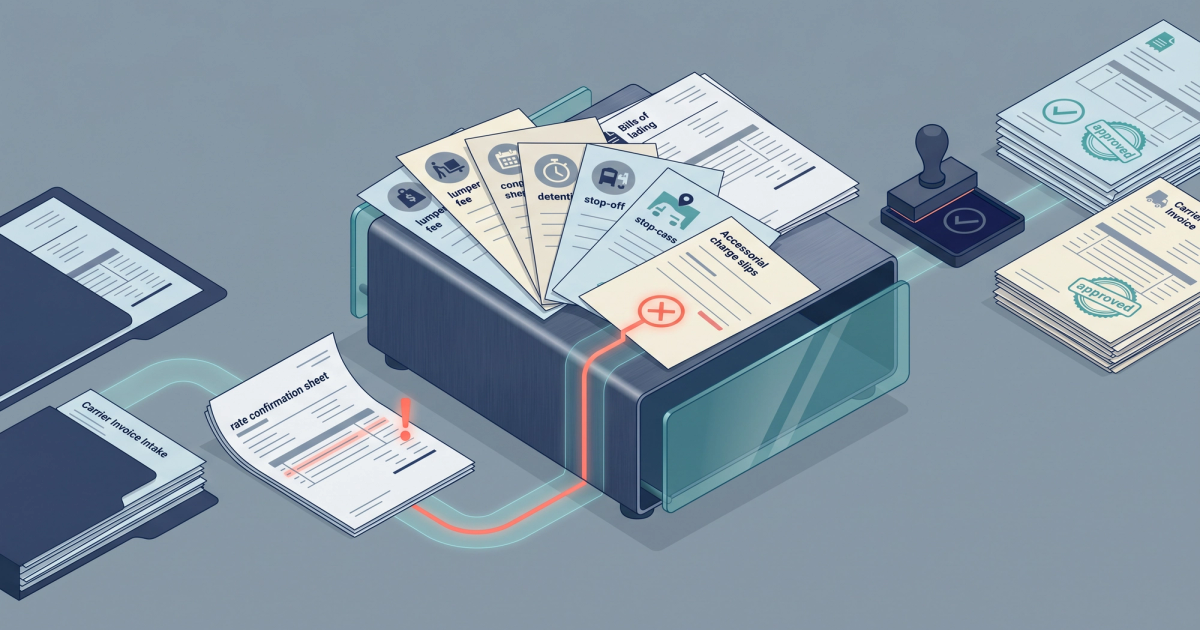
Invoice reconciliation in freight is the process of matching carrier invoices against rate confirmations, BOLs, and PODs to confirm every charge is accurate before payment. If your brokerage moves 500 loads a month and you're approving invoices without cross-checking the rate con, you could be losing roughly $2,850 per month to overbilling on detention, lumper fees, fuel surcharges, and accessorials alone. That's $34,200 a year walking out the door. The person sitting in the invoice reconciliation job description seat is the one who stops it. But here's the problem: most job descriptions for this role are copy-pasted from generic accounts payable templates that mention "matching invoices to purchase orders" and call it a day. They say nothing about rate cons, TONU disputes, or how to audit a fuel surcharge calculated on gross linehaul instead of net. This post fixes that. You'll get the actual daily tasks, the skills that matter, the KPIs worth tracking, and a ready-to-use job description template built specifically for freight brokerages.
What Invoice Reconciliation Actually Means in a Freight Brokerage
In the broadest sense, invoice reconciliation is an accounting process that compares invoices against purchase orders and receiving reports to verify accuracy before payment. In freight, the concept is the same but the documents are different. You're not matching a purchase order to a packing slip. You're matching a carrier's freight invoice to a rate confirmation, a bill of lading, a proof of delivery, and sometimes a lumper receipt or detention log.
The five steps of the reconciliation process in a freight brokerage look like this:
- 1. Receive the carrier invoice. This arrives via email, carrier portal, or directly through your TMS. It includes the linehaul rate, fuel surcharge, and any accessorial charges the carrier is billing.
- 2. Pull the rate confirmation. The rate con is the contract. It specifies the agreed linehaul, fuel surcharge terms, detention caps, and any pre-approved accessorials. This is the baseline everything gets measured against.
- 3. Match line items to the rate con. Every charge on the invoice gets compared against the rate con. If the rate con says $1,800 linehaul and the invoice says $1,850, that's a $50 variance that needs documentation or rejection.
- 4. Verify supporting documents. BOLs confirm pickup and delivery details. PODs confirm the load was actually delivered. Lumper receipts confirm third-party unloading fees. Detention logs confirm wait times. Without these, accessorial charges can't be validated.
- 5. Approve, dispute, or escalate. If everything matches, the invoice gets approved for payment. If there's a discrepancy, it gets flagged, documented, and sent back to the carrier for correction. If the dispute is complex (duplicate billing, rate con ambiguity), it escalates to an ops manager or account lead.
This process sounds straightforward. It isn't. According to a Reddit thread where freight brokers discussed their current reconciliation workflows, many brokerages are still running this process through email threads, spreadsheets, and manual margin checks. That's where errors survive and overbilling goes unnoticed. The understanding of invoice reconciliation as comparing invoices with purchase orders and receiving reports applies here, but the freight-specific version demands knowledge of detention rules, fuel surcharge formulas, and accessorial billing that generic AP roles never touch.
What This Role Does Every Single Day (Not the HR Version)
Every generic job posting for a billing coordinator lists "process invoices" and "reconcile accounts." That tells a freight broker nothing. Here's what the freight invoice reconciliation role actually looks like on a Tuesday morning.
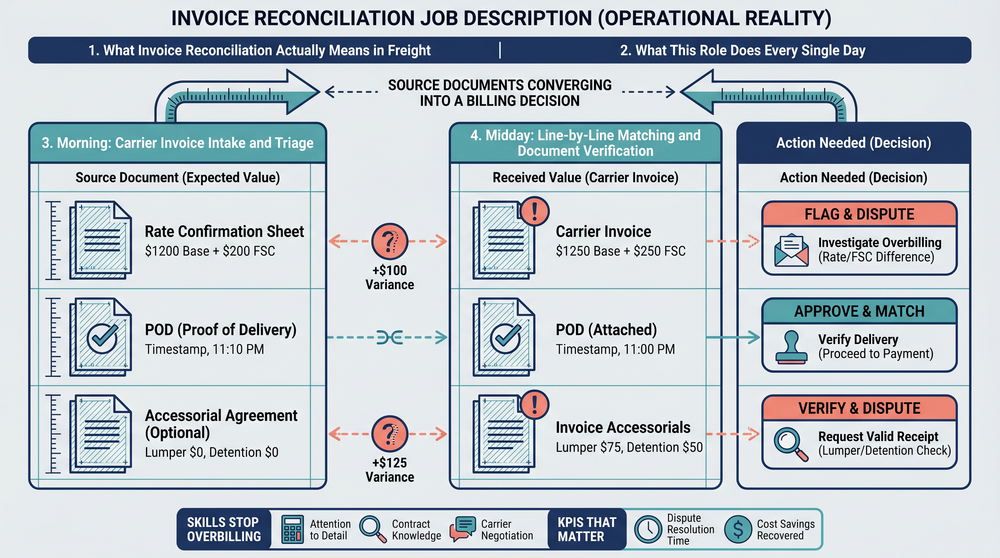
Morning: Carrier Invoice Intake and Triage
The day starts with an inbox full of carrier invoices. Some come through the TMS automatically. Most come as email attachments: PDFs, sometimes photos of handwritten documents, occasionally a scan of a BOL with coffee stains. The billing coordinator opens each one, logs it into the TMS or tracking spreadsheet, and categorizes it by load number. A freight broker with one billing coordinator handling 800 invoices per month manually spends an estimated 25 to 35 hours per week on reconciliation. Without clear SOPs and TMS integration, that role routinely falls 3 to 5 days behind. That backlog is where overbilling hides.
The first pass is a quick scan for obvious issues: invoice amount doesn't match the rate con, accessorial charges not mentioned in the original agreement, missing load numbers, or duplicate submissions. Anything that looks clean moves to the matching queue. Anything with a flag gets set aside for detailed review.
Midday: Line-by-Line Matching and Document Verification
This is the core of the job. The billing coordinator pulls up each load's rate confirmation and compares it against the carrier invoice, line by line. Linehaul rate: does it match? Fuel surcharge: is it calculated on the correct base rate? Detention: was it authorized, and does the billed amount fall within the cap specified on the rate con? Lumper fees: is there a receipt attached, and was this a shipper-paid or broker-paid arrangement?
For each load, the coordinator also pulls the BOL and POD. The BOL confirms what was picked up and where. The POD confirms what was delivered. If a carrier is billing a TONU charge on a load that has a signed POD showing delivery, that charge gets rejected immediately. If a detention charge shows 4 hours but the POD timestamps show the driver was in and out in 90 minutes, that's a dispute. As described in actual freight invoice controller job descriptions, this validation and reconciliation of logistics invoices is the central function of the role.
Afternoon: Dispute Resolution and Payment Batching
By afternoon, the coordinator has a stack of clean invoices ready for payment and a separate stack of disputes. Disputes get documented with the specific variance ("Invoice shows $275 detention; rate con caps detention at $50 after 2 hours"), the supporting evidence (POD timestamps, BOL notes), and a recommended action (reject charge, request corrected invoice, or escalate).
Clean invoices get batched for payment according to the brokerage's payment terms. The coordinator updates the TMS with payment status, links all supporting documents to the load record, and flags any patterns (carrier X has billed unauthorized detention on 6 of the last 10 loads, for example). This pattern tracking is what separates a billing coordinator who saves money from one who just moves paper. For deeper context on which line items get inflated most often, see our breakdown of carrier billing line items that get inflated.
The Skills That Actually Stop Carrier Overbilling
If you're writing a job description for this role, the skills section matters more than the duties section. Duties describe what the person does. Skills determine whether they catch the $225 detention overcharge or approve it without blinking.
Rate Con Literacy
This is the non-negotiable skill. The billing coordinator needs to read a rate confirmation the way a lawyer reads a contract. They need to know where the linehaul is stated, how the fuel surcharge is calculated (percentage of linehaul? DOE-indexed table? flat per-mile?), what the detention policy says (free time, hourly rate, daily cap), and which accessorials are pre-approved versus which require separate authorization. A candidate who comes from general AP and has never seen a rate con will take weeks to ramp up. A candidate who's worked in freight dispatch or carrier relations will already speak the language.
TMS Proficiency
The billing coordinator lives inside the TMS. Whether your brokerage runs on a major platform or a custom-built system, the person in this role needs to pull load details, attach documents, update payment statuses, and run reports without hand-holding. They also need to understand how data flows between the TMS, your accounting system, and your carrier payment platform. Per Trimble's documentation on freight cost reconciliation, the reconciliation screen in systems like Spectrum allows ticket-by-ticket comparison of freight costs. Your billing coordinator should be comfortable navigating similar workflows in whatever TMS you use.
Pattern Recognition
Individual overbills are a problem. Systematic overbilling is a pattern that costs thousands per month. The best billing coordinators don't just catch one bad invoice. They notice that a specific carrier consistently bills fuel surcharges on gross linehaul instead of net, or that detention charges from a particular warehouse always clock in at exactly 3 hours regardless of actual wait time. This skill is part data analysis, part operational intuition. It comes from processing high volumes and paying attention.
Document Organization
Every load generates a rate con, a BOL, a POD, the carrier invoice, and potentially lumper receipts, detention logs, and accessorial authorization emails. If these documents aren't organized by load number and accessible in seconds, reconciliation slows to a crawl. The coordinator needs to maintain a filing system (digital, inside the TMS) that makes any load's complete document trail retrievable in under a minute. When a dispute arises six weeks later, the coordinator who can pull the rate con and POD in 30 seconds wins. The one who has to dig through email threads for 20 minutes loses.
Clear Communication Under Dispute Pressure
Carrier invoice disputes are not friendly conversations. A carrier who billed $275 in detention and gets told they're only getting $50 is going to push back. The billing coordinator needs to communicate clearly, cite specific rate con language, attach supporting documents, and hold the line without escalating the relationship into a conflict. This is especially true for brokerages that work with a small carrier pool and can't afford to burn bridges over a billing dispute.
KPIs Worth Tracking for a Freight Billing Coordinator
You hired someone. They're processing invoices. How do you know if they're actually catching overbilling or just rubber-stamping everything? Here are the KPIs that tell you.
Dispute Rate and Recovery Rate
Track two numbers: how many invoices per month get flagged with discrepancies (dispute rate), and how much money gets recovered or prevented from being overpaid (recovery rate). If your billing coordinator is processing 500 invoices a month and flagging zero disputes, either you have the most honest carrier base in the industry or you have a reconciliation problem. A healthy dispute rate depends on your carrier mix, but if it's sitting at exactly 0%, something's wrong. The recovery rate is the dollar value. If the coordinator catches $2,850 in overbilling in a month, that's the number that justifies the role's salary.
Invoice Processing Time
How many business days does it take from invoice receipt to payment approval? Accessorial disputes resolved after payment take an average of 14 to 21 days to recover, compared to 2 to 3 days when caught pre-payment during reconciliation review. The goal is to keep invoice processing time short enough that disputes happen before the check goes out, not after. If your coordinator is consistently 3 to 5 days behind, either the volume is too high for one person or the workflow needs SOPs.
Pre-Payment vs. Post-Payment Catch Rate
This is the KPI that separates good billing coordinators from great ones. What percentage of discrepancies are caught before payment versus after? Pre-payment catches save money immediately. Post-payment catches require clawback requests, which take weeks and often succeed only partially. A coordinator who catches 90% of discrepancies pre-payment is worth significantly more than one who catches the same total dollar amount but only flags half of it after the carrier has already been paid.
Accuracy Rate
Of the invoices the coordinator approves, how many turn out to have errors that surface later (carrier complaints, duplicate payments, margin discrepancies caught during monthly close)? This is the flip side of the dispute rate. A high accuracy rate on approved invoices means the coordinator's matching process is thorough. A low accuracy rate means invoices are getting rubber-stamped.
Catching overbilling before payment takes 2–3 days to resolve. Catching it after payment takes 14–21 days. The pre-payment catch rate is the KPI that tells you whether your billing coordinator is saving money or chasing it.
A Job Description Template You Can Copy and Edit Right Now
Below is a freight-specific invoice reconciliation job description template. It's built around the actual tasks, skills, and KPIs covered above. Copy it, edit the specifics for your brokerage, and post it. Unlike generic invoice reconciliation job listings that describe payroll entries and packing list matching, this template reflects what the role actually does in a freight environment.
Job Title: Invoice Reconciliation Coordinator, Freight Brokerage
Reports to: Operations Manager or Controller Department: Back Office / Billing Operations Employment Type: Full-time Location: [Office / Hybrid / Remote]
Role Summary
You will be responsible for reviewing, matching, and approving carrier invoices against rate confirmations, BOLs, PODs, and supporting documentation for all brokered loads. Your primary objective is to ensure every carrier payment is accurate before it leaves the brokerage. You will identify and resolve billing discrepancies, flag overbilling patterns, and maintain complete documentation for every load in the TMS.
Daily Responsibilities
- Receive and log carrier invoices from email, carrier portals, and TMS integrations.
- Match each carrier invoice against the corresponding rate confirmation, verifying linehaul, fuel surcharge, detention, lumper fees, and all accessorial charges.
- Pull and review BOLs and PODs to confirm pickup, delivery, and timestamps for detention and TONU validation.
- Flag invoices with discrepancies and document the variance with specific dollar amounts, rate con references, and supporting evidence.
- Communicate disputes to carriers clearly, citing rate con terms and attaching relevant documents.
- Batch approved invoices for payment according to brokerage payment terms and carrier quick-pay agreements.
- Update load records in the TMS with payment status, linked documents, and dispute notes.
- Track and report on carrier billing patterns, including repeat overbilling by carrier, lane, or charge type.
- Reconcile monthly carrier statements against individual load payments to catch missed invoices or duplicate payments.
- Coordinate with dispatch and ops teams to verify accessorial authorizations and resolve ambiguous charges.
Required Skills and Experience
- 1 to 3 years of experience in freight billing, carrier accounting, or freight brokerage back office operations.
- Ability to read and interpret rate confirmations, including fuel surcharge formulas, detention caps, and accessorial terms.
- Proficiency with at least one TMS platform (examples: Tai TMS, McLeod, Aljex, Turvo, or similar).
- Strong Excel skills, including VLOOKUP, pivot tables, and conditional formatting for variance analysis.
- Experience with carrier invoice dispute resolution, including written communication and documentation.
- High attention to detail and ability to process 600 to 1,000 invoices per month without sacrificing accuracy.
- Familiarity with freight terminology: rate con, BOL, POD, TONU, layover, detention, lumper, drayage, fuel surcharge, linehaul, accessorial.
Performance Metrics
- Invoice processing time (target: same-day or next-day for clean invoices).
- Dispute rate and monthly dollar value of overbilling caught pre-payment.

- Pre-payment catch rate versus post-payment catch rate.
- Accuracy rate on approved invoices (target: under 1% error rate discovered post-approval).
- Document attachment completeness per load in TMS (target: 100% of loads with rate con, BOL, POD, and invoice linked).
Nice-to-Have Qualifications
- Experience with freight audit processes or carrier compliance review.
- Familiarity with QuickBooks, NetSuite, or other accounting platforms used alongside TMS.
- Background in dispatch or carrier sales (provides context for how charges originate).
- Exposure to automated reconciliation tools or document extraction software.
This template reflects the real scope of freight billing responsibilities. Tailor the volume numbers and TMS platforms to your brokerage. For a deeper look at how reconciliation errors affect margins, see our guide on how freight brokers stop paying carrier overbills.
Real Scenarios That Show Why This Role Pays for Itself
Abstract job descriptions don't convey the financial impact of this role. These examples do.
Example: Detention Overcharge on a Single Load
A carrier submits an invoice with $275 in detention charges. The billing coordinator pulls the rate con and sees that detention is capped at $50 per hour after 2 hours of free time. The POD shows the driver arrived at 8:00 AM and departed at 10:45 AM, putting total on-site time at 2 hours and 45 minutes. That's 45 minutes of billable detention at $50 per hour, which rounds to $50 (or $25 if billed in 15-minute increments at some brokerages). The carrier billed $275. The correct amount is $25 to $50. The coordinator flags the invoice, documents the variance, and sends a corrected amount back to the carrier. Savings on one load: $225.
Example: Lumper Fee Billed Twice
A carrier invoice includes a $185 lumper fee. The billing coordinator checks the load file and finds a note from the dispatcher: "Shipper covering lumper at destination." There's no lumper receipt attached to the carrier's invoice. The coordinator contacts the carrier, who confirms the lumper was paid on-site by the receiver's staff. Without the coordinator catching this, the brokerage would have paid $185 for a service already covered by the shipper. Multiply this by the frequency it happens across hundreds of loads and the number is significant.
Example: Fuel Surcharge Calculated on Wrong Base Rate
A carrier invoices a fuel surcharge of 22% applied to a gross linehaul of $2,200, totaling $484 in fuel. The rate con specifies the fuel surcharge is calculated on the contracted net linehaul of $1,950. Correct fuel surcharge: $429. Overcharge: $55. On a single load, $55 doesn't look catastrophic. But if this carrier hauls 200 loads per month for the brokerage and the same miscalculation applies across all of them, the annualized overcharge is $132,000. A billing coordinator who knows how to read fuel surcharge terms on a rate con catches this on load one, not load 2,400. For a full checklist of what to review on every carrier invoice, see our carrier invoice audit checklist.
Example: TONU Charge on a Delivered Load
A carrier submits an invoice that includes a $250 TONU (Truck Ordered, Not Used) charge. The billing coordinator pulls up the load record and finds a signed POD confirming delivery. The load was picked up and delivered as scheduled. The TONU charge is invalid. Without POD matching as a routine part of the reconciliation process, this $250 would be approved and paid. TONU charges typically range from $150 to $300 per occurrence, and when billed on loads that have documented delivery, they represent pure margin loss.
Frequently Asked Questions About Freight Invoice Reconciliation
What is an invoice reconciliation?
Invoice reconciliation is the process of comparing an invoice against supporting documents (contracts, delivery receipts, purchase orders) to verify that every charge is accurate before approving payment. In freight, this means matching a carrier's invoice to the rate confirmation, BOL, and POD to confirm linehaul, fuel surcharges, detention, and accessorials match what was agreed. According to Ramp's guide on invoice reconciliation, it's an accounting process that compares invoices with purchase orders and receiving reports to catch discrepancies before they become overpayments.
What are the 4 common reconciliation adjustments in freight?
The four most common adjustments in freight invoice reconciliation are: (1) detention charge corrections, where billed hours or rates exceed the rate con cap; (2) fuel surcharge recalculations, where the carrier applied the surcharge to the wrong base rate; (3) accessorial removals, where charges like lumper fees or layover are billed without authorization or supporting receipts; and (4) duplicate invoice rejections, where the same load gets invoiced more than once, often under slightly different reference numbers.
What skills do you need to be a reconciliation specialist in freight?
A freight reconciliation specialist needs rate con literacy (understanding fuel formulas, detention terms, and accessorial language), TMS proficiency, strong Excel skills for variance analysis, pattern recognition to spot systematic overbilling, and clear communication skills for handling carrier disputes. General AP experience helps, but freight-specific knowledge of documents like BOLs, PODs, and carrier packets is what separates effective freight billing coordinators from generic accounts payable staff.
How many invoices can one billing coordinator handle per month?
A single billing coordinator handling freight invoices manually can typically process 600 to 1,000 invoices per month, spending roughly 25 to 35 hours per week on reconciliation. At the higher end of that range, the role often falls 3 to 5 days behind without documented SOPs and TMS integration. Brokerages processing more than 800 invoices per month should evaluate whether the role needs additional headcount or automation support to maintain pre-payment catch rates.
What is the difference between freight audit and invoice reconciliation?
Invoice reconciliation is the daily process of matching individual carrier invoices against rate cons and supporting documents before payment. Freight audit is a broader review, often performed periodically, that examines billing patterns, carrier compliance, rate accuracy across lanes, and systemic overcharges. Reconciliation catches errors load by load. Audit catches patterns across hundreds or thousands of loads. The billing coordinator handles reconciliation daily. Freight audit may be handled by the same person, a separate analyst, or an outside audit firm.
Conclusion: The Role That Protects Your Margins
The person in the invoice reconciliation seat at your brokerage is the last line of defense between carrier overbilling and your margin. A clear, freight-specific job description is the first step to hiring someone who actually catches discrepancies instead of just processing paperwork. Build the role around rate con matching, document verification, dispute resolution, and pre-payment catch rate. Track the KPIs that measure real dollar impact, not just invoice throughput. And give the coordinator the tools, SOPs, and TMS access they need to stay ahead of the invoice queue instead of drowning in it.
If your billing coordinator is processing more than 50 invoices per week, tools that automatically flag invoice discrepancies against rate cons can reduce the manual hours spent on line-by-line matching and free the coordinator to focus on disputes, pattern analysis, and the judgment calls that automation can't make.
Sources
- What Is Invoice Reconciliation? A Step-by-Step Guide — Ramp
- What is Invoice Reconciliation? — DealHub
- Managing Freight Costs For Jobs — Trimble Spectrum Documentation
- Invoice Reconciliation Jobs, Employment — Indeed
- Job Title Invoice Controller, Materials and Logistics — Challenge Group
- How are you handling invoice reconciliation today? — Reddit r/FreightBrokers
Full guide: Invoice Reconciliation for Freight Brokers: Stop Paying Carrier Overbills
Full guide: Freight Invoice Reconciliation Process: Stop Losing Hours